

Affiliate disclosure: Some links in this guide may be paid referral links. If you purchase or sign up through one, One Stop Side Hustles may earn a commission. How our affiliate links work.
PRODUCT FLIPPING STARTER GUIDE
Discover how to start product flipping with minimal investment, identify profitable items worth flipping, source inventory from multiple channels, price and list items to sell fast, manage shipping and fees profitably, scale from part-time to full-time income, and avoid common mistakes that sink beginners. Whether you want extra income from items you already own or you're building a more serious resale operation, this guide covers a practical path.
2. Why Product Flipping Is a Great Side Hustle
3. Best Items to Flip for Profit
4. How Much Can You Earn & Pricing Strategies
6. Where to Source Inventory & Find Buyers
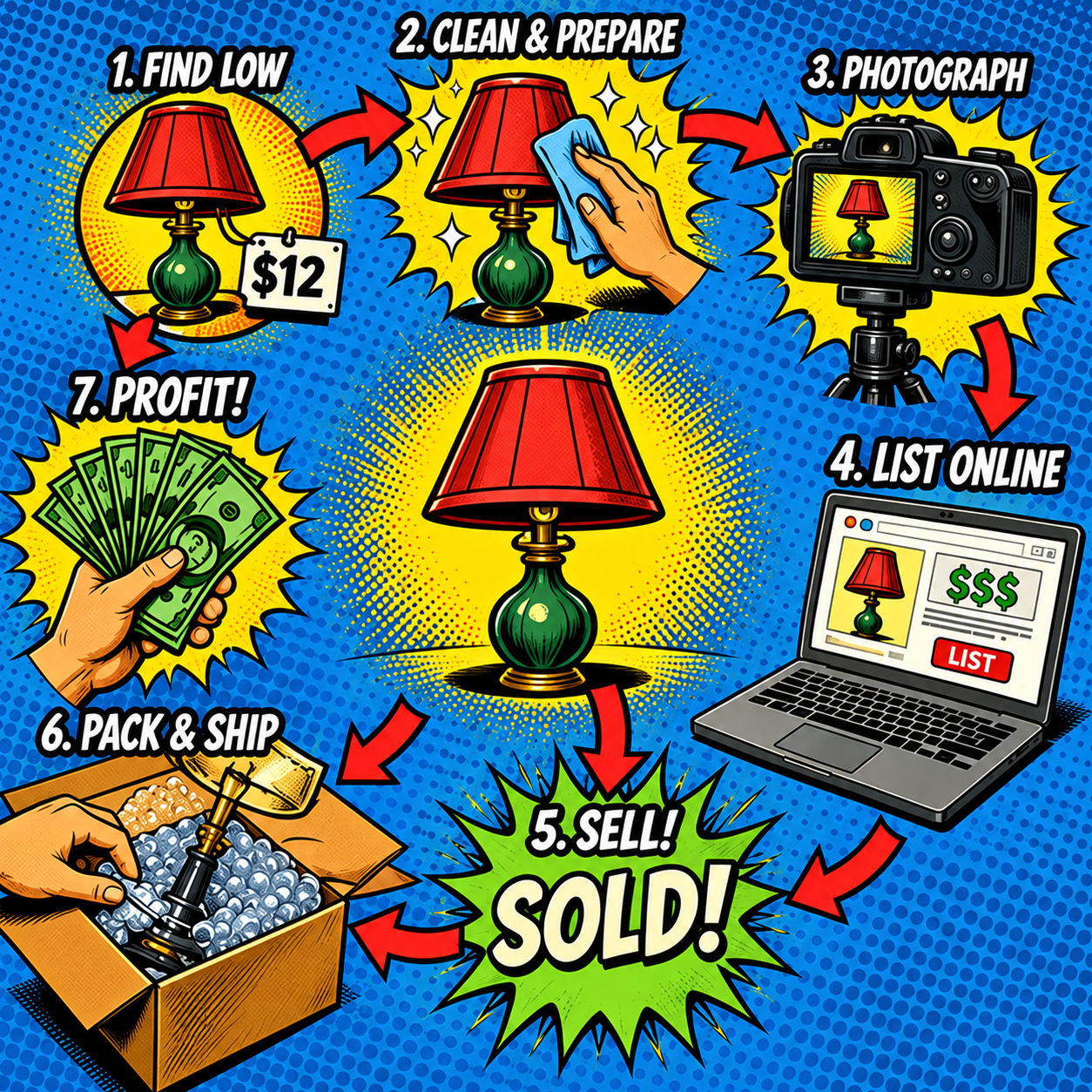
7. From Find to Sold: Your Repeatable Flipping Workflow
8. Build Trust & Improve Results
9. Learning, Templates & Resources
10. Your First 6 Months Product Flipping Plan
11. View the Product Flipping Starter Kit
12. Frequently Asked Questions
Quick Snapshot
Earn: Varies widely — some part-time sellers earn extra income; higher figures usually take more inventory, time, and systems
Work: Source, list, and ship on your own schedule
Start: Low cost — as little as $50 in starting inventory
Best for: Deal-hunters with an eye for undervalued items
Grow: Garage finds → focused categories → resale business
1. What Is Product Flipping?
Product flipping is buying items at below-market prices and reselling them at or near retail value for profit. You're the middleman connecting underpriced inventory with buyers willing to pay fair market value.
The basic model:
- Find undervalued items (thrift stores, yard sales, clearance, online deals)
- Buy at low price (typically 10-30% of resale value)
- Clean, test, photograph, and list item
- Sell on marketplace (eBay, Facebook, Mercari, Poshmark, Amazon)
- Ship to buyer and collect profit
- Reinvest in more inventory and scale
You handle: Sourcing, evaluation, listing, customer service, shipping, profit management
🎯 KEY TAKEAWAY
You're not manufacturing or creating—you're identifying arbitrage opportunities where items are priced below their true market value and capturing the spread. Success comes from knowing what sells, where to source, and how to move inventory quickly.

2. Why Product Flipping Is a Great Side Hustle
Product flipping is a strong side hustle because it turns undervalued finds, resale demand, and marketplace traffic into fast cash flow you can reinvest and scale.
💰 A good flip can create fast profit and immediate reinvestment
Flipping stands out because the cash cycle can move much faster than in many other side hustles.
The biggest advantages often come from:
- Buying below market value
- Selling into proven demand
- Reusing profits quickly
- Increasing buying power
- Improving margins over time
That fast feedback loop can help beginners learn quickly while building momentum from small wins.
🧠 You can start without specialized credentials
You do not need a formal license or technical certification to start learning the business.
The early skills are practical:
- Spotting deals
- Checking sold comps
- Inspecting condition
- Taking clear photos
- Writing better listings
As your judgment improves, you usually make better buying decisions and avoid more expensive mistakes.
⚡ It is one of the faster ways to create cash flow
Unlike slower side hustles that need a big audience or long buildup, flipping can start paying as soon as you source the right item and sell it.
Common turnaround speed includes:
- Same-day local sales
- Online sales within days
- Quick relisting cycles
- Fast profit feedback
- Immediate reinvestment
That makes flipping attractive for people who want a model with visible short-term results.
💻 The startup cost can stay small at first
Many people begin with a modest inventory budget and scale from there rather than needing a major upfront investment.
A simple starter approach often includes:
- A small buying budget
- Basic shipping supplies
- A phone for photos and research
- Space for a few listed items
- Reinvested early profits
That makes it easier to test categories and learn the business without taking huge financial risks early.

🕒 You can work around your own schedule
Product flipping is flexible because the work can be broken into sourcing, listing, and shipping blocks that fit around other responsibilities.
A common workflow might include:
- Evening sourcing
- Weekend thrift runs
- Batch photo sessions
- Listing blocks
- Daily shipping check-ins
That makes it much easier to run part-time while still building a repeatable system.
📈 There is a clear path from random flips to real systems
The business gets stronger when you stop guessing and start repeating what already works.
Common growth stages include:
- Testing categories
- Learning stronger sourcing routes
- Improving listing speed
- Raising average profit per item
- Building inventory systems
That progression gives flipping more upside than a one-off hustle that never becomes more efficient.
🌍 Buyers already exist across multiple marketplaces
You do not need to create demand from scratch because buyers are already searching for deals, used items, and niche products every day.
Strong resale demand exists on:
- eBay
- Facebook Marketplace
- Mercari
- Poshmark
- Amazon
That gives you flexibility to match different products with the platform most likely to move them.
🎯 Once you know what sells, the model becomes repeatable
The biggest long-term advantage is that flipping can evolve from lucky finds into a disciplined system.
That usually comes from:
- Repeating profitable categories
- Building sourcing habits
- Improving efficiency
- Protecting margins
- Reinvesting into better inventory
Over time, that can grow from part-time extra income into a much larger resale operation.
3. Best Items to Flip for Profit
Product flipping works best when you buy undervalued items, verify demand, and resell them where buyers are already searching. Your profit comes from research and discipline, not from buying cheap items at random.
Most beginners do better by choosing 1–2 easy-to-research categories, learning what sells, and expanding into higher-profit categories only after your judgment improves.
📝 QUICK NOTE
The resale ranges below are illustrative, not verified prices or guaranteed profit. Real profit depends on purchase cost, fees, shipping, supplies, returns, and your time. Check sold listings before buying, follow platform rules, and do not resell recalled, unsafe, or prohibited items.
👕 Beginner-Friendly Categories
👕 Clothing & Shoes
A common, lightweight category that is relatively easy to store and ship.
- 📌 What you might flip: Vintage denim, workwear, outerwear, athletic brands, boots, and strong-condition sneakers
- 👥 Common sources: Thrift stores, clearance racks, yard sales, and your own closet
- 💰 Illustrative resale range: Roughly $15–$150+, depending on brand, size, and condition
- ✅ Best for: Beginners who know brands, condition standards, and buyer preferences
💡 PRO TIP
Check tags, measurements, flaws, and authenticity cues before buying. Photograph flaws clearly so buyers know exactly what they are getting.
📚 Books
Low-cost inventory that is simple to research and good for learning the basics.
- 📌 What you might flip: Textbooks, professional books, niche hobby books, and certain vintage titles
- 👥 Common sources: Library sales, thrift stores, estate sales, and book sales
- 💰 Illustrative resale range: Roughly $5–$60, with specialized titles sometimes higher
- ✅ Best for: Beginners who want cheap inventory and straightforward sold-comp checks
💡 PRO TIP
Use sold listings rather than asking prices. Heavy, low-demand books can cost more to ship than they earn.

🎮 Electronics, Games & Media
🔌 Electronics
Potentially strong profit when the item is tested, complete, and clearly described.
- 📌 What you might flip: Consoles, tablets, headphones, cameras, and smart devices
- 👥 Common sources: Thrift stores, garage sales, local marketplaces, and liquidation or trade-in sources
- 💰 Illustrative resale range: Roughly $30–$400+, depending on model and condition
- ✅ Best for: Flippers who can test items and spot missing parts or locked devices
💡 PRO TIP
Do not buy electronics you cannot test confidently. Check power, screens, ports, accessories, and account locks, and wipe personal data from anything you sell.
🎮 Video Games & Consoles
A niche for retro systems, complete bundles, and higher-demand titles.
- 📌 What you might flip: Retro systems, complete-in-box games, controllers, and in-demand titles
- 👥 Common sources: Yard sales, thrift stores, local marketplaces, and collector groups
- 💰 Illustrative resale range: Roughly $10–$200+, with rare or complete items sometimes higher
- ✅ Best for: Gamers and beginners who can quickly compare sold prices
💡 PRO TIP
Verify discs, cables, controllers, and region details, and compare exact editions. Be cautious of reproductions and counterfeit items.

🛠️ Advanced High-Profit Categories
🛠️ Tools
Good margins when you understand brands, batteries, and working condition.
- 📌 What you might flip: Contractor-grade power tools, specialty tools, and bundled sets
- 👥 Common sources: Estate sales, garage sales, local marketplaces, and auctions
- 💰 Illustrative resale range: Roughly $30–$250+, depending on brand and completeness
- ✅ Best for: Flippers who can test tools and spot incomplete or unsafe gear
💡 PRO TIP
Test batteries and chargers, check safety guards, and look for missing parts. Check recall notices before listing any tool.
🧸 Collectibles
Potentially lucrative, but condition, authenticity, and niche knowledge matter a great deal.
- 📌 What you might flip: Toys, trading cards, comics, LEGO, vinyl, and other nostalgia-driven items
- 👥 Common sources: Estate sales, collector groups, auctions, and thrift stores
- 💰 Illustrative resale range: Highly variable; some items sell for little, while rare items can command much more
- ✅ Best for: Sellers who specialize and learn how to authenticate and grade condition
💡 PRO TIP
Specialize in one category before buying broadly. Use clear photos and honest condition descriptions, and avoid anything you cannot authenticate.

🏠 Home, Decor & Kitchen Finds
🏠 Home Goods & Decor
A solid middle-ground category with local and shipped resale options.
- 📌 What you might flip: Cookware, small appliances, vintage décor, lamps, mirrors, and branded kitchen items
- 👥 Common sources: Thrift stores, estate sales, garage sales, and clearance aisles
- 💰 Illustrative resale range: Roughly $15–$100+, depending on brand and condition
- ✅ Best for: Sellers who recognize quality brands and inspect condition quickly
💡 PRO TIP
Check for chips, cracks, odors, and missing parts. Fragile items need careful packing, so include packaging and shipping in your estimate.
🪑 Small Furniture
Higher upside per item, but more demanding to store, move, and sell.
- 📌 What you might flip: Solid-wood pieces, designer items, side tables, shelves, and refinishing-friendly furniture
- 👥 Common sources: Curb alerts, estate sales, garage sales, and local marketplaces
- 💰 Illustrative resale range: Roughly $50–$500+, often sold locally
- ✅ Best for: Sellers with storage space, transport, and local-selling experience
💡 PRO TIP
Measure and plan transport before you buy. Inspect for pests, stability, and structural damage, and price in your time and vehicle costs.

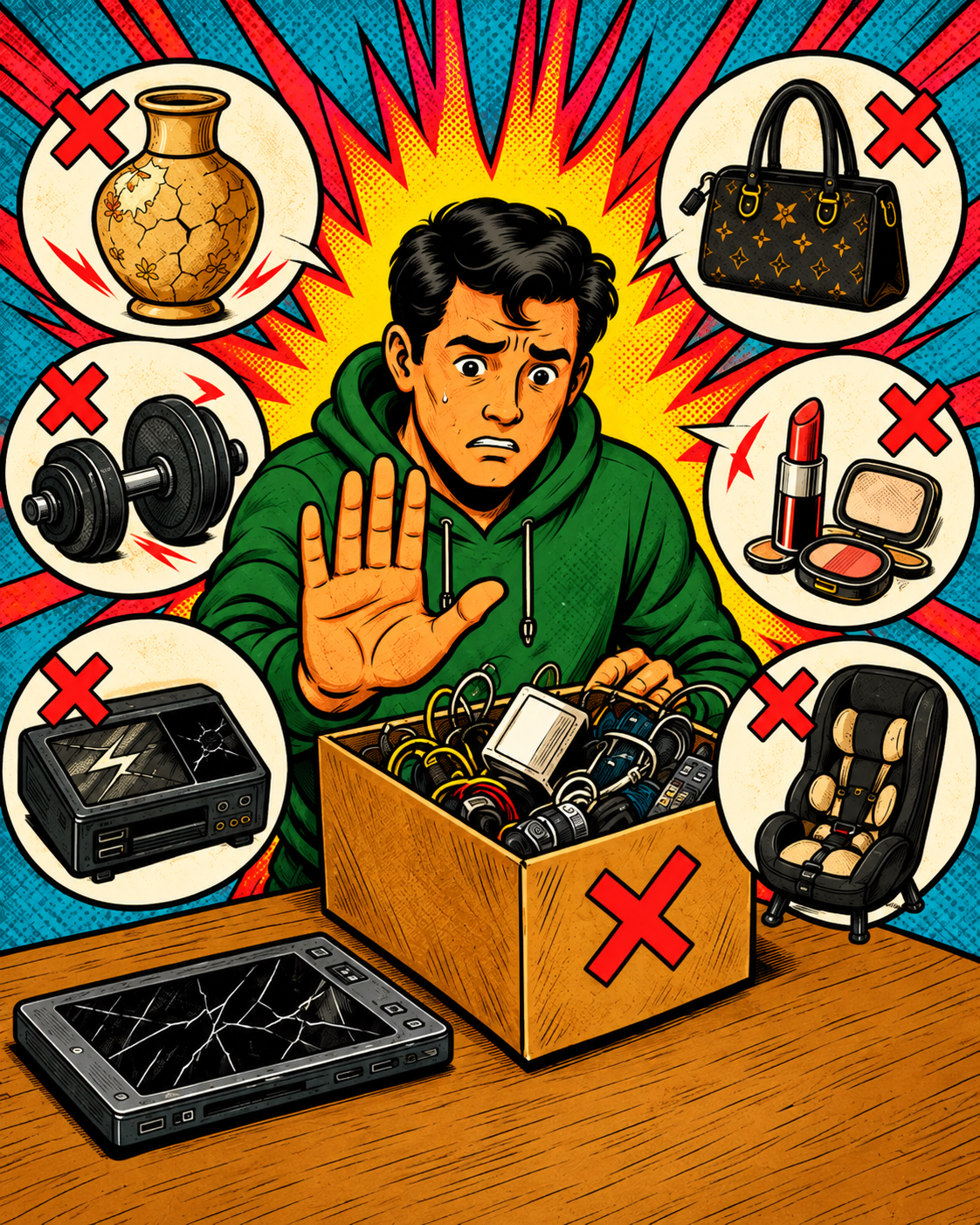
🚫 What Beginners Should Avoid
⚠️ High-Risk Categories
Some categories create safety, hygiene, authenticity, or platform-rule problems.
- Baby items, which may involve safety standards and recalls
- Cosmetics and underwear, which raise hygiene and policy concerns
- Hazmat items and restricted goods
- Counterfeit-prone luxury goods
✅ Avoid these until you have more experience and clearer systems.
📦 Low-Margin or Hard-to-Ship Items
Heavy, bulky, fragile, or oversupplied products can erase profit after fees and shipping.
- Cheap items are not automatically good flips if demand is weak
- Bulky items can cost more to store and ship than they earn
- The easiest beginner wins usually come from simple, researchable, shippable products
✅ Prefer small, durable items with clear sold-price evidence.
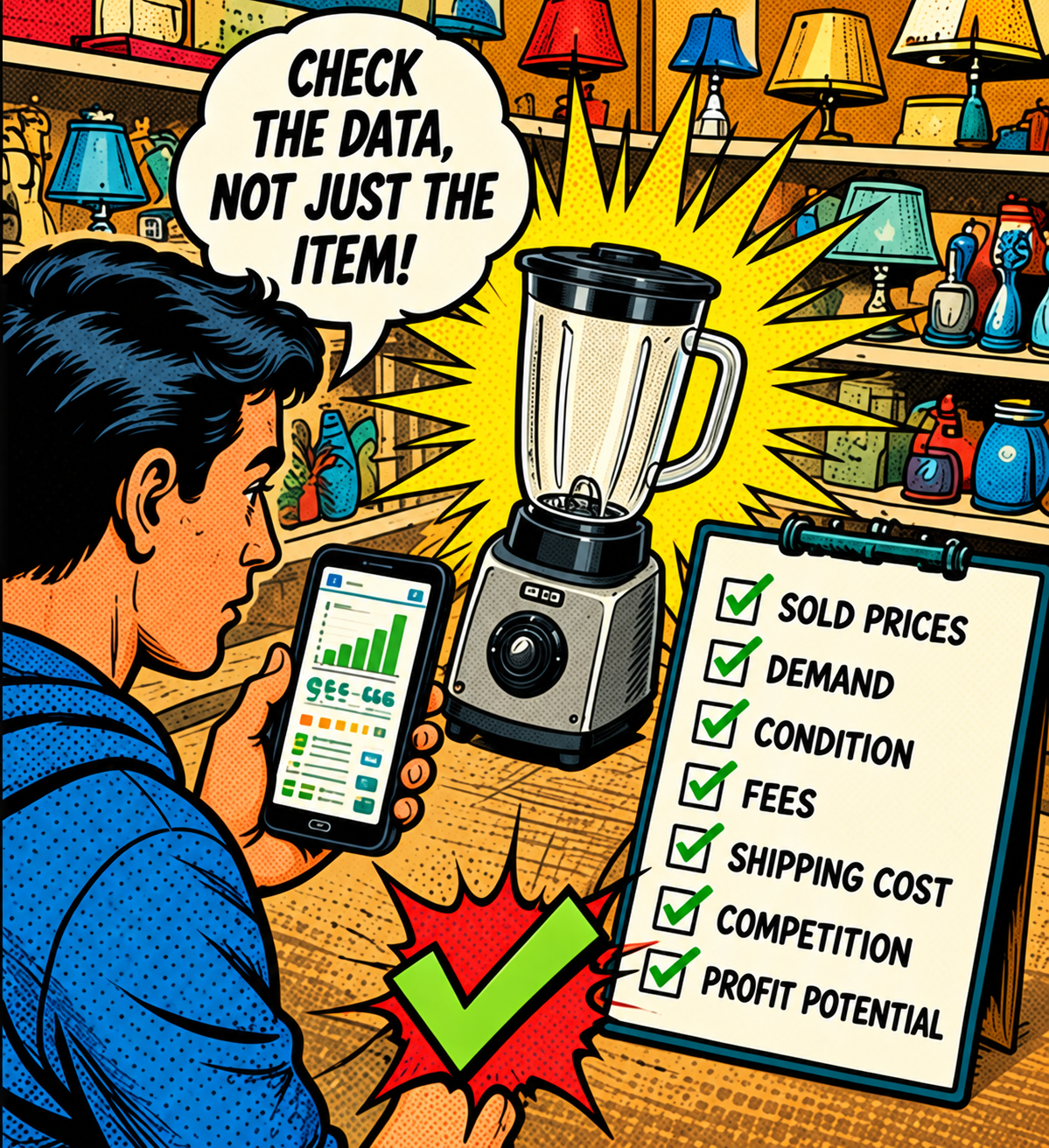
🔍 Quick Product Validation Checklist
🔍 Before You Buy
Do a few quick checks before spending money.
- Check sold comps, recent demand, condition, and competition
- Estimate fees, shipping, supplies, and likely return risk
- Ask whether the profit is worth the time, storage, and effort
✅ A short checklist prevents expensive impulse buys.
✅ Core Rule
Buy based on resale data, not guesswork.
- A cheap item is not a good flip if it sits forever or barely profits
- The best flips combine margin, demand, and manageable logistics
✅ If you cannot explain how it will sell, do not buy it yet.
🎯 Build Your Beginner Flipping Checklist
🎯 KEY TAKEAWAY
Start with clothing, shoes, books, video games, and small home goods. These categories are easier to source, research, and ship than bulky or highly specialized items. Keep your first purchases small so you can learn without risking money you cannot afford to lose.
🚀 ACTION STEP
Write a focused first plan:
- Category: Choose goods you can identify, inspect, price, and ship confidently.
- Validation: Research comparable sold listings rather than asking prices alone.
- Costs: Include purchase price, repairs, fees, shipping, and likely returns.
- First purchase: Set a small budget and buy only items that pass your inspection and margin checks.
4. How Much Can You Earn & Pricing Strategies
Use this chapter to connect sourcing costs, resale demand, and inventory turnover to your flipping pricing plan.
🧠 Reality Check (What Actually Separates Earners)
- Most beginners make small profits at first
- Not because flipping does not work
- 👉 Many buy items without checking resale demand
- 👉 Or they ignore fees, shipping, and time
- The flippers who earn more typically:
- Know their categories well
- Buy with strong margins
- List items clearly and quickly
- Reinvest profits consistently
💡 PRO TIP
In flipping, the money is often made when you buy, not when you sell.
🎯 KEY TAKEAWAY
Buy with evidence of demand and room for all costs. Unsold inventory ties up cash; more purchases do not automatically create more profit.
🔑 Smart Pricing Strategy
🧾 Buying Discipline & Cost Allowances
- Buy only when there is room for:
- Marketplace fees
- Shipping costs
- Profit
- Use sold comps before buying
🎯 Resale Pricing & Turnover
- Price based on:
- Condition
- Demand
- Competition
- Sell-through speed
- Decide whether you want:
- Faster sales at slightly lower margins
- Or slower sales at higher margins
🎯 KEY TAKEAWAY
Set a maximum buy price from realistic sold comparables, item condition, fees, shipping, and a margin buffer—not an optimistic asking price.
🧪 Real Example
📋 REAL-WORLD EXAMPLE
📌 Same Time, Different Outcomes
These scenarios illustrate possible income models, not verified typical outcomes. Their original income labels do not establish a consistent gross or net basis. Compare your actual proceeds, costs, working time, and unsold inventory instead of using these ranges as forecasts.
🌱 Scenario A: Casual flipper
- Buys random deals
- Low average profit per item
- Income: $300/month
🎯 Scenario B: Focused category flipper
- Knows what sells
- Better buying discipline
- Income: $1,500–$3,000/month
🚀 Scenario C: High-turnover reseller
- Fast sourcing, strong listing systems, better margins
- Reinvests profits aggressively
- Income: $4,000–$8,000+/month
💡 Same hustle type. Big difference in product knowledge, sourcing strategy, and inventory management.
🎯 KEY TAKEAWAY
Use these scenarios to understand the model, not to predict your own income. Compare actual results and risks with your written plan.
🎯 What Actually Drives Income
🧮 Buying Discipline × Realized Margin × Turnover = Income Potential
This is a business framework, not a mathematical earnings forecast.
📊 Key Income Drivers
- Buy price
- Lower sourcing cost = better margin
- Sell-through speed
- Faster turnover = quicker reinvestment
- Category
- Some niches move faster and command higher margins
- Platform choice
- eBay, Facebook Marketplace, Mercari, Poshmark, and Amazon all behave differently
- Listing quality
- Better photos, titles, and descriptions increase sell-through
💡 PRO TIP
The best flippers do not just find cheap stuff. They find underpriced items with proven demand.
📈 Sale Proceeds & Inventory Cash (Pricing Reality)
📖 Read the Numbers in Context
Sale proceeds are not profit. Sourcing, testing, cleaning, packing, shipping, fees, returns, and travel reduce the amount you keep. Cash spent on unsold stock is still tied up even when completed sales look profitable. Avoid debt-funded expansion based on projected resale prices.
🎯 KEY TAKEAWAY
Look beyond headline income: assess the complete economics, risks, and real cash available.
🚀 Build Your First Focused Flipping Test
Start with one familiar category, a small spending cap, sold comparables, and one main selling channel. Use a four-week test to learn real margins and turnover before buying more inventory.
🧭 Run a Disciplined Inventory Test
- Choose a category and budget. Select items you can identify, inspect, price, and ship safely. Set a small affordable purchase cap and storage limit. Start with suitable items you already own when possible; avoid categories requiring specialist authentication or safety testing you cannot perform.
- Check sold comparables before buying. Match model, condition, completeness, and sale date rather than relying on asking prices. Check shipping dimensions, platform restrictions, recalls, and authenticity. Do not sell counterfeit, stolen, recalled, or unsafe goods. Walk away when key facts or margins are uncertain.
- Calculate the maximum buy price. Allow for purchase cost, fees, packing, shipping, transport, testing or repairs, and possible returns. Use a conservative sale estimate and leave a margin buffer. Agree payment and inspection terms; keep receipts and sourcing records.
- List a small batch for four weeks. Test, clean, photograph, and describe each item accurately, including defects and missing parts. Use one primary channel and track listing dates, offers, and sales. Follow platform protections and safe local handover practices; avoid off-platform payment requests that undermine protection.
- Review sold and unsold inventory together. Record collected proceeds, refunds, item costs, direct expenses, and all work time. Review days to sale and remaining stock at the end of the test. Set a realistic markdown or exit plan and reinvest only money you can afford after refunds, expenses, and other obligations.
🎯 KEY TAKEAWAY
Buy with evidence of demand and room for all costs. Unsold inventory ties up cash; more purchases do not automatically create more profit.
💡 Example: A Four-Week Flipping Test
- Category: Small, familiar household items you can inspect and ship
- Inventory: A few suitable owned items or a small capped purchase batch
- Buying rule: Recent sold comparables and a written maximum buy price
- Listing: Clear condition photos, tested functions, and honest defect notes
- Channel: One selling platform or safe local marketplace
- Test: Four weeks with listing dates and a planned review of unsold stock
- Signals: Realized contribution, total work time, days to sale, and cash tied up
This is an inventory-learning test, not a promise of sales. Four weeks may not be enough to sell every item. Do not treat unsold stock at an optimistic listing value as earned income.
✍️ Write Your One-Line Earnings Test Plan
Use this structure to make the plan easy to review:
“For [category], I will test [small inventory batch] on [channel] for [period], within [purchase cap]. I will buy only when [sold-comparable and cost checks] support the price, then review [realized margin, work time, turnover, and unsold stock].”
✅ Completed example
“I will test a small batch of familiar household items on one selling channel for four weeks within a fixed purchase cap. I will use sold comparables and full costs before buying, list condition accurately, and review realized margin, total work time, days to sale, and unsold inventory before reinvesting.”
🚀 ACTION STEP
Before starting:
Keep the first plan focused. Build a workable process before adding more complexity.
📋 Pricing & Revenue Planning Reference
Use the existing stage ranges and flip examples as illustrations, not verified typical results or guaranteed timelines. Condition, sourcing cost, fees, shipping, returns, and days to sale affect outcomes. Distinguish gross sales, item contribution, business profit, and cash tied up in stock.
💵 What Product Flipping Can Earn
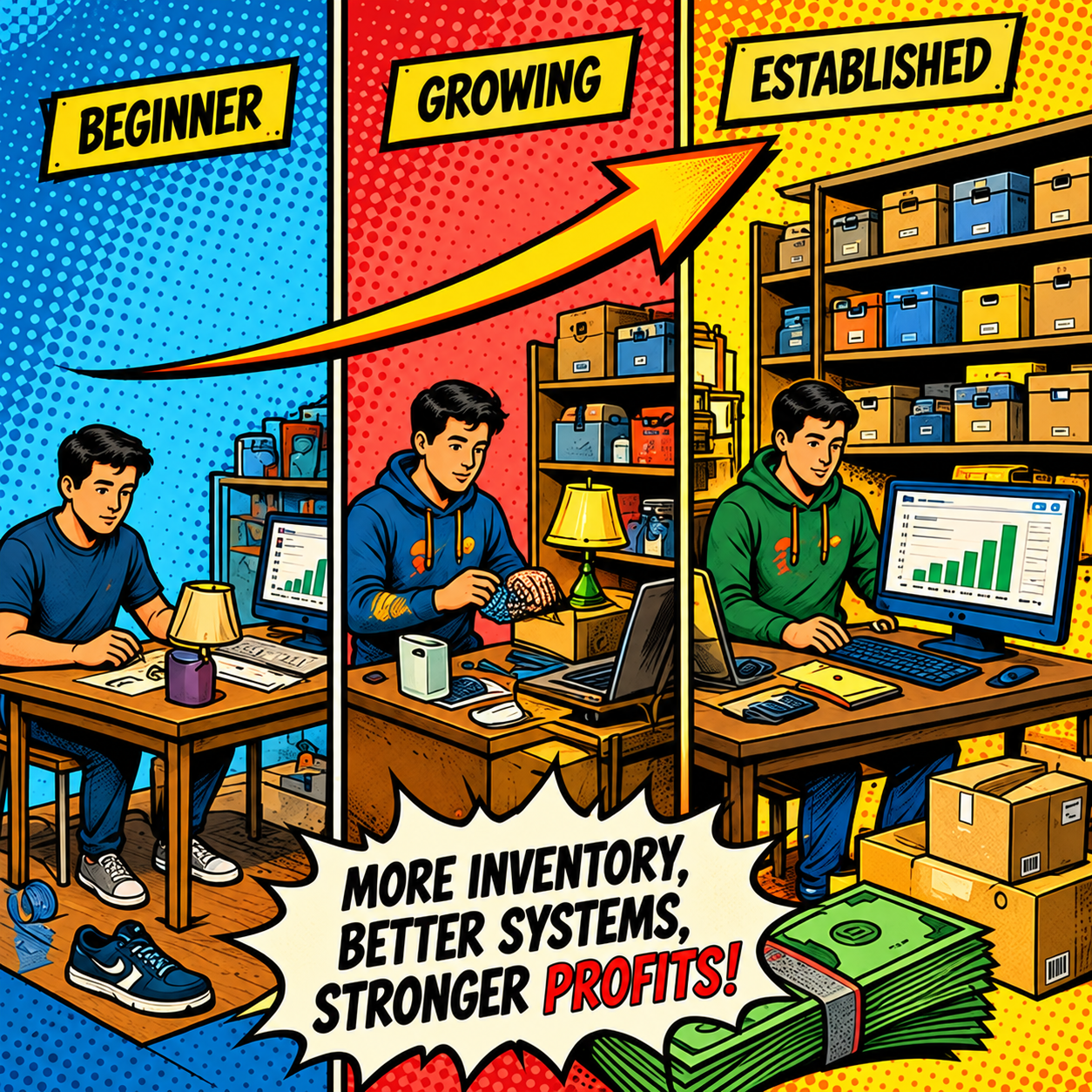
📊 Income Progression by Stage
🚀 Stage | 📦 Inventory Level | 💰 Typical Monthly Income | ⏳ Timeline | 📌 What’s Happening |
Beginner | Small part-time flips | $100–$800 | 0–3 months | Learning what sells, making small mistakes |
Developing | Regular sourcing + listings | $800–$2,500 | 3–6 months | Better buying decisions, faster turnover |
Established | Strong category knowledge | $2,500–$6,000 | 6–12 months | More inventory, stronger margins |
Advanced | High-volume / higher-ticket flips | $6,000–$10,000+ | 12–24 months | Better sourcing systems + repeat profits |
Professional | Full-time resale operation | $10,000+/month | 2+ years | Large inventory, optimized systems |
🎯 KEY TAKEAWAY
The stages describe possible progression, not guaranteed income or a required timeline. Use your own capital or business records to plan realistically.
📊 Key Metrics & Margin Snapshot
📈 Sale Proceeds & Inventory Cash (Pricing Reality)
📊 What Your Inventory Is Actually Worth
Metric | What to Record |
Collected sale proceeds | Separate sales, refunds, and pending payments |
Item contribution | Deduct item cost and direct selling expenses |
Time per item | Include sourcing, testing, listing, packing, and support |
Turnover | Record listing dates, days to sale, and unsold stock |
Cash exposure | Track purchase spend, refunds due, and inventory still held |
🎯 KEY TAKEAWAY
Evaluate realized margins and unsold stock together. A profitable sale does not prove that every item in the batch was a good purchase.
💸 How a Flip Actually Pays
🧾 How a Flip Actually Pays
💡 Item Detail | 💰 Example |
Buy price | $20 |
Sale price | $80 |
Marketplace fees | -$10 |
Shipping / supplies | -$10 |
Net profit | $40 |
🎯 KEY TAKEAWAY
Recalculate each item’s full costs and likely sale price. A sample flip is not a guaranteed margin for its category.
🧮 Check Your Project & Revenue Economics
Sold-item contribution = collected sale proceeds − refunds − item cost − direct selling costs.
Include fees, shipping, packing, repairs, and attributable transport without double-counting amounts already netted from a payout. Track unsold purchases separately when reviewing cash flow. Broader overhead and taxes still reduce business profit; unrealized listing values are not spendable earnings.
🚀 ACTION STEP
🗓️ Build a Monthly Flipping Revenue Snapshot
Use actual records and a sustainable plan—not projections alone—to decide what to continue.
5. Essential Tools & Setup
🛠 TOOLS & RESOURCES
🧰 Basic Startup Kit ($50-$150)
Item | Cost | Purpose |
Poly Mailers (100-pack) | $15-25 | Ship soft goods (clothing, shoes) |
Cardboard Boxes (various) | $0-30 | Save from shipments or buy bulk |
Packing Tape | $10-15 | Secure packages |
Kitchen Scale | $15-25 | Weigh packages for accurate shipping |
Measuring Tape | $5-10 | Measure clothing, furniture dimensions |
Smartphone | Have already | Research, photos, listing |
Bubble Wrap/Packing Paper | $15-30 | Protect fragile items |
Total: $75-160
⚙️ Intermediate Setup ($200-$500)
Everything in Basic Startup Kit PLUS:
Item | Cost | Purpose |
Thermal Label Printer | $120-200 | |
Ring Light | $25-50 | Better product photos |
Mannequin or Bust | $30-80 | Display clothing professionally |
Storage Bins/Shelves | $50-150 | Organize inventory |
Scanner App Subscription | $10-30/month | ScoutIQ, Profit Bandit for book scanning |
Total additional: $235-510
🚀 Advanced / Full-Time Setup ($1,000-$3,000)
Item | Cost | Purpose |
Workspace/Garage | $0-500/month | Dedicated space for inventory |
Professional Camera | $300-800 | High-quality photos for expensive items |
Inventory Management Software | $30-100/month | List Perfectly, Vendoo for cross-listing |
Vehicle | Have already or rent | Source from multiple locations daily |
Steamer/Iron | $50-100 | Clean up clothing |
Light Box | $50-150 | Professional product photography |
VA/Helper | $10-20/hour | List, ship, or source for you |
📱 Software & Apps (Essential)
Tool | Cost | Purpose |
Free (13% fees) | Largest marketplace, best for collectibles/vintage | |
Free to list locally in many cases | Local sales, fast turnover | |
Free (selling fees 10-13%) | Clothing, electronics, great mobile experience | |
Free (20% fee on $15+) | Clothing/shoes focus, social selling | |
$39.99/month (optional) | Huge buyer base, FBA option | |
Free (10% fee) | Trendy/vintage clothing, young audience | |
Free | Local sales alternative to Facebook | |
Free | Video game price lookups | |
Sold comps (eBay) | Free | Check "Sold" listings to see actual selling prices |
6. Where to Source Inventory & Find Buyers
Profitable flipping depends on both sides of the transaction: sourcing undervalued inventory and selling it where demand is strongest. Use this chapter to compare sourcing channels, validate deals, choose marketplaces, and build a repeatable buying-and-selling system.
🧥 Thrift Stores & Donation Shops — Best Beginner Source
Thrift stores are one of the easiest places to start because inventory is local, affordable, and beginner-friendly. You can learn what sells without risking a lot of money upfront.
📍 Best Places to Source
- Goodwill — clothing, shoes, home goods, electronics, books
- Salvation Army — furniture, clothing, décor, household items
- Habitat for Humanity ReStore — furniture, tools, appliances, home improvement items
- Local church thrift stores — often cheaper and less competitive
- Independent resale shops — good for niche finds and vintage items
🔍 What to Look For
- 👟 Name-brand shoes
- 👕 Brand-name clothing
- 🔌 Small electronics
- 🛠️ Tools
- 📚 Books and media
- 🏺 Vintage home décor
- 🏈 Sporting goods
- 🍳 Kitchen appliances
- 👜 Designer handbags or accessories
- 🪑 Small furniture
- 🎲 Board games and toys
☑️ Beginner Sourcing Checklist
Before buying, ask:
- Can I sell this for at least 2x my money?
- Is it easy to ship or sell locally?
- Is it clean, working, and complete?
- Are similar items actually selling?
- Are there hidden fees, repairs, or shipping costs?
💡 Beginner Tip: Use your phone to check sold prices before buying. Search the item on eBay and filter by Sold Items to see what buyers actually paid.
💻 Online Marketplaces — Find Underpriced Local Deals
Online marketplaces are great because people often underprice items when they want them gone quickly.
📍 Best Places to Source
Platform | Best For | Why It Works |
Furniture, electronics, tools, local bundles | Sellers often want quick pickup | |
Furniture, appliances, bikes, tools | Older platform, less competition in some areas | |
Local deals, electronics, home goods | Easy mobile browsing | |
Undervalued collectibles, lots, parts | Good for niche arbitrage | |
Clothing, toys, electronics, small goods | Sellers may accept lower offers |
🧠 Deal-Finding Tactics
- Search for misspelled brand names
- Look for poor-quality photos hiding valuable items
- Search terms like:
- moving sale
- must go
- bundle
- lot
- pickup today
- garage cleanout
- estate sale
- Message quickly and professionally
- Offer same-day pickup when possible
- Ask if the seller has similar items they want to get rid of
💡 Best Flip Types
- Furniture
- Bicycles
- Gaming consoles
- Small appliances
- Power tools
- Brand-name clothing lots
- Cameras
- Musical instruments
- Sports equipment
📝 Simple Message Template
Hi, is this still available? I can pick it up today if the condition is good. Would you take $[offer amount]?
⚡ Best Advantage: Speed wins. Many good marketplace deals go to the first serious buyer who can pick up quickly.
🏷️ Clearance & Liquidation — Source New Inventory Carefully
Retail clearance is good for flipping brand-new items, especially when stores discount seasonal products, discontinued items, or overstock.
📍 Where to Source
- Walmart Clearance
- Target Clearance
- Home Depot Special Buys
- Lowe’s Clearance
- Costco
- Sam’s Club
- Local discount stores
- Outlet stores
- Dollar stores
- Big-box seasonal aisles
🔍 What to Look For
- Toys
- Small appliances
- Tools
- Seasonal décor
- Beauty products
- Home goods
- Electronics accessories
- Shoes and apparel
- Storage products
- Holiday items
📦 Liquidation Sources
🧠 Clearance Rules
- Check sold comps before buying multiples
- Avoid products with damaged packaging unless the margin is high
- Watch expiration dates on beauty, food, and health products
- Do not buy restricted or gated products for Amazon unless you are approved
- Start small before buying full pallets or bulk lots
⚠️ Liquidation Warning: Liquidation can be profitable, but it is riskier for beginners. Pallets may include damaged, returned, incomplete, missing, or hard-to-sell items.
📍 Local Deals — Garage Sales, Estate Sales & More
Local sourcing can have some of the highest margins because sellers are usually focused on clearing space, not maximizing resale value.
🏘️ Best Local Sources
- Garage sales
- Yard sales
- Estate sales
- Moving sales
- Storage unit sales
- Flea markets
- Community sale days
- Church sales
- Neighborhood apps
- Local auctions
🌐 Useful Sites
🛍️ Best Items to Buy Locally
- Furniture
- Tools
- Vintage items
- Collectibles
- Cameras
- Musical instruments
- Sports equipment
- Video games
- Home décor
- Books and media
- Small appliances
- Outdoor gear
🕒 When to Go
Timing | Best For |
Early Morning | First access to the best items |
Midday | Less competition |
Near Closing | Best chance for bundles and discounts |
💡 Local Sourcing Tip
Go early for the best inventory, but go near closing time for the best deals. Sellers are often more willing to bundle or negotiate when they do not want to pack everything back up.
💡 Pro Move: Ask, “Do you have any more tools, electronics, games, shoes, or furniture you’re planning to sell?” Some of the best deals are not even displayed yet.
🛍️ Where to Sell — Match the Product to the Marketplace
Use different platforms depending on the item type. The best selling platform depends on size, shipping difficulty, demand, and buyer intent.
Selling Platform | Best For | Why Use It |
Collectibles, electronics, shoes, parts, niche items | Huge buyer base and strong search demand | |
Furniture, appliances, local pickup items | No shipping, fast local sales | |
Clothing, toys, small electronics, home goods | Simple listing process | |
Clothing, shoes, handbags, fashion accessories | Strong fashion-focused audience | |
Vintage, streetwear, trendy fashion | Good for younger buyers and unique pieces | |
Local goods, tools, bikes, furniture | Local-first selling option | |
Vintage, handmade, craft supplies | Good for unique or vintage inventory | |
New retail arbitrage items | High volume, but stricter rules |
🎯 Best Match by Item Type
Item Type | Best Selling Platforms |
Furniture | Facebook Marketplace, OfferUp, Craigslist |
Clothing | Poshmark, Depop, Mercari, eBay |
Electronics | eBay, Mercari, Facebook Marketplace |
Collectibles | eBay, Etsy |
Books | eBay, Amazon, local bundles |
Tools | Facebook Marketplace, OfferUp, eBay |
Vintage Items | Etsy, eBay, Facebook Marketplace |
Shoes | eBay, Poshmark, Mercari |
Baby Gear | Facebook Marketplace, OfferUp |
Video Games | eBay, Mercari, Facebook Marketplace |
💡 Key Selling Rule: Local platforms are best for bulky items. Shipping platforms are best for small, high-demand, easy-to-pack items.
🧭 Sourcing & Selling Strategy — Build a Repeatable System
The goal is not to buy random cheap items. The goal is to buy items with clear resale demand, healthy profit margin, and fast turnover.
🧮 Simple Flipping Formula
Buy Low → Verify Demand → Clean/Repair → Photograph Well → List on Best Platform → Reinvest Profit
🧠 Beginner Sourcing Strategy
Stage | Goal | Best Sources |
Week 1–2 | Learn pricing and demand | Thrift stores, Facebook Marketplace, eBay Sold Items |
Week 3–4 | Buy small, low-risk inventory | Shoes, small electronics, books, tools, home goods |
Month 2–3 | Focus on profitable categories | Furniture, clothing, electronics, collectibles |
Month 4+ | Build repeatable sourcing routes | Estate sales, clearance, liquidation, local sellers |
💰 Profit Rules
- Aim for at least 2x your money on small items
- Aim for at least $25–$50 profit per flip when possible
- Avoid bulky, broken, restricted, or hard-to-ship items unless the profit is worth it
- Check sold listings before buying
- Track purchase price, fees, shipping, supplies, mileage, and final profit
- Reinvest profits into better inventory
⭐ Best Beginner Categories
- Shoes
- Small appliances
- Tools
- Books
- Video games
- Sporting goods
- Home décor
- Small furniture
- Brand-name clothing
🚫 Avoid at First
- Large untested liquidation pallets
- Items with missing parts
- Counterfeit-prone designer goods
- Fragile glassware
- Oversized items with low profit
- Electronics you cannot test
- Items with unclear resale demand
- Products with legal, safety, or platform restrictions
🔍 What to Track
Metric | Why It Matters |
Purchase Price | Shows your true cost basis |
Sold Price | Measures demand and pricing accuracy |
Platform Fees | Prevents overestimating profit |
Shipping Cost | Can erase margins quickly |
Days to Sell | Shows how fast inventory turns |
Profit Per Item | Helps identify your best categories |
Profit Per Hour | Shows whether the flip was worth the time |
💡 Key Insight: The best flippers do not just find cheap items. They learn which items have demand, where to buy them underpriced, and which platform gives them the fastest profitable sale.
7. From Find to Sold: Your Repeatable Flipping Workflow
Successful flipping is not about buying as much cheap stuff as possible.
It is about making a series of disciplined decisions:
Research → Inspect → Calculate → Buy → Prepare → Photograph → List → Sell → Fulfill → Track → Decide
Every item should earn its place in your inventory.
Your goal is not simply: “Can I sell this for more than I paid?”
A better question is: “Is the likely return worth the money, time, storage, risk, and effort this item requires?”
Use the seven tabs in order for your first flips, then reopen the phase you need. Chapter 6 covers where to source and sell; this chapter takes one item from research to a closed, tracked sale.
🔍 PHASE 1 — Research, Inspect, and Buy With a Maximum Price
📋 Steps 1–5: Confirm demand with sold comps, check whether you can resell the item, inspect the actual piece, and buy only under a written maximum price.
✅ Ready to move on: You can explain the sold-comp range, the item’s condition, why it is safe to resell, and the most you will pay after fees, shipping, and hassle.
🔍 Step 1: Research Before You Buy
Do not let a low price create the illusion of a good deal.
Before purchasing an item, look for evidence that buyers actually want it.
Sold comps are completed sales. They show what buyers actually paid, not what another seller hopes to receive.
📋 Check Demand Evidence
Check:
- Recent sold listings
- Comparable condition
- Exact model or version
- Completeness
- Recent sale dates
- Number of similar items available
- Typical selling range
- Shipping difficulty
- Return risk
🔎 Match the Comparable Carefully
A similar-looking product may not actually be comparable.
Check details such as:
- Model number
- Size
- Edition
- Year
- Color
- Included accessories
- Condition
- Packaging
- Authenticity
🎯 Use Completed Sales as Evidence
🎯 KEY TAKEAWAY
Use completed sales as evidence. An unsold listing only tells you what another seller hopes to receive.
🚦 Step 2: Check Whether the Item Is Safe and Legal to Resell
Before thinking about profit, make sure the item belongs in your inventory at all.
Check for:
- Product recalls
- Platform restrictions
- Counterfeit risk
- Authenticity concerns
- Missing safety components
- Expiration dates when relevant
- Hazardous materials
- Stolen-property concerns
- Restrictions on used goods
- Category-specific selling requirements
Be especially cautious with products where failure, contamination, authenticity, or missing parts could create significant risk.
🛑 Stop When You Cannot Verify the Item
⚠ COMMON MISTAKE
If you cannot confidently determine:
What it is → Whether it is legitimate → Whether it is safe → Whether you may sell it
do not buy it yet.
A profitable-looking item is not worth the risk if you cannot verify what you are selling.
🔎 Step 3: Inspect the Actual Item
Sold comps tell you what good examples sold for.
They do not tell you whether the item in your hand is one of those examples.
Inspect:
- Overall condition
- Function
- Missing parts
- Cracks
- Stains
- Odors
- Corrosion
- Battery condition
- Screens
- Buttons
- Cables
- Zippers
- Soles
- Seams
- Labels
- Serial or model information
- Signs of repair
- Signs of counterfeit construction
🔌 Inspect Electronics Before Calling Them Working
Do not describe an item as working unless you have actually tested the functions you claim work.
👕 Inspect Clothing, Shoes, and Collectibles
For clothing and shoes, check:
- Size tag
- Measurements
- Stains
- Tears
- Pilling
- Sole wear
- Missing buttons
- Broken zippers
- Odors
For collectibles, condition and authenticity may matter more than almost anything else. If you do not understand the category well enough to evaluate those things, research more before buying.
💰 Step 4: Calculate Your Maximum Buy Price
Do not decide what an item is worth to you while standing at the register.
Work backward from a conservative resale estimate.
Consider:
- Expected selling price
- Marketplace fees
- Payment fees
- Shipping you may absorb
- Packaging
- Cleaning
- Testing
- Repair
- Travel
- Expected discounts
- Return risk
🧮 Work Backward From a Conservative Sale
💡 PRO TIP
Simple planning formula:
Expected Collected Sale − Expected Selling Costs − Desired Margin = Maximum Inventory Cost
The exact margin you require will depend on:
- Category
- Item value
- Work involved
- Turnover
- Risk
- Storage
- Your business goals
Turnover is how quickly inventory sells. Maximum buy price is the most you can pay and still leave room for costs and margin.
Buy from the numbers backward. Do not buy first and hope the numbers work later.
⏱️ Step 5: Include Time and Hassle in the Decision
Two items with the same dollar margin may not be equally good flips.
Even if both appear to offer the same gross margin, Item A may be the better business decision.
Ask:
How much work stands between buying this and actually getting paid?
That question will save you from plenty of “great deals.”
✅ Item A — Easier Flip
- Easy to test
- Easy to photograph
- Fits in a small box
- Strong demand
- Low return risk
⚠️ Item B — Hidden Work
- Needs repair
- Difficult to test
- Fragile
- Expensive to ship
- Takes up storage
- Likely to create buyer questions
🚀 Your First 5 Actions
🚀 ACTION STEP
Keep the first week focused on one clean flip—not filling a 500-item store.
🧼 PHASE 2 — Record, Clean, Test, Photograph, and Measure
📋 Steps 6–10: Log the purchase immediately, prepare the item honestly, test what you will claim, and photograph and measure it before listing.
✅ Ready to move on: The item has an inventory record, honest photos of defects, documented tests, and measurements you can put in the listing and shipping plan.
🧾 Step 6: Record the Item When You Buy It
Do not wait until the item sells to reconstruct the numbers.
Create an inventory record immediately.
Record:
- Item name
- Category
- Brand
- Model
- Source
- Purchase date
- Purchase price
- Condition
- Known defects
- Accessories
- Serial number when appropriate
- Receipt or proof of purchase
- Intended selling platform
- Storage location
🏷️ Give Growing Inventory an Internal ID
🎯 KEY TAKEAWAY
Give the item an internal ID if your inventory starts growing.
Example: SHOE-024
Then your bin, spreadsheet, photos, and listing can all point back to the same item.
If you cannot find an item after it sells, your inventory system has failed at exactly the wrong moment.
🧼 Step 7: Clean and Prepare the Item
Improve presentation without misrepresenting condition.
Depending on the product, that may mean:
- Wiping surfaces
- Removing dust
- Washing or steaming clothing appropriately
- Removing lint
- Cleaning shoes
- Organizing accessories
- Replacing inexpensive missing packaging when appropriate
- Charging devices
- Testing functions
A cleaner item can command more confidence.
A misleading item creates returns and disputes.
🚫 Do Not Hide Defects
Do not:
- Conceal damage
- Edit flaws out of photos
- Describe used items as new
- Cover odors with fragrance
- Claim repairs you did not perform
- Reset electronics without understanding what data or locks remain
🧪 Step 8: Test and Document Function
For anything functional, create a simple testing routine.
Example electronics check:
- Powers on
- Charges
- Display works
- Buttons respond
- Ports checked
- Speakers checked
- Wi-Fi or Bluetooth checked when relevant
- Factory reset completed when appropriate
- Account locks removed
- Accessories tested
📝 Record What You Tested
📋 REAL-WORLD EXAMPLE
Then your listing can say:
“Tested for power, charging, display, buttons, Wi-Fi, and speakers.”
instead of the vague:
“Works great.”
Specific condition information builds trust.
📸 Step 9: Photograph the Item Like the Buyer Cannot Touch It
Online buyers are inspecting the product through your photos.
Give them enough information to make a decision.
Photograph:
- Front
- Back
- Sides
- Top and bottom when relevant
- Labels
- Model numbers
- Size tags
- Accessories
- Important details
- Defects
- Damage
- Packaging
- Serial information when appropriate and safe
⚠️ Show the Bad Parts Too
💡 PRO TIP
Use:
- Good lighting
- Clean background
- Sharp focus
- Consistent framing
If there is:
- Scratch
- Stain
- Chip
- Tear
- Dent
- Wear
photograph it.
A defect shown clearly before purchase is usually easier to handle than a defect the buyer discovers afterward.
📏 Step 10: Measure Before Listing
Measurements reduce uncertainty.
Do this before the sale.
Guessing package size after an item sells can turn a profitable flip into an expensive shipping lesson.
👕 Clothing & Furniture Measurements
Clothing
- Chest
- Length
- Waist
- Inseam
- Rise
Furniture
- Height
- Width
- Depth
🔌 Electronics & Shipping Measurements
Electronics
- Model
- Storage
- Screen size when relevant
Shipping
- Packed dimensions
- Packed weight
🛒 PHASE 3 — Choose the Channel, Write the Listing, and Price to Your Goal
📋 Steps 11–14: Match the item to the right marketplace, write an accurate listing, price for your actual goal, and confirm you can ship it before it sells.
✅ Ready to move on: You know where the buyer will look, the listing describes condition specifically, the price matches your turnover goal, and shipping cost is estimated in advance.
🛒 Step 11: Match the Item to the Best Selling Channel
Chapter 6 covers marketplace options in detail.
At the item level, ask:
Where is this specific buyer most likely to look?
Consider:
- Buyer intent
- Item size
- Shipping difficulty
- Category
- Selling fees
- Local demand
- Platform rules
- Seller protection
- Competition
You do not need every item listed everywhere.
Use additional channels when they improve the odds enough to justify the extra management.
📦 Match Size and Demand to the Channel
Small + searchable + easy to ship
Often works well on shipping-focused marketplaces.
Bulky + expensive to ship + strong local demand
May fit local selling better.
✍️ Step 12: Build an Accurate Listing
A strong listing answers the buyer's questions before they have to ask.
Title
Include the most useful identifying details:
Brand + Product + Model + Size / Specification + Important Attribute
Description
Explain:
- What the item is
- Condition
- What is included
- What is missing
- Tested functions
- Important measurements
- Defects
- Relevant history when known
🧪 Example: Specific Condition Language
📋 REAL-WORLD EXAMPLE
Avoid vague descriptions like:
“Good condition.”
Prefer:
“Pre-owned. Light surface wear on the top panel and one small scratch on the right side. Tested for power, charging, Wi-Fi, speakers, and buttons. Charger included.”
That is much more useful.
💲 Step 13: Price for Your Actual Goal
The highest possible selling price is not always the best price.
Decide whether the goal is:
- Faster turnover
- Stronger margin
- Testing demand
- Clearing aging inventory
- Maximizing value on a rare item
Use current sold comparables and adjust for:
- Condition
- Completeness
- Demand
- Competition
- Shipping
- Seasonality
- Your desired turnover
🚫 Avoid Emotional Pricing
Do not think:
“I paid $80, so I need $150.”
The market does not care what you paid.
Your purchase cost determines whether the flip was good.
It does not determine what buyers owe you.
📦 Step 14: Prepare for Shipping Before the Sale
Do not wait until an item sells to discover that you have no safe way to ship it.
Before listing, know:
- Approximate packed weight
- Box or mailer needed
- Protective material required
- Carrier options
- Restricted-shipping issues
- Estimated shipping cost
⚠️ Check Whether Fragile Items Are Worth Shipping
Ask whether the possible profit really justifies:
- Extra packaging
- Breakage risk
- Larger box
- Higher shipping
- Potential claim
Sometimes the best shipping strategy is simply:
Do not buy that item.
🚚 PHASE 4 — Sell Safely and Ship Exactly What You Listed
📋 Steps 15–17: Handle local pickup safely, treat offers as inventory decisions, and pack the exact item the buyer purchased.
✅ Ready to move on: You have a safety rule for local sales, a minimum acceptable offer, and a packing check that matches the listing.
🤝 Step 15: Handle Local Sales Safely
For local pickup:
- Use clear communication
- Follow the marketplace's current safety guidance
- Meet in an appropriate public or designated exchange location when practical
- Avoid unnecessary personal information
- Confirm payment
- Allow reasonable inspection
- Do not let pressure override your safety rules
For large items requiring home pickup, think carefully about access, assistance, payment, and personal safety before agreeing.
💬 Step 16: Manage Offers Like a Business
You do not have to accept every offer.
When an offer arrives, consider:
- Your cost
- Selling fees
- Shipping
- Age of inventory
- Current demand
- Other interest
- Your minimum acceptable outcome
Ask:
Would I rather take this acceptable sale today or continue holding the item for a potentially better sale later?
There is no universal answer.
That is an inventory decision.
🚚 Step 17: Fulfill Exactly What You Sold
When an item sells, confirm before packing:
- Correct item
- Correct variant
- Correct accessories
- Condition still matches listing
- Shipping address through the platform
- Order details
📦 Pack for the Journey
Protect the item appropriately.
Do not rely on:
“The carrier should be careful.”
Assume the package will be:
- Stacked
- Moved
- Dropped
- Vibrated
Pack accordingly.
📋 Document Higher-Value Orders
Before closing the box, for higher-value or complicated orders, consider documenting:
- Item condition
- Included accessories
- Serial or identifying details
- Packaging
Keep appropriate records.
📊 PHASE 5 — Close the Books, Handle Problems, and Keep Inventory Moving
📋 Steps 18–21: Record real sale economics, handle returns factually, decide what to do with stale stock, and score every flip.
✅ Ready to move on: Each sold item has a contribution record, returns have a lesson attached, older inventory has a next action, and you can answer “Would I buy this again?”
✅ Step 18: Close Out the Sale in Your Records
A sale is not finished when the buyer clicks purchase.
Record the actual numbers.
Track:
- Collected sale amount
- Discounts
- Refunds
- Platform fees
- Shipping
- Packaging
- Item cost
- Repair cost
- Other direct selling costs
- Final contribution
- Days to sell
- Platform
- Total work time when useful
Final contribution is what remains after those direct costs—not automatically take-home profit.
💵 Keep Cash Flow Separate From Profit
If you sold an item for $100, that does not mean you made $100.
If you then spend the entire payout buying more inventory, that does not make the original sale unprofitable either.
Track:
Sale economics and inventory cash separately.
↩️ Step 19: Handle Returns and Problems Professionally
Returns are part of resale.
When there is a problem:
Review → Document → Follow Platform Process → Resolve
Common issues:
- Item arrived damaged
- Buyer says condition differs
- Missing accessory
- Shipping delay
- Fit issue
- Item malfunction
- Wrong item
- Lost package
Use the platform's current process and keep communication factual.
🚫 Do Not Make the Problem Worse
Do not:
- Argue emotionally
- Pressure buyers off-platform
- Delete records
- Invent facts
- Ignore legitimate problems
📚 Learn From Every Return
Every return should teach you something about:
- Inspection
- Listing accuracy
- Packaging
- Category risk
- Buyer expectations
⏳ Step 20: Manage Stale Inventory
🎯 KEY TAKEAWAY
Unsold inventory is not imaginary profit.
It is money and space tied up in stock.
Create an aging system. For each older item, decide whether to keep, improve, mark down, bundle, move channels, or exit.
The goal is not to prove that every purchase was right. The goal is to keep inventory productive.
✅ KEEP or 🛠️ IMPROVE
KEEP — Demand still exists and the price makes sense.
IMPROVE — Better photos, description, platform, or presentation may help.
📉 MARK DOWN or 📦 BUNDLE
MARK DOWN — Reduce the price to improve turnover.
BUNDLE — Combine compatible lower-value items.
🔀 MOVE CHANNELS or EXIT
MOVE CHANNELS — Try a marketplace better suited to the product.
EXIT — Recover what you reasonably can and free the cash and space.
📊 Step 21: Build an Item-Level Scorecard
Track enough information to learn from every flip.
Metric | What It Tells You |
Source | Where good inventory comes from |
Purchase Cost | Cash committed |
Listed Date | When the clock started |
Sold Date | Turnover |
Collected Sale | Actual proceeds |
Direct Costs | Selling expense |
Final Contribution | What the sale produced before broader overhead |
Days to Sell | Demand and pricing quality |
Work Time | Effort required |
Platform | Where the item performed |
Return / Issue? | Risk |
Would I Buy Again? | The most useful question |
🎯 Ask Whether You Would Buy It Again
The last column is especially powerful.
If the answer repeatedly becomes:
“Yes, I would buy this again at the right price,”
you may have found a category worth learning deeply.
🧪 PHASE 6 — Learn From Ten Disciplined Flips
📋 Steps 22–23: Complete ten tracked flips, review the set together, and classify what you would buy again, buy better, learn first, or pass.
✅ Ready to move on: You have ten flips on a scorecard, a written review of what worked, and a buy-again decision for each category you tried.
🧪 Step 22: Run Your First 10-Flips Challenge
Do not make your first goal:
“Build a 500-item store.”
Complete ten disciplined flips and learn from every one.
This is a learning framework, not a promise of ten sales. Use suitable items you already own when possible.
🗺️ Flips 1–3 — Learn the Workflow
Focus on:
- Sold comps
- Inspection
- Photos
- Listings
- Shipping
Use suitable items you already own when possible.
🧮 Flips 4–6 — Improve Your Buying Decisions
Focus on:
- Maximum buy price
- Full costs
- Condition
- Demand
- Turnover
Start asking:
“Would I buy this again?”
📈 Flips 7–9 — Find Patterns
Compare:
- Categories
- Sources
- Platforms
- Profitability
- Days to sale
- Time required
- Return risk
Look for evidence—not favorite products.
📋 Flip 10 — Review the System
Stop and review all ten.
Ask:
- Which item sold fastest?
- Which produced the strongest return for the effort?
- Which item created the most trouble?
- Which sourcing location was strongest?
- Which platform performed best?
- Which purchase would I never repeat?
- Which category deserves more study?
- How much cash is still tied up in unsold inventory?
- What should change before I buy more?
🚦 Step 23: Classify Each Flip With a Buy-Again Decision
After enough data, classify the type of flip.
A cheap purchase is not a victory if it becomes expensive inventory.
✅ BUY AGAIN
You understand the item, demand is real, costs are manageable, and the return justifies the effort.
🛠️ BUY BETTER
The category has potential, but your purchase price, condition standards, listing, or sourcing needs improvement.
📚 LEARN FIRST
The category interests you, but you need more knowledge about:
- Authentication
- Testing
- Models
- Condition
- Repair
- Pricing
Learn before risking more capital.
❌ PASS
The item consistently creates:
- Weak margins
- Slow turnover
- High return risk
- Difficult shipping
- Too much storage
- Too much work
- Unclear authenticity
- Safety or policy concerns
🗂️ PHASE 7 — Turn Proven Flips Into a Repeatable System
📋 Steps 24–25: Repeat the same research-to-review cycle and keep only the inventory decisions you would make again.
✅ Ready to move on: You can run the cycle without guessing, and your next purchases follow buy-again evidence instead of random cheap finds.
🔄 Step 24: Repeat a Clean Flipping Cycle
Use the same cycle:
Research → Inspect → Calculate → Buy → Record → Prepare → Photograph → List → Sell → Fulfill → Track → Review
Once that process becomes routine, the business stops feeling like treasure hunting.
It becomes inventory management.
🎯 Step 25: Keep Making Better Inventory Decisions
Your goal is not:
“Find more cheap stuff.”
It is:
“Make increasingly better inventory decisions.”
- Research before buying.
- Know your maximum price.
- Inspect honestly.
- Track every item.
- Describe condition accurately.
- Ship professionally.
- Learn from returns.
- Move stale inventory.
- Repeat the flips that prove themselves.
In product flipping, the best item is not necessarily the one with the biggest markup. It is the one you would confidently buy again.
⭐ ADVANCED STRATEGY
As you gain experience, create reusable tools. Keep these as optional operating-system choices, not beginner prerequisites.
Every system should answer one question:
Does this help me make better buying decisions or move good inventory faster?
🔎 Sourcing
- Buy checklist
- Maximum-buy calculator
- Category cheat sheets
- Sourcing-location notes
📦 Inventory
- Item IDs
- Purchase records
- Storage map
- Receipt archive
🧼 Preparation
- Testing checklists
- Cleaning station
- Measurement templates
- Condition grading notes
📝 Listings
- Photo checklist
- Description templates
- Title formulas
- Platform tracker
🚚 Fulfillment
- Shipping station
- Packaging guide
- Local-sale checklist
- Return log
📊 Performance
- Sold-item tracker
- Inventory-aging report
- Category results
- Buy-again decisions
🔄 Your Product Flipping Workflow
Use the same cycle: Research → Inspect → Calculate → Buy → Record → Prepare → Photograph → List → Sell → Fulfill → Track → Review
Then use Chapter 8 to improve profit per item. That separation is important: this chapter builds a disciplined find-to-sold process; Chapter 8 helps you raise contribution after the workflow already works.
🎯 The Goal
Your goal is not: “Find more cheap stuff.” It is: “Make increasingly better inventory decisions.”
In product flipping, the best item is not necessarily the one with the biggest markup. It is the one you would confidently buy again.
8. Build Trust & Improve Results
Use this section to build proof before you scale, showcase your listings and seller profile, stay recognizable and honest, communicate like a professional, use ready-made templates, master the listing and pricing habits that move inventory faster, check every item before you buy, list, and ship, choose a category mix and pricing path, and avoid the mistakes that cost new flippers money, reputation, and cash flow. Chapter 7 walks through the find-to-sold workflow; this chapter helps you earn buyer trust and raise profit per item. The goal is not just to sell more. It is to increase profit per item, sell inventory faster, and reinvest more selectively. Results vary with sourcing, fees, demand, and your time.
⭐ ADVANCED STRATEGY
1️⃣ Build Proof Before You Scale 📁
Buyers cannot hold your item, so they rely on evidence. So should you.
Before you spend more on inventory, build proof that your sourcing, pricing, and shipping actually produce profit, and proof for buyers that you are a reliable seller.
🛡️ Why Proof Builds Trust
Buyers and platforms reward sellers who show consistent, honest behavior.
Why this matters:
- Feedback and ratings show you ship on time and describe items accurately
- Sold-comp records show your prices come from real demand
- Inventory logs show which purchases actually earned money
- Clear photos and condition notes reduce disputes and returns
- Consistent policies show you run a professional operation
☑️ Minimum Proof Checklist
- A complete seller profile on at least one platform
- 5–10 completed sales with honest feedback
- A saved sold-comp for every item you buy
- An inventory log with cost, fees, shipping, and net profit
- A repeatable photo setup and listing template
- A clear returns and shipping policy
- Notes on which items sold fast and which sat
🛡️ How to Create Proof From Scratch
🧾 Option 1: Start a Sold-Comp Library
Show that prices come from real sales.
What to do:
- Save screenshots of recently sold listings, not just active ones
- Note condition, size, model, and sale date
- Record the highest and lowest recent sold prices
- Re-check comps if an item sits unsold for weeks
📦 Option 2: Run a Small Test Batch
Prove your process before you scale.
What to do:
- Buy 5–10 low-cost items you understand
- List them with full photos and honest condition notes
- Track days to sell, fees, shipping, and net profit
- Keep the batch small enough that a loss is affordable
⭐ Option 3: Earn Early Buyer Feedback
Feedback is your reputation currency.
What to do:
- Ship fast and package carefully
- Include a brief thank-you note or message
- Resolve questions politely and quickly
- Never pay for or fake reviews; follow each platform's rules
💡 PRO TIP
Treat your first 10 flips as a paid learning period. Record every cost, fee, and days-to-sell so your next purchases are based on data, not hunches.
🤝 Option 4: Learn From Experienced Resellers
Peers can help you avoid costly mistakes.
What to do:
- Join reseller communities and forums
- Ask which categories hold value in your area
- Compare fee and shipping strategies
- Review each platform's seller policies
Avoid:
- Buying because someone else's “haul” looked exciting
- Copying prices without checking sold comps
- Sharing personal addresses or payment details publicly
2️⃣ Showcase Your Listings & Seller Profile 🗂️
Your listings and profile are your storefront. Make trust visible at a glance.
✨ What Buyers Should See
What to Show | Why It Matters |
Clear, bright photos from multiple angles | Lets buyers inspect the item as if in person |
Close-ups of flaws, tags, and model numbers | Builds trust and reduces returns and disputes |
Complete, accurate item specifics | Helps search and cuts back-and-forth questions |
Clear shipping time and returns policy | Shows you run a reliable, accountable shop |
Feedback and ratings | Social proof from real buyers |
A tidy, consistent storefront or profile | Signals professionalism and encourages repeat buyers |
📍 Where to Showcase It
Place | Best For |
eBay | Wide demand, electronics, collectibles, sold comps |
Mercari | Fast listing, mixed household and small goods |
Poshmark / Depop | Fashion and style-driven items |
Facebook Marketplace | Bulky local items with no shipping |
Amazon | Books and new or qualifying items, subject to category rules |
Your own tracker in Notion | Private proof of cost, profit, and turnover |
💡 PRO TIP
Buyers pay more when an item looks cared for, clean, and ready to use. Take enough photos that they feel they already inspected it.
🗂️ Present Items Like a Pro
🧼 Clean & Improve Presentation
Small improvements can make an item look more valuable before you change the price.
Quick upgrades:
- 👕 Wash, steam, and lint-roll clothing
- 👟 Clean and polish shoes
- 📱 Wipe electronics and remove fingerprints
- 🧸 Remove dust, pet hair, and odors
- 🧽 Clean bags, toys, tools, and home goods
- 📦 Replace damaged packaging when possible
📸 Upgrade Your Photos
Photos are often the difference between a fast sale and an ignored listing.
Photo checklist:
- ☀️ Natural light or a simple ring light
- 🧱 Clean, uncluttered background
- 🔍 Close-ups of important details
- 📐 Front, back, side, and angle shots
- ⚠️ Flaws photographed honestly
- 🏷️ Brand tags, labels, and model numbers
📦 Bundle Strategically
Bundles raise order value and help slower items move.
Smart bundle ideas:
- 🎮 Video games with controllers and accessories
- 👕 Clothing sets by size, style, or brand
- 📚 Book sets by author or series
- 🧸 Toy lots by theme or age group
- 🧰 Tool bundles for DIY buyers
Pair low-value items with stronger items without lowering overall profit.
🚀 ACTION STEP
Relist your best-selling item with a full photo set, accurate details, and a clear condition note. Compare its views and offers with your older listings.
🔁 Keep Your Shop Consistent
- Use the same photo style across listings
- Use one description structure for every item
- Keep your response and shipping times predictable
- Review old listings monthly and refresh weak ones
3️⃣ Be Recognizable and Honest ✨
Consistency and honesty keep buyers coming back and keep your account safe.
🏷️ Be Recognizable
Make your shop easy to remember.
How to stand out:
- Use a consistent shop name and profile photo
- Focus on categories you understand
- Keep a consistent photo style and backdrop
- Write descriptions in a clear, friendly structure
- Include a short note in each package
🔎 Be Accurate and Transparent
Accuracy lowers returns and disputes.
Always:
- Disclose condition, flaws, and missing parts
- Use real photos of the actual item
- Quote real measurements and specifics
- State shipping times and policies clearly
- Answer buyer questions truthfully
📋 Condition Description Guide
Condition Detail | How to Describe It |
Flaws | Photograph and name every stain, scratch, chip, or missing part |
Testing | State what you tested, for example “powers on, tested with charger” |
Size and measurements | Measure items instead of relying on tags alone |
Included items | List what is and is not in the box |
Brand and model | Copy the exact details from the item or label |
Authenticity | Only claim what you can support; say “unverified” if unsure |
🚫 Authenticity & Safety Basics
- Never sell counterfeit, stolen, or recalled items
- Be cautious with luxury goods you cannot authenticate
- Avoid banned or restricted categories on each platform
- Check recalls for kids' items, helmets, and electronics before buying
- Do not sell opened cosmetics, underwear, or hazardous goods
- Follow platform fee and policy rules
- Keep your address and personal details private
⚠ COMMON MISTAKE
Describing an item as “like new” when it has wear. Over-promising causes returns, bad feedback, and platform disputes.
🤝 Safe Local Handovers
📍 Meet Safely
- Use a public, well-lit place or an official safe-exchange spot
- Bring a friend when possible
- Tell someone where you are going
- Avoid sharing your home address before the sale
💵 Protect Payments
- Prefer platform-protected payment methods
- Be wary of overpayment, check, or gift card requests
- Never ship before payment has cleared
- Keep a record of every transaction and message
4️⃣ Communicate Like a Professional 💼
Fast, clear, polite communication builds reputation and improves results.
💬 Core Communication Rules
- Reply promptly, ideally within a few hours
- Keep conversations on the platform
- Be polite and factual, even when a buyer is not
- Confirm shipping time and tracking when you ship
- Save important messages in case of a dispute
⏱️ Shipping Promises You Can Keep
- Ship within 1 business day when possible
- Print labels quickly and weigh items accurately
- Package items securely
- Photograph expensive items before shipping
- Upload tracking immediately
📞 Handling Common Situations
Situation | Professional Response |
Buyer asks if an item is available | Reply quickly and confirm condition, price, and shipping time |
Buyer makes a low offer | Counter politely with your lowest acceptable price or decline |
Buyer asks for more photos | Send clear photos promptly; this often closes the sale |
Buyer reports a problem | Apologize, ask for photos, and follow platform return rules |
Buyer is slow to pay | Send a polite reminder, then follow the platform's unpaid-item process |
Pushy or suspicious request | Stay on-platform, decline politely, and report if needed |
🔄 Returns, Refunds & Disputes
Steps:
- Read the buyer's message and review your listing
- Compare their photos with your listing photos
- Follow the platform's return and refund process
- Keep it calm, factual, and documented
- Learn from every return: what could the listing have said?
Remember: Platform rules and buyer-protection policies vary. Check the current rules before you reply.
💡 PRO TIP
Answer buyer questions quickly. A fast, clear reply can be the difference between a sale and a lost buyer.
5️⃣ Ready-to-Use Flipping Templates 📝
Copy, adapt, and reuse. Fill in the bracketed details with your own information.
📝 Listing Description Template
Use this for every item:
Title: [Brand] [Item] [Model/Size] [Color] [Key detail]

Condition: [New / Used - good / Used - fair]
Details: [Measurements, model number, materials]
Tested: [What was tested and how]
Flaws: [Every scratch, stain, or missing part]
Includes: [What is in the box / bundle]
Shipping: Ships within [1-2] business days
Returns: [Your policy]
🧮 Purchase Evaluation Template
Use this before you buy:
Purchase Evaluation

Item: [name, brand, model]
Asking price: [amount]
Recent sold comps: [low] - [high] ([N] sold)
Estimated sale price: [amount]
Platform fees: [amount]
Shipping + supplies: [amount]
Cleaning / repair: [amount]
Max buy price: [amount]
Expected profit: [amount]
Days to sell (est.): [number]
Decision: [Buy / Negotiate / Pass]
💬 Buyer Offer Reply
Use this when a buyer asks for a lower price:
Hi [Name],

Thanks for your interest in [item]! It is in
[condition] and ships within [time].

I can do [price] if you are ready to buy today.
Happy to send more photos or measurements.

[Your Name]
📥 Seller Outreach Message
For local sellers, estate sales, or bulk lots:
Subject: Interested in your [type of items]

Hi [Name],

I resell [category] and noticed you have [items].
I can pick up [date/time] and pay [method].

If you are open to bundle pricing, I can take
[quantity/lot]. Please let me know a good time.

Thanks,
[Your Name]
📊 Inventory Log Entry
Record this for every flip:
Inventory Log Entry

Item: [name / SKU]
Date bought: [date]
Source: [thrift / online / estate sale]
Cost: [amount]
Listed on: [platform], [price], [date]
Sold: [price], [date]
Fees: [amount]
Shipping: [amount]
Net profit: [amount]
Days to sell: [number]
Notes: [lessons]
↩️ Return / Defect Reply
Use this when a buyer reports a problem:
Hi [Name],

I'm sorry about the problem with [item]. Could you
send a photo showing [issue]? Once I have it, I will
follow [platform]'s return process and make it right.

Thanks for your patience,
[Your Name]
📌 Use Your Templates Every Time
- Save each template in Notion or your listing tool
- Personalize the first line before sending
- Keep personal details out of shared notes
- Update your inventory log the day an item sells
- Track which messages lead to sales
💡 PRO TIP
Save each template in Notion or your listing tool. Personalize the first line before sending, and update the numbers every time.
🧾 Compliance Reminder
- Describe items honestly in every listing
- Only sell items you are permitted to resell
- Follow platform rules for messaging and payments
- Keep records for taxes; consider professional advice
6️⃣ Listing & Sell-Through Mastery 🎣
Faster sell-through means faster reinvestment. Cash flow is growth.
🎣 Build a Listing That Converts
Listing Element | How to Do It |
Title | Lead with brand, item, model, size, and key search terms |
Main photo | Clean, bright, uncluttered; show the whole item |
Condition note | Mention condition and flaws near the top |
Price | Anchor to recent sold comps, not just active listings |
Offers | Allow offers and set an auto-decline floor |
Shipping | Offer fast handling and predictable delivery |
💲 Price Competitively
Pricing Choice | When to Use It |
Price slightly below comps | You want fast turnover and cash back quickly |
Price at comps | Good condition with steady demand |
Price above comps | Rare, complete, or in-demand items you can wait on |
Markdown after 30–60 days | Slow stock that is tying up cash |
Bundle discount | Moving related or low-value items together |
💡 PRO TIP
A quick 30% profit is often better than waiting months for a 50% profit. Faster turnover lets you reinvest in better inventory.
⚡ Speed Habits
🚚 Fast Shipping Wins
Fast shipping can improve buyer confidence, reviews, and ranking.
- 📦 Ship within 1 business day when possible
- 🧾 Print labels quickly
- 🛡️ Package items securely
- 🔔 Upload tracking immediately
- ⭐ Maintain strong shipping feedback
📉 Run Promotions
Promotions move stale inventory and create urgency.
- 🏷️ 10–15% discounts
- ⏳ Limited-time sales
- 📦 Bundle discounts
- 💬 Send offers to watchers
- 🎯 Mark down older inventory after 30–60 days
Do not discount randomly. Use promotions on slow items or already-popular listings.
📅 Use Seasonal Timing
Buyers shop before they need the item.
- 🧥 Winter gear → list in fall
- ☀️ Summer items → list in spring
- 🎄 Holiday items → list 1–2 months early
- 🎒 Back-to-school → list in summer
- 🏈 Sports gear → list before the season
- 🧰 Tools and outdoor items → list before spring projects
🚀 ACTION STEP
Pick your five slowest listings, check recent sold comps, then refresh the photos, adjust the price, or bundle them. Track the result in two weeks.
🔁 Refresh Weak Listings
- Improve the lead photo and title first
- Add missing details and measurements
- Check sold comps again
- Relist or adjust price after a clear review period
- Know when to donate or bundle old stock
7️⃣ Item Quality Checklist ✅
Check every item at three stages: buy, list, and ship.
🛒 Buy Check
✓ | Before You Buy |
☐ | Recent sold comps found and saved |
☐ | Condition checked, tested, or inspected |
☐ | Not counterfeit, recalled, or restricted |
☐ | Max buy price calculated after fees and shipping |
☐ | Expected profit meets your minimum |
☐ | You know where you will sell it |
📝 List Check
✓ | Before You List |
☐ | Cleaned, steamed, or polished |
☐ | Photos taken from every needed angle |
☐ | Flaws photographed and described |
☐ | Title and item specifics complete |
☐ | Price based on sold comps |
☐ | Shipping weight and size confirmed |
📦 Ship Check
✓ | Before You Ship |
☐ | Payment cleared |
☐ | Item matches the listing |
☐ | Packed securely with correct supplies |
☐ | Photo taken of expensive items |
☐ | Label printed and tracking uploaded |
☐ | Inventory log updated |
🔍 Quality Signals to Watch
- Strong sold history with multiple recent sales
- Complete items with original parts or packaging
- Items that are easy to ship and low return risk
- Brands and models you know well
- Condition that matches your photos
🚩 Red Flags to Walk Away From
- No sold comps or inconsistent prices
- Missing parts or unclear working status
- Unverifiable luxury or branded goods
- Items with safety recalls
- Bulky, fragile, or hard-to-ship goods with thin margins
🚀 ACTION STEP
Copy this checklist into your inventory tracker and tick it off for the next five items you buy.
⏱️ Keep It Quick
- Use a short checklist instead of memory
- Stop evaluating after a clear pass
- Walk away when numbers do not work
- Save good decisions as examples for future buys
8️⃣ Category & Pricing Strategy 🎯
Specialize on purpose and price from data. Resale ranges in Chapter 3 and Chapter 4 are illustrative, not guaranteed.
🎯 Category & Niche Strategy
Strategy | Best When | Watch Out For |
Narrow niche | You know one category deeply | Smaller supply and demand pool |
Few related categories | You want steady sourcing | Spreading too thin |
High-volume low-cost items | You want fast turnover | Fees and shipping eating margin |
Higher-ticket items | You have capital and expertise | More cash tied up, higher risk |
Bulk lots and bundles | You can resell parts for profit | Unsold leftovers |
📈 Growth Ladder
Stage | Illustrative Focus | How to Know You Are Ready |
Testing | Low-cost items under your comfort limit | You finish a batch with clear records |
Proving | Repeatable categories with steady comps | Profit per item stays consistent |
Scaling | Slightly higher-ticket inventory | You can fund buys from profits |
Systemizing | Templates, batching, shipping station | You can list and ship consistently |
📊 Scale Smarter
📊 Track Everything
- 💵 Purchase cost
- 🏷️ Listing price
- 💰 Final sale price
- 📦 Shipping cost
- 🧾 Platform fees
- 📈 Net profit
- ⏱️ Days to sell
- 🧩 Category or niche
🏆 Focus on Winners
Look for patterns:
- Best profit margins
- Fastest sell-through rate
- Easiest items to ship
- Repeatable sourcing opportunities
- Lowest return risk
- Categories you understand well
🔁 Reinvest Profits
- 🌱 Start with low-cost items
- 💵 Sell for profit
- 🔁 Reinvest in better inventory
- 📈 Increase average sale price
- 💎 Move into higher-margin categories
Avoid debt-funded expansion.
💡 PRO TIP
Your favorite category may not be your most profitable one. Let the numbers decide.
✅ The Profit-Boosting Formula
Better sourcing + better presentation + better pricing + better reinvestment.
Clean Item + Strong Photos + Smart Pricing + Fast Shipping = Higher Profit Per Flip
🧪 Example: Turning a Small Win Into Scale
Turning $50 into $100 is good. Repeating that process until you can buy $300–$500 inventory lots is how flipping can scale. This is an illustration, not a promise: results depend on sourcing, fees, demand, and time.
⭐ ADVANCED STRATEGY
Once you have consistent sales, cross-list on 3–4 platforms, batch photo sessions, build a dedicated shipping station, and review your numbers weekly. Outsource only what is already working.
9️⃣ Common Mistakes: Sourcing, Pricing & Positioning ⚠️
Most early losses come from buying, pricing, and positioning, not from selling.
❌ Buying Without Comps
The trap: “It looks like a deal.”
The reality: Active listing prices are not sale prices. Items can sit for months.
The fix: Check sold listings and calculate a max buy price before you pay.
❌ Ignoring Fees and Shipping
The trap: “I will sell it for $80, so I make $60.”
The reality: Platform fees, shipping, supplies, and returns can erase a large part of the margin.
The fix: Use net profit, not sale price, as your measure.
❌ Spreading Across Too Many Categories
The trap: “I will buy anything cheap.”
The reality: You cannot judge condition, value, or authenticity across every category.
The fix: Focus on a few categories you can learn deeply.
❌ Letting Inventory Sit
The trap: “I will wait for the full price.”
The reality: Unsold stock ties up cash and storage space.
The fix: Set a markdown timeline and track days to sell.
❌ Underpricing or Overpricing
The trap: Guessing a price.
The reality: Too high and nothing sells; too low and profit disappears.
The fix: Price from sold comps and test offers.
❌ Weak Photos and Descriptions
The trap: “The item will sell itself.”
The reality: Poor photos and vague listings reduce trust and sales.
The fix: Use a photo checklist and a listing template.
🚀 ACTION STEP
Pick one mistake below you recognize in your own process and add a rule to your checklist this week.
🔟 Common Mistakes: Rules, Returns & Cash Tie-Up ⚠️
Protect your account, your buyers, and your cash.
❌ Selling Counterfeit, Stolen, or Recalled Items
The trap: “It looks authentic.”
The reality: You can face account removal, refunds, and legal problems.
The fix: Only sell items you can verify, and check recalls on kids' and electronics categories.
❌ Ignoring Platform Rules
The trap: “Everyone does it.”
The reality: Policy violations can lead to restrictions or suspension.
The fix: Read and follow the current seller policies, and keep communication and payment on-platform.
❌ Unsafe Meetups or Payments
The trap: “It is just a quick sale.”
The reality: Local sales and off-platform payments carry personal and fraud risks.
The fix: Meet in public, use protected payments, and trust your instincts.
❌ Mishandling Returns and Disputes
The trap: Arguing with buyers.
The reality: Disputes hurt feedback and can cost you the sale and the item.
The fix: Document everything, stay polite, and follow platform procedures.
❌ Tying Up Too Much Cash
The trap: “More inventory means more profit.”
The reality: Unsold items can lock up your money and storage space.
The fix: Cap how much you hold in inventory, and do not use debt to expand.
❌ Burning Out
The trap: “I will source, photograph, list, and ship everything every day.”
The reality: Constant hustle leads to errors, mistakes, and quitting.
The fix: Batch tasks, set weekly time blocks, and stop sourcing when your listing backlog is full.
🚀 ACTION STEP
Write your own rules for what you will not buy, when you will mark down, and how much cash you will keep in inventory at once.
9. Learning, Templates & Resources
🛠 TOOLS & RESOURCES
Product Flipping brings together item research, condition checks, resale margins, and efficient fulfillment. You do not need to master everything at once. Choose resources that help you complete the next practical step.
🎓 Learning (Free & Paid)
Start with one source that fits your current level. Practice what it teaches before collecting more courses or tools.
🎬 Product Flipping Tutorials & YouTube
See how resellers inspect, photograph, list, and ship items before testing a small category yourself.
Watch Craigslist Hunter (YouTube Channel) for tutorials, examples, and practical ideas you can apply to product flipping and resale.
🟢 Beginner
Watch Hairy Tornado (YouTube Channel) for tutorials, examples, and practical ideas you can apply to product flipping and resale.
🟢 Beginner
Watch Daily Refinement (YouTube Channel) for tutorials, examples, and practical ideas you can apply to product flipping and resale.
🟡 Intermediate
Watch Ralli Roots (YouTube Channel) for tutorials, examples, and practical ideas you can apply to product flipping and resale.
🟡 Intermediate
🆓 Free Product Flipping Learning
Learn sold-price research, condition grading, fees, and shipping before buying inventory.
Use eBay Seller Center to build a repeatable secondhand-reselling workflow for Product Flipping: research demand and sold prices, create accurate listings, estimate marketplace fees and shipping, and manage orders. Its official seller education helps beginners make informed sourcing and selling decisions without guaranteeing sales or profit.
🟢 Beginner
Use eBay Seller Center to learn beginner concepts, examples, and workflows before starting product flipping and resale.
🟢 Beginner
Use Facebook Marketplace Help to learn beginner concepts, examples, and workflows before starting product flipping and resale.
🟢 Beginner

Use Mercari Seller Help to learn beginner concepts, examples, and workflows before starting product flipping and resale.
🟢 Beginner
Use Poshmark Seller Guide to learn beginner concepts, examples, and workflows before starting product flipping and resale.
🟢 Beginner
Use USPS Shipping Resources to learn beginner concepts, examples, and workflows before starting product flipping and resale.
🟢 Beginner
💬 Product Flipping Communities & Forums
Compare category knowledge and resale experiences while verifying authenticity, safety, and platform rules independently.
Use r/eBaySellerAdvice to ask questions, study real examples, and network with people doing product flipping and resale.
🟢 Beginner
Use r/Flipping to ask questions, study real examples, and network with people doing product flipping and resale.
🟢 Beginner

Use r/ThriftStoreHauls to ask questions, study real examples, and network with people doing product flipping and resale.
🟢 Beginner
Use eBay Community to ask questions, study real examples, and network with people doing product flipping and resale.
🟡 Intermediate
💰 Paid Product Flipping Courses
Consider specialist category education only when it helps you evaluate items more accurately than free research and hands-on practice.

Use Skillshare — Reselling Classes for structured training, courses, or credentials that build confidence in product flipping and resale.
🟢 Beginner

Use Udemy — Reselling Courses for structured training, courses, or credentials that build confidence in product flipping and resale.
🟢 Beginner

Use Coursera — Ecommerce Courses for structured training, courses, or credentials that build confidence in product flipping and resale.
🟡 Intermediate

Use LinkedIn Learning — Selling Online for structured training, courses, or credentials that build confidence in product flipping and resale.
🟡 Intermediate
Use Daily Refinement Reseller Training for structured training, courses, or credentials that build confidence in product flipping and resale.
🔴 Advanced
📝 QUICK NOTE
Use communities for ideas and troubleshooting, but verify legal, tax, licensing, and platform information through authoritative sources. Check current terms and costs before relying on a tool or course.
📝 What Should You Learn First?
Follow this order:
1️⃣ One resale category
Learn common models, defects, demand, and restrictions before buying broadly.
2️⃣ Sold-price research
Use comparable completed sales rather than asking prices alone.
3️⃣ Inspection & sourcing
Check condition, authenticity, ownership concerns, and product safety before purchasing.
4️⃣ Margin & logistics
Include purchase cost, fees, packing, shipping, returns, and storage in the decision.
5️⃣ Honest listings
Photograph actual condition and describe defects, dimensions, and included parts clearly.
6️⃣ Sales review
Track time to sell, realized profit, and unsold inventory before restocking.
🎯 KEY TAKEAWAY
Learn through a small, realistic practice task. Build confidence in the core workflow before adding more tools, paid courses, or commitments.
📄 Four Practical Starting Templates
Create these in a document, spreadsheet, or Notion page. They are working outlines—not ready-made legal agreements or professional advice. Use fictional data for practice and keep real records secure.
Sourcing Decision Sheet
Record: Item | Condition | Sold comparables | Costs | Risks | Maximum buy price
Use before committing money.
Inventory Register
Record: Item ID | Purchase date | Cost | Location | Status | Listing link
Keep stock and cash tied up in inventory visible.
Listing Checklist
Record: Photos | Defects | Measurements | Description | Price | Shipping
Reduce avoidable buyer confusion.
Sale & Profit Record
Record: Sale price | Purchase cost | Fees | Shipping | Returns | Net result
Review realized results instead of gross sales alone.
🚀 ACTION STEP
Choose one learning resource and draft your Sourcing Decision Sheet. Use a small practice example to identify the next skill you need before taking on live work or spending more money.
🧰 Resources
Use these resources to put your product flipping learning into practice. Start with a small, dependable setup and add a tool only when its purpose, cost, and limitations are clear.
🛒 Selling Marketplaces
Choose channels suited to the items you sell. Compare fees, buyer expectations, returns, and collection or shipping arrangements.
Use Facebook Marketplace to list products, reach buyers, and manage sales for product flipping and resale.
🟢 Beginner
Use Mercari to list products, reach buyers, and manage sales for product flipping and resale.
🟢 Beginner

Use Poshmark to list products, reach buyers, and manage sales for product flipping and resale.
🟢 Beginner
Use Whatnot to list products, reach buyers, and manage sales for product flipping and resale.
🟡 Intermediate
🔍 Sourcing Platforms
Find inventory sources you can inspect and evaluate. Start with a category you understand before making bulk purchases.
Use Craigslist to organize clients, files, schedules, communication, or repeatable workflows for product flipping and resale.
🟢 Beginner
Use Facebook Marketplace to organize clients, files, schedules, communication, or repeatable workflows for product flipping and resale.
🟢 Beginner

Use OfferUp to organize clients, files, schedules, communication, or repeatable workflows for product flipping and resale.
🟢 Beginner
Use EstateSales.net to organize clients, files, schedules, communication, or repeatable workflows for product flipping and resale.
🟡 Intermediate
Use GovDeals to organize clients, files, schedules, communication, or repeatable workflows for product flipping and resale.
🔴 Advanced
📊 Pricing & Research Tools
Check completed sales and comparable item conditions. Use realistic resale estimates before deciding a maximum purchase price.

Use Google Lens/syn to research keywords, niches, competitors, or content ideas that support product flipping and resale.
🟢 Beginner
Use eBay / eBay Sold Listings to research keywords, niches, competitors, or content ideas that support product flipping and resale.
🟢 Beginner
Use Terapeak Product Research to research keywords, niches, competitors, or content ideas that support product flipping and resale.
🟡 Intermediate
Use Keepa to research keywords, niches, competitors, or content ideas that support product flipping and resale.
🟡 Intermediate

Use WorthPoint to research keywords, niches, competitors, or content ideas that support product flipping and resale.
🔴 Advanced
📋 Inventory & Workflow Tools
Track item IDs, purchase costs, storage locations, and listing status. Keep unsold inventory visible so cash does not disappear into stock.
Use Google Drive to compare, buy, or organize the tools and supplies needed for product flipping and resale.
🟢 Beginner
Use Google Sheets to compare, buy, or organize the tools and supplies needed for product flipping and resale.
🟢 Beginner
Use Notion to compare, buy, or organize the tools and supplies needed for product flipping and resale.
🟢 Beginner
Use Trello to compare, buy, or organize the tools and supplies needed for product flipping and resale.
🟢 Beginner
Use Airtable to compare, buy, or organize the tools and supplies needed for product flipping and resale.
🟡 Intermediate
📦 Shipping & Packaging Tools
Plan packing, postage, tracking, and damage prevention. Estimate shipping before setting a final sale price.
Use Pirate Ship to compare, buy, or organize the tools and supplies needed for product flipping and resale.
🟢 Beginner
Use USPS to compare, buy, or organize the tools and supplies needed for product flipping and resale.
🟢 Beginner
Use FedEx to compare, buy, or organize the tools and supplies needed for product flipping and resale.
🟡 Intermediate
Use UPS to compare, buy, or organize the tools and supplies needed for product flipping and resale.
🟡 Intermediate
Use ShipStation to compare, buy, or organize the tools and supplies needed for product flipping and resale.
🔴 Advanced
📣 Listing & Marketing Tools
Create clear photos and accurate listings. Highlight actual condition and included parts rather than relying on generic product images.
Use Facebook Groups to promote your offer, capture leads, and build an audience around product flipping and resale.
🟢 Beginner

Use Instagram to promote your offer, capture leads, and build an audience around product flipping and resale.
🟢 Beginner

Use TikTok to promote your offer, capture leads, and build an audience around product flipping and resale.
🟢 Beginner

Use Canva / Canva Mockups to promote your offer, capture leads, and build an audience around product flipping and resale.
🟢 Beginner

Use PhotoRoom to promote your offer, capture leads, and build an audience around product flipping and resale.
🟢 Beginner
💳 Payments & Finance
Reconcile sales, fees, shipping, refunds, and purchase costs. Use net results to judge whether sourcing decisions paid off.
Use PayPal Business to handle payments, invoices, income tracking, or taxes for your product flipping and resale work.
🟢 Beginner
Use Square to accept in-person and online resale payments, send invoices or payment links, and review transaction records for your product-flipping business.
🟢 Beginner
Use Venmo Business to accept eligible resale payments through a business profile, share payment QR codes, request payments, and review transaction history.
🟢 Beginner
Use Wave to handle payments, invoices, income tracking, or taxes for your product flipping and resale work.
🟢 Beginner

Use Quickbooks to handle payments, invoices, income tracking, or taxes for your product flipping and resale work.
🟡 Intermediate
10. Your First 6 Months Product Flipping Plan
Your first 6 months in product flipping should be focused on building sourcing skills, pricing knowledge, listing habits, and profit tracking.
The goal is to move from:
Research → Source → Clean/Repair → List → Sell → Track Profit → Repeat
By the end of 6 months, you should know what items are worth flipping, where to find them, how to price them, how to create strong listings, and how to avoid buying inventory that does not sell.
🎯 6-Month Goal
By the end of your first 6 months, aim to have:
✅ One or two product categories to focus on
✅ Basic resale platform accounts created
✅ A simple sourcing checklist
✅ 20–50 items researched
✅ 10–30 items listed
✅ 5–15 items sold
✅ A profit tracker for costs, fees, shipping, and time
✅ A repeatable listing process
✅ A plan to scale into higher-profit items or faster-selling categories
🎯 KEY TAKEAWAY
Product flipping is not about buying cheap items. It is about buying items with enough resale demand, margin, and sell-through speed to make the work worth it.
📅 Month 1: Learn Resale Basics & Choose Product Categories
🎯 Main Goal
Understand how flipping works and choose beginner-friendly categories before buying too much inventory.
✅ What to Do
- Learn how resale pricing works
- Study sold listings on resale platforms
- Choose 1–2 product categories to start with
- Research common brands and models
- Learn how to spot condition issues
- Create a simple profit calculator
- Decide your starting budget
- Avoid buying items you do not understand yet
🏁 Month 1 Success Looks Like
- You understand basic resale platforms
- You know what categories interest you
- You can check sold prices before buying
- You have a starting budget
- You know not to buy random inventory just because it is cheap
⚠️ Beginner Mistake: Buying items based on asking prices instead of sold prices. What sellers ask for does not always match what buyers actually pay.
🗂️ Beginner-Friendly Product Categories
Category | Why It Works |
Clothing and shoes | Easy to source, steady demand |
Small electronics | Good margins if tested properly |
Books and media | Easy to list and ship |
Tools | Strong local resale demand |
Home goods | Useful items with broad buyers |
Toys and collectibles | Can have strong niche demand |
Sporting goods | Seasonal and hobby-driven buyers |
Furniture | Higher profit potential but more storage and transport needed |
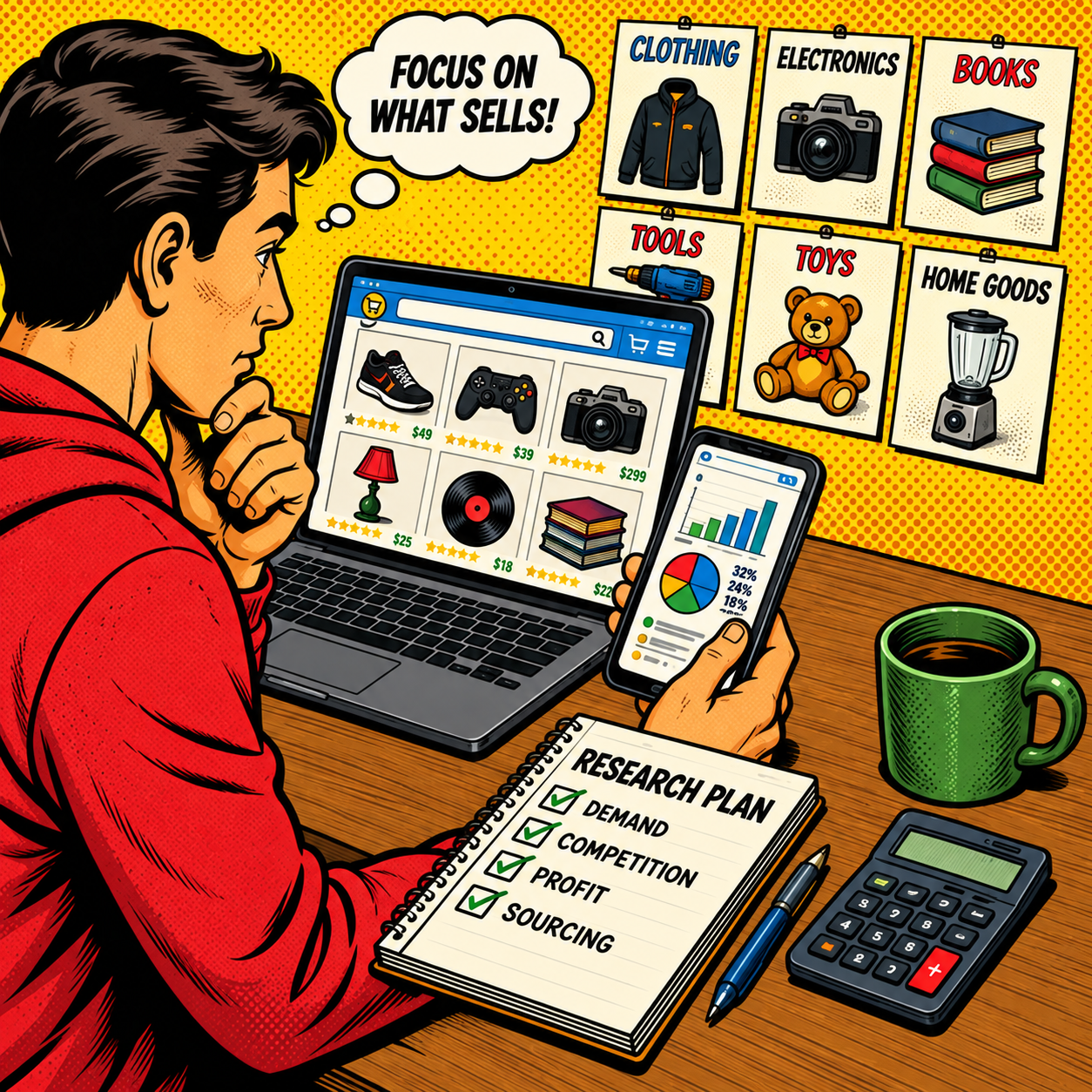
📅 Month 2: Source Your First Items Carefully
🎯 Main Goal
Find a small number of test items and learn how to evaluate profit before buying.
✅ What to Do
- Visit thrift stores, yard sales, clearance aisles, or online marketplaces
- Check sold comps before purchasing
- Inspect condition carefully
- Calculate fees, shipping, supplies, and possible profit
- Start with low-risk items
- Avoid bulky items unless you can store and move them
- Take notes on where good items are found
- Buy only what you can list quickly
🔍 What to Check Before Buying
- Recent sold comps
- Item condition
- Missing parts or flaws
- Estimated fees
- Shipping or pickup difficulty
- Profit after all costs
🏁 Month 2 Success Looks Like
- You sourced your first test items
- You checked sold prices before buying
- You understand basic item inspection
- You avoided overbuying
- You are ready to clean, photograph, and list items
🎯 KEY TAKEAWAY
The money is made when you buy. If the purchase price is too high, even a good listing may not leave enough profit.
📍 Places to Source Products
Source | Best For |
Thrift stores | Clothing, shoes, books, home goods |
Yard sales | Low-cost local finds |
Facebook Marketplace | Furniture, tools, electronics, local deals |
OfferUp | Local resale opportunities |
Estate sales | Vintage items, collectibles, tools |
Clearance sections | Retail arbitrage items |
Storage cleanouts | Bulk inventory, higher risk |
Friends and family | First low-cost items to practice listing |
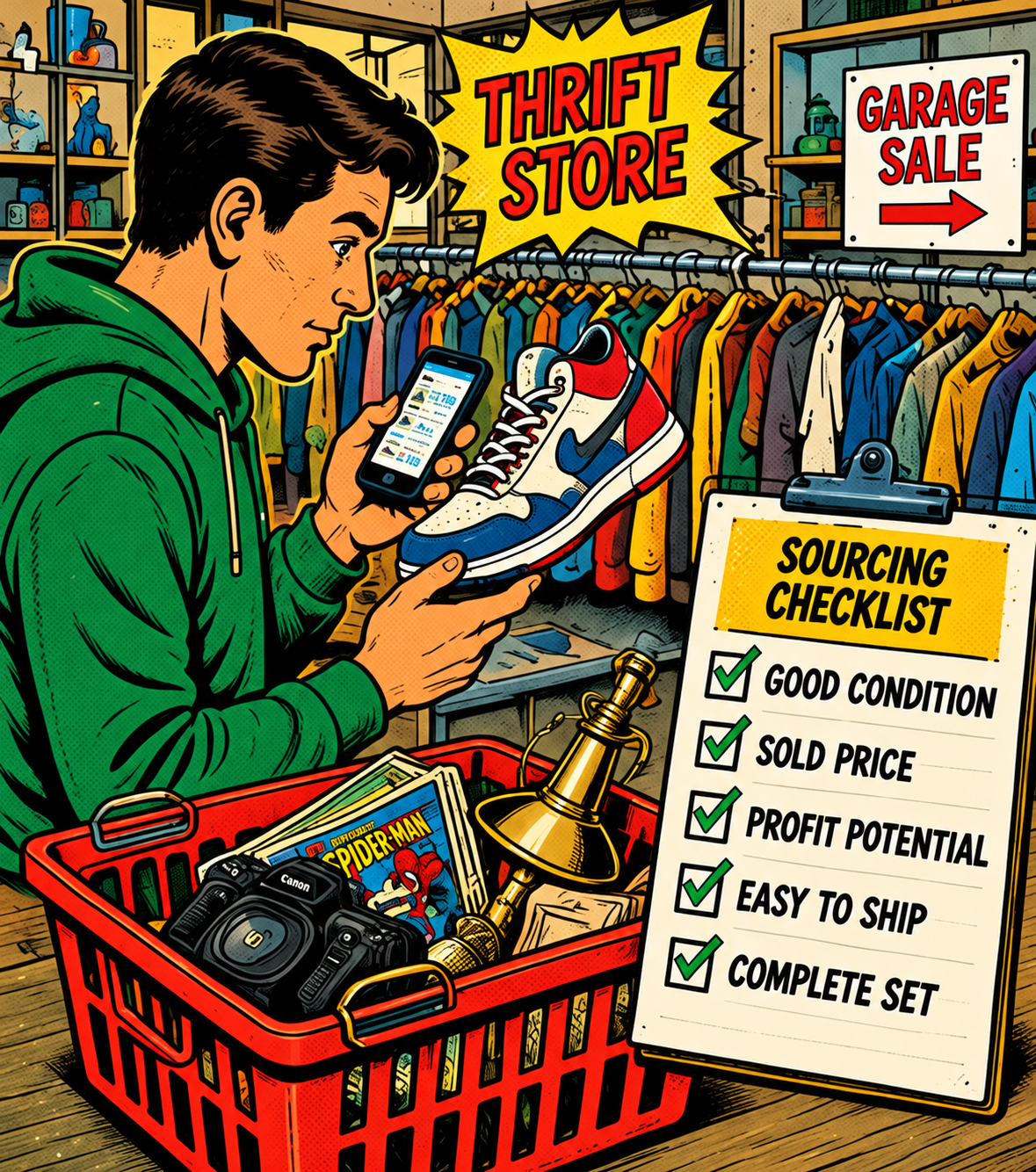
📅 Month 3: Create Listings & Make First Sales
🎯 Main Goal
List your first items professionally and learn what makes buyers click, message, and purchase.
✅ What to Do
- Clean or prepare each item
- Take clear photos from multiple angles
- Write accurate titles and descriptions
- Include size, condition, brand, model, and flaws
- Price based on sold listings
- Choose shipping or local pickup
- Respond to buyer questions quickly
- Track every sale and expense
👀 What to Watch First
- Views and messages
- Offers received
- Questions buyers ask
- Platform fees per sale
- Shipping cost surprises
- Profit after all costs
🏁 Month 3 Success Looks Like
- You listed your first items
- You completed your first sales
- You learned which items got interest
- You understand platform fees better
- You are tracking real profit, not just sale price
🎯 KEY TAKEAWAY
If an item gets views but no messages or offers, check the price, photos, title, and shipping cost before assuming the item is bad.
☑️ Strong Listing Checklist
Listing Element | Why It Matters |
Clear title | Helps buyers find the item |
Good photos | Builds trust and reduces questions |
Honest condition | Prevents returns and complaints |
Accurate measurements | Helps clothing, furniture, and tools sell |
Brand/model details | Improves search visibility |
Competitive price | Helps the item move faster |
Shipping details | Prevents confusion |
Clean description | Makes the buyer feel confident |
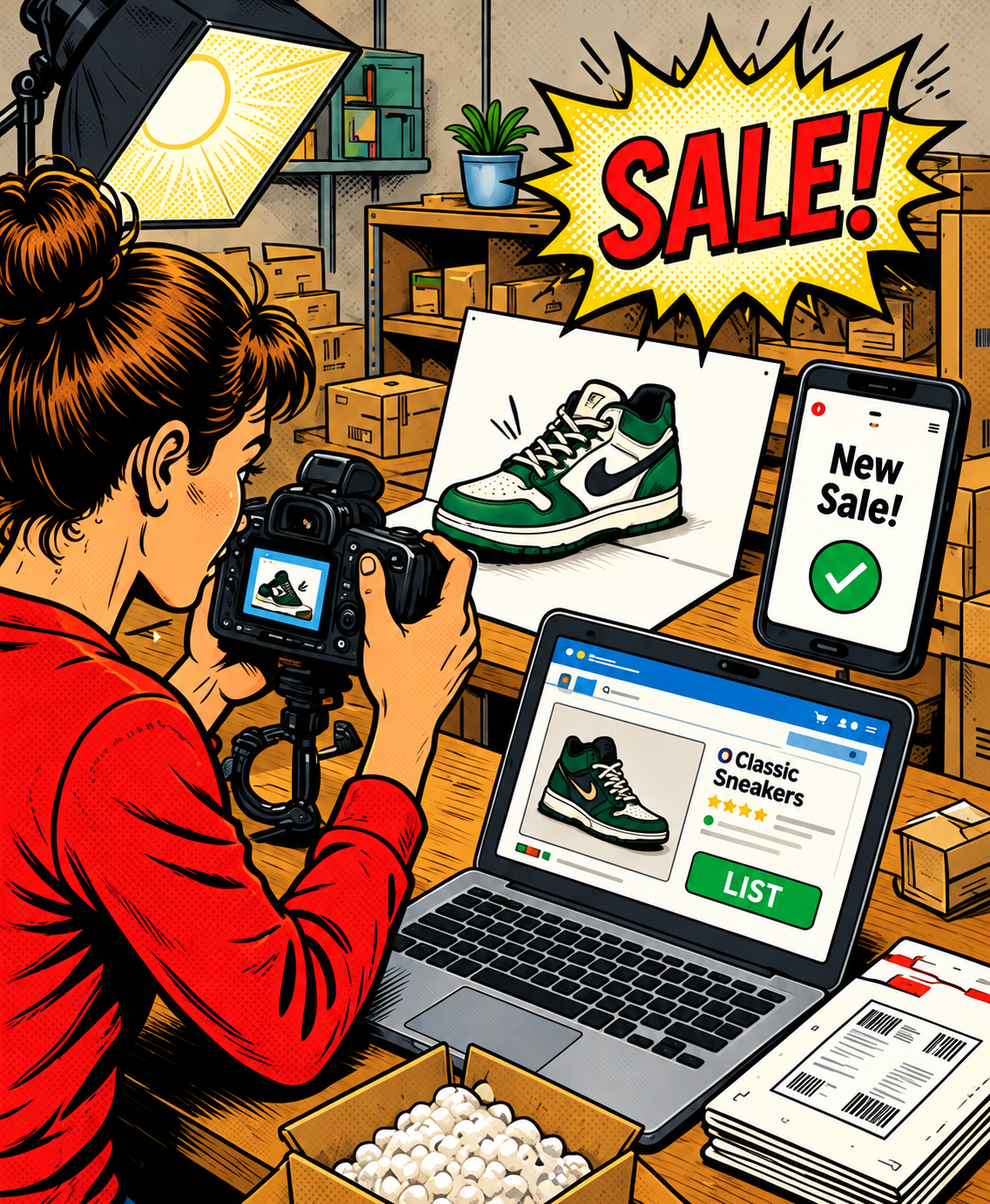
📅 Month 4: Build a Repeatable Flipping System
🎯 Main Goal
Create a simple process for sourcing, listing, selling, shipping, and tracking profit.
✅ What to Do
- Create a weekly sourcing schedule
- Create a photo setup for listings
- Build title and description templates
- Track inventory in a spreadsheet or Notion
- Track cost, fees, shipping, supplies, and profit
- Reinvest only part of your profit
- Relist or improve stale items
- Stop buying categories that do not move
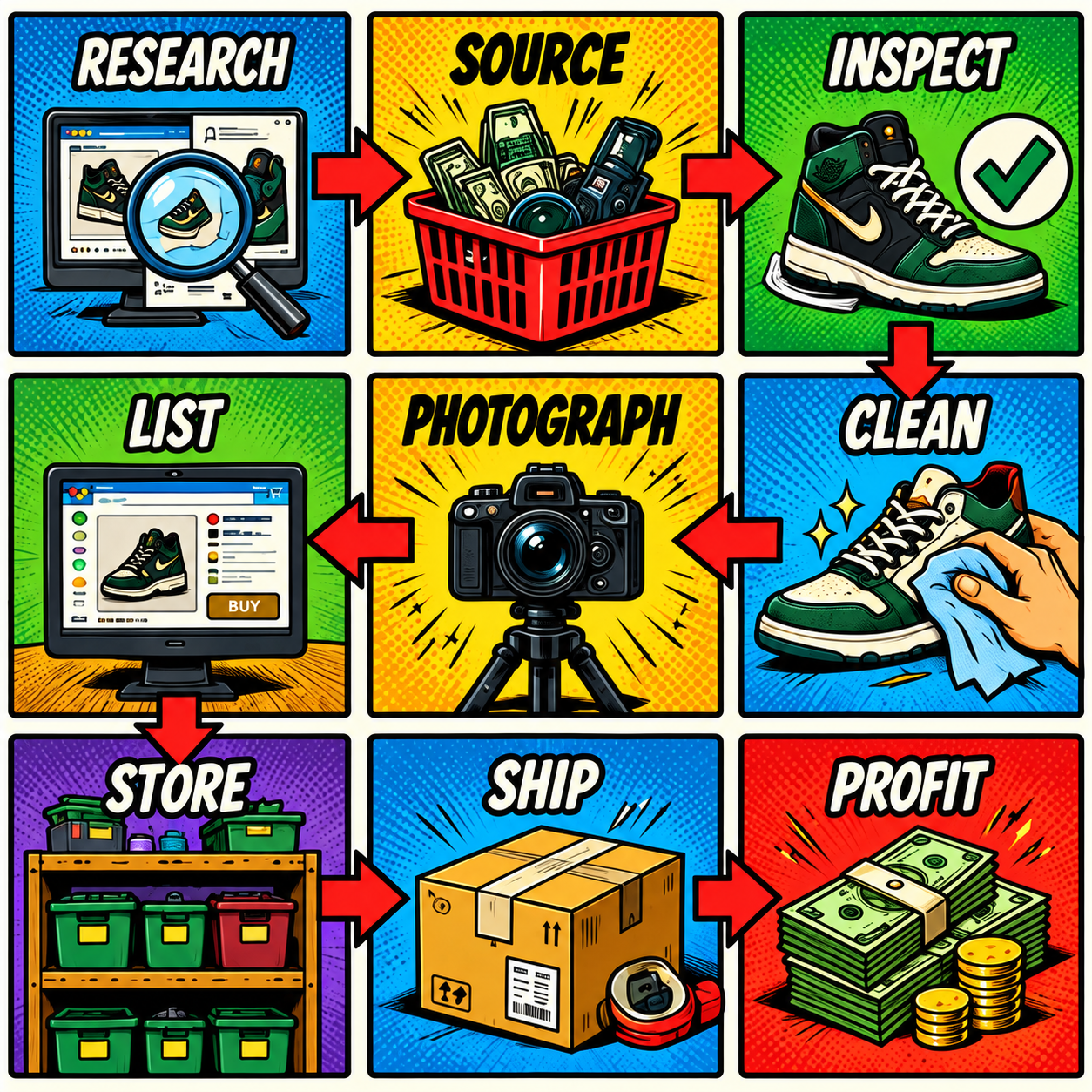
🏁 Month 4 Success Looks Like
- Your listing process is faster
- Your inventory is organized
- You know which categories are moving
- You are tracking real profit
- You are making better buying decisions
⚠️ Scale Smart: Do not let inventory pile up faster than you can list it. Unlisted inventory is money sitting still.
🗓️ Simple Weekly Workflow
Day | Task |
Monday | Research sold listings and update prices |
Tuesday | Source new inventory |
Wednesday | Clean and photograph items |
Thursday | Create listings |
Friday | Ship sold items and answer messages |
Weekend | Yard sales, marketplace sourcing, and inventory review |
🔄 Simple Product Flipping Workflow
Step | What Happens |
Research | Check sold prices and demand |
Source | Buy items below resale value |
Inspect | Check condition, flaws, and completeness |
Clean/prep | Make item photo-ready |
Photograph | Take clear photos from multiple angles |
List | Add title, description, price, and shipping |
Sell | Communicate with buyer and complete transaction |
Ship/deliver | Package safely or arrange pickup |
Track profit | Record real profit after all costs |
📅 Month 5: Improve Profit, Speed & Sourcing Quality
🎯 Main Goal
Focus on items that sell faster, produce better margins, and are easier to source repeatedly.
✅ What to Do
- Review your sold items
- Identify your highest-profit categories
- Identify items that sat too long
- Improve photos and titles on slow listings
- Test bundles or lot listings
- Build relationships with local sellers
- Negotiate better purchase prices
- Avoid low-margin items that take too much effort
🏁 Month 5 Success Looks Like
- You know your best product categories
- You are buying smarter
- Slow items are being improved or discounted
- Your profit tracking is more accurate
- You are reinvesting based on data instead of impulse
🎯 KEY TAKEAWAY
A fast-selling $20 profit item can be better than a $100 profit item that takes months, storage space, and constant price drops.
💰 Ways to Improve Profit
Improvement | Why It Helps |
Better sourcing | Increases profit before listing |
Cleaner photos | Builds buyer confidence |
Stronger titles | Helps search visibility |
Bundling low-cost items | Moves inventory faster |
Better shipping choices | Protects profit margin |
Faster listing routine | Turns inventory into cash sooner |
Category focus | Builds expertise |
Price adjustments | Helps stale inventory move |
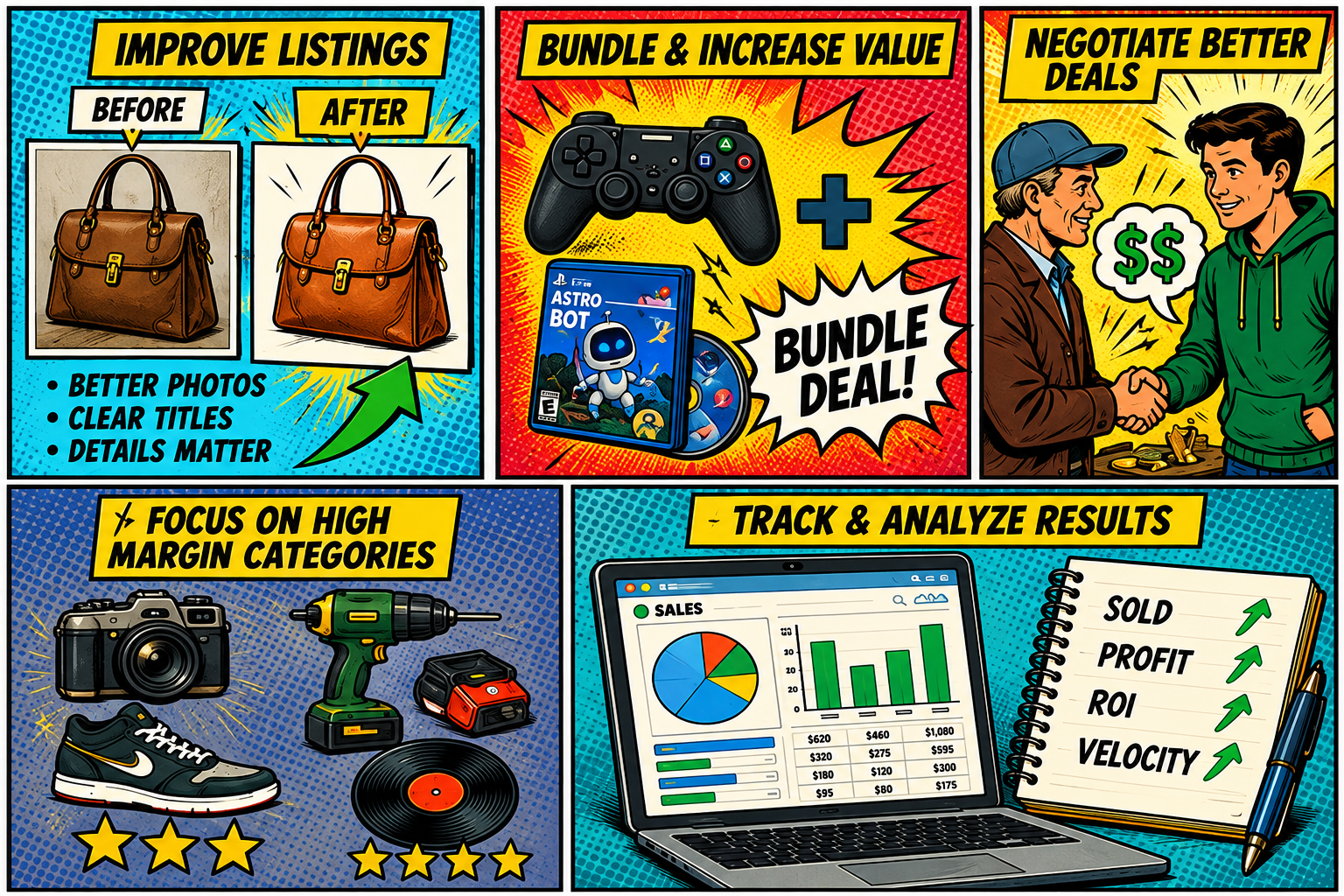
📅 Month 6: Review, Refine & Scale
🎯 Main Goal
Review your first 6 months and decide which categories, platforms, and sourcing methods are worth scaling.
✅ What to Do
- Review all items purchased
- Review all items sold
- Calculate total revenue, expenses, and profit
- Identify your fastest-selling categories
- Identify your highest-profit categories
- Remove weak inventory or discount it
- Choose your best sourcing locations
- Create a 90-day plan for months 7–9
❓ 6-Month Review Questions
- Which items sold fastest?
- Which items produced the most profit?
- Which items were not worth the effort?
- Which sourcing locations gave the best finds?
- Which platform worked best?
- Which items had hidden costs?
- How much inventory is still unsold?
- What should you stop buying?
- What category should you focus on next?
🏁 Month 6 Success Looks Like
- You know your strongest product category
- You understand your real profit margins
- You have a cleaner inventory system
- You are sourcing with more confidence
- You have a 90-day plan to grow without overbuying
🎯 KEY TAKEAWAY
Product flipping becomes easier when you stop buying everything and start specializing in items you can evaluate, list, and sell confidently.
📊 Decision Table
If This Happens | Do This |
Clothing sells fastest | Learn brands, sizes, and photo systems |
Tools have better margins | Source more tools and test local sales |
Furniture makes high profit | Plan storage, transport, and local delivery |
Electronics sell well | Improve testing and condition checks |
Inventory is piling up | Stop buying and list what you already have |
Shipping costs hurt profit | Focus on lighter items or local pickup |
One platform works best | List there first and cross-list later |
Items get views but no sales | Improve price, photos, title, or shipping |
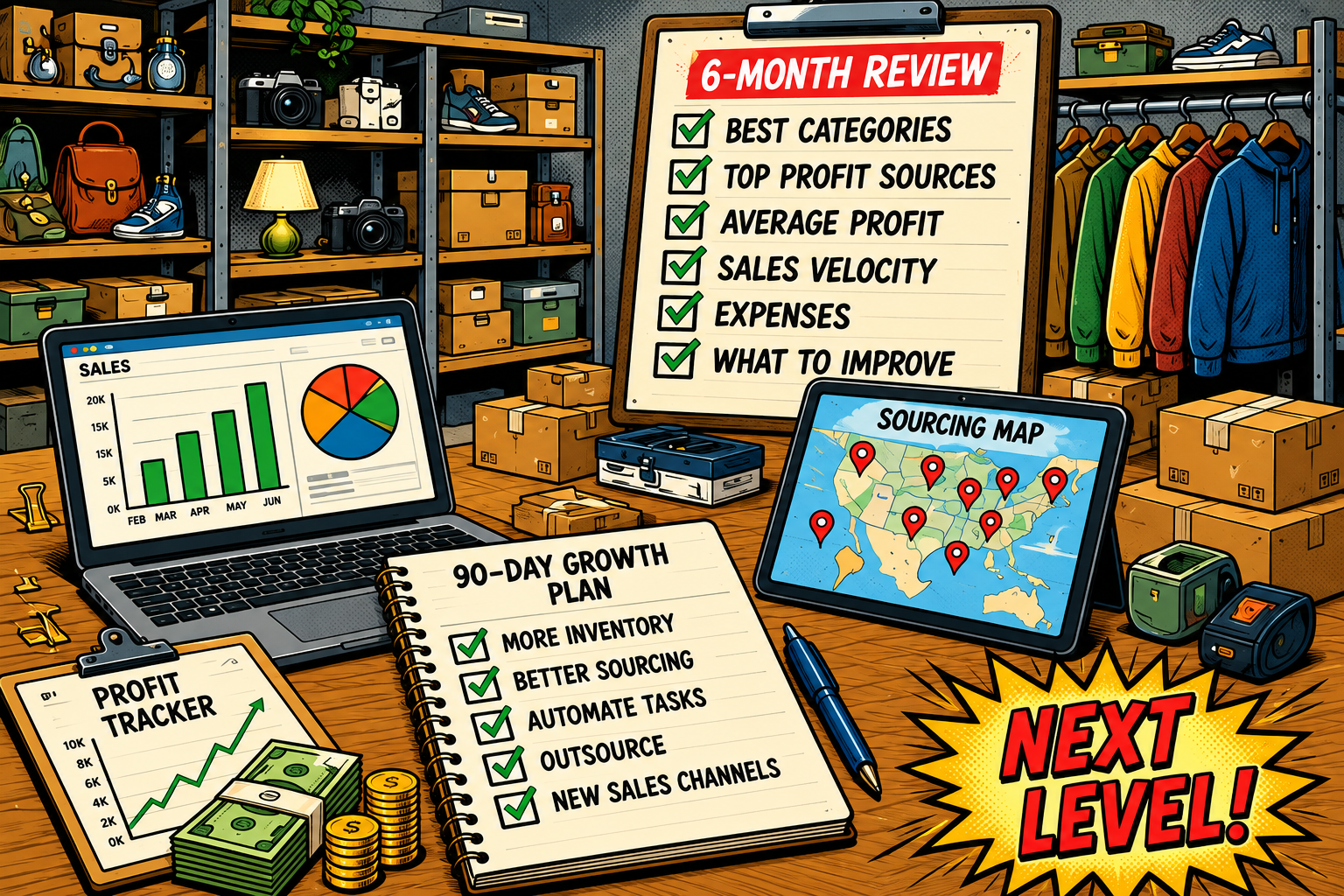
✅ 6-Month Success Checklist
By the end of 6 months, check whether you have:
✅ Chosen 1–2 product categories
✅ Researched sold listings before buying
✅ Created resale platform accounts
✅ Sourced first test items
✅ Cleaned and photographed items
✅ Created strong listings
✅ Sold first items
✅ Tracked cost, fees, shipping, and profit
✅ Built an inventory tracker
✅ Identified best-selling categories
✅ Removed or improved slow listings
✅ Created a plan for the next 90 days
⚠️ What Not to Do During the First 6 Months
Avoid these mistakes:
❌ Buying items without checking sold prices
❌ Treating asking prices as real market value
❌ Ignoring shipping costs and platform fees
❌ Buying too much inventory too early
❌ Listing with poor photos
❌ Hiding flaws or damage
❌ Selling items you cannot test properly
❌ Taking unsafe payment or meetup risks
❌ Letting inventory pile up unlisted
❌ Counting revenue as profit
⚠️ Reminder: Product flipping rewards discipline. Buy with margin, list quickly, track every cost, and let real sales data guide what you buy next.
🧭 Simple 6-Month Milestone Tracker
Month | Main Focus | Target Output |
Month 1 | Research & categories | 1–2 categories chosen |
Month 2 | First sourcing | First 5–10 items purchased carefully |
Month 3 | First listings | Items listed and first sales completed |
Month 4 | Flipping system | Inventory and profit tracker created |
Month 5 | Profit improvement | Best categories identified |
Month 6 | Review & scale | 90-day growth plan created |
🚀 Final 6-Month Strategy
Your first 6 months should follow this simple path:
Month 1: Learn resale basics and choose product categories
Month 2: Source your first items carefully
Month 3: Create listings and make first sales
Month 4: Build a repeatable flipping system
Month 5: Improve profit, speed, and sourcing quality
Month 6: Review results and scale carefully
The product flippers who grow fastest are not just good at finding deals. They know their numbers, list consistently, avoid bad inventory, and reinvest into what actually sells.
11. View the Product Flipping Starter Kit
🎁 Your Product Reselling Toolkit
The Product Flipping Starter Kit includes 12 browser-based workspaces for item evaluation, sourcing, listing creation, profit modeling, fee research and inventory tracking.
The 12 components:
✅ 1. Profitable Items Checklist — Review potential resale finds; sales are not guaranteed.
✅ 2. Brand Recognition Guide — Learn product and brand-identification approaches.
✅ 3. Profit Calculator Studio — Model purchase, shipping and selling costs.
✅ 4. Sourcing Route Planner — Plan visits to sourcing locations you select.
✅ 5. Listing Templates — Create accurate marketplace item descriptions.
✅ 6. Photo Checklist — Plan complete photographs of item condition.
✅ 7. Pricing Research Guide — Study sold comparisons and pricing signals.
✅ 8. Shipping Cost Calculator — Estimate packaging and delivery costs.
✅ 9. Platform Fee Breakdown — Record and compare current platform fees.
✅ 10. Inventory Tracking System — Track listed, stored and sold items.
✅ 11. 90-Day Goal Tracker — Organize sourcing, listing and sales goals.
✅ 12. Common Mistakes Guide — Review common beginner risks and oversights.
Also included in the editable master: A central dashboard and Start Here guide are present.
This is a review edition. It does not fetch live sold comparisons, update marketplace fees automatically, list inventory or guarantee profit; verify source data and fees independently.

12. Frequently Asked Questions
🎨 Do I need to be highly skilled to start?
No — but you do need to know what items are worth.
You can start by:
- 🏠 Selling unwanted items from your own home
- 👕 Sticking to categories you already know, like clothing, games, or tools
- 📱 Checking sold comps on eBay before every buy
- 📺 Learning through YouTube and practice
- 🧪 Starting with a small $50–$150 test budget
💡 Evaluation skill improves quickly with repetition — your first 20–50 flips are your training phase.
💰 How much can I realistically make?
Illustrative ranges, not typical or guaranteed results:
- 🌱 Casual seller: $100–$500/month
- 📈 Part-time: $500–$3,000/month
- 🚀 Full-time: $5,000–$10,000+/month
💡 Top flippers scale by:
- 🧭 Specializing in profitable categories
- 🔁 Increasing inventory turnover
- 🛒 Cross-listing on multiple marketplaces
- 💵 Reinvesting profits into better inventory
🛍️ Where should I sell first?
Best starting platforms:
- 📍 Facebook Marketplace for local, no-shipping sales
- 🛒 eBay for the largest buyer audience and sold-comps data
- 👕 Poshmark or Mercari for clothing and smaller items
👉 Start with one platform, master it, then expand.
📦 Do I need inventory upfront?
Yes — but start small.
Begin with:
- 🏠 Items you already own
- 🧪 5–10 sourced items to test
- 💵 A fixed sourcing budget, such as $50–$150
- 📸 Clean photos
- 📝 Strong descriptions
Buy more only after your first flips sell.
💡 Avoid overbuying — let sell-through guide your spending.
💵 How should I price my products?
Use this baseline:
- 🏷️ Sold comps — what buyers actually paid
- 🧾 Marketplace and payment fees
- 📦 Shipping and packaging
- 💰 Target profit margin
Then price to move within your target timeline.
💡 Never compete on price alone — good photos, honest condition notes, and fast shipping win sales.
🚀 How do I get my first sales?
Start with:
- 📸 Bright, clean photos
- 🔍 Keyword-rich titles buyers actually search
- 💵 Competitive pricing based on sold comps
- 🚚 Fast shipping options
- 🔁 Refreshing or relisting stale listings
💡 Your first goal:
👉 Get 5–10 sales, then ask for reviews where appropriate.
⭐ How important are reviews?
They can help, especially early, but they are not a substitute for accurate listings and fair pricing.
Reviews may help with:
- 🤝 Building trust
- 🔍 Marketplace visibility over time
- 🛒 Buyer confidence
- 💰 Supporting your asking price on some marketplaces
💡 Helpful reviews can support sales, but they do not guarantee ranking or higher prices.
⚠️ What are the biggest beginner mistakes?
Avoid these:
❌ Buying without checking sold comps
❌ Ignoring fees and shipping costs
❌ Poor photos
❌ Overpaying for inventory
❌ Holding items that never sell
❌ Giving up too early
💡 Most people fail because they stop before momentum builds.
🔁 Can this become a full business?
Some sellers do, if demand, margins, storage, and systems support it.
Path:
- 🌱 Start with casual flips
- 🛍️ Build consistent sales
- 📦 Increase sourcing volume
- 🧭 Specialize in winning categories
- 🏷️ Scale into a full resale operation
👉 A smaller number of flippers grow into full-time resale businesses — it is not automatic.
13. Important Considerations
Before you buy your first item to flip, understand these key realities — flipping rewards research and discipline, not just bargain hunting.
🧠 This Is Both Sourcing AND Operations
You’re not just finding deals.
You’re also:
- 📦 Managing inventory
- 💬 Handling buyers
- 📣 Writing and promoting listings
- 🚚 Packing and shipping orders
- 🧾 Tracking expenses and profit
- 📸 Photographing every item
👉 Treat this like a business from day one.
💰 Profit ≠ Revenue
You must account for:
- 🏷️ What you paid for the item
- 💳 Marketplace and payment processing fees
- 📦 Packaging
- 🚚 Shipping
- ⏰ Your sourcing and listing time
- 📉 Price drops on slow-moving items
💡 Many beginners think they’re profitable — but aren’t.
📦 Time vs. Money Trade-Off
Flipping trades time for margin.
More sales mean:
- ⏰ More sourcing trips
- 🧼 More cleaning and testing
- 📝 More listing work
- 🚚 More shipping
- 💬 More customer messages
Eventually, you must:
- 🗂️ Source and list in batches
- 🧭 Specialize in faster, familiar categories
- 🛠️ Use cross-listing and shipping tools
- ⚙️ Create repeatable systems
📸 Listing Quality Is Not Optional
Even great items won’t sell without visibility.
You must:
- 🔍 Learn basic marketplace SEO, especially titles buyers search
- 📸 Improve your product photos
- 📝 Write clear, honest descriptions
- 🔄 Refresh or relist stale listings
- 🛒 Cross-list to reach more buyers
👉 Visibility = sales.
⚖️ Legal & Safety Requirements
Depending on what you sell, you may need to follow specific rules.
Examples:
- 🧾 Flipping income is taxable — track it from day one
- 🏢 Consider a business license as sales grow
- 🔌 Test electronics and disclose condition honestly
- 🧸 Check recalls before selling kids’ items
- 🚫 Never sell counterfeit or trademark-infringing goods
💡 Always research before selling regulated items.
🔁 Consistency Wins
This business rewards long-term consistency.
Focus on:
- 📅 Sourcing and listing consistently
- 📦 Keeping inventory moving
- 📸 Improving photos with every batch
- 🧠 Learning from sell-through data
- ⭐ Building reviews
- 📈 Reinvesting profits steadily
👉 This business rewards long-term consistency, not quick bursts of effort.
14. Your Next Steps
🚀 ACTION STEP
🟢 Step 1: Choose Your Category
Pick ONE category so you don’t overwhelm yourself.
Choose items that are:
- 🔍 Easy to evaluate
- 🛍️ In proven demand
- ❤️ Familiar or interesting to you
- 📦 Easy to ship
- 💰 Profitable after fees and shipping
🟢 Step 2: Source Your First Items
Start small:
- 🏠 Sell 5–10 items you already own
- 🧪 Then spend a small test budget, such as $50–$150
- 📱 Check sold comps before every purchase
- 🧼 Clean and test everything you buy
- 📝 Record what you paid for each item
🟢 Step 3: List Everything
Pick one marketplace and get your items live.
Do this:
- 🛒 Open your seller account
- 📸 Upload bright, clean photos
- 🔍 Use searchable keywords in titles
- 💵 Price from sold comps
- 🚚 Set clear shipping options
🟢 Step 4: Get Your First Sales
Start with:
- 📱 Sharing listings in local groups
- 💬 Responding to messages quickly
- 📉 Dropping the price 5–10% on stale listings
- 🚚 Offering fast, tracked shipping
- ⭐ Asking early buyers for reviews
👉 Goal: First 5–10 sales, then ask for reviews where appropriate.
🟢 Step 5: Improve & Optimize
After your first sales:
- 📊 See what sells fastest
- 📸 Improve photos
- 📝 Improve titles and descriptions
- 💵 Adjust pricing if needed
- 🧠 Learn from buyer questions
- 🔁 Source more of what sells
🟢 Step 6: Build Momentum
Keep growing by:
- ➕ Adding new inventory weekly
- 🗓️ Listing on a consistent schedule
- ⭐ Collecting reviews
- 📦 Streamlining your shipping process
- 🧭 Doubling down on winning categories
- 🔁 Building repeatable sourcing routes
🎯 30-Day Goal
Aim for:
- 🛍️ 15–25 items listed
- 💰 5+ sales
- ⭐ Your first reviews
- 📸 Better listing photos
- 📊 A clear idea of what sells fastest
🔥 Your First Milestone
👉 Treat $500/month as a possible milestone, not a guarantee.
From there, it is often easier to decide what to repeat because you’ll know:
- What sells
- What buyers pay for
- What pricing works
- Which platform performs best
🚀 Final Step
Don’t wait for perfection.
👉 Start small.
👉 Improve fast.
👉 Stay consistent.
Your first sale is often the hardest — the process usually gets clearer after that.
15. The Bottom Line
🎯 KEY TAKEAWAY
Product flipping is one of the most accessible ways to turn a good eye for deals into income. It is not just finding cheap stuff — it is buying below market value and reselling where demand already exists.
🙋 If you:
✔ Research sold prices before buying anything
✔ Start small — as little as $50 and categories you know
✔ Write listings with clear photos and honest descriptions
✔ Track real profit after fees, shipping, and time
🏗️ You can build:
💰 Extra income is possible part-time; larger figures usually take more inventory, time, and systems — not a typical starting point
🔁 Cash can move faster than in many hustles, though payout timing depends on the platform and the sale
📈 A resale process that can improve as your eye for deals and your records improve
🚀 Start with your own garage — list your first item when you can describe it accurately.
16. Recommended Websites & Tools
🛠 TOOLS & RESOURCES
You do not need every resource listed below. This directory brings together the major platforms, tools, and resources from this guide, along with additional research and learning options, so you can find them in one place when you need them.
Start with the essentials. Add tools only when your flipping operation develops a specific need for them.
🛒 Resale Marketplaces & Selling Apps
- eBay — Major resale marketplace for collectibles, vintage items, electronics, clothing, tools, books, and shipped product flips.
- eBay App — Mobile app for researching sold comps, listing items quickly, managing messages, and checking prices while sourcing.
- Facebook Marketplace — Local selling platform for furniture, tools, electronics, home goods, local bundles, and fast cash pickup sales.
- Mercari — Mobile-friendly resale marketplace for clothing, electronics, shoes, collectibles, toys, and smaller shippable items.
- Poshmark — Clothing, shoes, and accessories marketplace for fashion-focused flippers and closet resellers.
- Amazon — Large buyer marketplace mentioned for reselling books, retail arbitrage items, and certain consumer products.
- Amazon Seller — Seller platform for listing products on Amazon, using seller tools, and scaling into retail arbitrage or FBA workflows.
- Amazon FBA — Fulfillment service where Amazon stores, packs, ships, and handles customer service for eligible resale inventory.
- Depop — Trend-focused resale marketplace for vintage clothing, streetwear, Y2K fashion, and younger buyers.
- OfferUp — Local buying and selling app for electronics, furniture, tools, home goods, and neighborhood flips.
- Etsy — Marketplace mentioned for vintage, unique, collectible, handmade-adjacent, and specialty resale items.
💡 PRO TIP
List on 2–3 marketplaces at once — eBay, Facebook, and Mercari reach different buyers. Cross-listing the same item multiplies exposure.
📍 Local Sourcing & Thrift Store Resources
- Goodwill — Thrift store source for clothing, shoes, books, electronics, home goods, toys, and beginner-friendly flips.
- Salvation Army — Donation shop source for clothing, furniture, décor, household items, and low-cost resale inventory.
- Habitat for Humanity ReStore — Reuse store for furniture, tools, appliances, building materials, home improvement items, and local high-margin finds.
- Craigslist — Local classifieds platform for sourcing furniture, appliances, bikes, tools, local bundles, and underpriced items.
- Facebook Marketplace — Local deal source for quick-pickup items, furniture, electronics, tools, and bundles sellers want gone fast.
- OfferUp — Local deal-hunting app for sourcing underpriced items, electronics, home goods, and neighborhood resale opportunities.
- EstateSales.net — Estate sale search site for finding local estate sales with furniture, collectibles, tools, books, décor, and vintage inventory.
- Yard Sale Search — Yard sale discovery tool for planning weekend sourcing routes and finding garage sales nearby.
- Nextdoor — Neighborhood platform for local free/cheap items, moving-sale leads, community posts, and nearby resale opportunities.
📝 QUICK NOTE
Your best margins come from local sourcing — thrift stores, garage sales, and clearance aisles where sellers underprice.
🏷️ Retail Clearance, Warehouse Clubs & Bulk Sourcing
- Walmart Clearance — Retail clearance source mentioned for finding discounted consumer goods that may be flipped for profit after research.
- Target Clearance — Retail clearance source for household goods, toys, seasonal items, and discounted products with resale potential.
- Home Depot Special Buys — Home improvement deal source for tools, hardware, appliances, and clearance items.
- Lowe’s Clearance — Home improvement clearance source for tools, home goods, seasonal items, and hardware-related flips.
- Costco — Warehouse club mentioned for bulk buying, seasonal deal hunting, and retail arbitrage research.
- Sam’s Club — Warehouse club mentioned for bulk products, seasonal items, and potential resale sourcing.
- BULQ — Liquidation marketplace for bulk inventory lots, returns, shelf pulls, and larger resale sourcing.
- Liquidation.com — Liquidation auction platform for bulk lots, returned merchandise, and wholesale resale inventory.
- Direct Liquidation — Liquidation marketplace for sourcing bulk retail returns, overstock, and pallets.
- 888 Lots — Bulk inventory platform for product lots, wholesale deals, and resale sourcing at scale.
🔎 Product Research, Price Checking & Scanning Tools
- eBay Sold Listings — Price research filter for checking what items actually sold for before buying inventory.
- PriceCharting — Video game, console, and collectible price lookup tool for checking retro game values quickly.
- Amazon Seller App — Amazon scanning and seller tool for checking product prices, sales rank, fees, and resale eligibility.
- Google Lens — Visual search tool mentioned for identifying unfamiliar brands, tags, products, and possible resale value.
- ScoutIQ — Book-scanning app for checking book resale value, sales rank, and profitability while sourcing.
- Profit Bandit — Scanning app for retail arbitrage and book/product research while sourcing inventory.
📝 QUICK NOTE
Never buy without checking sold listings first. eBay sold prices are the truth; asking prices are fiction.
📦 Shipping, Labels & Fulfillment Setup
- Rollo — Thermal label printer brand mentioned for printing shipping labels quickly and improving shipping workflow.
- Brother — Printer brand mentioned for thermal label printers and shipping-label setup.
- Amazon FBA — Fulfillment option for storing, shipping, and managing eligible resale products through Amazon’s logistics network.
🗂️ Cross-Listing, Inventory & Tracking Tools
- List Perfectly — Cross-listing and inventory management tool for posting resale items across multiple marketplaces faster.
- Vendoo — Reseller cross-listing tool for managing listings, inventory, and multi-platform product posting.
- Google Sheets — Spreadsheet tool for tracking purchase price, sale price, fees, shipping costs, inventory location, and net profit.
- Notion — Workspace mentioned for tracking inventory, sourcing notes, item status, listing workflow, and resale business systems.
🎯 KEY TAKEAWAY
You do not need every tool on this page. One marketplace, sold-price research, and a shipping scale are enough to flip your first item.
🧭 How to Use This Directory
🧰 Start With a Simple Setup
Do not start by creating accounts with every service listed above. For most beginners, a simple setup is enough:
- One selling app
- Sold-price research
- A shipping scale
- One tracking spreadsheet
That is enough to start building. Add tools only when you can name the specific problem they will solve.
🎯 KEY TAKEAWAY
Tools support the business. They are not the business.
Your biggest advantages will come from:
Research → Margin → Turnover → Reinvestment
17. Explore Similar Side Hustles
 Selling Crafts & Handmade Goods — Sell your own creations alongside flipped inventory on the same marketplaces.
 Dropshipping: Start an Online Store Without Holding Inventory — A no-inventory cousin to flipping once you know what sells.
- Print-on-Demand — Design your own products instead of sourcing them.
 Gig Economy Apps: Earn Money on Your Schedule Using Your Phone — Fill slow sourcing weeks with flexible app-based income.
 Investing & Dividend Income: Grow Your Wealth with Smart Investments — Put your flipping profits to work for long-term wealth.
- Selling Digital Products — No shipping, no sourcing — build a pure digital inventory.