

Affiliate disclosure: Some links in this guide may be paid referral links. If you purchase or sign up through one, One Stop Side Hustles may earn a commission. How our affiliate links work.
INVESTING & DIVIDEND INCOME STARTER GUIDE
Learn how dividend investing works—including investment types and risks, choosing platforms, and building a long-term plan. Early income is often small, and results depend on capital, yield, time, and market performance. Dividends are not guaranteed.
1. What Is Investing & Dividend Income?
2. Why Investing & Dividend Income Is a Great Side Hustle
3. Common Investment Types for Dividend Income
4. How Much Can You Earn & Pricing Strategies
5. Platforms & Tools to Get Started
6. Where to Find Investment Opportunities
7. From Foundation to Repeatable Investing
8. Build Trust & Improve Results
9. Learning, Templates & Resources
10. Your First 6 Months Investing & Dividend Income Plan
11. Get Your Investing Starter Kit
12. Frequently Asked Questions
Quick Snapshot
Earn: Highly variable — early dividends are often small; larger cash flow depends on capital, yield, time, and market results
Work: Mostly hands-off after setup — contribute regularly and review on a schedule
Start: Higher cost — income scales with capital invested
Best for: Patient people building long-term wealth
Grow: Reinvest dividends → compounding → a larger income base over time
1. What Is Investing & Dividend Income?
Investing puts money into assets such as stocks, bonds, or real estate with the goal of earning long-term growth or income; outcomes and dividends are not guaranteed.
Investing means putting your money into assets (stocks, bonds, real estate) to earn returns over time through growth and income.
Dividend income specifically comes from owning shares in companies that distribute a portion of their profits to shareholders regularly (usually quarterly or monthly).
⚙️ How Dividend Investing Works
- Buy shares in dividend-paying companies or funds
- Hold the shares (you must own on the "ex-dividend date")
- Receive payments directly to your brokerage account (quarterly, monthly, or annually)
- Reinvest or spend the dividends as cash or additional shares
🎯 KEY TAKEAWAY
Unlike growth stocks (Tesla, Amazon) that pay no dividends, dividend stocks (Coca-Cola, Verizon) share profits with investors. You earn income whether the stock price rises or falls.

2. Why Investing & Dividend Income Is a Great Side Hustle
Investing and dividend income is a strong side hustle because it can create long-term wealth, increasing cash flow, and a system that scales with discipline rather than more hours worked.
💰 It is one of the clearer paths to hands-off income
Unlike most side hustles, dividend investing can pay you without requiring client work, scheduling, or active labor once the assets are in place.
Early benefits often include:
- Small cash distributions
- Visible income tracking
- Reinforcement of saving habits
- Motivation to keep contributing
The income may start small, but the structure is what makes it powerful.
🎯 The upside scales with capital, not extra labor
That is one of the biggest differences from service-based income.
The main drivers are:
- Amount invested
- Asset quality
- Yield
- Consistency of contributions
- Time invested in the market
That means growth does not depend on taking more shifts or trading more hours for money.
🕒 It does not need much ongoing time after setup
Once your account, plan, and contribution system are set up, the process can stay very simple.
A practical routine usually means:
- Contribute consistently
- Reinvest dividends
- Review holdings occasionally
- Avoid emotional changes
That makes it one of the more compatible side hustles for busy people focused on long-term progress.
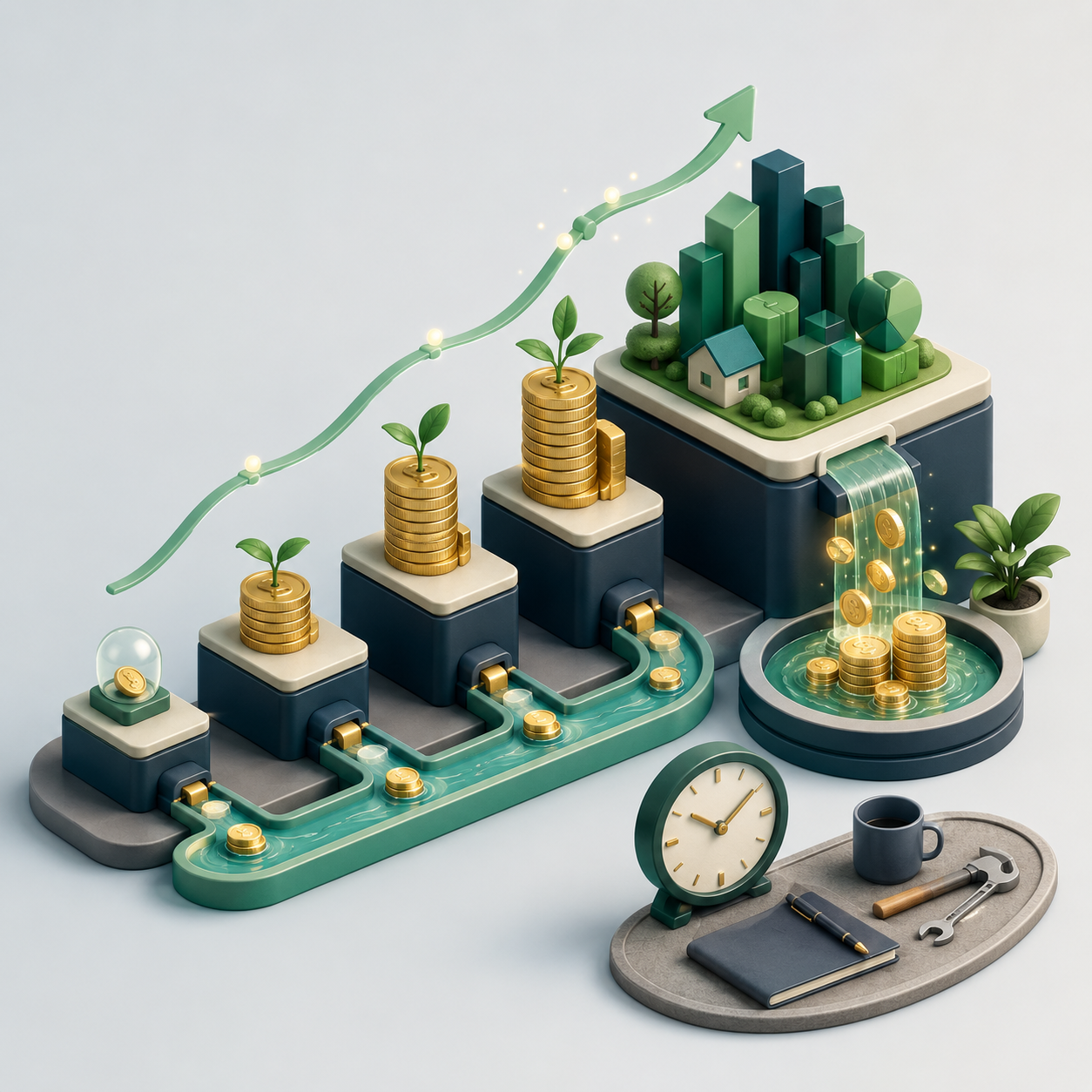
📈 Compounding can turn small starts into meaningful growth
Reinvested dividends can buy more shares, which can then produce more dividends later.
The growth cycle is simple:
- Invest
- Receive dividends
- Reinvest them
- Increase share count
- Repeat over time
This is where patience becomes an actual income advantage.
🧠 It builds assets, not just monthly income
Dividend investing can help you grow two things at once:
- Cash flow
- Portfolio value
- Financial resilience
- Long-term optionality
- A future income base
That combination is what makes it more than a short-term money tactic.
💻 Automation makes consistency easier
Most modern brokerages let you reduce friction dramatically through automation.
Common tools include:
- Recurring deposits
- Automatic purchases
- DRIP reinvestment
- Portfolio alerts or trackers
These systems help turn good intentions into a repeatable investing habit.
🌍 It is a time-tested strategy with flexible entry points
You do not need to start with a huge portfolio or complex stock-picking approach.
Many people begin with:
- Dividend ETFs
- Broad-market funds
- A few quality dividend stocks
- Automated monthly investing
That flexibility makes the strategy accessible even while you are still learning.
⚠️ Patience and risk control are part of the opportunity
This side hustle is powerful, but it works best when expectations stay realistic.
Good guardrails include:
- Avoiding extreme yields
- Diversifying
- Keeping an emergency fund
- Thinking in years, not weeks
- Staying consistent during volatility
The people who benefit most are usually the ones who stay disciplined the longest.
3. Common Investment Types for Dividend Income
Dividend income can come from several different investment types, but the smartest setup is usually a simple one you can understand, fund consistently, and hold through market ups and downs.
The goal is not to own everything. The goal is to combine income, diversification, and staying power in a way that matches your risk tolerance.
📦 Funds & Diversified Investments
📊 Dividend ETFs
Examples: Broad dividend ETFs, dividend-growth ETFs, high-dividend ETFs, value-oriented dividend funds
- ⭐ Difficulty: ⭐⭐ Beginner-friendly | 🧺 Diversification: Often high
- 💰 Income Source: Dividends distributed by the fund from its underlying holdings
- 📊 Typical Role: Core portfolio holding, diversified income, long-term investing
- 🌟 Best for: Beginners who want exposure to many dividend-paying companies without researching and managing every stock individually
📈 Broad-Market & Index ETFs
Examples: Total-market funds, S&P 500 index funds, large-cap index ETFs, diversified equity funds
- ⭐ Difficulty: ⭐⭐ Beginner-friendly | 🌎 Diversification: Often high
- 💰 Income Source: Potential dividends plus changes in the value of the fund
- 📊 Typical Role: Long-term portfolio foundation and broad stock-market exposure
- 🌟 Best for: Investors who want to prioritize broad diversification and long-term growth rather than maximizing current dividend yield
💡 PRO TIP
Many ETFs hold multiple companies or securities, which can make diversification easier, although narrowly focused ETFs may still be concentrated. Investor
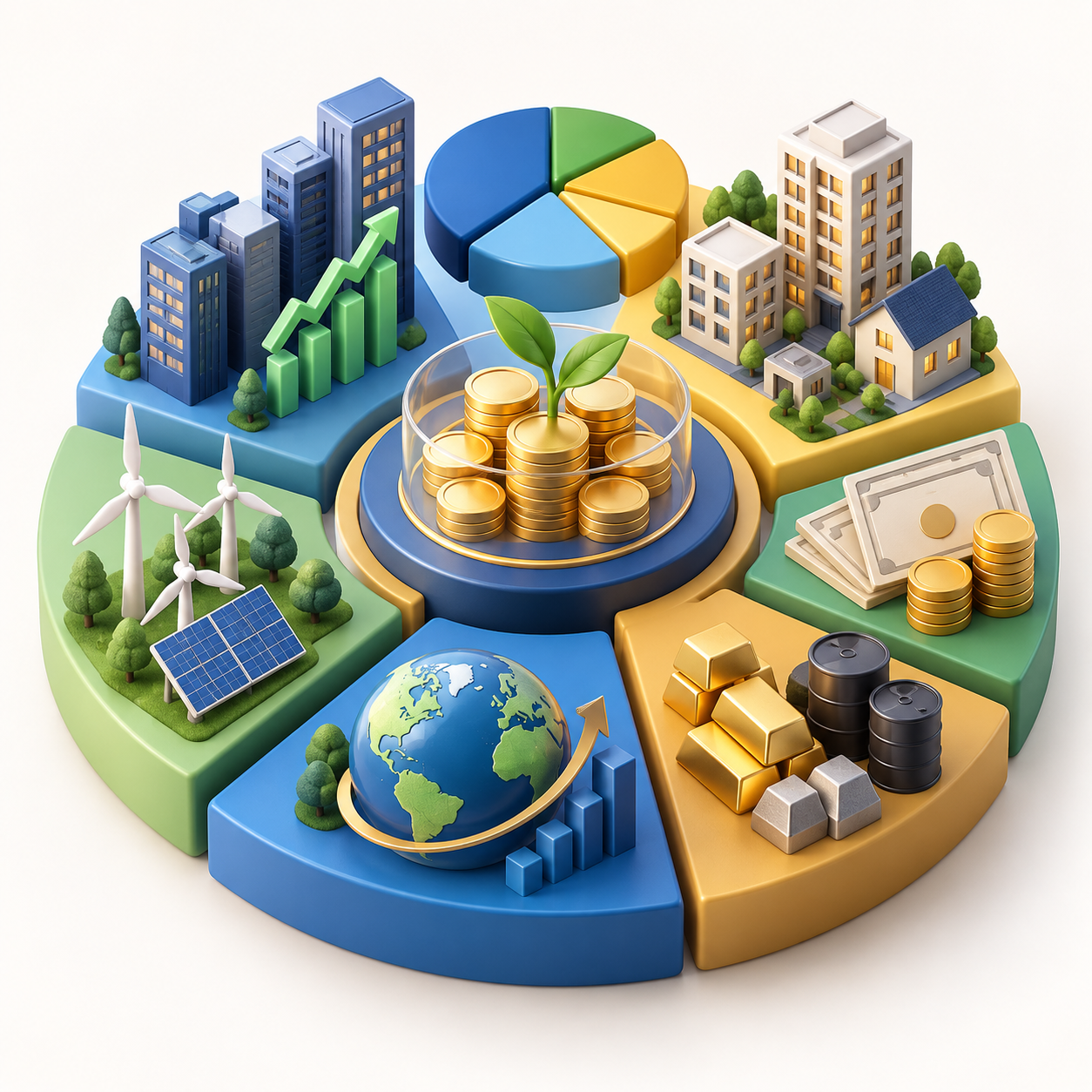
🏢 Individual Income-Producing Investments
🏦 Individual Dividend Stocks
Examples: Established companies that regularly distribute a portion of earnings to shareholders
- ⭐ Difficulty: ⭐⭐⭐⭐ Moderate to hard | 🔎 Research Required: High
- 💰 Income Source: Company dividend payments
- 📊 Typical Role: Targeted dividend income and potential long-term appreciation
- 🌟 Best for: Investors who want more control over their holdings and are comfortable researching individual businesses
🏢 REITs
Examples: Residential, industrial, healthcare, retail, storage, and data-center real-estate investment trusts
- ⭐ Difficulty: ⭐⭐⭐ Moderate | 🏘️ Real-Estate Exposure: High
- 💰 Income Source: Distributions generated by real-estate-related businesses and assets
- 📊 Typical Role: Income generation and additional portfolio diversification
- 🌟 Best for: Investors interested in real-estate exposure without directly purchasing and managing rental property
💡 PRO TIP
Individual stocks create more company-specific exposure than diversified funds, so the performance of each selected company matters more. Investor

🏦 Fixed-Income Investments
📜 Individual Bonds
Examples: U.S. Treasury securities, municipal bonds, and corporate bonds
- ⭐ Difficulty: ⭐⭐⭐ Moderate | 🛡️ Income Predictability: Generally higher than stocks
- 💰 Income Source: Interest payments rather than stock dividends
- 📊 Typical Role: Income, capital preservation, and balancing stock exposure
- 🌟 Best for: Investors looking to add fixed-income investments to a stock-heavy portfolio
📜 Bond Funds & Bond ETFs
Examples: Treasury bond funds, investment-grade corporate bond funds, municipal bond funds, and broad bond-market ETFs
- ⭐ Difficulty: ⭐⭐ Easy to moderate | 🧺 Diversification: Can be high
- 💰 Income Source: Interest generated by the bonds held inside the fund
- 📊 Typical Role: Diversified fixed-income exposure and portfolio stability
- 🌟 Best for: Investors who want bond exposure without selecting and managing numerous individual bonds
💡 PRO TIP
A bond represents money lent to an issuer, which generally agrees to pay interest and return principal according to the bond's terms. Investor
🌱 Dividend Growth & Higher-Income Strategies
📈 Dividend-Growth Companies
Examples: Companies with long records of maintaining and increasing dividend payments
- ⭐ Difficulty: ⭐⭐⭐ Moderate | ⏳ Focus: Long term
- 💰 Income Source: Current dividends with the possibility of dividend growth over time
- 📊 Typical Role: Growing income and long-term wealth accumulation
- 🌟 Best for: Patient investors who care more about sustainable, growing income than simply finding the highest current yield
⚠️ Higher-Yield Investments
Examples: High-dividend stocks, higher-yield bond funds, concentrated income funds, and other yield-focused investments
- ⭐ Difficulty: ⭐⭐⭐⭐ Advanced | ⚠️ Risk: Can be substantially higher
- 💰 Income Source: Larger distributions or interest payments
- 📊 Typical Role: Supplemental income rather than automatically serving as a portfolio foundation
- 🌟 Best for: Investors who understand why an investment's yield is high and can evaluate the additional risks involved
🏗️ Simple Portfolio Approaches
🛡️ Fund-First Portfolio
Example Structure: Broad-market ETF + dividend ETF
- ⭐ Complexity: ⭐ Low | 🔧 Maintenance: Low
- 🎯 Primary Goal: Keep investing simple while spreading money across many companies
- 💰 Income Focus: Moderate
- 🌟 Best for: New investors who want a straightforward starting structure and do not want to research individual companies
💰 Core + Income Portfolio
Example Structure: Broad ETF core + dividend investments + bonds or REIT exposure
- ⭐ Complexity: ⭐⭐⭐ Moderate | 🔧 Maintenance: Moderate
- 🎯 Primary Goal: Combine diversification, growth, and multiple potential sources of investment income
- 💰 Income Focus: Moderate to higher depending on allocation
- 🌟 Best for: Investors who understand the basics and want greater control over how their portfolio is constructed

🎯 Build Your Beginner Investment Plan
🎯 KEY TAKEAWAY
Start with a diversified fund-first approach, learn how each investment works, and add individual stocks, REITs, or bonds only when they support a clear long-term plan.
🚀 ACTION STEP
Write a focused first plan:
- Purpose & timeframe: Define your goal, time horizon, and risk tolerance.
- Investment review: Understand diversification, fees, liquidity, and how each holding produces returns.
- Risk limits: Avoid choosing investments on yield alone or treating dividends as guaranteed income.
- Written plan: Document a contribution and review routine; seek qualified advice when needed.
4. How Much Can You Earn & Pricing Strategies
Dividend income is one of the more hands-off income models long term, but it is also one of the slowest to feel exciting in the beginning. Early progress is usually driven by capital contributed, yield quality, reinvestment, and time.
🧠 Reality Check
Most beginners earn very little at first because:
- Small portfolios produce small dividend payments
- Meaningful recurring income usually takes years
- High yields alone do not solve the time problem
- Consistency matters more than excitement
The investors who grow fastest usually stay patient, contribute regularly, and avoid hype.
🎯 KEY TAKEAWAY
Patience, affordable contributions, diversification, and risk awareness matter more than finding a “perfect” dividend stock. Dividends can be reduced or eliminated, and your capital can lose value.
🔑 Best Income Strategy
Focus on:
🌱 Asset Quality & Contributions
- Quality assets over flashy yields
- Regular monthly contributions
📈 Reinvestment & Long-Term Structure
- Dividend reinvestment early on
- Diversification
- Long-term holding periods
The goal is not just a high yield today — it is a reliable income base that can grow over time.
🎯 KEY TAKEAWAY
Treat dividend yield as one input, not a promise of return. Evaluate total return, concentration, costs, and the sustainability of distributions alongside income.
🧪 Real Example
📋 REAL-WORLD EXAMPLE
These are hypothetical illustrations using a constant 4% annual yield before taxes and applicable costs. Monthly figures are rounded annual income divided by 12—not promised monthly payouts. Contributions do not establish how long it takes to reach a portfolio size; returns and distributions can change.
🌱 Scenario A: Early-stage investor
- $200/month invested
- $5,000 portfolio
- 4% yield
- Around $17/month
🎯 Scenario B: Consistent long-term investor
- $500/month invested over time
- $50,000 portfolio
- 4% yield
- Around $167/month
🚀 Scenario C: Large dividend base
- $250,000 portfolio
- 4% yield
- Around $833/month
The framework stays similar — the scale changes with capital and time.
🎯 KEY TAKEAWAY
Use these scenarios to understand the model, not to predict your own income. Compare actual results and risks with your written plan.
🎯 What Actually Drives Income
🧮 Capital × Distribution Rate = Illustrative Annual Income
This illustrates the income relationship, assuming the stated distribution rate; it is not a guarantee.
- Capital: The amount actually invested determines the income base.
- Distribution rate: Current or historical yields can change and are not guaranteed.
- Contributions: New deposits add capital; they are not investment gains.
- Reinvestment: Dividends can purchase more shares, but future results remain uncertain.
- Risk, fees, and taxes: Income alone does not measure how well the portfolio performs.
📈 Dividend Yield & Total Return (Income Reality)
📖 Read the Numbers in Context
A monthly equivalent is annualized arithmetic, not a monthly payment schedule. Dividends are part of total return, not free money on top of an unchanged share value. Market losses can exceed distributions, and inflation can erode spending power.
🎯 KEY TAKEAWAY
Look beyond headline income: assess the complete economics, risks, and real cash available.
🚀 Build Your First Dividend Income Plan
Start with a clear goal, an affordable contribution budget, an appropriate account, and a diversified long-term plan. Use the first four weeks to establish a process—not to judge investment performance or chase immediate income.
🧭 Build a Disciplined Investing Setup
- Check your financial foundation. Review essential spending, emergency savings, debt, near-term cash needs, and income stability. Decide how much you can afford to invest without relying on dividends to cover immediate bills. Keep emergency money separate and do not borrow to force an income target.
- Write the goal and risk limits. State your time horizon, whether you want future growth or current cash flow, and how much market fluctuation you can tolerate. Define diversification and concentration limits suitable to your situation. An income goal does not justify increasing risk solely to reach a higher yield.
- Compare accounts and investment structures. Review account eligibility, contribution and withdrawal restrictions, fees, tax treatment, and brokerage features. Understand each fund or security’s holdings, concentration, liquidity, costs, and distribution policy. Do not assume every ETF is diversified or every distribution comes from earnings.
- Establish an affordable contribution routine. If investing fits your situation, fund the appropriate account and follow your written plan. Consider automation and dividend reinvestment only where they support your goals. Reinvested dividends may still be taxable in a taxable account. Seek qualified financial or tax advice for personal decisions.
- Review the process, not four-week returns. Record deposits, holdings, fees, cash distributions, reinvestment, withdrawals, and allocation. At the end of four weeks, check whether the workflow and budget are sustainable—not whether a holding “won.” Schedule longer-term reviews and avoid reacting to every price move.
🎯 KEY TAKEAWAY
Patience, affordable contributions, diversification, and risk awareness matter more than finding a “perfect” dividend stock. Dividends can be reduced or eliminated, and your capital can lose value.
💡 Example: A Four-Week Investing Setup
- Purpose: Build a long-term investment habit, not replace earned income immediately
- Budget: Choose an affordable recurring contribution after essential spending and a suitable financial buffer
- Account: Compare available account types and their rules before funding
- Structure: Research a diversified approach appropriate to the investor’s horizon and risk tolerance; no named security is recommended here
- Reinvestment: Decide whether distributions should stay invested or remain as cash; record either choice
- Four-week output: A written plan, reviewed account terms, a contribution routine, and a simple tracker
- Review standard: Budget adherence, diversification, costs, and understanding—not short-term price performance
This is an educational setup example, not individualized financial advice or a four-week return test. Investing involves loss-of-principal risk. A contribution is your money transferred into the account; it is not earned income or profit.
✍️ Write Your One-Line Investment Plan
Use this structure to make the plan easy to review:
“For [long-term goal], I will invest only [affordable amount] on [schedule], using [appropriate account and diversified approach]. I will review [allocation, costs, distributions, and budget] at [review interval], rather than selecting investments by yield alone.”
✅ Completed example
“For a long-term wealth-building goal, I will first review my budget, emergency reserves, time horizon, and risk tolerance. If investing is appropriate, I will establish an affordable recurring contribution to a suitable account, document a diversified approach, and review allocation, costs, and actual distributions periodically without using four-week returns as a verdict.”
🚀 ACTION STEP
Before starting:
Keep the first plan focused. Build a workable process before adding more complexity.
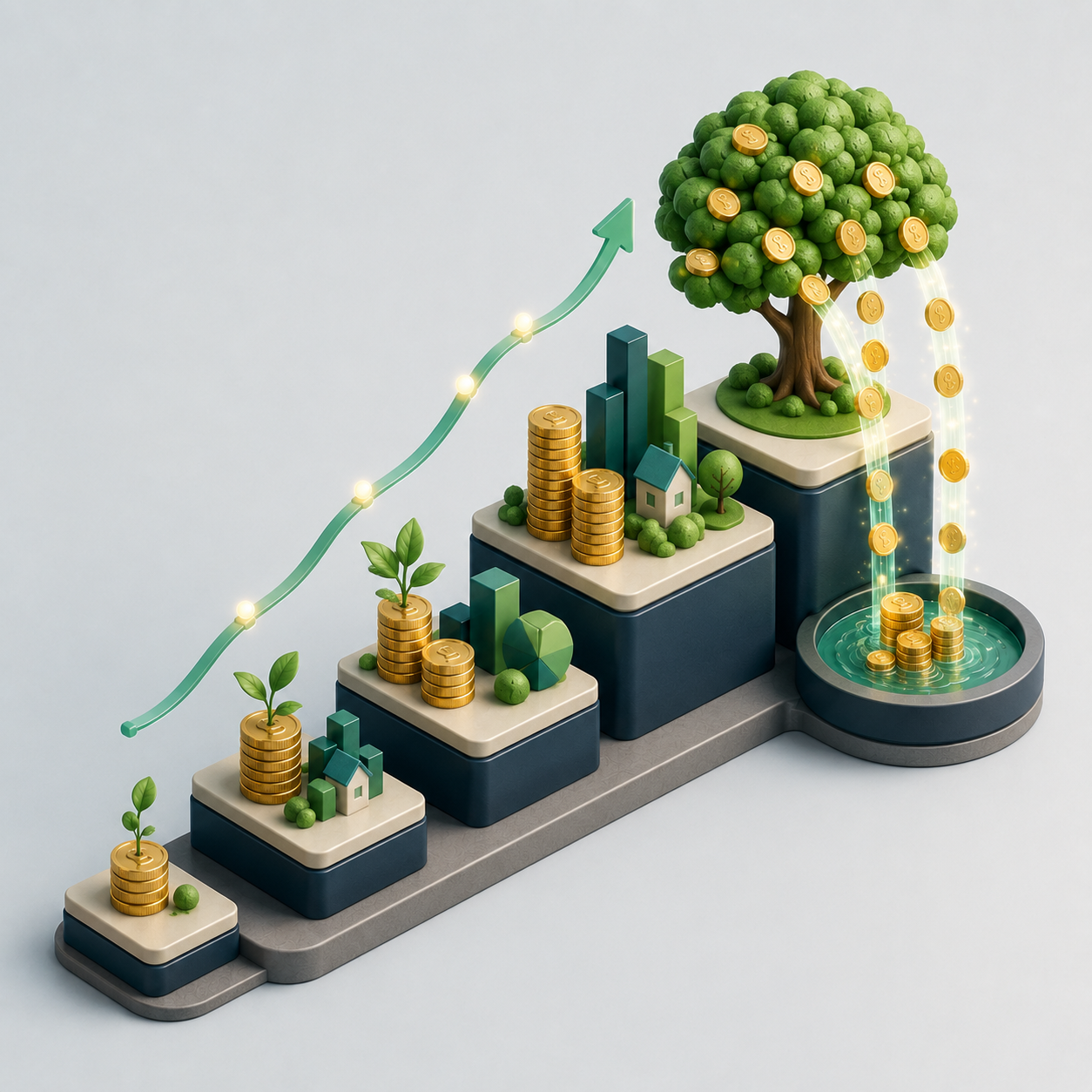
📋 Pricing & Revenue Planning Reference
Read the income-driver, yield, and stage tables alongside capital, diversification, fees, tax treatment, and payout uncertainty. Existing stage ranges and timelines are illustrative planning references, not verified typical outcomes. Yield examples assume the stated rate stays constant; actual payments can differ and may not arrive monthly.
💵 What Dividend Portfolios Can Produce
📊 Income Progression by Stage
🚀 Stage | Portfolio Size | 💰 Typical Monthly Dividend Income | ⏳ Timeline | 📌 What’s Changing |
Beginner | $500–$5,000 | $2–$25/month | 0–6 months | Learning the process and building the habit |
Developing | $5k–$25k | $25–$125/month | 6–18 months | Reinvestment and growing contributions become noticeable |
Established | $25k–$100k | $125–$500/month | 1–5 years | Compounding starts to show up more clearly |
Advanced | $100k–$500k | $500–$2,500/month | 5–15 years | Portfolio size begins to create more noticeable recurring cash flow |
High-Income Portfolio | $500k+ | $2,500+/month | 10+ years | Large capital and patience produce a strong income base |
🎯 KEY TAKEAWAY
The stages describe possible progression, not guaranteed income or a required timeline. Use your own capital or business records to plan realistically.
📊 Key Metrics & Margin Snapshot
📈 Dividend Yield & Total Return (Income Reality)
📊 The 3 Biggest Income Drivers
Factor | Why It Matters |
Capital invested | More invested money creates a larger dividend base |
Yield quality | Higher yield can help, but only if the payout is sustainable |
Time + reinvestment | Compounding is what turns small payments into bigger future income |
🎯 KEY TAKEAWAY
Capital and distributions help explain income, but income growth does not prove a positive total return. Separate new contributions from investment performance.
💸 Dividend Income Planning
🧾 What Different Yields Can Produce on $10,000
Yield | Annual Income | Monthly Equivalent | Note |
2% | $200/year | ~$17/month | Often steadier, lower income |
3% | $300/year | ~$25/month | Balanced starting range |
4% | $400/year | ~$33/month | Common dividend target |
5% | $500/year | ~$42/month | Higher income, more caution needed |
6%+ | $600+/year | $50+/month | Often riskier and needs deeper review |
🎯 KEY TAKEAWAY
These are hypothetical yield calculations, not recommended yields or promised payments. Evaluate the investment’s risks and total-return prospects before considering its income.
🧮 Check Your Investment Income & Returns
Total return includes distributions and changes in investment value.
Track actual cash received separately from projected annual income. Deduct applicable costs and consider taxes when assessing spendable cash. Reinvested distributions remain invested rather than available to spend. Avoid double-counting reinvested dividends when using a tracker that already includes them in total return.
🚀 ACTION STEP
🛡️ Build a Dividend & Portfolio Review Snapshot
Use actual records and a sustainable plan—not projections alone—to decide what to continue.
5. Platforms & Tools to Get Started
🛠 TOOLS & RESOURCES
🏦 Brokerage Platforms (Where to Buy)
🏛️ Platform | 🎯 Best For | 💸 Fees | 💰 Minimum | 📝 Detailed Features & Notes |
🟢 Fidelity | All-around best | $0 trades | $0 | Industry Leaders: Offers excellent market research | Fractional shares (Stocks by the Slice starting at $1) | Industry-leading customer service. | A major hidden perk is that uninvested cash is automatically swept into a high-yield money market fund (SPAXX). |
Long-term investors | $0 trades | $0 | Dividend investing: Strong ecosystem, including the SCHD ETF | Trading: Integrated thinkorswim platform | Checking: Unlimited global ATM fee rebates | |
🔴 Vanguard | Buy-and-hold investors | $0 trades | $0 | Index investing: Low-cost mutual funds such as VTSAX and a retirement focus | Interface: Dated compared with newer apps, with less emphasis on active trading |
Beginners, simple UI | $0 trades | $0 | Mobile app: Simple interface and fractional shares | IRA match: 1%, or 3% with Robinhood Gold at $6.99/month | Limitations: Fewer research tools and fixed-income choices | |
🟣 E*TRADE | Active/Options traders | $0 trades | $0 | Ownership: Morgan Stanley | Options trading: Power E*TRADE offers tools for analyzing and executing complex strategies |
Automated investing | $0 trades | $100 | Pie Portfolios: Deposits automatically buy fractional shares toward target allocations | Fee: $3/month when the total account balance is under $10,000 | |
📈 Webull | Active mobile traders | $0 trades | $0 | Charting: Advanced mobile indicators and Level 2 market data | Practice: Paper trading simulator | Promotions: Free-stock offers for new accounts |
🌟 Recommendation for Beginners: Fidelity or Charles Schwab (These two offer the best combination of zero-commission trading, fractional shares, industry-leading research, and excellent customer support).
🤖 Automatic Investing Programs
⚙️ Program | 🧠 How It Works | 🏦 Available At |
💧 DRIPs (Dividend Reinvestment Plans) | Automatically uses your cash dividends to buy fractional shares of the stock that paid them. | Almost all major brokerages (Fidelity, Schwab, Vanguard). |
🤖 Robo-Advisors | AI automatically builds, rebalances, and tax-loss harvests a dividend/growth portfolio for you. | Betterment, Wealthfront (Usually $0 minimums, ~0.25% management fee). |
🔄 Recurring Investments | Set a schedule to automatically pull $X from your bank and invest it into specific stocks/ETFs weekly or monthly. | Most major brokerages (Fidelity, Robinhood, M1 Finance). |
🔍 Dividend Screening & Research
🔎 Tool | 🎯 Purpose | 💰 Cost | 📝 Notes |
Stock analysis & Quant ratings | Free tier (Premium is ~$239/yr) | Industry standard for reading articles, checking dividend safety grades, and seeing payout history. | |
🗺️ Finviz | Stock screener & Heatmaps | Free (Elite available) | Best free screener on the web. You can filter thousands of stocks by dividend yield, P/E ratio, and sector. |
Dividend specific data | Free (Premium available) | Great for quickly checking consecutive years of dividend growth (to find Dividend Aristocrats). |
📊 Investment Tracking & Wealth Tools
🛠️ Tool | 🎯 Purpose | 💰 Cost | 🌟 Best For |
📈 Empower (formerly Personal Capital) | Wealth management, net worth tracking | Free | Comprehensive portfolio overview and retirement planning. |
Budgeting + Investments | ~$99/year | The premium standard for budgeting since Mint shut down. | |
Budgeting + Subscriptions | Free (Premium available) | Beginners focused on budgeting who also want to link investments. | |
Dividend tracking, tax reports | Free to ~$31/mo | Serious dividend investors who need accurate annualized return data. | |
Dividend calendar (App) | Free (Pro available) | Tracking precise ex-dividend and payment dates on mobile. |
6. Where to Find Investment Opportunities
Compare investment types by diversification, fees, risk, income quality, and time horizon. Start with a simple structure you understand, then expand only when each holding has a clear role.
📈 Brokerage Platforms for Buying Investments
Brokerage platforms are your gateway to investing. This is where you buy dividend stocks, dividend ETFs, REITs, bonds, and other income-producing investments.
Platform | Best For | Why Investors Like It |
Beginners to advanced investors | Strong research tools, fractional shares, retirement accounts, customer support | |
Long-term investors | Strong education, research tools, and access to popular ETFs | |
Passive investors | Known for low-cost index funds and long-term investing | |
New mobile-first investors | Simple app interface and easy account setup |
🔎 What to Look For in a Brokerage
- 💸 Low or no trading commissions
- 🧩 Fractional shares
- 🔁 Dividend reinvestment options
- 🏦 Retirement account options
- 🔍 Research tools
- 📱 Easy-to-use interface
- 🤝 Good customer support
- 📈 Long-term investing features
💡 PRO TIP
Fidelity and Charles Schwab are strong starting options because they balance simplicity, research tools, education, and long-term investing features.
🧠 Dividend Stocks for Direct Company Ownership
Dividend stocks are shares of companies that regularly distribute part of their profits to shareholders through cash payments called dividends.
🔎 Where to Find Quality Dividend Stocks
Look for companies with a long history of paying and raising dividends.
🗂️ Common Dividend Stock Categories
Category | Meaning |
Dividend Aristocrats | Companies that have raised dividends for 25+ consecutive years |
Dividend Kings | Companies that have raised dividends for 50+ consecutive years |
Blue-Chip Dividend Stocks | Large, established companies with strong brands and long operating history |
Dividend Growth Stocks | Companies that may have lower starting yields but strong dividend growth over time |
💡 Popular Examples
- The Coca-Cola Company
- Johnson & Johnson
- Procter & Gamble
- PepsiCo
- McDonald’s
- Walmart
💡 Why Investors Like Dividend Stocks
- Regular income
- Potential stock price growth
- Dividend increases over time
- More control over your portfolio
- Can be part of a long-term income strategy
👀 What to Watch Out For
- High yields can be risky
- Dividends are not guaranteed
- Individual stocks require research
- One company can underperform
- Sector concentration can increase risk
👉 Best For
Investors who want more control, long-term growth potential, and rising dividend income over time.
📊 Dividend ETFs for Diversified Income
Dividend ETFs bundle dozens or hundreds of dividend-paying companies into one investment. This makes them one of the simplest ways to build dividend exposure without picking individual stocks.
📊 Popular Dividend ETFs
ETF | General Focus |
SCHD | High-quality dividend companies with strong fundamentals |
VYM | Broad exposure to dividend-paying stocks |
DGRO | Companies with consistent dividend growth |
JEPI | Higher-income strategy with monthly distributions |
💡 Why Dividend ETFs Are Powerful
- Instant diversification
- Easier than choosing individual stocks
- Lower single-company risk
- Simple portfolio management
- Beginner-friendly
- Can be combined with automatic dividend reinvestment
🎯 Best Use Cases
- Starting a dividend portfolio
- Building long-term income
- Reducing individual stock risk
- Creating a simple “set it and add monthly” strategy
- Learning before buying individual companies
💡 PRO TIP
For most beginners, dividend ETFs are usually the simplest starting point because they reduce the risk of relying on only a few individual companies.
🏢 REITs for Real-Estate Income Exposure
REITs, or Real Estate Investment Trusts, let you invest in income-producing real estate without directly buying houses, apartments, offices, or commercial buildings.
🏢 Popular REIT Categories
REIT Type | What It Invests In |
Retail REITs | Shopping centers, retail properties |
Residential REITs | Apartments and housing communities |
Healthcare REITs | Hospitals, senior housing, medical offices |
Industrial REITs | Warehouses and logistics properties |
Data Center REITs | Data centers and cloud infrastructure |
Self-Storage REITs | Storage facilities |
💡 Popular REIT Examples
💡 Why Investors Use REITs
- Real estate exposure
- Recurring income potential
- Portfolio diversification
- No tenants, repairs, or direct property management
- Often attractive dividend yields
👀 What to Watch Out For
- REITs can be sensitive to interest rates
- Property sectors perform differently
- Dividends can fluctuate
- Higher yield does not always mean better quality
👉 Best For
Investors who want real-estate income exposure without becoming landlords.
📉 Bonds and Income Funds for Stability
Bonds are debt investments where governments, companies, or institutions borrow money and pay interest over time. They are often used to add stability and income to a portfolio.
📜 Common Bond Investments
Investment Type | Description |
Treasury Bonds | Backed by the U.S. government |
Corporate Bonds | Issued by companies; may offer higher yields with more risk |
Municipal Bonds | Issued by state or local governments |
Bond ETFs | Funds that hold many bonds in one investment |
Income Funds | Funds designed to generate regular income |
📜 Popular Bond ETFs
- BND
- AGG
- TLT
- SHY
- IEF
💡 Why Investors Use Bonds
- Portfolio stability
- Lower volatility than stocks
- Predictable interest income
- Risk balancing
- Useful for conservative investors
👀 What to Watch Out For
- Bond prices can fall when interest rates rise
- Corporate bonds have default risk
- Long-term bonds can be more volatile
- Bond income may not grow like dividend income
👉 Best For
Conservative investors, income-focused investors, or anyone trying to balance risk in a dividend portfolio.
🔍 Research and Screening Tools
Research tools help investors evaluate dividend safety, yield, valuation, historical performance, and diversification before buying.
Tool | Best Use |
Stock analysis, earnings insights, dividend research | |
Dividend tracking and payout data | |
ETF, mutual fund, and stock research | |
Backtesting and portfolio analysis | |
Quick stock data, charts, and financial news | |
Stock screening and market snapshots |
🛠️ What to Research Before Buying
- Dividend yield
- Dividend growth history
- Payout ratio
- Revenue and earnings trends
- Debt levels
- Sector exposure
- Historical performance
- Portfolio overlap
- Expense ratio for ETFs
- Long-term income potential
⚠️ Avoid Chasing Yield
A very high dividend yield can sometimes be a warning sign. It may mean the stock price has fallen sharply or the dividend may not be sustainable.
⚠️ Key Warning
The goal is not to find the highest yield. The goal is to find investments that can keep paying and potentially growing income over time.
🎯 Build a Simple Beginner Investment System
The goal is to build a portfolio that can generate consistent income over years or decades, not to chase quick returns.
🗺️ Beginner Roadmap
- Open a brokerage account
- Choose 1–2 beginner-friendly dividend ETFs
- Turn on automatic dividend reinvestment if it fits your goals
- Contribute consistently every month
- Learn how to evaluate dividend safety
- Add individual dividend stocks later
- Use REITs or bonds for diversification when appropriate
- Track income growth over time
🛡️ Beginner Portfolio Building Blocks
Investment Type | Role in Portfolio |
Dividend ETFs | Simple diversified income foundation |
Dividend Stocks | More control and dividend growth potential |
REITs | Real estate income exposure |
Bonds / Bond ETFs | Stability and predictable income |
Cash Reserve | Safety for emergencies and opportunities |
🧠 Important Mindset
The best dividend portfolios are built through:
- Not chasing unsustainable yields
- Diversifying across companies and sectors
- Avoiding emotional investing
- Reinvesting dividends
- Long-term compounding
- Consistency
- Patience
📈 Simple Growth Path
Open Brokerage → Buy Dividend ETF → Reinvest Dividends → Contribute Monthly → Add Stocks/REITs Later → Track Income Growth
🎯 KEY TAKEAWAY
The most successful dividend investors focus less on “getting rich quickly” and more on building reliable income steadily over time.
7. From Foundation to Repeatable Investing
Opening an account is only the beginning. The real job is to turn spare cash into a plan you can fund without using money you need soon—and without treating dividends as a paycheck.
Use the seven tabs in order for your first setup, then return to the phase you need. Build a process you can sustain; opening an account or receiving a dividend is not proof of investment success.
🛡️ PHASE 1 — Protect Your Financial Foundation
📋 Steps 1–3: Check essential expenses, accessible savings, high-interest debt, and the cash you can leave invested.
✅ Ready to move on: You have separated near-term money and written an affordable contribution; waiting is valid if the foundation is not ready.
🛡️ Step 1: Keep Near-Term Money Out of the Market
Decide whether the cash is actually available for a long-term investment. Rent, groceries, emergency costs, and bills due soon should not depend on a stock price.
Before you shop for a dividend fund:
🏦 Set a Cash Buffer You Can Reach
Investor.gov treats savings as the place for short-term needs and emergency funds, and investing as money you put into assets with the expectation of a return—and with risk. Markets fluctuate, and individual investments may lose value. [1]
Some investors keep up to several months of income in savings so the money is there if they need it. That is a planning range, not a rule for every household. [2]
⚠️ Common Mistake: Treating Yield as a Paycheck
⚠ COMMON MISTAKE
Investing this month’s rent because a yield looks like a paycheck. A distribution is not a substitute for an emergency fund.
💳 Step 2: Treat High-Interest Debt as Part of the Plan
If you carry balances that charge more than you can reasonably expect from a diversified portfolio, paying them down can matter more than buying another income fund. Investor.gov notes that unpaid credit-card interest can greatly exceed what you might earn on savings or investments. [1]
This is not a command to freeze all investing. It is a reminder that a 4% yield does not cancel 20% interest.
✍️ Step 3: Write an Affordable Contribution—Not a Target Income
Choose an amount that still works after essentials, savings, and debt payments. Do not reverse-engineer a monthly dividend goal and then stretch to fund it.
The first investing decision is not what to buy. It is how much money you can leave invested if prices fall and distributions shrink.
🚀 Your First 3 Suitable Contributions
🚀 ACTION STEP
Complete these only with money you can leave invested.
- Foundation: Confirm the cash buffer, debt picture, goal, and account type in writing.
- Research: Read the prospectus or company disclosures for one diversified holding that fits the plan. Buy only that role.
- Record: Log the contribution, fees, and any distribution separately from market value. Set the next review date.
Three careful contributions teach more than a watchlist of 40 stocks. A dividend credit is not proof you should pick individual companies or go all-in. These are process checkpoints, not a requirement to make three purchases or a promise of results.
🎯 PHASE 2 — Define the Goal and Set Up the Account
📋 Steps 4–7: Match purpose, horizon, risk tolerance, and account rules before selecting holdings.
✅ Ready to move on: Your goal is written, the account fits your circumstances, and its terms and security settings are understood.
🎯 Step 4: Name the Goal, Horizon, and Risk You Can Live With
Do not start with “which dividend stock.” Start with what the money is for.
Write down:
- Purpose (retirement, long-term wealth, later cash flow)
- When you might need the money
- How much decline you could tolerate without selling
- How often you can add cash
⏳ Match the Tools to the Timeframe
Money needed in a few years is not the same as money for decades. Short-term needs often belong in lower-volatility savings or cash-like options, not in a concentrated stock bet. [1]
A long horizon does not make a holding safe. It only gives you more time to recover if you can stay invested. Recovery is not guaranteed.
🏦 Step 5: Choose the Account Before the Holding
The wrapper can change taxes, withdrawal rules, and what you can buy.
Compare, for your situation:
- Taxable brokerage vs. workplace retirement plan vs. IRA or similar
- Eligibility and contribution limits
- When you can take money out, and at what cost
- Account fees and available investments
📌 Check Account Rules Before Comparing Platforms
Workplace plans and IRAs can be useful building blocks, with different tax rules and yearly limits. Do not pick an account because a video called it “the best.” Use Chapter 5 to compare platforms after you know the account type. [1]
An IRA is a U.S. individual retirement account; use the account options and current rules that apply where you live.
💵 Step 6: Choose a Cash Account Unless You Understand Borrowing
A cash brokerage account requires you to pay the full amount for purchases. A margin account lets the firm lend you money, using the account as collateral. Borrowing to buy securities adds risk you may not want as a beginner. [3]
If you do not have a specific, understood reason to use margin, keep the first account as a cash account.
🔐 Step 7: Open, Verify, and Secure the Account You Chose
Use the brokerage’s official site or app and confirm the firm through your jurisdiction’s regulator before sharing sensitive information.
- Complete the required identity, eligibility, and account-type checks.
- Review fees, investment access, withdrawal rules, and the uninvested-cash arrangement.
- Confirm whether borrowing or optional trading features are enabled; do not accept features you do not understand.
- Use a unique password and available multi-factor authentication.
- Link your own funding account through the official process and confirm setup before transferring money.
Keep account numbers, identity documents, and login details out of any public tracker. Save account terms privately.
🧺 PHASE 3 — Give Every Holding a Clear Role
📋 Steps 8–10: Build around portfolio roles, examine the underlying holdings, and write risk limits before browsing investments.
✅ Ready to move on: You can explain the intended mix, spot overlap, and identify your concentration and yield-chasing guardrails.
🧺 Step 8: Choose a Structure You Can Explain in One Sentence
Build the portfolio around roles, not ticker collecting. A ticker is an investment’s trading symbol.
A beginner structure often starts with diversified funds, then adds other roles only when needed:
- A broad stock-market fund for long-term growth exposure
- A dividend-oriented fund if income is a stated goal
- Bond or cash holdings if you need a different risk mix
- Individual stocks or REITs only if you can research them
No named security is recommended here. Fit the mix to your horizon and risk—not to a social-media “core portfolio.”
⚖️ Step 9: Diversify by Holdings, Not Just Ticker Count
Asset allocation splits money among stocks, bonds, and cash. Diversification means not putting all your eggs in one basket: if one investment loses money, others may offset some of the loss. It cannot guarantee you will not lose money in a market drop. [1]
Many ETFs hold a range of companies, which can lower single-company risk. Some ETFs are still narrow, and some even track a single stock. Read the holdings. [4]
🔎 Check Each Position’s Role and Overlap
Before you add a position, answer:
- What role does it play?
- What does it actually hold?
- How much of the portfolio will it be?
- Do I already own the same companies through another fund?
📝 Step 10: Set Concentration and Yield Limits Before You Shop
Write the rules while you are calm.
Write limits you can review later:
- The maximum exposure you will allow to a company, sector, or narrow fund, based on your situation.
- How you will review overlapping holdings before adding another position.
- A rule to investigate an unusually high yield rather than treating it as a buy signal.
Do not adopt an arbitrary percentage or yield target from a list. Record a suitable rule or seek qualified advice if unsure.
🧪 Example: A Written Fund-First Plan
📋 REAL-WORLD EXAMPLE
“I am investing for long-term accumulation, not this year’s bills. After essentials and a cash reserve, I can contribute a set amount each payday to a cash brokerage or retirement account I qualify for. I will use a diversified fund-first mix I can explain, reinvest distributions while I am accumulating, and review allocation, costs, and actual cash received on a schedule—not after every price move. I will not buy a holding because the yield is high or because it was on a list.”
🔍 PHASE 4 — Check Risks, Costs, and Distribution Quality
📋 Steps 11–14: Use disclosures rather than rankings to understand what you would own, what it costs, and where distributions come from.
✅ Ready to move on: You can explain the holding, its main risks and costs, and why it fits; otherwise you have chosen to wait.
📖 Step 11: Read the Holding, Not the Headline Yield
Never buy solely because of a high yield, a rising price, a “best stocks” list, or a social post.
A prospectus is a fund’s official disclosure document.
- For a fund: Read its objective, holdings, concentration, risks, expense ratio, and distribution policy. The expense ratio is the fund’s annual operating-cost percentage.
- For a company: Understand the business, cash flow, debt, and whether the dividend is optional—not owed to you.
⚠️ Remember That Funds and Payouts Can Lose Value
⚠️ RISK CHECK
ETFs are not guaranteed or insured by the FDIC. You can lose money. Dividends or interest can change with market conditions. Past performance does not predict future returns. [4]
🧾 Step 12: Compare the Full Cost of the Investment
Fees and expenses reduce returns. A higher-cost fund must outperform a lower-cost fund just to leave you even. Compare the prospectus fee table, and remember brokerage commissions may sit outside that table. [5]
💧 Step 13: Check Where the Distribution Comes From
Fund distributions are not guaranteed. A fund can pay a distribution and still lose money. Some payouts include return of capital—giving you back your own money—which can look like income. Distributions are not the same as performance; total return is the fuller picture. [6]
🚩 Common Mistake: Choosing the Highest Yield
⚠ COMMON MISTAKE
Choosing the highest yield on a screener. A large payout can mean the price already fell, the fund is returning capital, or the dividend may not last.
🛑 Step 14: Pass When You Cannot Explain the Risk
If you cannot say what you own, why it might fall, and how you would get your money back, wait. Passing is an investing decision.
Before buying, write a short research note:
- What I own and why it fits my plan.
- What could reduce its value or distributions.
- Costs, liquidity, and how I could sell or withdraw under the account’s rules.
- The disclosures I reviewed and any unanswered questions.
An unanswered material question means more research—not a rushed order.
💰 PHASE 5 — Make and Verify Planned Contributions
📋 Steps 15–18: Transfer only affordable money, check the purchase, decide how to handle distributions, and automate a tested process if suitable.
✅ Ready to move on: The actual purchase status is confirmed, the distribution setting matches your plan, and any automation has been checked.
💰 Step 15: Fund Only the Amount in the Written Plan
Transfer the contribution you already decided you can afford. A deposit is your money moving into the account. It is not profit, not a dividend, and not proof the strategy works.
Skip a month if the budget is tight. Do not use a credit card, margin, or bill money to “stay consistent.”
🛒 Step 16: Check, Submit, and Verify the Planned Purchase
A transfer puts cash into the account; it does not necessarily buy an investment. Follow the brokerage’s purchase process only after the holding passes your research checks.
- Confirm available trading cash and any deposit restrictions.
- Match the full investment name and trading symbol—not just a similar abbreviation.
- Check the account, purchase amount or share quantity, fees, and supported fractional-share rules.
- Read the selected order type and execution conditions; use the broker’s explanation if unclear.
- Review the order preview against your written plan before submitting.
- Check whether it filled, remains open, was rejected, or was cancelled. Save the actual execution confirmation; do not duplicate an uncertain order.
If any detail is unexpected, pause and clarify with the broker before proceeding.
🔁 Step 17: Decide What Happens to Distributions
You can generally reinvest (buy more shares) or keep cash.
Reinvestment can help a position grow if the investment itself does well. It does not remove market risk, and payouts can change. In a taxable account, reinvested distributions may still be taxable. Confirm the tax treatment for your account. [6]
Write a default rule, for example:
“While I am accumulating, I will reinvest distributions unless my written plan changes.”
A DRIP (dividend reinvestment plan) uses a distribution to buy additional shares where supported. Confirm the setting for each relevant holding.
🤖 Step 18: Automate Only After You Understand the Trade
Recurring transfers, recurring buys, and dividend reinvestment can reduce skipped months. Automate a plan you have already researched—not a ticker you have not read.
- Set transfers and purchases separately where the platform requires it.
- Keep the amount and timing aligned with the affordable contribution you wrote down.
- Check the first scheduled transfer, purchase, and any reinvestment actually occurred as intended.
- Pause or adjust automation when your budget or plan changes.
Automation does not replace research or make an unaffordable contribution suitable.
💡 Pro Tip: Learn the Manual Process First
💡 PRO TIP
Turn automation on after the first manual contribution, so you have seen the order, the cash sweep, and the confirmation.
📊 PHASE 6 — Track Actual Cash and the Complete Portfolio
📋 Steps 19–21: Record deposits, market value, distributions, reinvestment, allocation, and costs without confusing contributions with returns.
✅ Ready to move on: Your tracker distinguishes actual cash from forecasts and new deposits from investment performance; your private plan has a review date.
📊 Step 19: Separate Contributions From Returns
Track the complete picture, not only the dividend line.
Field | What to record |
Contributions | Your deposits and withdrawals |
Value | Current market value |
Cash received | Distributions actually paid |
Reinvested | Income kept invested |
Allocation | Mix and largest positions |
Costs | Account, fund, and trading fees |
Fit | Still matches the written plan? |
Total return includes distributions and changes in value. Do not double-count reinvested dividends if your report already includes them.
🧮 Step 20: Label Projected Monthly Income as an Estimate
Actual income is cash that already arrived. A “monthly equivalent” of an annual yield is arithmetic, not a promised paycheck. Distribution rates change, and prices can fall by more than you received.
When a fund pays a distribution, NAV (net asset value—the fund’s per-share asset value) typically drops by about that amount. That transfer is not automatically a loss—or a gain. [6]
🗒️ Step 21: Keep a Private One-Page Plan
Update the private page when the plan changes, not when the market is noisy:
- Goal and time horizon
- Contribution amount and schedule
- Account type
- Portfolio roles
- Distribution rule
- Review date
- Risk limits (yield-chasing, concentration, near-term cash)
📅 PHASE 7 — Maintain and Improve the Plan
📋 Steps 22–24: Review affordability, holding quality, concentration, and records; decide what to continue, adjust, research, or stop.
✅ Done when: You have made a documented decision, chosen one improvement if needed, and set the next review—not chased a higher yield.
📅 Step 22: Review the Process, Not Four-Week Prices
A falling price is not, by itself, a reason to scrap the plan. More useful review triggers:
- Your goal or horizon changed.
- You need the money sooner.
- Concentration drifted.
- Fees or the investment strategy changed.
- A dividend was cut.
- You no longer understand the holding.
Plan → invest → record → review on a schedule. Do not run Market drop → panic sell → buy back after it rises.
Use your scheduled review and meaningful changes—not every price move—to decide whether the plan still fits.
🔧 Step 23: Improve One Variable After Each Review
Ask:
- Was the contribution still affordable?
- Did I buy something I cannot explain?
- Are contributions mixed up with returns?
- Is one holding or sector too large?
- Did I react to a headline?
🎛️ Choose One Considered Adjustment
Then change one thing:
- Lower the contribution
- Widen diversification
- Tighten the yield rule
- Pause new tickers
- Get qualified advice
Do not respond to a quiet month of dividends by concentrating in a higher yield.
✅ Step 24: Decide What to Repeat—and What to Stop
If this is true | Do this |
✅ The money is long-term, the holding fits, and you understand the risks | Continue. Repeat the contribution. |
🛠️ The plan fits, but fees, overlap, or record-keeping are messy | Adjust. Change one variable. |
➕ You want individual stocks, REITs, or a new account type | Re-scope. Research first; do not add complexity to chase yield. |
❌ You need the cash soon, do not understand the holding, or are stretching the budget | Stop or keep it in savings. Walking away is a valid decision. |
🔄 Repeat Your Investing Workflow
🚀 ACTION STEP
Use the same cycle for every contribution:
Check Foundation → Define Goal → Choose Account → Research → Diversify → Invest → Record → Review
After your next contribution, fill in the private tracker, choose one improvement, and make a continue / adjust / re-scope / stop decision before you add another holding.
🎯 Keep the Goal Clear
🎯 KEY TAKEAWAY
Your goal is not:
“Collect the highest yield on the screener.”
It is:
“Build a plan you can still follow when prices fall and dividends look boring.”
A dependable investor does not buy every high yield. They invest money they can leave invested, understand what they own, and let a written plan—not a ticker list—decide the next contribution.
⭐ ADVANCED STRATEGY
Keep one private set of templates:
The purpose is not extra paperwork. It is to stop rebuilding the same quality process from memory every time a yield looks exciting.
⚠️ Educational Note
⚠️ EDUCATIONAL NOTE
Investing involves risk, including possible loss of principal. Dividends and other distributions are not guaranteed. Account rules and tax treatment vary. This chapter does not recommend any security, strategy, or account for you. Consider qualified financial or tax advice before acting.
8. Build Trust & Improve Results
Use this section to build trust in your process, document your portfolio, stay honest with yourself, review like a professional, automate good habits, choose an allocation you can hold, and avoid the mistakes that cost new dividend investors money, income, and peace of mind. Chapter 7 walks you through the repeatable investing workflow; this chapter helps you stay disciplined, measure what matters, and keep improving. This is educational content, not financial advice. Investing involves risk, including loss of principal, and dividends are not guaranteed.
⭐ ADVANCED STRATEGY
1️⃣ Build Proof Before You Invest Real Money 📁
Non-negotiable
There is no client to vouch for you and no guarantee that any holding will pay. Before you add real money, show yourself that your foundation is solid, your plan is written, and you can follow it when prices move.
🛡️ Why Proof Builds Trust
You need evidence that your process works, not just excitement about a yield.
Why this matters:
- Markets move up and down, and you will see losses at times
- A written plan is easier to follow than memory when prices fall
- Dividends can be reduced or eliminated
- A small, tracked start shows whether the habit is sustainable
- Clear records make later decisions calmer
☑️ Minimum Foundation Checklist
- Essential expenses covered and an emergency fund started or planned
- High-interest debt under control
- A written goal, time horizon, and risk tolerance
- An account type chosen before any holding
- One diversified holding you can explain in a sentence
- A private tracker for deposits, distributions, and costs
- A review date on the calendar
- Money you can leave invested if prices fall
🛡️ How to Create Proof Before You Invest Real Money
🏠 Option 1: Use What You Already Have
Start with the financial habits you already practice.
What to do:
- Review monthly income and expenses
- List current savings, debts, and near-term bills
- Decide how much you could leave invested without stress
- Write down your goal and time horizon
- Remove any money you may need soon from the plan
📝 Option 2: Practice on Paper First
Run a watchlist or paper portfolio as if real money were involved.
What to do:
- Pick 3–5 diversified funds or stocks to follow, with a written role for each
- Record a hypothetical contribution on a set date
- Track distributions, costs, and value changes for several weeks
- Label everything as practice
- Review whether you stayed within your own rules
🎁 Option 3: Make a Small First Contribution
Use a modest, affordable amount to learn how deposits, orders, and distributions work.
What to do:
- Choose an amount you can leave invested even if it falls in value
- Use fractional shares if your platform supports them
- Save the confirmation and record the contribution
- Keep the process the same as you will use later
- Increase contributions only if your budget allows
💡 PRO TIP
Starting small is a way to learn the process, not a way to prove a strategy. Judge your first contributions on whether you followed your plan, not on short-term price moves.
🤝 Option 4: Learn With Others
People who also invest can help you learn, but they are not your advisor.
What to do:
- Join a beginner community and ask questions
- Find an accountability partner for monthly check-ins
- Read official investor-education resources
- Seek qualified financial or tax advice for personal decisions
Avoid:
- Buying because of a social media post or list
- Sharing account numbers or login details
- Borrowing money to invest
2️⃣ Track and Document Your Portfolio 🗂️
🖼️ What to Include in Your Portfolio Tracker
What to Track | What It Shows |
Contributions and withdrawals | How much of your own money went in and out |
Current market value | What the holdings are worth now |
Cash distributions received | Income that actually arrived, not forecasts |
Reinvested amounts | Income kept invested |
Allocation and largest positions | Whether the mix still matches your plan |
Fees and costs | What the account and funds cost you |
Fit with your plan | Whether each holding still has a clear role |
Keep it tight:
- Update it on a set schedule, not after every price move
- Label projected annual income and monthly equivalents as estimates
- Do not double-count reinvested dividends
- Save actual confirmations of purchases and distributions
🛡️ Where to Keep Your Records
Place | Best For |
Private Notion page or spreadsheet | One home for your plan, log, and review notes |
Brokerage statements and confirmations | Official records of trades, distributions, and fees |
Portfolio tracker app | Viewing holdings, allocation, and dividend dates (see Chapter 5) |
Tax records folder | Year-end tax forms and cost-basis information |
Private one-page plan | Goal, schedule, roles, rules, and review date |
Protect your privacy:
- Keep account numbers, identity documents, and logins out of any shared page
- Use a unique password and multi-factor authentication
- Share a tracker only after removing sensitive details
- Back up important records
💡 PRO TIP
Total return includes distributions and changes in value. Keep contributions separate from returns so new deposits are never mistaken for investment gains.
3️⃣ Be Recognizable and Honest ✨
Trust is built by what you can write down, repeat, and verify.
🎨 Make Your Strategy Instantly Recognizable
- Write your strategy in one sentence, such as “Diversified funds first, reinvest distributions, review on a schedule”
- Give every holding a clear role
- Use the same tracker format every month
- Name your accounts and files consistently
- Describe what a holding does for the portfolio, not just its yield
Why it works:
- You can explain the plan to yourself in seconds
- A clear structure makes it easier to spot overlap
- Consistent records reduce emotional decisions
🧱 Core Principles
- Start now, even small: Time in the market often matters more than perfect timing, though results are never guaranteed
- Diversify across sectors: Avoid putting all money in one industry; funds can make this easier
- Reinvest at first: Reinvested distributions can buy more shares while you build, but market risk remains
- Look at dividend growth, not just yield: A high yield can be a warning sign; check whether payouts look sustainable
- Avoid “yield traps”: Unusually high yields often signal risk
🤝 Be Honest With Yourself
Do:
- State your goal, horizon, and risk tolerance in writing
- Admit when you do not understand a holding
- Separate contributions from returns
- Label projections as estimates
- Seek qualified advice for personal decisions
Avoid:
- Treating yield as a paycheck
- Assuming dividends or principal are guaranteed
- Hiding losses by changing your tracker
🔐 Keep Your Plan Private and Secure
Do:
- Use official brokerage sites and apps
- Confirm a firm through your regulator before sharing sensitive information
- Use a unique password and multi-factor authentication
- Be cautious with unsolicited tips and “guaranteed” returns
Avoid:
- Posting account numbers or screenshots with personal details
- Following anyone who promises high returns without risk
- Giving anyone access to your accounts you do not fully trust
4️⃣ Act Like a Disciplined Investor 💼
Disciplined investors treat their plan like a process, not a mood.
💬 Clear, Prompt Record-Keeping
Do:
- Log each deposit, purchase, and distribution when it happens
- Read order previews and confirmations carefully
- Ask your broker or a qualified professional when something is unclear
- Keep all agreements and account terms saved privately
- Verify that automation actually ran as intended
Avoid:
- Trading from a notification or headline
- Duplicating an uncertain order
- Ignoring fees, tax forms, or account statements
- Making changes without updating your plan
🔁 Handling Market Drops & Surprises
Do:
- Re-read your written plan before taking any action
- Check whether your goal, horizon, or finances changed
- Keep contributing only if it is still affordable
- Review whether a dividend was cut or a holding changed
- Wait before acting on fear or excitement
Prevent problems by:
- Keeping emergency money separate
- Setting rules while you are calm
- Avoiding panic selling and market timing
🟢 Follow a Review Rhythm
When | What to Do |
Each contribution | Confirm the purchase filled, save the confirmation, log the amount |
Monthly | Review income, expenses, contribution, and tracker; check cash distributions |
Quarterly | Check holdings, allocation, concentration, costs, and dividend changes |
Annually | Rebalance if needed, review goals and risk tolerance, gather tax records |
After a life change | Revisit goal, horizon, emergency fund, and contribution amount |
⏱ Keep Reviews Calm and Consistent
- Use a fixed day for your monthly check-in
- Review the process, not four-week returns
- Record one improvement after each review
- Update your plan when your life changes, not when headlines change
- Stay realistic: dividend income grows slowly at first
📝 QUICK NOTE
A scheduled review beats constant checking. Frequent price-watching tends to invite emotional decisions.
5️⃣ Plan & Review Templates 📝
📝 One-Page Investment Plan Template
Create this before your first contribution and update it only when your situation changes:
Do not invest until the goal, affordable amount, and account type are written down.
✅ Monthly Check-In Template
Use this once a month to record what actually happened:
Monthly Check-In

Date: [date]
Contribution made: [amount]
Holdings purchased: [name, amount, fees]
Distributions received: [cash / reinvested]
Total value: [amount]
Allocation notes: [largest positions, overlap]
Costs this month: [account, fund, trading]
Did I follow my plan? [yes / no, why]
One improvement for next month: [change]
Keep the log private and save it with your brokerage records.
🔍 Pre-Purchase Research Note
Fill this in before buying any new holding:
Pre-Purchase Research Note

Holding: [full name and trading symbol]
Role in my plan: [why it fits]
What it owns: [holdings, concentration]
Costs: [expense ratio, fees, liquidity]
Distribution source: [earnings / return of
capital / interest]
Main risks: [what could reduce value or payouts]
Disclosures reviewed: [prospectus / filings]
Unanswered questions: [list]
Decision: [buy / wait / pass]
📅 Quarterly Review Template
Use this to review the process, not just the price:
Quarterly Review

Date: [date]
Goal or horizon changed? [yes / no]
Emergency fund and bills covered? [yes / no]
Largest position: [name, % of portfolio]
Overlapping holdings: [list]
Dividend cuts or changes: [list]
Fees changed: [list]
Decision: [continue / adjust / re-scope / stop]
Next review: [date]
☑️ What Your Plan Should Cover
- Purpose, time horizon, and risk tolerance
- How much you can afford to invest and how often
- Which account type you will use and why
- The role of each holding and its costs
- How distributions are handled (reinvest or cash)
- Concentration, yield, and near-term cash limits
- When you will review and who you may consult
- A note that returns and dividends are not guaranteed
📌 Use Your Templates Every Time
- Save each template in your notes app or Notion
- Fill in the brackets, then read the page back before acting
- Update the plan after each review
- Keep actual confirmations, not just screenshots
💡 PRO TIP
Write the rules while you are calm. A template you filled in last month is easier to trust than a feeling you have today.
6️⃣ Habit & Automation Mastery 🔁
Good intentions fade. Systems keep you consistent when markets get loud.
🪝 Triggers That Create Good Habits
Trigger | Habit or Rule |
Payday | Transfer the planned contribution before discretionary spending |
Distribution arrives | Log it and apply your written reinvest or cash rule |
Exciting yield or tip | Run your research note before anything else |
Market drop headline | Re-read your plan; act only through a scheduled review |
Quarter-end | Take an allocation snapshot and check costs |
Major life change | Revisit goal, horizon, and emergency fund |
🧠 Habit Tactics That Work
🔁 Automate carefully
- Recurring transfers, recurring buys, and reinvestment can reduce skipped months
- Make the first contribution manually so you understand each step
- Confirm the first automated run actually occurred
- Pause or adjust automation when your budget changes
🧘 Reduce noise
- Check prices less often
- Mute stock tips and “best yield” lists
- Review on a fixed schedule instead
📅 Use Dollar-Cost Averaging
- Invest the same affordable amount on a regular schedule
- It can remove some emotion from timing decisions
- It does not guarantee a profit or prevent loss
📚 Keep Learning in Small Pieces
- Learn one concept a month, such as fees or payout ratios
- Read fund disclosures before buying
- Revisit your plan when your knowledge improves
🤝 Add Accountability
- Share your process, not your account details, with a partner
- Review your plan together on a set date
- Seek qualified advice for personal tax and planning questions
🚀 ACTION STEP
Pick one trigger from the table, write the rule in your plan this week, and add the next review date to your calendar.
7️⃣ Portfolio Quality Checklist ✅
Quality control is part of investing. It protects your capital and reduces regret.
☑️ Portfolio Quality Checklist
Check | What to Verify |
Role | The holding has a clear job in your plan |
Diversification | You know what the fund or company actually holds and where positions overlap |
Concentration | No single company, sector, or narrow fund is larger than your own limit |
Costs | Expense ratio, fees, and trading costs are understood |
Distribution source | Payouts come from sustainable earnings, not just return of capital |
Yield sanity | An unusually high yield has been investigated, not treated as a buy signal |
Account fit | The account type, taxes, and withdrawal rules suit the goal |
Cash buffer | Emergency money and near-term bills are covered separately |
Records | Contribution, confirmation, and distribution are logged |
🔍 Pre-Purchase Review
Before buying, check:
- What you own and why it fits your plan
- What could reduce its value or distributions
- Costs, liquidity, and how you could sell under the account's rules
- The disclosures you reviewed and any unanswered questions
- The order preview against your written plan
Common reasons to pause:
- You cannot explain the risk in a sentence
- The yield is far above comparable investments
- The money may be needed soon
- You are reacting to a headline or social post
- A material question is still unanswered
🧰 The Fundamentals
- Keep emergency money separate from investments
- Diversify across companies, sectors, and asset types
- Reinvest at least initially, if it fits your plan
- Keep costs low and understand fees
- Review on a schedule
- Avoid decisions made from emotion
🔁 Why It Matters
- Dividends can be reduced or eliminated
- Fees and taxes reduce what you keep
- A diversified portfolio can lower single-company risk, though it cannot guarantee against loss
- A written process makes it easier to stay invested through volatility
🛠 TOOLS & RESOURCES
Use the brokerage, research, and tracking tools in Chapters 5 and 6, and keep a reusable checklist in your notes app so you run it before every purchase.
8️⃣ Allocation & Cost Strategy 🎯
The best allocation is the one you understand, can afford, and can hold through volatility.
🎯 Choose a Risk Direction
Risk Profile | Illustrative Mix (from earlier guide) | Best Fit |
Conservative | About 70% bonds or bond funds, 30% dividend stocks | Lower tolerance for swings |
Moderate | About 50% dividend stocks or ETFs, 30% growth, 20% bonds | Balance of income and growth |
Aggressive | About 80% stocks (dividend and growth), 20% alternatives | Long horizon, higher tolerance for loss |
These mixes are illustrations carried over from earlier guidance, not recommendations. Your own allocation should reflect your goal, horizon, and risk tolerance.
🛡️ Set Your Own Guardrails
Guardrail | Example Some Investors Use | Your Number |
Maximum in any single stock | 5% of the portfolio | [set your own] |
Number of holdings | 15–20+ across sectors | [set your own] |
International exposure | 15–30% of the portfolio | [set your own] |
Emergency fund | 3–6 months of expenses | [set your own] |
Money needed within 5 years | Keep out of the market | [set your own] |
Guardrail reminder: Examples are planning references, not rules for every investor. Write numbers that fit your situation, or seek qualified advice.
🎯 How to Build Your Strategy in 5 Steps
1️⃣ Define the Goal and Horizon
Write what the money is for and when you might need it.
2️⃣ Choose the Account First
Compare taxable, retirement, and other accounts before choosing holdings.
3️⃣ Build a Diversified Core
Start with broad, low-cost funds you can explain, then add other roles only if needed.
4️⃣ Control Costs and Taxes
Compare expense ratios and fees. Small annual fees compound; the earlier guide illustrated that a 1% annual fee could leave around 25% less wealth over 30 years. Understand how dividends are taxed in your account.
5️⃣ Rebalance and Review
Check allocation at least annually. If one holding has grown too large, consider trimming it or directing new contributions elsewhere, and watch taxes and costs.
🚀 Advanced Strategies (Use After the Basics)
📅 Dollar-Cost Averaging (DCA)
- Invest the same amount regularly regardless of price
- Can reduce emotional timing decisions
- Does not ensure a profit
🏦 Tax-Advantaged Accounts
- Roth IRA: Qualified withdrawals can be tax-free (rules and eligibility apply)
- Traditional IRA: Tax-deferred, taxed at withdrawal
- Taxable account: Qualified dividends are often taxed at 0–20%
🪜 Dividend Ladder
- Hold investments with different payment months
- Can smooth cash flow across the year
- Does not reduce market or dividend risk
🧾 Tax-Loss Harvesting
- Selling losing positions may offset gains
- Be aware of wash-sale and other rules
- Confirm details with a qualified tax professional
Vague Approach | Specific Approach |
“I want a high dividend” | “I invest [amount] monthly into diversified funds for [goal] and review distributions quarterly” |
“Buy what is trending” | “Every holding has a written role and passes my research note” |
“Check the price every day” | “I review allocation, costs, and distributions on a schedule” |
⭐ ADVANCED STRATEGY
Add advanced tools only after the basics are working: dollar-cost averaging, tax-advantaged accounts, a dividend ladder, and rebalancing. Each adds complexity and none guarantees returns. Consider qualified financial or tax advice before using them.
9️⃣ Common Mistakes: Yield, Diversification & Costs ⚠️
The most expensive mistakes often feel like opportunities.
❌ Chasing High Yields Blindly
The trap: “A 10% yield is better than a 3% yield.”
The reality: 10%+ yields are often red flags. The price may have fallen, the payout may include return of capital, or a cut may be coming.
The fix: Investigate the source and sustainability of a payout. One rule of thumb is a payout ratio under 80%, but ratios vary by sector and business.
❌ Not Diversifying
The trap: “I'll put most of my money in one company I like.”
The reality: Single-company and sector concentration can increase risk, and dividends can be cut.
The fix: Spread money across companies, sectors, and asset types. Read what funds actually hold.
❌ Treating Dividends as Guaranteed
The trap: “This company always pays, so it's like a paycheck.”
The reality: Dividends can be reduced or eliminated, and principal can fall in value.
The fix: Label projections as estimates, track actual cash received, and keep emergency savings separate.
❌ Ignoring Fees and Costs
The trap: “A small fee doesn't matter.”
The reality: Costs compound, and a higher-cost fund must outperform a lower-cost fund just to leave you even.
The fix: Compare expense ratios, account fees, and trading costs before you buy.
⚠ COMMON MISTAKE
Chasing yield, skipping diversification, and ignoring costs all look like income problems but are really planning problems.
🔟 Common Mistakes: Taxes, Emotions & Cash Needs ⚠️
Protecting your capital, your taxes, and your temperament is part of running a durable investing plan.
❌ Panic Selling and Market Timing
The trap: “I'll sell now and buy back when it feels safe.”
The reality: Nobody can consistently predict market movements, and selling after a drop can lock in losses. Price drops still matter if you need to sell, even when a dividend is paid.
The fix: Follow your written plan and review on a schedule. Buying more during a downturn is optional and still carries risk.
❌ Not Rebalancing
The trap: “I'll leave it alone and never look.”
The reality: Portfolios drift over time, and one position can become far larger than you intended.
The fix: Review allocation at least annually and adjust deliberately, keeping taxes and costs in mind.
❌ Ignoring Taxes and Account Rules
The trap: “I'll worry about taxes later.”
The reality: Dividends may be taxed, reinvested dividends can still be taxable in a taxable account, and account rules affect withdrawals.
The fix: Understand qualified versus non-qualified dividends, keep tax records, and seek qualified tax advice.
❌ Investing Money You Need Soon
The trap: “This will pay for next year's expenses.”
The reality: Markets can fall when you need cash. Investing is long-term, not get-rich-quick.
The fix: Keep emergency savings and near-term bills separate, and avoid borrowing to invest.
🚀 ACTION STEP
Save your one-page plan, monthly check-in, and research note as reusable templates this week, then use them for every contribution.
9. Learning, Templates & Resources
🛠 TOOLS & RESOURCES
Investing & Dividend Income brings together risk awareness, diversification, research, and long-term record-keeping. You do not need to master everything at once. Choose resources that help you complete the next practical step.
🎓 Learning (Free & Paid)
Start with one source that fits your current level. Practice what it teaches before collecting more courses or tools.
🎬 Investing Tutorials & YouTube
Use explainers to understand concepts such as dividends, diversification, and total return—not to copy stock picks.
Watch Graham Stephan (YouTube Channel) for tutorials, examples, and practical ideas you can apply to dividend investing.
🟢 Beginner

Watch Humphrey Yang (YouTube Channel) for tutorials, examples, and practical ideas you can apply to dividend investing.
🟢 Beginner
Watch The Plain Bagel (YouTube Channel) for tutorials, examples, and practical ideas you can apply to dividend investing.
🟢 Beginner
Watch Dividend Data (YouTube Channel) for tutorials, examples, and practical ideas you can apply to dividend investing.
🟡 Intermediate
Watch Joseph Carlson (YouTube Channel) for tutorials, examples, and practical ideas you can apply to dividend investing.
🟡 Intermediate
🆓 Free Investing Learning
Build a foundation in risk, costs, account types, and investment disclosures before comparing products.
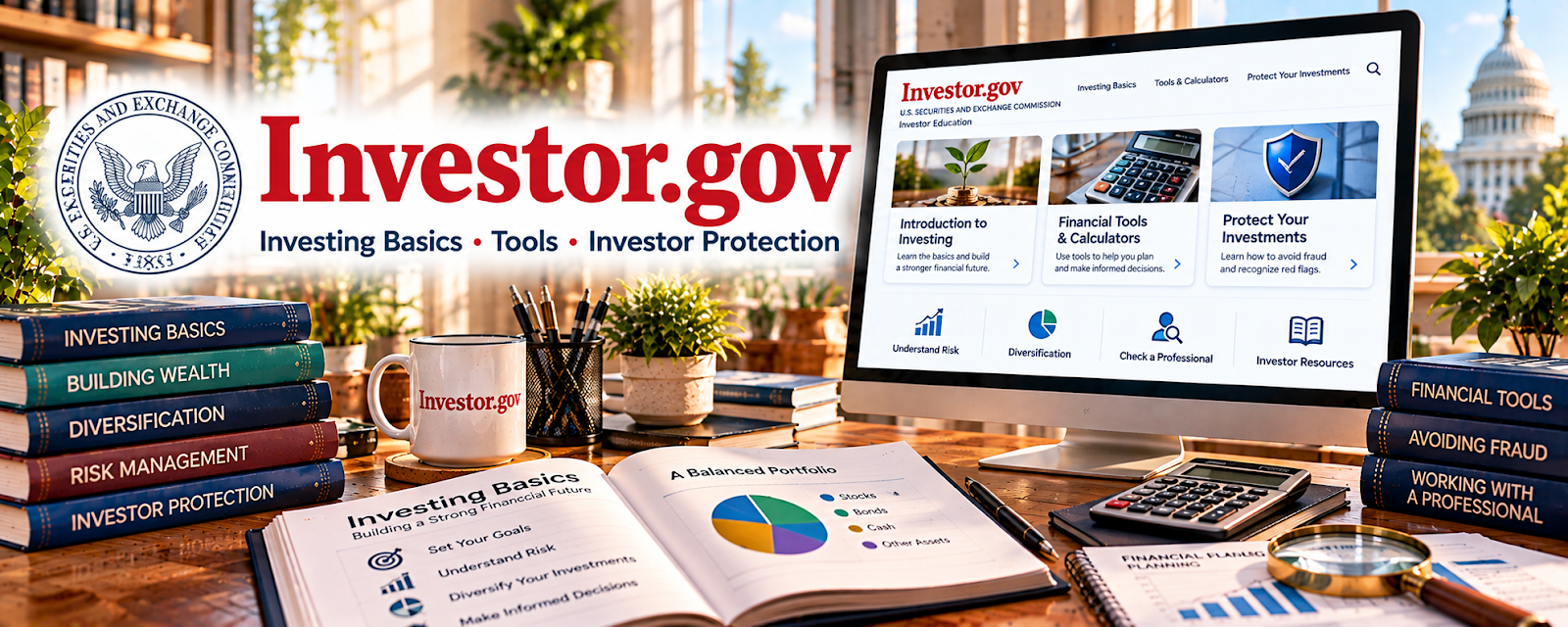
Use Investor.gov to learn beginner concepts, examples, and workflows before starting dividend investing.
🟢 Beginner
Use Vanguard Dividend Reinvestment Guide to learn beginner concepts, examples, and workflows before starting dividend investing.
🟢 Beginner
Use FINRA Investor Insights to learn beginner concepts, examples, and workflows before starting dividend investing.
🟡 Intermediate
💬 Investing Communities & Forums
Use investor discussions to surface research questions while treating individual portfolios and income claims with caution.
Use r/Bogleheads to ask questions, study real examples, and network with people doing dividend investing.
🟢 Beginner
Use r/dividends to ask questions, study real examples, and network with people doing dividend investing.
🟢 Beginner
Use Bogleheads Forum to ask questions, study real examples, and network with people doing dividend investing.
🟡 Intermediate
Use r/investing to ask questions, study real examples, and network with people doing dividend investing.
🟡 Intermediate
Use Seeking Alpha Community to ask questions, study real examples, and network with people doing dividend investing.
🔴 Advanced
💰 Paid Investing Courses
Evaluate education for clear risk coverage and transparent costs; be wary of courses built around guaranteed returns.

Use Skillshare — Investing Classes for structured training, courses, or credentials that build confidence in dividend investing.
🟢 Beginner

Use Udemy — Dividend Investing Courses for structured training, courses, or credentials that build confidence in dividend investing.
🟢 Beginner

Use Coursera — Investment Management for structured training, courses, or credentials that build confidence in dividend investing.
🟡 Intermediate

Use LinkedIn Learning — Investing for structured training, courses, or credentials that build confidence in dividend investing.
🟡 Intermediate
Use Wall Street Prep for structured training, courses, or credentials that build confidence in dividend investing.
🔴 Advanced
📝 QUICK NOTE
These are educational research and record-keeping tools, not personalized investment recommendations. Investments can lose value; dividends and returns are not guaranteed. Verify information through primary disclosures and qualified advisers when needed.
📝 What Should You Learn First?
Follow this order:
1️⃣ Goals & risk
Understand your time horizon, loss tolerance, liquidity needs, and the difference between investing and guaranteed income.
2️⃣ Investment basics
Learn stocks, funds, diversification, total return, and how dividends can change or stop.
3️⃣ Costs & taxes
Understand fees, account types, and applicable tax considerations before choosing an account.
4️⃣ Research quality
Read primary disclosures and distinguish yield from the sustainability of distributions.
5️⃣ A written approach
Define contribution, diversification, and review rules without chasing the highest yield.
6️⃣ Ongoing review
Track contributions, distributions, costs, and concentration; review against your plan.
🎯 KEY TAKEAWAY
Learn through a small, realistic practice task. Build confidence in the core workflow before adding more tools, paid courses, or commitments.
📄 Four Practical Starting Templates
Create these in a document, spreadsheet, or Notion page. They are working outlines—not ready-made legal agreements or professional advice. Use fictional data for practice and keep real records secure.
Learning & Goals Worksheet
Record: Goal | Time horizon | Liquidity needs | Risk questions | Topics to study
Use to prepare for research or a qualified adviser conversation.
Investment Research Notes
Record: Asset | Primary sources | Costs | Risks | Distribution history | Open questions
Compare evidence without treating past dividends as promises.
Portfolio Record
Record: Holding | Contributions | Cost basis record | Distributions | Fees | Allocation
Keep records for review and official tax reporting support.
Review Checklist
Record: Date | Goal changes | Concentration | Costs | Distributions | Next review
Use a planned review routine rather than reacting to headlines.
🚀 ACTION STEP
Choose one learning resource and draft your Learning & Goals Worksheet. Use a small practice example to identify the next skill you need before taking on live work or spending more money.
🧰 Resources
Use these resources to put your investing & dividend income learning into practice. Start with a small, dependable setup and add a tool only when its purpose, cost, and limitations are clear.
🏦 Brokerage Platforms
Compare account features, costs, and available investments. Verify regulatory status and account protections through official sources before opening an account.
Use Charles Schwab to research investments, buy dividend-paying assets, and monitor portfolio activity.
🟢 Beginner
Use Fidelity to research investments, buy dividend-paying assets, and monitor portfolio activity.
🟢 Beginner
Use Vanguard to research investments, buy dividend-paying assets, and monitor portfolio activity.
🟢 Beginner
Use Robinhood to research investments, buy dividend-paying assets, and monitor portfolio activity.
🟢 Beginner
Use M1 Finance to research investments, buy dividend-paying assets, and monitor portfolio activity.
🟡 Intermediate
🔍 Investment Research Tools
Read disclosures, financial information, and distribution records. Use primary sources to investigate risks rather than selecting investments from yield rankings alone.
Use Google Finance to research keywords, niches, competitors, or content ideas that support dividend investing.
🟢 Beginner

Use Yahoo Finance to research keywords, niches, competitors, or content ideas that support dividend investing.
🟢 Beginner
Use Finviz to research keywords, niches, competitors, or content ideas that support dividend investing.
🟡 Intermediate
Use Morningstar to research keywords, niches, competitors, or content ideas that support dividend investing.
🔴 Advanced
Use Seeking Alpha to research keywords, niches, competitors, or content ideas that support dividend investing.
🔴 Advanced
📊 Portfolio Tracking & Analysis
Monitor contributions, allocations, costs, and distributions. Use tracking to understand exposure, not to predict guaranteed income.
Use Google Sheets to maintain a custom spreadsheet of holdings, dividend records, and portfolio calculations for your investing research and records.
🟢 Beginner
Use Yahoo Finance Watchlists to organize watchlists and monitor financial market information for investments you follow for your investing research and records.
🟢 Beginner
Use Sharesight to track investment holdings, portfolio performance, and dividend records for your investing research and records.
🟡 Intermediate
Use TrackYourDividends to organize dividend holdings and monitor portfolio income information for your investing research and records.
🟡 Intermediate

Use Snowball Analytics to review portfolio holdings, dividend information, and investment performance for your investing research and records.
🔴 Advanced
🌐 Investment Websites & Resources
Build understanding of investment concepts and current disclosures. Separate educational explanations from promotions and personalized recommendations.
Investment education, definitions, tutorials, investing basics, financial terms, and free learning resources.
🟢 Beginner
Financial independence, index fund investing, frugal living, lifestyle optimization, and long-term wealth building.
🟢 Beginner
Dividend news, dividend data, stock screeners, payment calendars, and income investing research.
🟡 Intermediate
Fund and stock research, ratings, portfolio tools, investment analysis, and market education.
🟡 Intermediate
Stock analysis, dividend coverage, market commentary, investment research, and community insights.
🟡 Intermediate
10. Your First 6 Months Investing & Dividend Income Plan
Your first 6 months with investing and dividend income should be focused on building financial knowledge, safe habits, consistency, and realistic expectations.
The goal is to move from:
Learn → Budget → Brokerage Setup → Research → Small Investments → Track Progress
By the end of 6 months, you should understand basic investing terms, know how much you can safely invest, have a simple portfolio plan, and be building dividend income slowly without chasing risky “get rich quick” returns.
🎯 6-Month Goal
By the end of your first 6 months, aim to have:
✅ A basic understanding of stocks, ETFs, dividends, and risk
✅ A monthly investing budget
✅ An emergency fund plan
✅ A brokerage account opened
✅ A simple watchlist of dividend stocks or ETFs
✅ A beginner portfolio strategy
✅ Automatic contributions started if possible
✅ A dividend and portfolio tracker
✅ A long-term plan for growing income safely
🎯 KEY TAKEAWAY
Dividend income grows slowly at first. The real power comes from consistency, reinvesting, and letting time work.
📅 Month 1: Learn the Basics & Check Your Money Foundation
🎯 Main Goal
Understand how investing works and make sure your basic financial foundation is stable before putting money into the market.
✅ What to Do
- Learn basic investing terms
- Understand the difference between stocks, ETFs, bonds, and funds
- Learn what dividends are
- Review your monthly income and expenses
- Start or strengthen your emergency fund
- Pay attention to high-interest debt
- Decide how much you can safely invest
- Write down your investing goals
🏁 Month 1 Success Looks Like
- You understand basic investing terms
- You know how much money you can safely invest
- You are not investing money needed for bills
- You have started thinking long term
- You understand that dividends are not guaranteed income
⚠️ Beginner Mistake: Investing money needed for rent, bills, debt, or emergencies. Dividend investing should not replace having a basic safety cushion.
📖 Beginner Investing Terms
Term | What It Means |
Stock | Ownership share in a company |
ETF | A fund that holds many investments |
Dividend | Cash payment some companies pay shareholders |
Yield | Dividend income compared to stock price |
Portfolio | Your collection of investments |
Diversification | Spreading money across multiple investments |
Risk tolerance | How much market movement you can handle |
Reinvesting | Using dividends to buy more shares |
📅 Month 2: Open Your Account & Build a Watchlist
🎯 Main Goal
Set up your investing account and start researching dividend-friendly investments.
✅ What to Do
- Choose a reputable brokerage platform
- Open and verify your account
- Learn how deposits, buys, sells, and dividends work
- Research dividend ETFs and beginner-friendly funds
- Build a watchlist of 10–20 investments
- Compare dividend yield, history, fees, and risk
- Avoid chasing extremely high yields
- Decide whether you want individual stocks, ETFs, or both
🏁 Month 2 Success Looks Like
- Your brokerage account is set up
- You understand how to buy investments
- You have a watchlist
- You know the difference between yield and quality
- You are ready to make small, planned investments
🎯 KEY TAKEAWAY
A high dividend yield can be a warning sign. Look for quality, consistency, and sustainability, not just the biggest payout.
💡 Dividend Investment Types
Investment Type | Best For |
Dividend ETFs | Beginners who want diversification |
Index funds | Long-term broad market growth |
Blue-chip dividend stocks | Established companies with dividend history |
REITs | Real estate income exposure |
Bond funds | Lower-risk income focus |
Dividend growth stocks | Companies that may raise dividends over time |
High-yield stocks | Higher income potential but often higher risk |

📅 Month 3: Make Your First Small Investments
🎯 Main Goal
Start investing with a small amount and learn how your portfolio behaves.
✅ What to Do
- Choose your first investment amount
- Start small while learning
- Buy diversified investments if you want less single-company risk
- Track purchase dates and prices
- Turn on dividend reinvestment if it fits your plan
- Avoid checking prices obsessively
- Continue learning about risk and market swings
- Keep investing money separate from emergency money
🏁 Month 3 Success Looks Like
- You made your first planned investments
- You are tracking what you bought
- You understand that prices move up and down
- You are not panic-selling
- You have started building investing confidence
🎯 KEY TAKEAWAY
Your first investments should teach you discipline. Start with amounts you can handle emotionally and financially.
🛡️ Beginner Portfolio Approaches
Approach | Best For |
ETF-focused | Simpler beginner portfolio |
Dividend growth | Long-term income growth |
Balanced portfolio | Mix of growth and income |
REIT income | Real estate-focused dividends |
Core-and-satellite | Broad ETF core with a few individual stocks |
Automatic investing | Consistency without overthinking |
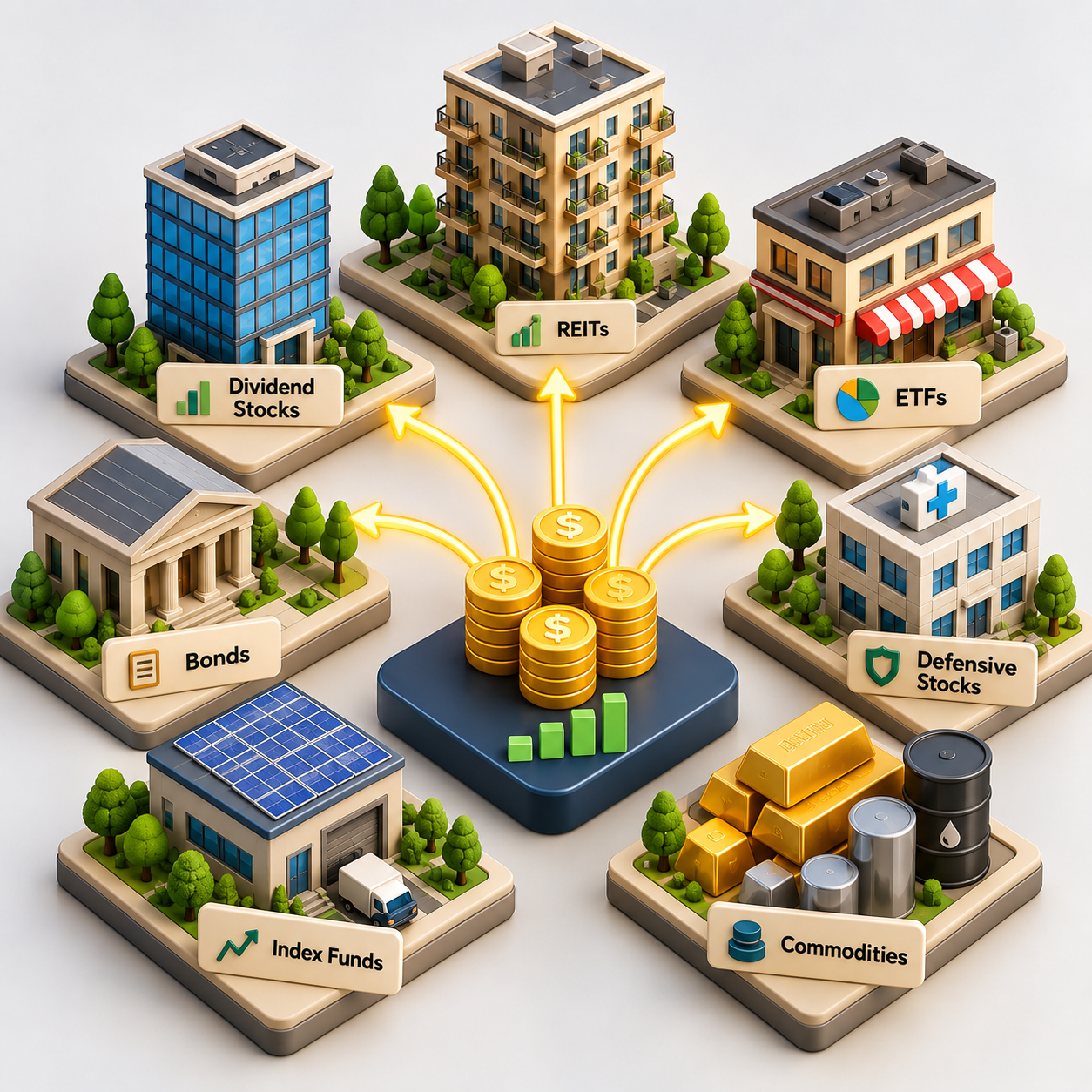
📅 Month 4: Create a Repeatable Investing System
🎯 Main Goal
Turn investing into a steady monthly habit instead of random buying.
✅ What to Do
- Set a monthly contribution goal
- Decide your investment schedule
- Automate deposits if possible
- Create a portfolio tracker
- Track dividends received
- Review your asset mix monthly
- Keep learning about taxes and account types
- Avoid reacting to every market headline
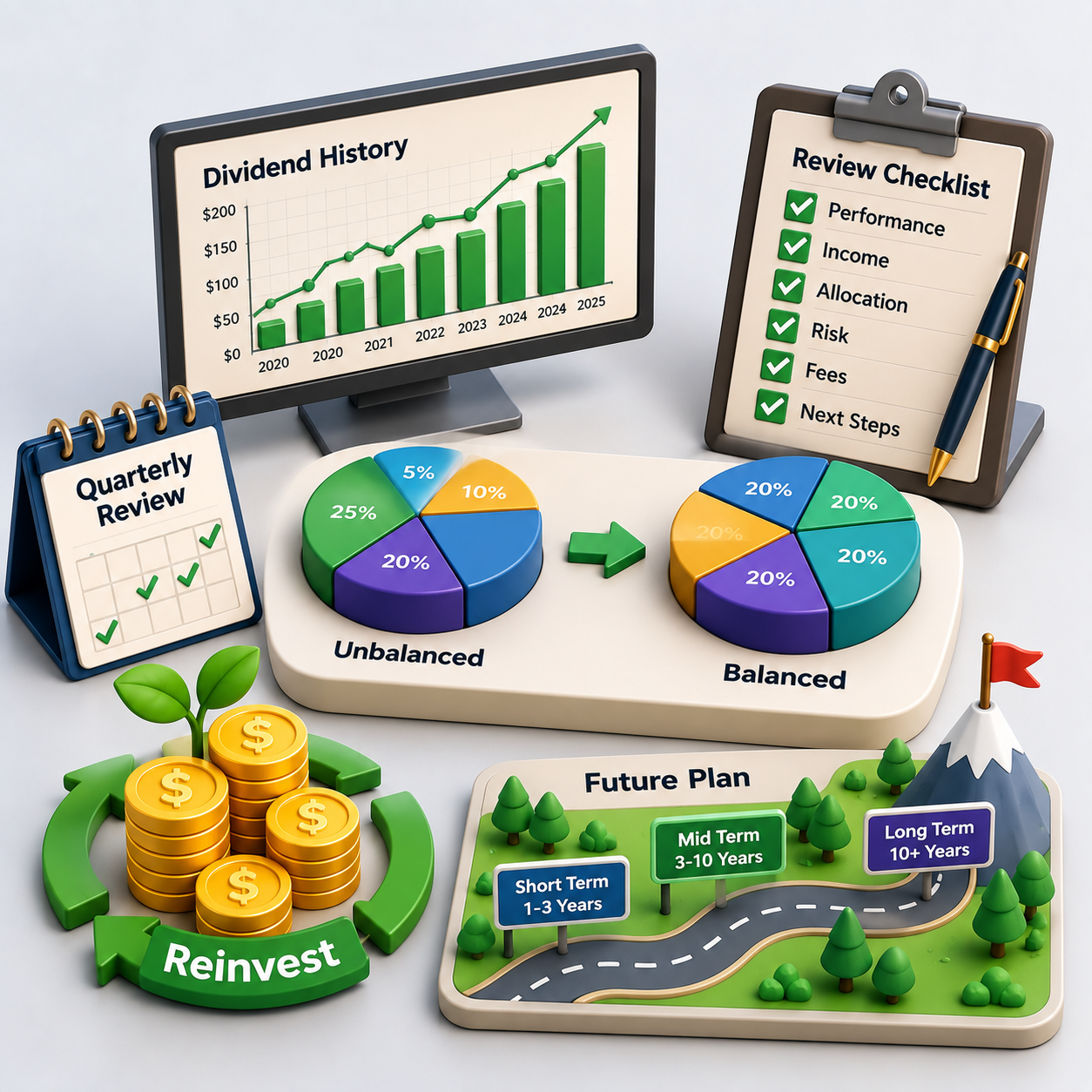
🏁 Month 4 Success Looks Like
- You have a monthly investing routine
- You are tracking dividends and contributions
- You are making decisions from a plan
- You understand your portfolio better
- You are avoiding emotional buying and selling
⚠️ Scale Smart: Do not change your entire strategy every time the market moves. Investing works best when your plan is stable enough to survive normal ups and downs.
🔄 Simple Investing Workflow
Step | What Happens |
Budget review | Confirm how much you can invest |
Deposit | Move money into brokerage |
Research | Review watchlist and portfolio balance |
Buy | Purchase planned investments |
Track | Record shares, cost, and dividend estimates |
Reinvest | Use dividends to buy more shares if desired |
Review | Check progress monthly |
Adjust | Improve strategy without panic decisions |
🔄 Simple Monthly Workflow
Time | Task |
Week 1 | Review income, expenses, and investing amount |
Week 2 | Deposit funds and review watchlist |
Week 3 | Invest according to your plan |
Week 4 | Track dividends, portfolio value, and lessons learned |
📅 Month 5: Improve Research & Risk Management
🎯 Main Goal
Learn how to evaluate dividend investments more carefully before adding more money.
✅ What to Do
- Review dividend history
- Check company or fund quality
- Look at payout ratios when researching stocks
- Compare ETF expense ratios
- Understand sector concentration
- Avoid putting too much money into one stock
- Review your risk tolerance
- Continue building diversified positions
🏁 Month 5 Success Looks Like
- You are researching more carefully
- You are not chasing yield blindly
- Your portfolio is more diversified
- You understand your biggest risks
- You know which investments fit your long-term plan
🎯 KEY TAKEAWAY
Dividend investing is not only about income. You still need to protect your capital, manage risk, and choose investments that can survive over time.
🛠️ Dividend Research Factors
Factor | Why It Matters |
Dividend history | Shows consistency over time |
Dividend growth | Shows whether payouts may increase |
Payout ratio | Helps judge sustainability |
Company earnings | Dividends need business strength |
ETF expense ratio | Fees reduce long-term returns |
Sector exposure | Too much concentration adds risk |
Debt levels | High debt can pressure dividends |
Valuation | Overpaying can reduce future returns |

📅 Month 6: Review, Rebalance & Build Your Long-Term Plan
🎯 Main Goal
Review your first 6 months and create a realistic plan for growing dividend income over the next year.
✅ What to Do
- Review all investments purchased
- Review total contributions
- Review dividends received
- Review estimated annual dividend income
- Check if your portfolio is too concentrated
- Decide whether to adjust your monthly contribution
- Update your watchlist
- Create a 90-day investing plan for months 7–9
❓ 6-Month Review Questions
- How much did you contribute total?
- How much dividend income did you receive?
- What is your estimated annual dividend income?
- Which investments feel too risky?
- Are you too concentrated in one company or sector?
- Did you stick to your budget?
- Did you panic during market drops?
- Are you reinvesting dividends?
- What should you learn next?
🏁 Month 6 Success Looks Like
- You understand your portfolio
- You know your dividend income progress
- You have a consistent investing routine
- You understand your risks
- You have a realistic plan for months 7–9
🎯 KEY TAKEAWAY
Dividend income is built with patience. The early stage feels slow, but every contribution and reinvested dividend helps the income base grow.
📊 Decision Table
If This Happens | Do This |
You are too concentrated | Add more diversified ETFs or funds |
You chase high yields | Focus on dividend quality and sustainability |
You invest inconsistently | Automate deposits or set a fixed schedule |
You feel nervous during drops | Reduce risk or learn more before adding money |
Dividends are small | Stay consistent and think long term |
You do not track progress | Build a simple dividend tracker |
You want faster income | Increase contributions only if your budget allows |
You are unsure what to buy | Keep learning and use diversified options |

✅ 6-Month Success Checklist
By the end of 6 months, check whether you have:
✅ Learned basic investing terms
✅ Reviewed your budget
✅ Started or planned an emergency fund
✅ Opened a brokerage account
✅ Built a dividend watchlist
✅ Made small planned investments
✅ Tracked purchases and dividends
✅ Avoided chasing extreme yields
✅ Created a monthly investing routine
✅ Reviewed portfolio risk
✅ Estimated annual dividend income
✅ Created a plan for the next 90 days
⚠️ What Not to Do During the First 6 Months
Avoid these mistakes:
❌ Investing money needed for bills or emergencies
❌ Chasing the highest dividend yield
❌ Buying stocks only because social media recommends them
❌ Ignoring fees, taxes, and risk
❌ Putting all money into one company
❌ Panic-selling during normal market drops
❌ Expecting large dividend income immediately
❌ Confusing dividends with guaranteed income
❌ Ignoring emergency savings
❌ Changing strategy every week
⚠️ Reminder: Investing involves risk, and dividends are not guaranteed. Build slowly, diversify, and make decisions based on a plan.
🧭 Simple 6-Month Milestone Tracker
Month | Main Focus | Target Output |
Month 1 | Learn basics | Budget, goals, emergency fund plan |
Month 2 | Account setup | Brokerage opened, watchlist created |
Month 3 | First investments | Small planned purchases made |
Month 4 | Investing system | Monthly routine and tracker |
Month 5 | Research & risk | Better quality checks and diversification |
Month 6 | Review & plan | 90-day investing plan created |
🚀 Final 6-Month Strategy
Your first 6 months should follow this simple path:
Month 1: Learn investing basics and check your money foundation
Month 2: Open your account and build a watchlist
Month 3: Make your first small investments
Month 4: Create a repeatable investing system
Month 5: Improve research and risk management
Month 6: Review progress and build your long-term plan
The investors who succeed are not usually the ones chasing fast returns. They are the ones who invest consistently, manage risk, reinvest patiently, and stay focused on long-term growth.
11. Get Your Investing Starter Kit
🎁 Your Investing Research & Planning Toolkit
The Investing & Dividend Income Starter Kit brings together 12 browser-based educational tools to research dividend investing, model scenarios, organize records and practice portfolio planning.
The 12 components:
✅ 1. Beginner's Account Opening Checklist — Review basic brokerage selection, account setup and security considerations.
✅ 2. Dividend Stock Screener — Learn how to compare potential holdings using research inputs; nothing is pre-approved as a suitable investment.
✅ 3. Dividend Reinvestment Calculator — Explore hypothetical reinvestment and compounding scenarios.
✅ 4. Tax Tracking Template — Organize dividend records for possible tax reporting.
✅ 5. Portfolio Allocation Worksheet — Model asset mix and diversification choices.
✅ 6. Investing Glossary — Explore common investing and dividend terminology.
✅ 7. Monthly Contribution Tracker — Record planned and actual contributions.
✅ 8. Dividend Calendar Template — Organize expected and actual payment dates based on verified records.
✅ 9. Risk Tolerance Questionnaire — Reflect on risk preferences and financial time horizons.
✅ 10. First-Year Investing Roadmap — Work through a structured sequence of investing education and review tasks.
✅ 11. Dividend Yield & Growth Analyzer — Calculate and compare dividend yield and growth assumptions.
✅ 12. Rebalancing & Exit Strategy Guide — Plan portfolio review triggers and decision criteria.
Also included in the editable master: A central investing dashboard and Start Here guide are included in the editable master.
Educational tools only—not personal investment recommendations, a brokerage account or live market-data service. Holdings, yields, returns and dividends are not guaranteed; verify current information independently. The customer edition remains subject to final validation.
12. Frequently Asked Questions
💵 How much money do I need to start?
You can start with $1 using fractional shares on most platforms.
Realistically, $100–$500 is a good starting point, then add monthly.
💡 The habit matters more than the starting amount.
💤 Is dividend investing really hands-off?
It can be more hands-off after setup — not fully automatic.
Initial research is required, and you still need to contribute, review holdings, and manage risk.
Simple maintenance:
- 📊 Check quarterly
- ⚖️ Rebalance annually
- 🔁 Keep contributions automatic
💡 It is one of the more hands-off side hustles long-term, but dividends and principal are not guaranteed.
📈 What's the difference between dividend yield and dividend growth?
Yield = annual dividend / stock price.
This shows your immediate income.
Growth = annual dividend increase.
This shows your future income potential.
💡 The best dividend stocks usually have both: solid yield + consistent growth.
🛡️ Are dividends guaranteed?
No. Companies can cut or eliminate dividends.
To reduce risk, focus on:
- 🏆 Dividend aristocrats
- 📈 Companies with 25+ years of dividend increases
- 💰 Strong cash flow
- ⚖️ Diversified ETFs
💡 Stability matters more than chasing the highest yield.
📊 Should I invest in individual stocks or ETFs?
For beginners: ETFs.
Why?
- 📦 Instant diversification
- ⚖️ Lower risk
- 🧠 Less research required
- 🔁 Easier to manage
Individual stocks can come later once you understand fundamentals and have a larger portfolio.
🧾 How are dividends taxed?
Qualified dividends: Usually taxed at 0%–20%, depending on income and holding period.
Non-qualified dividends: Taxed as ordinary income.
Roth IRA: Qualified withdrawals can be tax-free, subject to IRS rules.
💡 A Roth IRA is often a strong account type for long-term dividend investing, depending on eligibility.
🔁 When should I take dividends as income vs. reinvest?
Reinvest while building your portfolio, especially during the first 10–20 years.
Take as income once your portfolio generates enough to support your lifestyle.
For many people, that usually requires a portfolio around $300K–$500K+, depending on expenses and yield.
📉 Can I lose money with dividend investing?
Yes. Stock prices fluctuate, and you can see paper losses.
Risks include:
- 📉 Stock price drops
- ⚠️ Dividend cuts
- 🏢 Company underperformance
- 🌎 Market downturns
But if you hold long-term, stay diversified, and reinvest, historical returns have generally been positive over 10+ year periods.
🎯 What's a good dividend yield?
A 3%–5% yield is often the sweet spot.
General rule:
- 📉 Under 2% = lower current income
- ✅ 3%–5% = balanced income + safety
- ⚠️ Over 7% = potential red flag
💡 Balance yield with growth, stability, and dividend safety.
📅 How much should I invest per month?
Invest whatever you can consistently afford.
Examples:
- 💵 $25/month builds the habit
- 💰 $100/month creates real momentum
- 🚀 $500+/month accelerates growth
💡 $100/month for 30 years beats $1,000/month for 3 years.
Consistency > amount.
13. Important Considerations
Before you start, understand the realities of investing:
⏳ This Is a Long-Term Strategy
- 📆 It can take 10–20 years to reach major income levels
👉 This is not quick money.
📉 Market Volatility Is Normal
- 📊 Prices go up and down
- 📉 You will see losses at times
- 🧠 Long-term investors stay invested
👉 Volatility is part of the process.
⚠️ High Yield ≠ Safe Investment
- 🚩 10%+ yields are often red flags
- 📉 Companies may cut dividends
- 🧾 High payouts may not be sustainable
👉 Focus on stability + growth.
💸 You Can Lose Money
- 📉 Stocks can drop
- ⚠️ Dividends can be reduced
- 🏢 Companies can underperform
👉 Diversification reduces risk.
🧠 You Must Avoid Emotional Decisions
- 😨 Panic selling hurts long-term returns
- ⏱️ Timing the market rarely works
- 🔁 Consistency usually wins
💡 The goal is to stay disciplined through market cycles.
🧾 Taxes & Accounts Matter
- 💰 Dividends may be taxed
- 📊 Qualified dividends may receive better tax treatment
- 🛡️ Roth IRA = tax-free growth potential
👉 Account strategy affects long-term wealth.
⚖️ You Need an Emergency Fund First
Before investing heavily, aim for:
- 🏦 3–6 months of expenses saved
- 💳 High-interest debt under control
- 🧾 Basic budget in place
👉 Don’t invest money you need soon.
🔁 This Is NOT Hands-Off at First
At the beginning, you must:
- 📚 Learn the basics
- 🧾 Choose accounts
- 📊 Pick funds/stocks
- 🔁 Set up contributions
👉 But it can become more hands-off over time.
💡 Final Reality Check
This is:
✔ 📈 One of the more scalable long-term income strategies
✔ 🏛️ Proven over decades
✔ 🚪 Accessible to almost anyone
But also:
❌ Requires patience
❌ Requires consistency
❌ Requires discipline
🚀 A common delay is waiting for a perfect moment — start only with money you can leave invested.
14. Your Next Steps
🚀 ACTION STEP
📍 Today
- 📦 View the starter kit above
- 📚 Read one Investopedia article about dividend investing
- 🧮 Calculate how much you can invest monthly, such as $50, $100, or $500
📅 This Week
- 📖 Read The Little Book of Common Sense Investing or watch 5 beginner YouTube videos
- 🏦 Open a brokerage account, such as Fidelity, Schwab, or Vanguard
- 🔗 Link your bank account and enable DRIP
- 🔍 Research 3 dividend ETFs, such as SCHD, VYM, or JEPI
🗓️ This Month
- 💰 Make your first investment, starting with a dividend ETF
- 🔁 Set up automatic monthly contributions
- 👥 Join the r/dividends community on Reddit
- 📊 Track your first month, but don’t obsess over daily price movement
🚀 Months 2–12
- 📅 Continue monthly contributions and never skip if possible
- 📚 Learn about 2–3 new stocks or funds per month
- ⚖️ Add diversification, such as REITs, international funds, or bonds
- 💸 Receive your first dividends and watch them reinvest
- 📈 Increase contributions by 10–20% if your income allows
15. The Bottom Line
🎯 KEY TAKEAWAY
Investing & dividend income is a long-term wealth-building approach — recurring cash flow is possible through contributions, dividends, and compounding, not a shortcut.
🙋 If you:
✔ Start now, even with $25–$100/month
✔ Stay consistent through market ups and downs
✔ Reinvest dividends while you build
✔ Focus on stability and growth, not the highest yield
🏗️ You can build:
💰 A contribution habit, such as $100/month, that can grow only with time, returns, and additional savings — not a set income ladder
💤 More hands-off income after setup, with ongoing reviews
🛡️ A long-term wealth system, not a replacement for an emergency fund
🚀 The people who tend to do better aren’t the flashiest — they’re the most consistent.
16. Recommended Websites & Tools
🛠 TOOLS & RESOURCES
You do not need every resource listed below. This directory brings together the major platforms, tools, and resources from this guide, along with additional research and learning options, so you can find them in one place when you need them.
Start with the essentials. Add tools only when your investing strategy develops a specific need for them.
🏦 Brokerage Platforms
- Fidelity — Brokerage platform for buying dividend stocks, ETFs, REITs, bonds, retirement investments, and fractional shares.
- Charles Schwab — Brokerage platform for long-term investors, dividend ETF access, retirement accounts, research tools, and education.
- Vanguard — Brokerage and fund company known for low-cost index funds, ETFs, mutual funds, and buy-and-hold investing.
- Robinhood — Beginner-friendly mobile brokerage app for simple stock and ETF investing with fractional shares.
- E*TRADE — Brokerage platform for active investors, options traders, market research, and more advanced trading tools.
- M1 Finance — Automated investing platform built around portfolio “pies,” recurring investments, and fractional-share allocation.
- Webull — Mobile trading platform with advanced charts, paper trading, market data, and active-investor tools.
💡 PRO TIP
Pick one brokerage and automate everything. Automatic monthly contributions plus DRIP remove emotion from the process.
🤖 Automatic Investing & Robo-Advisors
- Betterment — Robo-advisor platform mentioned for automated portfolio building, rebalancing, and hands-off investing.
- Wealthfront — Robo-advisor platform mentioned for automated investing, diversified portfolios, and hands-off wealth-building workflows.
- M1 Finance — Automated investing option for setting target allocations and using recurring deposits to rebalance a portfolio over time.
🔍 Dividend Research & Stock Screening Tools
- Seeking Alpha — Stock analysis and research platform for dividend safety, earnings insights, analyst commentary, and income-investing research.
- Finviz — Stock screener for filtering companies by dividend yield, valuation, sector, market cap, performance, and other financial metrics.
- Dividend.com — Dividend-focused research site for checking payout data, dividend history, yield, and dividend growth information.
- Morningstar — Investment research platform for stocks, ETFs, mutual funds, ratings, portfolio analysis, and fund comparison.
- Yahoo Finance — Free market data site for stock quotes, charts, financial news, company data, and watchlists.
- Portfolio Visualizer — Portfolio analysis and backtesting tool for comparing asset allocations, historical performance, risk, and income strategies.
📝 QUICK NOTE
A high yield means nothing if the dividend gets cut. Screen for payout ratio, cash flow, and dividend history first.
📊 Portfolio Tracking, Budgeting & Wealth Tools
- Empower — Net worth and portfolio tracking tool for viewing investment accounts, retirement planning, and overall financial progress.
- Monarch Money — Budgeting and financial tracking platform for organizing spending, goals, accounts, and investments in one dashboard.
- Rocket Money — Budgeting and subscription-tracking app for managing cash flow, bills, subscriptions, and linked financial accounts.
- Sharesight — Portfolio tracking tool for dividend tracking, performance reporting, tax reporting, and investment return analysis.
- Stock Events — Dividend calendar and portfolio app for tracking ex-dividend dates, payment dates, upcoming income, and stock events.
👥 Communities & Learning Resources
- r/dividends — Reddit community mentioned for dividend investing discussion, portfolio examples, beginner questions, and income-investing ideas.
- Seeking Alpha — Research and article platform useful for reading investor commentary, dividend opinions, and stock-specific analysis.
- Yahoo Finance — Market news and quote resource for following company updates, financial headlines, and general investing research.
🎯 KEY TAKEAWAY
You do not need every tool on this page. One brokerage account, automatic monthly contributions, and one dividend ETF are enough to start.
🧭 How to Use This Directory
🧰 Start With a Simple Setup
Do not start by creating accounts with every service listed above. For most beginners, a simple setup is enough:
- One brokerage account
- One dividend ETF
- Automatic monthly contributions
- DRIP turned on
That is enough to start building. Add tools only when you can name the specific problem they will solve.
🎯 KEY TAKEAWAY
Tools support the business. They are not the business.
Your biggest advantages will come from:
Starting early → Investing consistently → Reinvesting dividends → Staying disciplined
17. Explore Similar Side Hustles
 Affiliate Marketing: Get Paid to Promote What You Love — Build another income stream you can funnel straight into your portfolio.
 Selling Digital Products — Create products that sell while you sleep as your dividends compound.
 Online Bookkeeping: Earn Steady Income by Helping Businesses Stay Organized — Turn your comfort with numbers into steady active income to invest.
 Blogging: Build an Online Brand and Earn from Your Words — Document your investing journey and monetize the audience it attracts.
 Freelance Writing: Get Paid to Write Online — Write about finance for clients while your portfolio grows in the background.
 Newsletter Monetization: Get Paid to Write About What You Love — Share your investing insights and earn from subscribers and sponsorships.
⚠️ Important Disclaimer
This is educational content, not financial advice. Investing involves risk, including loss of principal. Past performance doesn't guarantee future results. Consult a licensed financial advisor before making investment decisions. Tax situations vary—consult a tax professional. The author may hold positions in mentioned securities.