
Affiliate disclosure: Some links in this guide may be paid referral links. If you purchase or sign up through one, One Stop Side Hustles may earn a commission. How our affiliate links work.
FREELANCE WRITING STARTER GUIDE
Learn how freelance writing works—including finding clients, setting rates, building a portfolio, and moving from early paid articles toward more specialized projects.
2. Why Choose Freelance Writing?
3. Choose Your Niche & Services
4. Earnings, Pricing & Offer Selection
5. Essential Tools & Your Starting Setup
6. Find Clients & Reach Your Audience
7. How to Start: Your Beginner Roadmap
8. Build Trust & Improve Results
9. Learning Resources & Templates
10. Your First 6 Months in Freelance Writing
11. Get the Freelance Writing Starter Kit
12. Frequently Asked Questions
Quick Snapshot
Earn: Highly variable — many writers start with smaller one-off pieces; later income depends on niche, rates, and repeat work
Work: Write remotely and choose your own clients
Start: Low cost — a laptop and 2–3 writing samples
Best for: Clear writers who consistently meet deadlines
Grow: Niche down → retainers and premium rates
1. What Is Freelance Writing?
Freelance writing is getting paid to create written content for clients—blogs, articles, web copy, product descriptions, emails, social media posts, newsletters, and more. You work remotely, set your own schedule, and get paid based on what you produce.
Unlike traditional employment, you choose which projects to take, which clients to work with, and how much to charge. You're essentially running a content creation business.
🔄 How It Works (Simple 4-Step Process)
- Build a basic portfolio (3-5 writing samples)
- Find clients (job boards, direct outreach, agencies)
- Pitch your services (email, proposal, or application)
- Write and get paid (per word, per article, or hourly)
🎯 KEY TAKEAWAY
You don't need publication credits or a degree. Your ability to write clearly, meet deadlines, and understand what clients actually need—that's what gets hired.

2. Why Choose Freelance Writing?
Freelance writing is a great side hustle because it combines low startup cost, portable income potential, and a skill that can become more valuable as you specialize.
💰 Rates can rise much faster than hours
Writing is one of the few side hustles where stronger positioning can change your income quickly.
Common progression:
- Beginner articles
- Niche content work
- Retainers and premium projects
- Higher-value copy or strategy
That means growth often comes from better offers, not just longer workdays.
🧠 You build a skill with long-term leverage
Strong writing can lead into several better-paid services:
- SEO content
- Copywriting
- Email marketing
- Content strategy
- Ghostwriting
This makes freelance writing a skill stack, not just a one-off gig.
💻 It is easy to start with a simple setup
Most beginners can launch with:
- A laptop
- Internet access
- A few writing samples
- A simple portfolio link
You do not need a degree, fancy equipment, or office space to begin.
⚡ You can land early work surprisingly fast
Businesses always need written content, and many care more about reliability than credentials.
Early projects often come from:
- Sample-based pitches
- Job boards
- Direct outreach
- Simple starter offers
That makes it possible to get proof and momentum without waiting months.

🤝 Recurring clients can stabilize income
Many clients need fresh content every week or month.
Common repeat work includes:
- Blog posts
- Newsletters
- Website updates
- Product copy
- Ongoing SEO content
That repeat demand can reduce the constant pressure to keep finding new clients.
📈 Specialization makes the business easier to scale
As your niche gets clearer, several things usually improve:
- Your rates
- Your portfolio strength
- Your pitch clarity
- Your referral quality
- Your speed on similar projects
Niche focus often turns average writing into a stronger business offer.
🌍 There is demand in almost every industry
Writers are needed anywhere businesses need attention, trust, or conversions.
Common demand comes from:
- Blogs
- Email funnels
- Ads
- Website pages
- Social and thought leadership content
That gives freelance writing a wide range of possible client paths.
🧪 It can expand into bigger income streams
Once you understand audience, messaging, and content goals, writing can grow into:
- Copywriting
- Affiliate content
- Digital products
- Personal brand monetization
- Consulting or strategy
It can start as side income and evolve into a broader online business.
3. Choose Your Niche & Services
Freelance writing is much broader than blog posts alone. It can expand into SEO, email marketing, website copy, ghostwriting, technical writing, thought leadership, and conversion-focused content.
You do not need to offer everything. The smartest beginner move is to start with 1–2 clear services, build relevant samples, and move into higher-value specialties as your skill, proof, and client confidence grow.
📝 Content & SEO Writing
📝 Blog Posts & Articles
- 📄 What it includes: Informational blog posts, how-to articles, listicles, product education, and thought leadership content
- 👥 Who hires: Blogs, SaaS companies, agencies, publications, affiliate sites, and small businesses
- 💰 Typical pay: $20–$500+ per article
- ✅ Best for: Beginners who want a clear, steady starting point
💡 PRO TIP
Blog writing becomes more valuable when you can write clearly, research quickly, and structure content for readability.
🔎 SEO Content Writing
- 🔍 What it includes: Keyword-focused articles, service pages, buying guides, comparison posts, and search-driven website content
- 👥 Who hires: SEO agencies, local businesses, SaaS brands, law firms, medical brands, and e-commerce companies
- 💰 Typical pay: $75–$750+ per piece
- ✅ Best for: Writers who want recurring work tied to traffic growth
💡 PRO TIP
Good SEO writing is about search intent, structure, and usefulness, not keyword stuffing.

🛒 E-Commerce & Product Writing
🏷️ Product Descriptions
- 🛍️ What it includes: Product blurbs, bullet points, Amazon or Etsy listings, Shopify pages, and benefit-focused product copy
- 👥 Who hires: E-commerce brands, Amazon sellers, Etsy stores, agencies, and product businesses
- 💰 Typical pay: $20–$100 per description or batch packages
- ✅ Best for: Beginners who want repeatable, lower-complexity writing work
💡 PRO TIP
Good product copy sells the result, not just the feature list.
🛒 E-Commerce Copywriting
- 🛒 What it includes: Launch copy, category pages, product emails, upsells, and abandoned cart messaging
- 👥 Who hires: DTC brands, Shopify stores, Amazon sellers, and e-commerce agencies
- 💰 Typical pay: $250–$2,500+ per project
- ✅ Best for: Writers who want stronger business-value projects tied to sales
💡 PRO TIP
The better you understand buyer psychology, the more valuable e-commerce writing becomes.

📱 Social, Brand & Short-Form Writing
📱 Social Media Content
- 📱 What it includes: Captions, short posts, threads, scripts, carousels, repurposed content, and monthly content batches
- 👥 Who hires: Creators, brands, consultants, agencies, coaches, and startups
- 💰 Typical pay: $25–$100 per post or small monthly retainers
- ✅ Best for: Writers who like punchy, shorter, conversational content
💡 PRO TIP
Social writing often earns more when sold as a package instead of isolated posts.
💼 LinkedIn Ghostwriting & Thought Leadership
- 💼 What it includes: Founder posts, executive content, authority-building posts, and professional profile support
- 👥 Who hires: Founders, executives, consultants, recruiters, SaaS leaders, and personal brands
- 💰 Typical pay: $500–$3,000+/month
- ✅ Best for: Writers who can capture voice and turn expertise into clear positioning
💡 PRO TIP
These clients usually pay for authority and opportunity, not just “writing words.”

🌐 Website, Email & Conversion Writing
🌐 Website Copy
- 🌐 What it includes: Homepages, About pages, service pages, FAQs, product pages, and site refresh copy
- 👥 Who hires: Small businesses, coaches, consultants, agencies, local services, and startups
- 💰 Typical pay: $300–$5,000+ per project
- ✅ Best for: Writers who want stronger project pricing than basic article work
💡 PRO TIP
Website copy needs to explain the offer, audience, and next step very quickly.
📧 Email Marketing & Newsletters
- 📧 What it includes: Welcome sequences, promotions, launch emails, nurture emails, onboarding emails, and newsletters
- 👥 Who hires: SaaS companies, course creators, e-commerce brands, agencies, consultants, and creators
- 💰 Typical pay: $50–$200+ per email or $200–$2,000+/month for recurring work
- ✅ Best for: Writers who want clear business outcomes and long-term retainers
💡 PRO TIP
Email often pays well because it connects directly to opens, clicks, and sales.

🧠 Specialized & Higher-Income Writing
📑 Technical, Grant & Documentation Writing
- 💻 What it includes: Documentation, onboarding guides, grant proposals, technical explainers, and structured business writing
- 👥 Who hires: SaaS companies, nonprofits, schools, government groups, and enterprise teams
- 💰 Typical pay: $50–$150/hour or premium project pricing
- ✅ Best for: Writers who like research, structure, and complex topics
💡 PRO TIP
Specialized writing pays more because clarity is harder and business stakes are higher.
📚 Ghostwriting, Case Studies & White Papers
- 👻 What it includes: Executive content, case studies, long-form thought leadership, books, and research-backed B2B assets
- 👥 Who hires: Executives, founders, SaaS companies, consultants, agencies, and public-facing experts
- 💰 Typical pay: $500–$50,000+ depending on scope
- ✅ Best for: Experienced writers who can manage voice, interviews, structure, and higher-value messaging
💡 PRO TIP
This tier often pays for trust, confidentiality, and business results as much as writing skill.

🎯 Build Your Beginner Writing Offer
🎯 KEY TAKEAWAY
Start with blog posts, product descriptions, newsletters, or social content. These services are usually easier to learn, easier to sell, and strong enough to build samples and repeat work.
🚀 ACTION STEP
Write a focused first plan:
- Service & audience: Choose one writing format and one likely client type.
- Samples: Draft two relevant pieces that show your tone and research skills.
- Scope: Define length, research, revisions, turnaround, and pricing.
- Outreach: Send a focused pitch that explains the content problem you solve.
4. Earnings, Pricing & Offer Selection
Use this chapter to connect your writing niche, client value, proof, and pricing model before choosing your next income-building step.
🧠 Reality Check (What Actually Separates Earners)
- Most beginner writers start with lower-paying gigs
- Not because writing has a low ceiling
- 👉 Many writers compete on price instead of business value
- 👉 General writing is easier to replace
- Writers who earn more usually:
- Specialize in a clearer niche
- Understand the client’s business goal
- Deliver consistently and meet deadlines
- Build repeat-client relationships
🎯 KEY TAKEAWAY
Writing skill matters, but business value and positioning usually matter more.
🔑 Smart Pricing Strategy
📦 Projects & Retainers
- Move toward:
- Per-project pricing
- Monthly retainers
- Higher-value offers
🎯 Higher-Value Specialties
- Focus on specialties such as:
- SEO content
- SaaS or tech writing
- Email copy
- Website copy
🎯 KEY TAKEAWAY
Writing creates the deliverable, but clear scope, positioning, and repeat-client systems determine whether it becomes sustainable income.
🧪 Real Example
📋 REAL-WORLD EXAMPLE
These scenarios illustrate gross revenue, not typical outcomes or take-home pay. They exclude research, revisions, admin time, fees, and other costs.
🌱 Scenario A: General writer
- Charges $0.03/word
- Writes 50,000 words/month
- Income: $1,500/month
🎯 Scenario B: Niche SEO writer
- Charges $0.10/word
- Same workload
- Income: $5,000/month
🚀 Scenario C: Higher-value copywriter
- Charges $1,000 per project
- Completes 5–10 projects/month
- Income: $5,000–$10,000+/month
🎯 KEY TAKEAWAY
Same writing base. Big difference in specialization, offer type, and client value.
🎯 What Actually Drives Income
Most beginners think:
👉 “I need more writing jobs.”
A useful positioning framework is:
🧮 Skill × Niche × Business Value = Income Potential
- General writing = lower pricing power
- Specialized writing = better pricing
- Writing tied to business results = the strongest income ceiling
📈 Effective Hourly Rate (Pricing Reality)
📖 Read the Numbers in Context
Your quoted rate is only part of the picture. Research, interviews, meetings, drafting, revisions, and project administration all use time.
- Niche: Specialized knowledge can support stronger positioning.
- Content type: Articles, website copy, and email sequences have different scopes.
- Client fit: Budget, clarity, and repeat-work potential matter.
- Proof: Relevant samples and testimonials can support your pricing.
- Process: A clear brief and revision limit protect your margin.
🎯 KEY TAKEAWAY
Compare project revenue with total time and direct costs—not word count or the headline fee alone.

🚀 Build Your First Paid Writing Offer
Start with one client type, one writing service, one clear package, and one primary outreach channel. Set a realistic test window and decide what signals you will track before approaching prospects.
🧭 Run a Disciplined Writing Offer Test
- Define the client and problem. Choose a specific audience and the content need you can help address. Write the offer in one sentence: who you help, what you deliver, and why it is useful. Avoid promising rankings, leads, or sales you cannot control.
- Choose a repeatable package. Specify the deliverable, approximate length, research depth, interviews if needed, turnaround, and included revision rounds. Clarify what the client supplies and what costs extra. Create two relevant samples before pitching.
- Run a small, consistent outreach test. Choose one primary channel—such as direct email, a relevant job board, or agency applications—for four weeks. Research each prospect, tailor the pitch, and link to a relevant sample. Set a manageable weekly target rather than sending generic messages at scale.
- Review business signals weekly. Track prospects contacted, replies, calls, proposals, paid projects, time spent, and collected revenue. Note why clients accept or decline. For completed work, record research, drafting, revisions, and administration separately so you can estimate your effective rate.
- Iterate on evidence. Few replies may signal weak targeting or a vague pitch; calls without bookings may point to fit, scope, proof, or price. Repeat offers that attract suitable clients and produce workable margins. Change one major variable at a time before adding more services.
🎯 KEY TAKEAWAY
You do not always need more writing volume to earn more. You often need better positioning, better-fit clients, clearer packages, and stronger proof that your work supports a business goal.
💡 Example: A Four-Week Writing Offer Test
- Audience: Small SaaS businesses with an active product but inconsistent educational content
- Promise: Turn one customer question into a clear, well-researched article
- Package: One 1,000–1,200-word article, an agreed outline, source links, and one consolidated revision round
- Boundaries: Client provides product access and subject expertise; interviews, uploading, graphics, and additional revisions are quoted separately
- Proof: Two relevant sample articles; label self-initiated samples honestly
- Cadence: Research and contact five suitable prospects per week for four weeks; follow up respectfully where appropriate
- Signals: Track replies, qualified conversations, proposals, bookings, and total delivery time—not just the number of messages sent
- Pricing: Set a test quote using estimated hours, your working rate, direct costs, and a revision allowance; confirm scope and payment terms before starting
The test is for learning, not a promise of clients or income. A proposal or invoice is not the same as collected revenue.
Gross revenue is the amount paid for your writing. Actual profit depends on that revenue after software, platform fees, contractors, and other business costs. Taxes and unpaid prospecting time also affect what you take home.
✍️ Write Your One-Line Writing Offer Test Plan
Use this structure to make the test easy to evaluate:
“For [client type], I will offer [writing package] through [primary outreach channel] for [test window]. The package includes [scope and revision limit]. I will decide whether to repeat or adjust based on [replies, paid bookings, delivery time, and margin].”
✅ Completed example
“For small SaaS businesses, I will offer a 1,000–1,200-word educational article through tailored email outreach for four weeks. The package includes an agreed outline, source links, and one consolidated revision round. I will contact five suitable prospects per week and review qualified replies, paid bookings, total project time, and contribution after direct costs before expanding the offer.”
🚀 ACTION STEP
Before pitching your first package:
Keep the first offer focused. Improve the package before adding more services, niches, or outreach channels.

📋 Pricing & Revenue Planning Reference
Review the writing stages, effective-rate examples, and pricing models alongside your niche, client goals, samples, project scope, and repeat-work opportunities. The existing income and pricing ranges are planning references, not guaranteed results; timelines vary with experience, availability, and demand.
💵 What Freelance Writers Actually Earn
📊 Income Progression by Stage
🚀 Stage | ✍️ Experience Level | 💰 Typical Monthly Income | ⏳ Timeline | 📌 What’s Happening |
Beginner | First gigs and sample-building | $200–$1,000 | 0–3 months | Low rates, learning client expectations, building proof |
Developing | Repeat clients and improving speed | $1,000–$3,000 | 3–6 months | Cleaner delivery, stronger samples, and better-fit projects |
Established | Niche writer with clearer positioning | $3,000–$8,000 | 6–12 months | Higher rates, referrals, and more confidence in one specialty |
Advanced | Specialized writer | $8,000–$15,000+ | 12–24 months | Premium clients, higher-value offers, and stronger systems |
Professional | Authority or small writing business | $15,000+/month | 2+ years | Retainers, premium projects, referrals, and team support |
🎯 KEY TAKEAWAY
Income can rise as you move from generalist work → niche expertise → better-fit clients, but no stage or timeline guarantees a particular monthly income.
📊 Key Metrics & Margin Snapshot
📈 Effective Hourly Rate (Pricing Reality)
📊 What a Project Fee Is Actually Worth
These are illustrative calculations for the same project fee, not market-rate benchmarks. Total hours include research, drafting, revisions, and project administration.
Project Fee | Total Project Time | Gross Effective Rate |
$300 | 3 hours | $100/hour |
$300 | 6 hours | $50/hour |
$300 | 10 hours | $30/hour |
🎯 KEY TAKEAWAY
Gross effective rate = project revenue ÷ total project hours. This is before direct costs, taxes, and unpaid business-development time. Compare actual project economics, not the quoted fee alone.
📡 Track the Signals That Matter
- Qualified replies: Does the offer reach clients with the right need and budget?
- Paid bookings: Are conversations turning into agreed, paid work?
- Revision time: Is the brief clear and the scope controlled?
- Collected revenue: Have invoices actually been paid?
- Repeat work: Do clients return for the same useful service?
💸 Freelance Writing Pricing Models
🧾 Common Pricing Models
💡 Pricing Model | 💰 Typical Rates | 📈 Best Use Case |
📄 Per word | $0.03–$0.50+ | Blog posts, articles, and some SEO work |
⏱️ Hourly | $20–$100+/hour | Editing, strategy, research-heavy projects, and consulting |
📦 Per article | $50–$1,000+ | SEO content and standard content packages |
📅 Retainer | $500–$5,000+/month | Ongoing newsletters, blogs, social content, or thought leadership |
🎯 Project-based | $500–$10,000+ | Website copy, email funnels, sales pages, and premium copy projects |
🎯 KEY TAKEAWAY
Retainers and project pricing can create more predictability than scattered one-off assignments when scope, capacity, and payment terms are clear.
🧮 Check Your Writing Economics
Net contribution = collected project revenue − project-specific costs and fees.
Divide net contribution by total project hours to compare delivery efficiency. Track unpaid outreach, administration, and other overhead separately when evaluating the whole business. A retainer is not automatically profitable if its scope keeps expanding.
🚀 ACTION STEP
🗓️ Build a Monthly Writing Revenue Snapshot
Use collected revenue, real delivery time, and costs—not word count or invoice totals alone—to decide what to repeat.

5. Essential Tools & Your Starting Setup
A freelance-writing setup should support research, clean drafts, client collaboration, and reliable delivery. Begin with a familiar document editor and a small project tracker; paid SEO and AI tools are optional additions, not proof of writing quality.
🧰 Your Minimum Viable Setup
🧰 Start With What You Already Have
- Workspace: An existing computer, internet connection, and focused writing time.
- Drafting: One document editor that supports comments and version history.
- Research: A source log and access to reliable reference material.
- Business records: A pitch tracker, calendar, agreed brief, invoices, and time records.
- Portfolio: A few representative samples in one shareable location.
💡 PRO TIP
Practice sharing a draft with comment access, then deliver a clean final file. Check permissions and formatting so the client does not need to troubleshoot your tools.
🧭 Choose One Working Path
Articles and blog posts: Build a research-to-outline-to-draft workflow around a defined reader question.
SEO assignments: Confirm search intent, client expectations, and supplied tool access. Optimization scores do not replace accuracy or useful writing.
Business copy: Capture the audience, offer, brand voice, factual claims, and desired action before drafting.
🎯 KEY TAKEAWAY
A clear brief, credible research, and dependable revisions are more valuable than a stack of overlapping subscriptions.
⚙️ Set Up Your Workflow in 5 Steps
🎯 1. Define the Assignment
Agree on audience, purpose, scope, approximate length, deliverables, deadline, fee, revision rounds, and usage rights. Clarify whether interviews, SEO research, uploading, or images are included.
🔐 2. Organize Client Work
Keep the brief, sources, draft versions, feedback, and final files together. Track pitches and deadlines in one place. Limit file access and confirm confidentiality and retention expectations.
🔍 3. Research and Outline
Collect authoritative sources, distinguish facts from assumptions, and outline a clear answer to the reader’s problem. Record links and source dates so important claims can be checked again.
✏️ 4. Draft and Edit Carefully
Write in the agreed voice, verify claims, and review structure, clarity, and originality. Evaluate grammar suggestions rather than accepting all of them. Follow the client’s AI policy and do not upload confidential material to third-party tools without authorization.
📤 5. Deliver and Close the Loop
Check links, names, numbers, formatting, and requested citations. Send the agreed file with a brief handoff note, handle revisions within scope, invoice according to the agreement, and record the full time spent.
Before you begin:
💸 Keep Your Tool Budget Lean
⚠ COMMON MISTAKE
Buying a costly optimization suite before landing work that needs it—or treating an AI draft as a finished client deliverable.
Use free drafting and tracking tools first. Ask whether a client supplies specialist software access; purchase tools only when the assignment and expected return justify the expense.
🚀 ACTION STEP
Build a brief template and pitch tracker, write one relevant sample, and test draft sharing and final delivery. Track total project time to refine your future quotes.
📋 Tool, Equipment & Setup Reference
🛠 TOOLS & RESOURCES
Use these existing comparisons as a reference library, not a requirement to buy or use every option.
📝 QUICK NOTE
Original comparison entries are retained. Listed prices, fees, eligibility, availability, timelines, and performance claims have not been reverified here. Check current provider terms and applicable requirements before relying on them; a free software tier does not eliminate equipment, training, transaction, or other business costs.
✍️ Writing & Editing Tools
Tool | Cost | Purpose | Why Use It |
Free or $12/month | Grammar, spelling, and tone checking | Catches errors before clients see them | |
Free online or $19.99 desktop | Clarity and readability editing | Makes writing clearer and more concise | |
$120/year or $20/month | Deep editing and writing improvement | Helps strengthen style and writing skills |
🗂️ Organization & Project Management
Tool | Cost | Purpose | Why Use It |
Free–$10/month | Track pitches, deadlines, and client information | Keeps multiple clients and projects organized | |
Free | Writing and collaboration | Most clients already use it for comments and revisions | |
Free–$15/month | Track projects and deadlines | Provides a simple visual workflow | |
Free–$20/month | Manage clients, rates, and portfolio items | Scales well as your client list grows |
🔎 Research Tools
Tool | Cost | Purpose | Why Use It |
Included with Surfer SEO | Competitor content analysis | Supports better-informed article research | |
Free | Find academic and reliable sources | Adds credible research to articles | |
Free or paid | Identify company technology stacks | Helps research and pitch technology companies |
📈 Research & SEO Tools
Tool | Cost | Purpose | Best For |
$99–$199/month | Optimize articles for search engines | SEO-focused writers creating higher-value content | |
$69–$299/month | Content optimization and semantic SEO | SaaS and blog writers | |
Included with Grammarly | Check writing across websites and platforms | Catching mistakes throughout your workflow | |
Free–$20/month | Brainstorming, outlines, and editing support | Ideas and structure—not full content replacement |
📁 Pitch & Portfolio Tools
Tool | Cost | Purpose | Why Use It |
Free; $5/month membership to earn from articles | Host writing samples | Provides a portfolio platform with a built-in audience | |
Free portfolio | Create a professional writer portfolio | Looks polished and is easy to share | |
Personal website | $0–$50/year | Create a professional home base | Shows clients you are serious about your writing business |
6. Find Clients & Reach Your Audience
Combine fast-moving job sources with direct outreach and authority building. Use each channel for a specific stage instead of relying on one platform.
📋 Job Boards for Early Opportunities
Job boards are a strong starting point because clients are already looking for writers. The key is applying quickly, sending tailored pitches, and using samples that match the job.
⚖️ Platform Comparison
🔎 ProBlogger Jobs
Feature | Details |
Best For | Blog writing, niche articles, higher-quality writing clients |
Pay Range | $50–$500+ per article |
Competition | Moderate |
How to Win | Strong cover letter, relevant samples, niche expertise |
Pros | Better clients, better pay, less crowded than broad freelance platforms |
Cons | Fewer jobs posted daily, portfolio helps a lot |
🎯 Best Strategy
- 📅 Check daily
- ⚡ Apply within the first hour when possible
- 🧾 Use writing samples that match the client’s niche
- ✉️ Keep your pitch short and specific
- 🎯 Mention relevant experience immediately
📝 Contently Gigs
Gigs | The Freelancer, by Contently
Feature | Details |
Best For | Publication-focused writing, byline articles, professional writing opportunities |
Pay Range | $50–$300+ per article |
Competition | Moderate |
How to Win | Strong pitches, published clips, clear expertise |
Pros | Better-paying clients, publication credits, professional opportunities |
Cons | Lower volume, portfolio needed to compete |
🎯 Best Strategy
- Build a Contently portfolio
- Highlight bylines if you have them
- Apply to jobs that match your niche
- Pitch with a clear article angle or relevant experience
💡 PRO TIP
ProBlogger is better once you have a few writing samples. Even 2–3 strong mock samples can help you compete.
🏢 Content Agencies for Recurring Assignments
Content agencies hire freelance writers to complete client projects. They can offer more stable work than one-off gigs, but you usually need samples and must pass an application or vetting process.
🏢 Agency Overview
⚙️ How Content Agencies Work
- You apply as a freelance writer
- The agency reviews your samples
- You may be assigned client projects
- Some platforms let you pitch for assignments
- Work may be recurring if your quality is strong
🌐 Popular Content Agencies
Agency | Best For |
Brand journalism, enterprise content, professional portfolios | |
Blog posts and recurring content | |
Large client base and varied content types | |
Vetted freelance writers and business content | |
Enterprise content marketing |
💰 Typical Pay Range
- Usually around $0.08–$0.30 per word
- Often better than entry-level job boards
- Usually less than high-end direct clients
✅ Pros
- More consistent work
- Less client hunting
- Often multiple projects per month
- Good for building experience and samples
- Can lead to niche specialization
⚠️ Cons
- Application process required
- Rates may be controlled by the platform or agency
- Less control over client relationships
- Competition with other vetted writers
🚀 Direct Outreach for Higher-Value Clients
Direct outreach is one of the best ways to find higher-paying writing clients because you are not competing inside a crowded marketplace. You are reaching businesses that already need content but may not have a writer yet.
📨 Outreach Playbook
👥 Who to Target
Look for businesses that need ongoing content:
- Coaches
- Consultants
- SaaS companies
- E-commerce brands
- Local service businesses
- Real estate companies
- Marketing agencies
- Financial service providers
- Health and wellness businesses
- Online course creators
🔎 How to Find Prospects
Go to Google and search:
- “blog posts about [topic]”
- “[niche] company blog”
- “[industry] tips blog”
- “[service] near me blog”
- “best [industry] software blog”
Look for websites that:
- Have a blog but post inconsistently
- Have outdated articles
- Have weak headlines
- Have thin or generic content
- Sell a product or service with good revenue potential
- Clearly benefit from better SEO or content marketing
✉️ Simple Outreach Email
📈 Expected Results
- Lower response rate than warm leads
- Often around 10–20% if targeted well
- Higher-quality clients
- Less direct competition
- Better chance of long-term relationships
- More control over pricing
💡 PRO TIP
Do not email random businesses. Target companies that already understand content marketing but are not publishing enough.
👔 LinkedIn for Authority and Inbound Leads
LinkedIn is one of the strongest platforms for freelance writers because business owners, marketers, founders, coaches, and content managers are already there.
💼 LinkedIn Playbook
🧑💼 Optimize Your Profile
Your headline should clearly say who you help and what you write.
✨ Headline Examples
- Freelance Writer | SaaS Blog Content | SEO Articles
- B2B Content Writer | Tech, AI & Software Blogs
- Freelance Writer for Coaches & Consultants
- SEO Blog Writer | Personal Finance & Business Content
- Website Copywriter | Helping Small Businesses Turn Visitors Into Leads
📣 What to Post
Post 2–3 times per week about:
- Writing tips
- SEO content advice
- Blog strategy
- Client results
- Before-and-after writing examples
- Common content mistakes
- Your writing process
- Lessons from freelance writing
- Niche-specific insights
🔗 How to Find Clients on LinkedIn
- Connect with content managers, founders, coaches, and agencies
- Comment thoughtfully on posts in your niche
- DM people who engage with your content
- Share your portfolio and rate card when relevant
- Offer a quick content audit or article idea list
📈 Expected Results
- Slower build, usually 3–6 months
- Higher-quality clients
- Strong fit for retainers
- Better for premium positioning
- Less price-shopping than beginner marketplaces
🎯 KEY TAKEAWAY
LinkedIn works best when your profile, posts, comments, and portfolio all point to the same niche.
✒️ Publications and Bylines for Credibility
Writing for publications can help you build authority, land bylines, and create portfolio samples that impress future clients.
📨 Pitching Guide
🎯 Best For
- Journalistic articles
- Opinion pieces
- Essays
- Niche expertise articles
- Magazine-style content
- Reported stories
- Thought leadership
🔎 Where to Find Opportunities
- Contently Gigs
- Publication submission pages
- Writer newsletters
- Journalism job boards
- Substack communities
- Magazine pitch calls
- Editor posts on LinkedIn or X/Twitter
🏆 How to Win Publication Work
- Study the publication before pitching
- Send a specific article idea
- Explain why the topic fits their audience
- Include relevant clips
- Keep the pitch short
- Follow submission guidelines exactly
📝 Basic Pitch Structure
Hi [Editor Name],

I’d like to pitch an article for [Publication Name]:

Proposed headline:
[Headline]

Angle:
[2–3 sentences explaining the story, audience fit, and why it matters now.]

Why me:
[Brief credibility, experience, or connection to the topic.]

Clips:
[Link 1]
[Link 2]

Best,
[Your Name]
📝 QUICK NOTE
Publication writing may not always pay the most at first, but strong bylines can help you land better freelance clients later.
🧭 Build a Balanced Client-Finding System
The smartest path is to combine beginner-friendly platforms, portfolio-building, direct outreach, and long-term authority building.
📅 90-Day Client Plan
🌱 Beginner Path
Stage | Focus | Best Channels |
Month 1 | Build samples and profiles | Upwork, Fiverr, mock portfolio, ProBlogger |
Months 2–3 | Get first paid work and testimonials | Upwork, Fiverr, job boards |
Months 3–6 | Improve niche positioning | Content agencies, LinkedIn, direct outreach |
Months 6+ | Move into better clients and retainers | Direct outreach, LinkedIn, referrals, agencies |
🧩 Best Beginner Writing Niches
- Blog writing
- SEO articles
- Product descriptions
- Website copy
- Email newsletters
- Social media captions
- Real estate content
- Personal finance content
- SaaS and tech content
- Health and wellness content
📁 What to Include in Your Portfolio
- 3–5 writing samples
- Short bio
- Services offered
- Niches you write for
- Contact form or email
- Testimonials, if available
- Clear examples of blog posts, product descriptions, or website copy
📆 Weekly Client-Finding Routine
Task | Weekly Goal |
Job board applications | 5–10 |
Custom freelance proposals | 5–10 |
Direct outreach emails | 10–20 |
LinkedIn posts | 2–3 |
Portfolio improvement | 1 update |
Follow-ups | 5–10 |
🎯 KEY TAKEAWAY
The writers who earn more usually stop selling “writing” and start selling a business outcome: traffic, leads, authority, conversions, or time saved.
7. How to Start: Your Beginner Roadmap
🧭 Use This Roadmap While You Work
You do not need a journalism degree, a huge portfolio, or a personal brand to begin. Start with one client type, one writing service, three relevant samples, and one primary outreach channel.
Use the seven phase tabs in order, then reopen the phase you need during a real project. Confirm each checkpoint before adding platforms or lowering your price again. Paid work is not guaranteed, and most pitches get no reply.
🎯 YOUR FIRST GOAL Get a client-ready sample set, send specific pitches, and complete one paid project with a clear scope.
🎯 PHASE 1 — Choose Your Client and Scope Your Service
📋 Steps 1–2: Turn “I write” into an offer someone can understand, refer, and buy. Choose one client type and one manageable deliverable before building samples or opening more accounts.
✅ Ready to move on: One client type, one writing service, and a first-project scope you can state in a sentence.
🧩 Step 1: Write One Specific Client-and-Content Promise
Do not start pitching as a generalist. Vague writing is hard to hire and easy to underprice. Finish this line:
“I help [specific client] create [specific content] so they can [useful result].”
A beginner offer should be:
- Specific enough that a contact knows whom to introduce
- Tied to a content type you can actually deliver
- Scoped as a draft, article, or page—not a guaranteed ranking or sales result
- Easy to finish alongside your current schedule
Strong starter services: blog posts, product descriptions, newsletters, or social captions. Leave website copy, ghostwriting, and technical docs until you have relevant proof.
💡 PRO TIP If people reply “so you write anything?”, the offer is still too broad. Name the client, the format, and the job the writing is supposed to do.
📦 Step 2: Define What Your First Project Includes
Write down the boundaries of your starter package:
- Approximate length or number of pieces
- Research depth and whether interviews are included
- Turnaround time and your available writing hours
- Number of revision rounds
- What the client must provide
- Payment before starting or a defined payment schedule
You do not need a custom website yet. You need a sentence, a sample, and a way to send work.
“I help local service businesses turn one customer question into a clear 1,000-word article. If someone needs consistent blog content, a short intro is enough.”
Phase complete when: You can say who you help, what you write, and what a first project includes in one breath.
🚀 Your First Week: Five Practical Actions
🚀 ACTION STEP
- Define the offer: Write your one-sentence client, content type, and first-project scope.
- Build matching proof: Finish or polish three relevant pieces; if starting from zero, draft the first now and schedule the remaining two.
- Make the work accessible: Put samples behind one shareable link and test it signed out and on your phone.
- Prepare specific pitches: Customize the job-board and direct templates with one real observation and the closest matching sample.
- Start and log outreach: Send a manageable first batch through your primary channel. If capacity permits, use the fuller weekly example of 5 warm notes, 5 tailored applications, and 5 specific emails. Record replies and schedule respectful follow-ups before redesigning anything.
Do these in order. If samples take longer than a week, finish the proof before pitching unfinished work; this is a starting plan, not a promise of a first-week client.
🧱 PHASE 2 — Create Samples and a Usable Portfolio
📋 Steps 3–7: Build 3–5 client-ready samples and put them behind one shareable link. A small, matching portfolio is more useful than a large folder of unrelated drafts; you do not need publication credits to begin.
✅ Ready to move on: 3–5 matching samples sit behind one portfolio link that works signed out and on your phone.
✍️ Step 3: Choose How You Will Create Your Samples
A clip is a writing example you show prospects. Choose the fastest honest route to relevant work:
- Guest posts: Pitch 1–2 article ideas to blogs that accept submissions. Published links add credibility. Allow roughly 2–3 weeks as a planning example, but editor responses and publication dates vary.
- Your own page: Use Medium or a simple blog. Write 3–5 short, polished niche pieces with a clear headline, sections, and takeaway. A 1–2-week planning window depends on your available time and research needs.
- Spec samples: Self-initiated work written as if a real client hired you. Choose topics your target clients actually need and label them honestly as sample work. Replace them with permissioned paid work as it becomes available.
Do not wait months for permission to show how you write. Guest posts are optional, not a prerequisite to pitching.
🎯 Step 4: Draft Three Pieces That Match Your Offer
For each sample, write a mini brief: target reader → reader question → useful answer → tone → format.
Each piece should show:
- A specific reader rather than “everyone”
- A useful answer, not filler
- Clean structure, descriptive headings, and a takeaway
- The tone and content type your target client would want
Write about the niche you want to get paid for. A SaaS sample is a weaker fit for a real-estate pitch than a relevant property article.
Start with at least three strong pieces; add up to five when they demonstrate a distinct skill or format. Skip topics you cannot research accurately. Clients hire for reliability as much as style.
🔎 Step 5: Check Every Sample Before Showing It
Use the same quality checks you will use for paid work:
⚠ COMMON MISTAKE Building a portfolio of random personal essays, then pitching business blogs. Samples should look like the work you want to be hired to do.
Ready to publish your portfolio when: You have at least three relevant pieces you would willingly show a paying client.
📁 Step 6: Publish One Clear Portfolio Link
A messy folder of drafts is not a portfolio. Give people one link that explains who you help and shows the work.
Include:
- A short bio
- The one service you are selling
- The niche you write for
- 3–5 polished samples, not twenty mixed drafts
- A contact email or form
Medium, Contently, Google Docs, or a simple page are enough. Polish later; a custom website is optional.
Lead with the sample closest to the client you are pitching. A small, matching portfolio beats a large, generic one: relevance matters more than the number of clips.
📌 Example Portfolio Mix
Use this mix as a reference, not a requirement to collect every kind of clip. Pieces can overlap; three relevant spec samples are enough to start.
Portfolio piece | Purpose |
1–2 published guest posts | Shows someone else ran your work |
2–3 spec samples | Shows niche fit fast |
1 Medium or blog article | Shows voice and consistency |
🔗 Step 7: Test the Portfolio as a Stranger Would
Before sending the link:
If a prospect has to hunt, they will not hunt.
Phase complete when: One link shows your offer and at least three relevant samples a stranger can open without asking you to explain the folder.
📩 PHASE 3 — Start Specific Conversations With Suitable Clients
📋 Steps 8–12: Create two short pitch versions, choose one primary outreach channel, and track a sustainable weekly batch. A portfolio without pitches does not get hired; focus on the client's content need, not your desire to get hired.
✅ Ready to move on: Two pitch versions, one primary channel, a target list, and a logged first outreach batch.
📋 Step 8: Customize a Pitch for Posted Writing Work
Use this for posted writing jobs on ProBlogger or Upwork; adapt it to buyer inquiries on Fiverr. Follow each listing's application instructions and keep the pitch scannable.
Hi [Name],

I can help with this [blog / content] project. I write [their topic] for [their audience] and can deliver a clear, researched draft that matches your voice.

I focus on:

- Readable structure
- Accurate research
- On-time delivery
- Clean formatting and an easy revision pass

Portfolio: [link]

If useful, I can confirm timeline, length, and what you need from me before I start.

[Your Name]
✉️ Step 9: Write a Direct Pitch Around a Real Observation
Use this when you contact a business that already publishes, or has a clear content need. Check the observation and topic fit before sending.
Hi [Name],

I saw [specific, factual observation about their content]. I help [client type] create [content type] that [useful result you can actually support].

Two topic ideas that would fit:

1. [Idea 1]
2. [Idea 2]

Portfolio: [link]

If you want more consistent publishing, I can send a short outline or a sample angle. No pressure either way.

[Your Name]
💡 PRO TIP Personalization beats length. Name the client, name the content gap, and point to one matching sample. Do not paste a biography.
👥 Step 10: Choose One Primary Channel and Build Your List
Start with the channel that best fits your offer and existing access:
- Warm contacts first: Tell former coworkers, business owners you know, and people in your niche that you are taking a specific kind of writing work. Ask for an introduction or conversation, not a favor that puts them on the hook to sell for you.
- Then job boards: Apply to roles matching your samples. Customize the first two lines. Apply quickly, but do not spray the same paragraph everywhere.
- Then a short direct list: Find 20 businesses with thin, outdated, or inconsistent content in your niche. Mention one real observation, not an invented problem.
Choose one as your main channel; use the others selectively. See Chapter 6 for platform comparisons rather than creating accounts everywhere.
📅 Step 11: Set a Weekly Outreach Cadence You Can Keep
For a fuller outreach week, use this example:
- 5 tailored job applications
- 5 warm messages or follow-ups
- 5 personalized direct notes
- 1 portfolio or sample improvement
Treat this as a capacity example, not a requirement to run three channels at once. If time is tight, start with five strong messages through your primary channel and add volume only when you can maintain relevance.
Do not open five marketplaces, three agencies, and a daily LinkedIn posting habit in week one. Volume without relevance wastes the samples you just built.
Reserve time for replies and writing, not only for sending more pitches.
📬 Step 12: Send Your Batch, Track Replies, and Follow Up
Keep a simple tracker: name → date → channel → relevant sample → follow-up date → result → next action.
- Send specific messages to relevant people; follow submission and platform rules.
- Record replies, questions, declines, and potential projects.
- Follow up respectfully two or three times at most, then stop. Stop earlier for a refusal, opt-out, or instruction not to follow up.
- Space follow-ups sensibly; do not resend the same message every day.
- Bring an interested prospect into the project-qualification conversation in Phase 4.
Rejection is normal; silence is not a verdict on the whole offer. Paid work is not guaranteed, and most pitches get no reply.
Phase complete when: Both pitch versions have a working portfolio link, and your first tailored batch is sent and logged. Keep this routine running while you work through later phases.
🤝 PHASE 4 — Qualify the Client and Confirm Written Terms
📋 Steps 13–16: Turn interest into a defined assignment, not a vague promise of work. The first client is for a completed project, a testimonial, and a clearer process—not a promise that writing will replace your income this month.
✅ Ready to move on: A suitable client, a written brief, a quote that protects scope, and confirmed terms and payment.
🚩 Step 13: Check Client Fit Before Saying Yes
Look for a named contact, a budget, a brief, and a normal timeline. Confirm the client, project, payment route, and your ability to do the work.
Skip or pause projects with:
- No clear payment method
- “We'll figure out the details later”
- Requests for unpaid test articles instead of a short paid trial
- Pressure to start before terms are clear
- Research, subject expertise, or deadlines outside what you can honestly deliver
A lower-priced first job can be worthwhile if its scope and economics are workable and it produces a relevant, permissioned sample or usable testimonial. It is not worthwhile if it trains you to say yes to everything.
If the client only wants a conversation, agree on the next discussion—not a premature start date.
💬 Step 14: Collect a Brief and Resolve Missing Inputs
A brief is the agreed instruction sheet for the writing. Ask questions before drafting:
- Who is the reader, and what should they understand or do?
- What topic, angle, format, and approximate length are required?
- Which brand examples show the desired voice?
- Which product facts, source materials, interviews, or access will the client provide?
- Are keywords, citations, links, images, or uploading included?
- Who gives consolidated feedback and final approval?
- Are AI tools allowed, and what confidentiality or file-access limits apply?
Record missing inputs and when they are due. Summarize decisions back to the client so you are not relying on a scattered message thread.
🧮 Step 15: Quote the Actual Work and Protect Your Scope
Estimate time for research, interviews, outlining, drafting, meetings, revisions, and administration. Use Chapter 4's pricing guidance to set a quote covering time and direct costs—not just word count.
Confirm:
- Deliverable, approximate length, and research depth
- Whether interviews, images, SEO research, or uploading are included
- Turnaround and client-input deadlines
- Included revision rounds and what counts as a new assignment
- Fees for additional work and how changes are approved
An introductory rate is optional. If you use one, label it as introductory and keep the scope tight. Do not discount unlimited research, interviews, and extra revisions.
Do not promise rankings, leads, or sales you cannot control.
🧾 Step 16: Confirm Terms and Payment Before Starting
Get the following in writing:
- Deliverable, length, due date, and client responsibilities
- Fee, invoice schedule, payment method, and payment due dates
- Any agreed deposit or milestone payment before work begins
- Revision rounds, additional-work approval, and cancellation terms
- Whether AI tools are allowed and confidentiality expectations
- Who owns the final copy and whether portfolio use is permitted
Use the agreed platform workflow if applicable. Verify any required deposit or funded milestone before starting; do not assume a promise means payment has arrived.
📝 QUICK NOTE A booked call is not a paid client. An accepted pitch is not collected payment.
Phase complete when: Scope and fee are agreed in writing, required starting payments are confirmed, and essential client inputs are available. Otherwise, clarify the next conversation rather than beginning the draft.
✍️ PHASE 5 — Build an Accurate Draft From the Agreed Brief
📋 Steps 17–20: Research, outline, draft, and edit the actual assignment. Use the workflow from Chapter 5 with one source log and one controlled draft; tools support your judgment rather than replacing it.
✅ Ready to move on: A source-logged, edited draft that matches the agreed brief.
🔎 Step 17: Research the Question and Build a Source Log
Start with the client's approved materials and reliable sources appropriate to the topic. Your job is to answer the reader's question, not collect filler.
Record:
- Claim or question being checked
- Source link, author or organization, and source date
- Relevant evidence and limitations
- What needs confirmation from the client or a subject expert
Use primary sources where practical. Check statistics, product details, names, and quotations rather than trusting a search snippet or AI-generated answer.
Do not invent interviews, personal experience, client results, or supporting evidence. Flag uncertainty and ask before using a claim you cannot verify. Keep confidential material in approved locations.
🧭 Step 18: Outline the Reader's Answer and Confirm the Angle
Build a short outline before the full draft:
- Working headline and opening answer
- Main sections in a logical order
- Evidence, examples, or quotations needed in each section
- A useful conclusion and agreed next action
Check it against the brief: audience, purpose, length, tone, and required topics. For SEO work, match the reader's search intent—the goal behind their query—without forcing keywords into every sentence.
If outline approval is included, send it to the agreed reviewer and resolve major changes before drafting. If not, use it as your own control sheet. Flag missing inputs or deadline risks early.
📝 Step 19: Draft in the Client's Voice and Agreed Format
Write the answer first, then strengthen the flow. Follow the approved brief and outline instead of wandering into a new assignment.
- Lead with what the reader needs to know.
- Use descriptive headings, short paragraphs, and concrete examples.
- Match the client's tone without copying their existing text.
- Include requested source links, citations, or keyword placement naturally.
- Mark unresolved questions clearly; do not disguise guesses as facts.
- Save a dated version so edits and feedback can be traced.
Follow the client's AI policy. Do not upload confidential information to third-party tools without authorization. An AI draft or optimization score is not a finished client deliverable.
🛠️ Step 20: Edit for Usefulness, Accuracy, and Readability
Do a structural pass before polishing individual sentences:
Read aloud or review after a short break when time permits. Ask about missing facts rather than quietly stretching the scope.
Phase complete when: You have a clean, sourced draft that meets the agreed brief and is ready for final delivery checks.
📦 PHASE 6 — Hand Off Clean Work and Close the Assignment
📋 Steps 21–24: Protect the deadline, make review easy, handle only the agreed revisions, and track payment. You are responsible for the deliverable and a clear handoff—not just for reaching a word count.
✅ Ready to move on: Final files and a handoff note are sent, agreed revisions are done, and the invoice is sent and tracked.
✅ Step 21: Run the Final Client-Ready Check
Before sending:
If you are also uploading or publishing, do it only within the agreed scope and approval process; check the resulting page and links. A draft delivery is not permission to publish.
Communicate early if a real issue threatens the deadline; do not disappear.
📤 Step 22: Send the Draft With a Clear Handoff Note
Submit on time through the agreed delivery route. Name the file clearly and give the reviewer one obvious version to use.
Your handoff note should state:
- What you delivered and where to open it
- What still needs the client, such as a product fact or approval
- How to request the included revision
- Who should consolidate feedback and when it is needed
Example: “Here is the 1,000-word draft and source list. Please confirm the product detail highlighted in the document and send one consolidated set of comments for the included revision round by [agreed date].”
Communicate proactively on the first job. Do not make the client guess whether the assignment is finished.
🔄 Step 23: Handle Agreed Revisions and Confirm the Final Version
Review feedback against the brief and included revision rounds:
- Consolidate comments from the agreed reviewer before editing.
- Clarify conflicting or vague feedback instead of guessing.
- Correct errors and make changes within the agreed scope.
- Quote a new angle, extra deliverables, interviews, or additional rounds separately before doing them.
- Confirm the revision deadline and any new client inputs needed.
- Deliver a clean final version with a brief summary of changes.
A revision round is one consolidated pass on the agreed assignment, not unlimited rewrites. Use the number stated in your agreement.
Record final approval or delivery status. Archive the superseded version so the client does not accidentally use it.
💳 Step 24: Invoice on Schedule and Verify Payment
Invoice according to the agreement—not only when you remember after delivery. Record:
- Client and project reference
- Agreed fee, invoice date, and payment due date
- Deposits or milestone payments already received
- Remaining balance and agreed payment method
- Final delivery or approval status
Use the platform's payment and milestone process where required. Track invoiced revenue separately from collected revenue: sending an invoice does not mean it has been paid.
Follow up professionally on overdue payments and resolve disputes through the agreed process. Do not quietly add more work while payment issues remain unresolved.
Phase complete when: The scoped project and revisions are delivered, payment status is recorded, and any outstanding approval or payment has a clear next action.
🔄 PHASE 7 — Turn the First Job Into Proof and a Repeatable Process
📋 Steps 25–28: Log the real workload, request permissioned proof, follow up with good-fit clients, and improve the next cycle. A first gig is useful; a reliable way to win and deliver the next one is more valuable.
✅ Done when: Time and economics are logged, proof is requested, your pipeline is reviewed, and one improvement is chosen for the next cycle.
⏱️ Step 25: Log Total Time and Review the Project Economics
Record research, meetings, outlining, drafting, revisions, and administration—not just typing time. Include fees and direct project costs.
Use simple checks:
- Gross effective rate = collected project revenue ÷ total project hours.
- Net contribution = collected project revenue − project-specific costs and fees.
Compare net contribution with total delivery time. Track unpaid outreach and other overhead separately; taxes also affect take-home income.
Note what caused overruns: missing inputs, extra reviewers, heavy research, vague feedback, or expanding scope. Adjust the next quote, brief, deadline, or revision boundary using actual work—not wishful estimates.
⭐ Step 26: Ask for a Testimonial and Portfolio Permission
Ask while the work is fresh and the client is happy. Keep requests separate and easy to answer:
- Testimonial: Ask what was useful about the work, communication, or reliability. Do not request invented rankings, sales, or other results.
- Portfolio use: Ask whether you may link to the published piece or show an approved excerpt and name the client.
- Confidential or ghostwritten work: Do not share it without explicit permission; an anonymous description may also need approval.
Example: “Would you be comfortable sharing a sentence about the experience? Separately, may I include the published article in my portfolio?”
Use permissioned paid work to replace weaker spec samples. If permission is unavailable, respect that boundary and keep honestly labeled samples.
📋 What Your First Job Should Leave You With
Goal | Why it matters |
On-time delivery | Trust |
Clean files | Repeat work |
One included revision | Professionalism |
Testimonial or permissioned clip | Social proof |
Time log | Better pricing |
The “one included revision” example applies only when that is your agreed package. Track outstanding items rather than assuming all five arrive automatically.
🤝 Step 27: Offer a Logical Next Piece Only When the Fit Is Good
If the client is happy, suggest one relevant next step:
- Another article answering a related customer question
- A defined monthly content package
- A referral to someone with the same content need
A retainer is an ongoing agreement for recurring work. Before offering one, define deliverables, capacity, revisions, deadlines, and payment terms; it is not unlimited availability.
If the fit was poor, finish the agreed obligations, use the sample only with permission, and move on. Do not chase repeat work that recreates the same scope or payment problems.
Use Chapter 8 for deeper specialization and growth strategies once this first cycle is working.
📊 Step 28: Review Your Pipeline and Improve the Next Cycle
Once a week, review pitches, replies, conversations, proposals, paid bookings, delivery time, collected revenue, and repeat work.
- Few suitable replies: Check targeting, the first two lines, and sample relevance.
- Conversations but no bookings: Check fit, scope, proof, budget, and the next action.
- Work booked but poor economics: Tighten the brief and boundaries or revise future quotes.
- Good client fit and workable delivery: Repeat the offer before adding services or platforms.
Keep the outreach tracker active while serving clients. Change one major variable at a time; do not lower prices again simply because one batch was quiet.
⭐ ADVANCED STRATEGY After each project, write down the exact words the client used for the problem. Use that language in the next pitch and sample headline without revealing confidential details.
Cycle complete when: You have delivered one scoped project, logged time and payment status, asked for a testimonial or next piece, and chosen one improvement for the next cycle.
🎯 Turn the Roadmap Into One First-Client Cycle
🎯 KEY TAKEAWAY
Your first goal is not a full writing business. It is one complete cycle:
Offer → Samples → Portfolio → Pitch → Outreach → Agreed paid project → Research and writing → Delivery and payment → Proof
Once you can repeat that, you have something more useful than a random first gig: a way to get the next one. Clear scope, accurate work, reliable communication, and permissioned proof make the cycle worth repeating.
📁 Keep One Reusable Project Kit
Once you have completed the beginner cycle, reuse the working pieces instead of starting from scratch:
- Offer and scope sheet
- Two pitch templates and outreach tracker
- Brief and source-log templates
- Outline, editing, and final-delivery checklists
- Handoff note, revision log, invoice record, and time log
- Approved testimonials and portfolio permissions
Keep each client's brief, sources, versions, feedback, and final files together. Limit access and follow agreed confidentiality and retention expectations. Add automation only when the manual process is dependable.
🔄 Run a Small Post-Project Review
After each assignment, record:
- The client's own words for the problem
- Which sample or pitch prompted interest
- Estimated versus actual hours
- Revision causes and missing inputs
- Payment status and client fit
- Permissioned proof and the next suitable offer
Update one template, checklist, or scope boundary from what you learned. Batch routine outreach or administration when useful, but do not automate away personalization, factual checks, or client approval.
Keep this operating layer optional until you can reliably deliver one scoped project.
8. Build Trust & Improve Results
Use this section to build trust, present your writing professionally, communicate clearly, deliver polished work, market with purpose, specialize strategically, and avoid the mistakes that cost new freelance writers clients, income, and energy. Chapter 7 gets you started; this chapter helps you look credible, charge confidently, and keep clients coming back.
⭐ ADVANCED STRATEGY
1️⃣ Build Proof Before You Pitch 📁
Non-negotiable
Clients are trusting you with their message, their audience, and often their reputation. Before pitching, show that you can deliver clear, accurate, on-brief writing.
🛡️ Why Proof Builds Trust
Buyers want evidence that you can write what they need, not just that you can write.
Why this matters:
- They are paying before they see the final draft
- Generic or mismatched samples feel risky
- Relevant samples prove you understand their audience
- Reliability matters as much as style
- Clear examples help them choose a package faster
☑️ Minimum Proof Checklist
- 3–5 polished samples that match the work you want
- One clear niche or service focus
- A short bio and the services you offer
- One shareable portfolio link that works signed out and on a phone
- At least one testimonial once you have it
- A contact email or form
- Samples that are labeled honestly as spec or published
🛡️ How to Create Proof Before Your First Paid Client
📝 Option 1: Write Spec Samples
Create pieces as if a real client had hired you.
What to do:
- Pick topics your target clients actually need
- Write a mini brief: reader → question → answer → tone → format
- Follow your full process, from research to final edit
- Label each piece clearly as sample work
- Replace them with permissioned paid work as it arrives
🌐 Option 2: Publish on Your Own Page
Use a free platform to host your best work.
What to do:
- Publish 3–5 short, polished niche pieces on Medium or a simple blog
- Use clear headlines, sections, and takeaways
- Write about the niche you want to get paid for
- Link every piece from one portfolio page
- Skip topics you cannot research accurately
🎁 Option 3: Offer a Few Discounted First Projects
Use a small number of reduced-price slots to earn real examples and reviews.
What to do:
- Offer 2–3 slots, clearly labeled as introductory
- Keep the same scope, revision limit, and terms you will use later
- Ask permission to share the finished piece
- Request a short testimonial on delivery
- Move to standard pricing as soon as the batch is done
{cap("tip","A discount should shorten the trust gap, not set your long-term rate. Use free samples only when they help build your portfolio, prove your skill, or enter a profitable niche.")}
✍️ Option 4: Pitch Guest Posts
Published links add credibility, but they are optional.
What to do:
- Pitch 1–2 article ideas to blogs that accept submissions
- Study the publication and follow its guidelines exactly
- Treat the piece like a real client project
- Add the published link to your portfolio
Avoid:
- Waiting months for permission to show how you write
- Copying another writer’s work
- Showing client work without permission
2️⃣ Showcase Your Portfolio 🗂️
🖼️ What to Include in Your Portfolio
Portfolio Piece | What It Shows |
Samples that match your niche | You can write what clients actually hire for |
Published guest posts or bylines | Someone else trusted your work |
Blog or Medium articles | Your voice and consistency |
Case studies or before / after edits | The value added by your writing |
Testimonials | Other clients were happy working with you |
Services and niches list | What you offer and who you write for |
Keep it tight:
- Show 3–5 polished samples, not twenty mixed drafts
- Lead with the sample closest to the client you are pitching
- Include a short bio, services, and contact details
- Retire older pieces when stronger ones replace them
🛡️ Where to Show Your Portfolio
Place | Best For |
Medium | A free portfolio with a built-in audience |
Contently | A polished, easy-to-share writer portfolio |
Personal website | One home base that links everything |
LinkedIn profile | Authority and inbound leads |
Google Docs or PDF | Sharing a tailored selection with a specific prospect |
Substack or newsletter | Building an audience and showing expertise |
Display testimonials:
- Ask after a successful project while the client is happy
- Request specific results, not vague praise
- Place one near your contact link or pitch
✍️ Content Platforms That Can Help You Grow
Platform | What They Pay | How It Works |
Medium | Partner Program earnings based on reads and engagement | Write articles and earn based on reader activity |
Substack | Paid newsletter subscriptions | Build an email list and charge subscribers |
LinkedIn Newsletter | Indirect income through visibility and leads | Publish newsletters to build authority and attract clients |
Hashnode | Authority and technical writing opportunities | Write technical articles and build credibility |
Vocal Media | Reads, bonuses, and challenges | Publish articles and earn from reads or contests |
NewsBreak | Creator earnings for approved publishers | Publish news-style or local content |
⚠️ Reality check: Recurring income from writing platforms is usually slow at the beginning. They usually should not be your only income source, but they work well to build authority, create portfolio samples, grow an audience, test content ideas, attract inbound leads, and build trust before pitching clients.
💡 PRO TIP
Write on these platforms around the same niche you want paid clients for. If you want SaaS clients, publish SaaS marketing articles. If you want finance clients, publish personal finance or fintech content.
3️⃣ Be Recognizable and Honest ✨
Trust is built by what clients can see, repeat, and verify.
🪜 Position Yourself Clearly
Do not try to write everything. Pick 1–2 profitable niches so clients know exactly what you do and why they should hire you.
Beginner: “Freelance writer”
Better: “Tech and SaaS content writer”
Best: “I write SEO blog posts that help SaaS companies rank in Google for their target keywords.”
Why niching down wins:
- Easier to market and refer
- Stands out from general writers
- Attracts better clients
- Can support charging 2–3x more, though results vary
- Builds stronger portfolio samples
- Competes on expertise instead of price
🎯 Choose a Niche Where Businesses Spend
Choose a niche where businesses already spend money on content.
Strong freelance writing niches include:
- SaaS
- Finance and personal finance
- Health and wellness
- Real estate
- Legal content
- B2B marketing
- Cybersecurity
- E-commerce
- AI tools and technology
Use your headline everywhere: LinkedIn, portfolio, email signature, and pitches.
💼 Make Your Profile Recognizable
- Use a clear headline that says who you help and what you write
- Keep your photo, bio, and portfolio aligned
- Post 2–3 times per week about writing tips, SEO advice, and lessons
- Make your profile, posts, comments, and portfolio point to the same niche
Avoid:
- Mixing unrelated topics in the same portfolio
- Vague claims like “I write anything”
🤝 Be Honest About Your Work
Do:
- Label spec work as sample work
- Use your own wording and credit your sources
- Verify facts, numbers, and quotes
- Follow the client’s AI policy and confidentiality needs
Avoid:
- Promising rankings, leads, or sales you cannot control
- Passing off unreviewed AI drafts as finished work
- Hiding limitations until after payment
4️⃣ Communicate Like a Professional 💼
Clients judge your reliability from your first reply.
💬 Clear, Prompt Communication
Do:
- Reply to inquiries within a stated time, such as 24–48 hours
- Confirm audience, goal, length, and deadline before you start
- Ask for a clear brief and any source material
- Send updates when a deadline or scope changes
- Communicate early if you might miss a deadline
- Deliver before the deadline when possible
Avoid:
- Going silent while you work
- Over-promising a turnaround you cannot meet
- Starting with unclear or incomplete details
🔁 Handling Feedback and Revisions
Do:
- Explain how many revision rounds are included
- Ask for consolidated feedback in one round
- Respond to feedback professionally and quickly
- Quote extra rounds or new scope separately
Avoid:
- Unlimited revisions
- Taking feedback personally
- Changing scope without a written update
📅 Availability Status
Status | What to Tell Clients |
Open | “I’m accepting new projects. Send me your brief.” |
Limited spots | “I have [number] openings this month.” |
Waitlist | “I’m fully booked. Join the waitlist for the next opening.” |
Closed | “I’m not taking new projects right now. Check back on [date].” |
⏱ Turnaround: State your response time and typical delivery timeline on your portfolio and in your proposals so expectations are clear.
5️⃣ Pitch, Kickoff & Delivery Templates 📝
📋 Pitch for a Posted Job
Hi [Name],

I can help with this [blog / content] project.
I write [their topic] for [their audience] and
can deliver a clear, researched draft that
matches your voice.

I focus on:
- Readable structure
- Accurate research
- On-time delivery
- Clean formatting and an easy revision pass

Portfolio: [link]

If useful, I can confirm timeline, length, and
what you need from me before I start.

[Your Name]
✉️ Direct Pitch Around a Real Observation
Hi [Name],

I saw [specific, factual observation about their
content]. I help [client type] create
[content type] that [useful result you can
actually support].

Two topic ideas that would fit:
1. [Idea 1]
2. [Idea 2]

Portfolio: [link]

If you want more consistent publishing, I can
send a short outline or sample angle.

[Your Name]
🤝 Project Kickoff Message
Send this after the client agrees to the scope:
Hi [Client Name],

Thanks for choosing me for your [project]!
Here is a summary before I start:

Deliverable: [type / length]
Fee: [amount] ([50% deposit] due now,
balance due on delivery)
Turnaround: [timeframe] after payment and brief
Revisions: [1–2] consolidated rounds included
Usage / ownership: [terms]

Please confirm and send your brief, sources,
and any style guide.

[Your Name]
📤 Delivery & Testimonial Message
Hi [Client Name],

Your [deliverable] is ready: [link].

Summary: [what is included and any notes]
Revisions: please send consolidated feedback by
[date] and I will turn changes around within
[timeframe].

If you are happy with the work, would you share
a short testimonial? I would also appreciate an
introduction to anyone who needs similar content.

Thank you,
[Your Name]
💰 Rate Increase Script for Existing Clients
Hi [Client],

I’ve really enjoyed working with you over the
past [timeframe].

As my experience, process, and specialization
have grown, I’m updating my rates to [new rate],
effective [date].

Let me know if this works for you.

Best,
[Your Name]
Do not apologize for raising your rates. Present it professionally and confidently.
📋 Terms to Cover in Writing
- Scope, length, deliverables, and deadline
- Fees, payment schedule, and late payment terms
- Number of revision rounds and extra-round pricing
- Ownership, usage, and bylines
- Confidentiality and AI-tool policy
- Kill fee or cancellation terms
- Client responsibilities, such as briefs and timely feedback
🛠 TOOLS & RESOURCES
Save these as reusable templates in Notion or Google Docs, and use a simple proposal or contract tool when you want signatures and invoicing in one place.
6️⃣ Marketing Hook Mastery 🎣
Good writing still needs a reason for people to stop scrolling and hire you.
🪝 Hooks That Get Attention
Hook Type | Example |
Common mistake | “3 SEO mistakes I see on every SaaS blog” |
Before / after | Show a weak headline and your improved rewrite |
Mini audit | “I reviewed your blog. Here are 3 quick wins” |
Process reveal | “How I research and outline a 1,500-word article” |
Case study | “How a client’s newsletter earned more replies” |
Myth-buster | “Why keyword stuffing doesn’t help [niche]” |
Free resource | “Download my article brief template” |
🎯 Marketing Tactics That Work
- Post 2–3 times per week on LinkedIn
- Share writing tips, SEO content advice, and lessons from client work
- Comment thoughtfully on posts in your niche
- DM people who engage with your content
- Offer a quick content audit or article idea list
- Publish niche articles on Medium, Substack, or a LinkedIn newsletter
Avoid:
- Generic outreach to random businesses
- Selling in every post
- Sharing confidential client information
⏱ Limited-Time and Capacity Offers
- “Two new retainer slots open this month”
- “Intro price for the first 3 clients in a new niche”
- “Content audit this week only”
Keep scarcity honest. Use real limits.
🤝 Referrals and Collaborations
- Ask directly after a successful project
- Partner with designers, SEO specialists, and agencies
- Guest-write for peers in your niche
- Share completed work with permission
Happy clients may not refer you unless you ask.
⭐ ADVANCED STRATEGY
The writers who earn more usually stop selling “writing” and start selling a business outcome: traffic, leads, authority, conversions, or time saved.
7️⃣ Delivery Quality Checklist ✅
The final review protects your reputation and makes repeat work and referrals easier.
🔍 Before You Deliver
Check | Why It Matters |
Matches the brief and audience | You solved the content need |
Facts, names, numbers, and links verified | Errors damage trust quickly |
Sources recorded and quotes accurate | Claims can be checked again |
Original wording, no copied text | Protects you and the client |
Voice and formatting match instructions | Reduces revision rounds |
Headings, structure, and takeaway are clear | Easy to read and scan |
Placeholders and typos removed | Looks professional |
🔎 SEO Basics for Search Content
SEO writing is more valuable because it helps clients attract traffic and leads. Learn:
- Keyword research
- Search intent
- Headings and structure
- Internal links
- Meta descriptions
- Useful, accurate content rather than keyword stuffing
Optimization scores do not replace accuracy or usefulness.
✅ Final Pre-Delivery Review
- Re-read the original brief
- Read aloud for clarity and tone
- Check links and sharing permissions
- Confirm the file format and name
- Record total project time
📈 Track Your Results
- Qualified replies and paid bookings
- Revision time and scope changes
- Collected revenue vs. invoices
- Repeat work and referrals
- Effective rate = project revenue ÷ total project hours
🚀 ACTION STEP
Create a one-page delivery checklist and review every project against it before you hit send.
8️⃣ Specialization, Rates & Retainers 🎯
Clients usually hire the writer who feels made for their business problem, not the one who says yes to everything.
🎯 Choose a Direction
Niche / Service | Typical Range* | Notes |
Blog posts and articles | $20–$500+ per article | Clear, steady starting point |
SEO content | $75–$750+ per piece | Recurring, traffic-linked |
Product descriptions | $20–$100 per description or batch | Repeatable, lower complexity |
Social media content | $25–$100 per post or small retainers | Often earns more as a package |
Website copy | $300–$5,000+ per project | Stronger project pricing |
Email marketing and newsletters | $50–$200+ per email or $200–$2,000+/month | Tied to opens, clicks, and sales |
LinkedIn ghostwriting | $500–$3,000+/month | Pays for authority and voice |
Technical and grant writing | $50–$150/hour or premium projects | Research and structure heavy |
*Ranges are illustrative and vary by market, experience, and results.
💰 Retainer Pricing Example
Retainer menu example (adjust to your own pricing):

1 article / month ................ $200/month
4 articles / month ............... $800/month
Discounted retainer .............. $700/month
8 articles / month ............... $1,400–$1,600/month

Add-ons:
Rush delivery .................... +[amount]
Extra revision round ............. +[amount]
SEO research / brief ............. +[amount]
Retainer pitch example:
“Instead of booking one article at a time, we could set up a monthly content retainer. For example, I can write 4 articles per month for $700/month, which gives you consistent content and saves you about 10% compared to booking each article separately.”
Why it adds up: Just 2–3 retainer clients can create $1,500–$2,500/month in predictable income, though results vary.
🔁 How to Build Retainers in 6 Steps
1️⃣ Prove Yourself
Complete 3–5 strong projects for the client or in the niche.
2️⃣ Spot a Recurring Need
Identify content the client needs every week or month.
3️⃣ Suggest a Monthly Package
Offer a clear bundle, such as 4 articles per month.
4️⃣ Offer a Slight Discount
Price it a bit below one-off rates to reward commitment.
5️⃣ Lock In a Term
Ask for a 3–6 month agreement.
6️⃣ Define Deliverables
Write down quantity, length, revisions, and deadlines.
📈 When and How to Raise Your Rates
✅ Raise Your Rates When
- You are consistently booked
- You have strong portfolio samples
- You have specialized in a niche
- You have about 10–15 positive testimonials
- You are getting repeat clients
- Clients accept your prices without hesitation
- You are delivering measurable results
- You have retainer clients
🧮 How Much and How
A reasonable increase is usually 20–30% at a time.
- Raise rates for new clients first
- Keep some existing clients at the old rate during transition
- Give current clients advance notice
- Do not raise rates mid-contract
- Increase after a successful project or renewal
- Tie your pricing to value, not just word count
Generic Positioning | Specific Positioning |
“Freelance writer” | “SEO blog writer for SaaS companies” |
“I write anything” | “Email sequences for online course creators” |
“Content writer” | “Case studies and white papers for B2B cybersecurity firms” |
⭐ ADVANCED STRATEGY
Raise prices when your calendar fills, your best work is in demand, or you are turning down projects you would happily have taken at a higher rate. Compare project revenue with total time, not word count alone.
9️⃣ Common Mistakes: Pricing, Pitching & Positioning ⚠️
The most expensive mistakes are often the ones that feel humble or polite.
❌ Applying With Generic Proposals
The trap: Sending the same pitch to everyone.
The reality: Generic pitches get ignored.
The fix: Customize every pitch based on the client’s business, content, audience, and goals.
❌ Not Reading the Client’s Content First
The trap: Pitching fast without research.
The reality: Clients can tell when you did not research them.
The fix: Read their website, blog, social media, and current content before pitching.
❌ Underpricing Consistently
The trap: “Low prices will win me clients.”
The reality: Low prices often attract low-quality clients.
The fix: Start where you need to, but raise your rates as your samples, testimonials, and skills improve.
❌ Writing for Free Endlessly
The trap: “Free work will turn into paid work.”
The reality: It rarely does without a clear strategy.
The fix: Use free samples only when they build your portfolio, prove your skill, or enter a profitable niche.
❌ Trying Every Type of Writing
The trap: Saying yes to every format.
The reality: Doing everything makes your offer harder to understand.
The fix: Specialize in a few services, such as SEO blog posts, email newsletters, case studies, landing pages, or white papers.
❌ Ignoring SEO
The trap: Treating all articles the same.
The reality: SEO writing is more valuable because it helps clients attract traffic and leads.
The fix: Learn keyword research, search intent, headings, internal links, meta descriptions, and content structure.
⚠ COMMON MISTAKE
A mixed portfolio, a vague niche, and generic pitches all make the client work harder to say yes.
🔟 Common Mistakes: Contracts, Payment & Burnout ⚠️
Protecting your time and energy is part of running a professional writing business.
❌ Missing Deadlines
The trap: “I’ll make it work at the last minute.”
The reality: Missed deadlines damage trust quickly.
The fix: Set realistic timelines, communicate early, and deliver before the deadline when possible.
❌ Not Asking for Testimonials
The trap: Assuming happy clients will volunteer.
The reality: Testimonials help you land better clients faster.
The fix: Ask after a successful project while the client is happy with the result.
❌ Saying Yes to Every Project
The trap: Taking any work to stay busy.
The reality: Bad-fit projects can drain your time and energy.
The fix: Choose projects that match your niche, rates, timeline, and skill set.
❌ Giving Up After Rejection
The trap: Treating silence as failure.
The reality: Rejection is normal in freelancing, and most pitches get no reply.
The fix: Track your pitches, improve your offer, follow up professionally, and keep going.
❌ No Contract or Clear Scope
The trap: Casual agreements feel friendly.
The reality: They invite scope creep, unlimited revisions, and ownership disputes.
The fix: Use written terms every time, even for small projects.
❌ Starting Work Before Payment
The trap: “I trust them, they seem nice.”
The reality: Unpaid work is hard to recover, and an invoice is not collected revenue.
The fix: Collect a deposit or the first payment before you begin.
❌ Overloading Your Calendar
The trap: Filling every slot to maximize income.
The reality: Quality, deadlines, and your energy suffer.
The fix: Cap active projects and block time for pitching, admin, and rest.
❌ Mishandling AI and Confidentiality
The trap: Pasting client material into any tool.
The reality: It can breach confidentiality or the client’s AI policy.
The fix: Follow the client’s rules and get authorization before using third-party tools.
🚀 ACTION STEP
This week, save your pitch, kickoff, and delivery messages as reusable templates, then use them on every project.
9. Learning Resources & Templates
🛠 TOOLS & RESOURCES
Freelance Writing brings together research, effective drafts, client briefs, and dependable delivery. You do not need to master everything at once. Choose resources that help you complete the next practical step.
🎓 Learning (Free & Paid)
Start with one source that fits your current level. Practice what it teaches before collecting more courses or tools.
🎬 Freelance Writing Tutorials & YouTube
Follow writers’ research and draft walkthroughs to see how a client brief becomes a finished piece.
Watch Location Rebel (YouTube Channel) for tutorials, examples, and practical ideas you can apply to freelance writing.
🟢 Beginner

Watch Zulie Rane (YouTube Channel) for tutorials, examples, and practical ideas you can apply to freelance writing.
🟢 Beginner
Watch Alex Cattoni (YouTube Channel) for tutorials, examples, and practical ideas you can apply to freelance writing.
🟡 Intermediate
Watch The Futur (YouTube Channel) for tutorials, examples, and practical ideas you can apply to freelance writing.
🟡 Intermediate
🆓 Free Freelance Writing Learning
Build a foundation in briefs, fact-checking, structure, and revision before pitching assignments.

Use GrammarBook.com to learn beginner concepts, examples, and workflows before starting freelance writing.
🟢 Beginner

Use Purdue OWL to learn beginner concepts, examples, and workflows before starting freelance writing.
🟢 Beginner
Elna Cain’s freelance-writing resources help beginners choose a writing niche, develop portfolio samples, research prospective clients, and improve pitches. Use the lessons to build a practical client-acquisition and delivery workflow for a freelance writing side hustle.
🟢 Beginner

Use HubSpot Blog Writing Resources to learn beginner concepts, examples, and workflows before starting freelance writing.
🟢 Beginner

Use Google Search Central SEO Starter Guide to learn beginner concepts, examples, and workflows before starting freelance writing.
🟡 Intermediate
Use Copyblogger to learn beginner concepts, examples, and workflows before starting freelance writing.
🟡 Intermediate
💬 Freelance Writing Communities
Find feedback on pitches and samples while respecting client confidentiality and other writers’ work.

Use Freelance Writing Jobs to ask questions, study real examples, and network with people doing freelance writing.
🟢 Beginner
Use r/writing to ask questions, study real examples, and network with people doing freelance writing.
🟢 Beginner

Use r/copywriting to ask questions, study real examples, and network with people doing freelance writing.
🟡 Intermediate

Use r/freelanceWriters to ask questions, study real examples, and network with people doing freelance writing.
🟡 Intermediate
Use Editorial Freelancers Association to ask questions, study real examples, and network with people doing freelance writing.
🔴 Advanced
💰 Paid Freelance Writing Courses
Choose instruction that includes relevant writing practice or editorial feedback rather than promises of high-paying clients.

Use Skillshare — Freelance Writing Classes for structured training, courses, or credentials that build confidence in freelance writing.
🟢 Beginner

Use Udemy — Freelance Writing Courses for structured training, courses, or credentials that build confidence in freelance writing.
🟢 Beginner

Use Coursera — Writing Courses for structured training, courses, or credentials that build confidence in freelance writing.
🟡 Intermediate

Use LinkedIn Learning — Freelance Writing for structured training, courses, or credentials that build confidence in freelance writing.
🟡 Intermediate

Use American Writers & Artists Institute for structured training, courses, or credentials that build confidence in freelance writing.
🔴 Advanced
📝 QUICK NOTE
Use communities for ideas and troubleshooting, but verify legal, tax, licensing, and platform information through authoritative sources. Check current terms and costs before relying on a tool or course.
📝 What Should You Learn First?
Follow this order:
1️⃣ Niche & format
Choose a subject you can research well and one deliverable such as articles or case studies.
2️⃣ Briefs & audience
Clarify the reader, purpose, brand voice, scope, and required sources.
3️⃣ Research & verification
Collect credible evidence, interview carefully, and distinguish facts from claims.
4️⃣ Drafting & editing
Practice useful structure, clear sentences, and revision against the brief.
5️⃣ Pitching & terms
Build relevant samples and agree on price, usage, revisions, and payment terms.
6️⃣ Delivery & repeat work
Meet deadlines, resolve feedback, and keep a record of completed assignments.
🎯 KEY TAKEAWAY
Learn through a small, realistic practice task. Build confidence in the core workflow before adding more tools, paid courses, or commitments.
📄 Four Practical Starting Templates
Create these in a document, spreadsheet, or Notion page. They are working outlines—not ready-made legal agreements or professional advice. Use fictional data for practice and keep real records secure.
Writing Brief
Record: Audience | Goal | Angle | Length | Voice | Sources | Deadline
Use before drafting or accepting an assignment.
Pitch Tracker
Record: Prospect | Idea | Sample | Sent date | Follow-up | Reply
Keep targeted outreach organized.
Assignment Board
Record: Client | Deliverable | Stage | Due date | Revisions | Payment status
Track work from approval through invoice.
Editorial QA Checklist
Record: Facts | Quotes | Links | Originality | Brief match | Final format
Review the draft before sending it to the client.
🚀 ACTION STEP
Choose one learning resource and draft your Writing Brief. Use a small practice example to identify the next skill you need before taking on live work or spending more money.
🧰 Resources
Use these resources to put your freelance writing learning into practice. Start with a small, dependable setup and add a tool only when its purpose, cost, and limitations are clear.
✍️ Writing & Drafting Tools
Organize research, outlines, drafts, and revisions. Choose a writing environment that makes client feedback and version control manageable.
Use Google Docs to draft, edit, and share project documents with authorized collaborators for Freelance Writing.
🟢 Beginner
Use Grammarly to review grammar, spelling, clarity, and tone in written drafts for Freelance Writing.
🟢 Beginner
Use Hemingway Editor to review readability, sentence complexity, and clarity in written drafts for Freelance Writing.
🟢 Beginner

Use Notion to organize project notes, documents, tasks, and reusable workflows in one workspace for Freelance Writing.
🟢 Beginner
Use ProWritingAid to review grammar, style, readability, and structure in written drafts for Freelance Writing.
🟡 Intermediate
💼 Business & Client Management
Track assignments, deadlines, scope, and payment status. Use a simple system before adding a full client-management suite.
Use Google Drive to store, organize, and share project files with authorized recipients for Freelance Writing.
🟢 Beginner
Use Trello to organize assignments, checklists, and project stages on task boards for Freelance Writing.
🟢 Beginner

Use Wave to organize bookkeeping records and manage invoicing for a small business for Freelance Writing.
🟢 Beginner

Use Bonsai to organize client projects, proposals, contracts, and invoicing workflows for Freelance Writing.
🟡 Intermediate

Use HoneyBook to manage client inquiries, project communication, contracts, and invoicing workflows for Freelance Writing.
🔴 Advanced
📚 Style Guides & References
Check style, usage, and editorial conventions. Follow the client’s preferred standard and document exceptions.

Use APA Style to check style, grammar, formatting, and reference rules for editing or writing deliverables.
🟡 Intermediate

Use MLA Style Center to check style, grammar, formatting, and reference rules for editing or writing deliverables.
🟡 Intermediate

Use AP Stylebook to check style, grammar, formatting, and reference rules for editing or writing deliverables.
🟡 Intermediate

Use Chicago Manual of Style Online to check style, grammar, formatting, and reference rules for editing or writing deliverables.
🟡 Intermediate

Use AMA Manual of Style to check style, grammar, formatting, and reference rules for editing or writing deliverables.
🔴 Advanced
📣 Marketing & Client Outreach
Find suitable prospects and manage pitches. Lead with relevant ideas and samples rather than a generic writing offer.
Use Facebook Groups to promote your offer, capture leads, and build an audience around freelance writing.
🟢 Beginner

Use X to promote your offer, capture leads, and build an audience around freelance writing.
🟢 Beginner

Use LinkedIn to promote your offer, capture leads, and build an audience around freelance writing.
🟢 Beginner

Use HARO / Connectively Alternatives to promote your offer, capture leads, and build an audience around freelance writing.
🟡 Intermediate

Use Muck Rack to promote your offer, capture leads, and build an audience around freelance writing.
🔴 Advanced
🔍 Research & SEO Tools
Research claims, audience needs, and search intent. Keep evidence separate from brainstorming and verify important facts at the source.

Use Google Trends to research keywords, niches, competitors, or content ideas that support freelance writing.
🟢 Beginner
Use AnswerThePublic to research keywords, niches, competitors, or content ideas that support freelance writing.
🟢 Beginner

Use Ubersuggest to research keywords, niches, competitors, or content ideas that support freelance writing.
🟢 Beginner

Use Ahrefs to research keywords, niches, competitors, or content ideas that support freelance writing.
🔴 Advanced

Use Semrush to research keywords, niches, competitors, or content ideas that support freelance writing.
🔴 Advanced
🗂️ Portfolio & Sample Platforms
Present samples that match the work you want. Label self-initiated examples clearly and obtain permission for client work.
Use LinkedIn Articles to publish long-form professional writing samples and demonstrate subject knowledge for freelance writing.
🟢 Beginner

Use Medium to publish articles and essays that demonstrate your writing skills and niche knowledge for freelance writing.
🟢 Beginner

Use Substack to publish articles and newsletters that showcase your writing and build an audience for freelance writing.
🟢 Beginner

Use WordPress.com to publish a writing portfolio, service pages, and sample articles for freelance writing.
🟢 Beginner

Use Contently Portfolio to organize and showcase selected writing samples for prospective freelance clients for freelance writing.
🟡 Intermediate
💻 Freelance Writing Job Boards
Explore advertised assignments and writing opportunities. Confirm the brief, budget, usage, and payment terms before starting.
Use Fiverr to find paid opportunities, pitch services, or connect with clients for freelance writing.
🟢 Beginner
Use ProBlogger Jobs to find paid opportunities, pitch services, or connect with clients for freelance writing.
🟡 Intermediate

Use Freelancer to find paid opportunities, pitch services, or connect with clients for freelance writing.
🟡 Intermediate
Use Upwork to find paid opportunities, pitch services, or connect with clients for freelance writing.
🟡 Intermediate
Use Constant Content to find paid opportunities, pitch services, or connect with clients for freelance writing.
🟡 Intermediate
10. Your First 6 Months in Freelance Writing
Your first 6 months in freelance writing should be focused on building writing samples, a clear niche, client outreach habits, and a repeatable delivery process.
The goal is to move from:
Skill → Samples → Offer → Clients → Results → Repeat Work
By the end of 6 months, you should know what type of writing you offer, who you write for, how to price your work, where to find clients, and how to turn small writing jobs into ongoing income.
🎯 6-Month Goal
By the end of your first 6 months, aim to have:
✅ One clear writing niche or service type
✅ 3–5 strong writing samples
✅ A simple writer profile or portfolio
✅ A basic rate sheet
✅ A client intake form or project brief
✅ 2–5 paid or practice writing projects completed
✅ A repeatable writing and revision workflow
✅ Testimonials or client feedback
✅ A plan to specialize, raise rates, or offer recurring writing packages
🎯 KEY TAKEAWAY
Freelance writing is easier to sell when clients can quickly see what you write, who you help, and what result your writing supports.
📅 Month 1: Choose Your Writing Niche & Create Samples
🎯 Main Goal
Pick a writing direction and create samples that show what you can do.
✅ What to Do
- Choose one type of writing to start with
- Pick a target audience or industry
- Study examples from successful freelance writers
- Create 3–5 sample pieces
- Save your samples in a simple portfolio folder
- Write a short writer bio
- Research beginner writing rates
- Build a list of potential clients or platforms
🏁 Month 1 Success Looks Like
- You picked a writing service
- You know who you want to write for
- You created your first writing samples
- You have a simple place to show your work
- You understand what beginner clients may need
⚠ COMMON MISTAKE
Saying “I write anything” with no samples. Clients want proof that you can write the kind of content they need.
🧭 Freelance Writing Niches to Consider
Writing Niche | Best For |
Blog writing | Businesses, creators, and websites |
SEO articles | Websites that need search traffic |
Email newsletters | Brands, coaches, and online businesses |
Website copy | Small businesses and service providers |
Product descriptions | E-commerce stores |
Social media captions | Creators and local businesses |
Case studies | B2B companies and service providers |
Ghostwriting | Founders, creators, and professionals |

📅 Month 2: Build Your Offer & Client Materials
🎯 Main Goal
Turn your writing skill into a clear service that clients can understand and buy.
✅ What to Do
- Create a simple service menu
- Decide your starting rates
- Create a project brief or intake form
- Write a basic proposal template
- Create a revision policy
- Set turnaround times
- Build or update your portfolio page
- Start posting helpful writing-related content

🏁 Month 2 Success Looks Like
- Your writing services are clearly listed
- Your samples match your offer
- Your prices are written down
- Your intake process is ready
- You can explain your service in one sentence
📦 Beginner Writing Packages
Package | What It Includes |
Blog post package | 1 article with headings and light SEO |
SEO article package | Keyword-focused article for search traffic |
Website page package | Homepage, About page, or service page |
Email package | 3–5 promotional or newsletter emails |
Social caption package | 10–20 captions for posts |
Product description package | Clear product copy for online stores |
LinkedIn ghostwriting | Short posts for professionals or founders |
💡 PRO TIP
A clear writing package makes clients feel safer because they know what they are paying for.
📦 What to Include in Your Offer
- Type of writing
- Word count or deliverable
- Research included or not included
- Number of revisions
- Turnaround time
- Starting price
- File delivery format
- What the client needs to provide
📅 Month 3: Find Your First Clients
🎯 Main Goal
Start pitching, applying, and reaching out so you can complete your first writing projects.
✅ What to Do
- Tell your network you offer writing services
- Apply to beginner freelance writing jobs
- Reach out to small businesses, bloggers, creators, or agencies
- Join writing and business communities
- Send simple, personalized pitches
- Offer a limited starter package
- Track all outreach in a spreadsheet
- Ask for testimonials after completed projects
🏁 Month 3 Success Looks Like
- You are actively pitching
- You completed your first writing project
- You learned what clients ask for
- You understand how long projects take
- You have feedback or a testimonial
💡 PRO TIP
Keep your pitches short and specific. Focus on the client’s problem, not just your desire to get hired.
📍 Places to Find Freelance Writing Clients
Source | Best For |
LinkedIn | Professional clients and business writing |
Upwork | Beginner freelance writing jobs |
Fiverr | Productized writing packages |
Facebook groups | Small business and creator clients |
Reddit communities | Research and niche opportunities |
Local businesses | Website copy, blogs, and social captions |
Content agencies | Recurring writing assignments |
Personal network | First trust-based referrals |

📅 Month 4: Create a Repeatable Writing Workflow
🎯 Main Goal
Build a writing process that helps you deliver quality work without starting from scratch every time.
✅ What to Do
- Create writing templates
- Build a research checklist
- Create a first-draft process
- Use a final editing checklist
- Track deadlines and revisions
- Organize client files
- Improve your communication templates
- Follow up with past clients for more work

🏁 Month 4 Success Looks Like
- You have a repeatable writing process
- Your deadlines are organized
- Your drafts are cleaner
- Client communication feels easier
- You are building confidence with paid work
⚠ COMMON MISTAKE
Do not accept too many writing projects at once. Missed deadlines can hurt your reputation quickly.
🗓️ Simple Weekly Workflow
Day | Task |
Monday | Pitch clients and follow up |
Tuesday | Research and outline projects |
Wednesday | Write first drafts |
Thursday | Edit and revise |
Friday | Deliver work and send invoices |
Weekend | Update portfolio and plan next week |
🔄 Simple Freelance Writing Workflow
Step | What Happens |
Inquiry | Client asks about your writing service |
Intake | Client shares goals, audience, and details |
Quote | You confirm price, scope, and timeline |
Payment | Client pays deposit or full amount |
Research | You gather details and examples |
Draft | You write the first version |
Revision | Client requests approved changes |
Delivery | You send final copy |
Follow-up | You ask for feedback or repeat work |
📅 Month 5: Improve Your Portfolio, Rates & Repeat Work
🎯 Main Goal
Use early projects to improve your credibility and earn more from better-fit clients.
✅ What to Do
- Add your best samples to your portfolio
- Ask clients for testimonials
- Review which projects paid best
- Raise rates slightly for new clients if demand is growing
- Create recurring packages
- Pitch previous clients on monthly work
- Build stronger niche-specific samples
- Improve your proposal and onboarding process
🏁 Month 5 Success Looks Like
- Your portfolio looks stronger
- You have testimonials or proof
- You understand which projects are worth repeating
- Your rates are more realistic
- You have started offering monthly packages
🎯 KEY TAKEAWAY
Freelance writing becomes more stable when you move from one-time projects to recurring content work.
📦 Recurring Writing Packages
Package | Best For |
Monthly blog package | 2–4 blog posts per month |
Newsletter package | Weekly or biweekly emails |
Social caption package | Monthly caption batches |
Website content updates | Ongoing page and service edits |
SEO content package | Keyword-focused article plan |
LinkedIn ghostwriting package | Weekly professional posts |
Product copy package | Monthly product description updates |
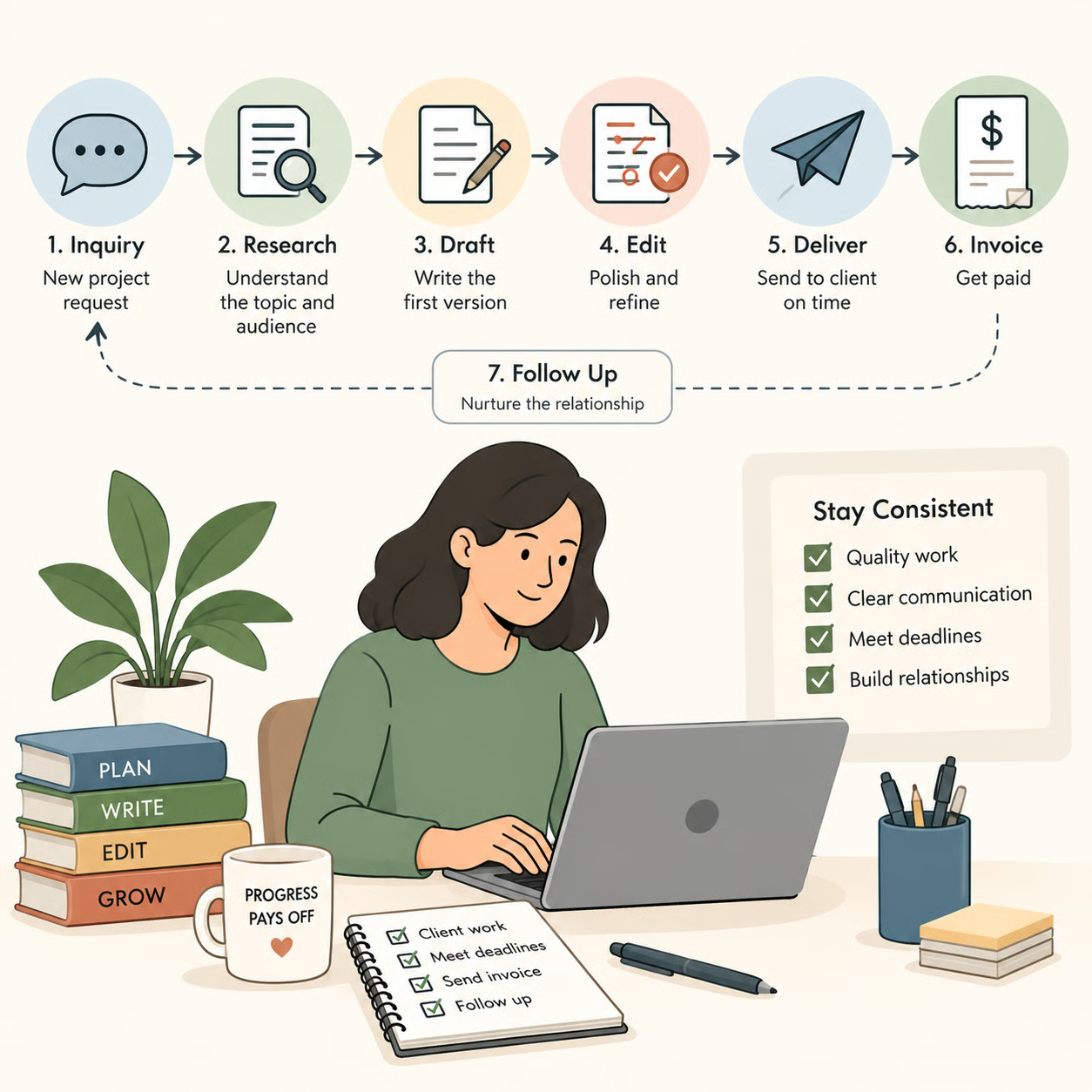
📅 Month 6: Review, Specialize & Scale
🎯 Main Goal
Review your first 6 months and decide what type of writing business you want to build next.
✅ What to Do
- Review all completed writing projects
- Identify your favorite type of writing
- Identify your most profitable service
- Review where clients came from
- Remove services that are too time-consuming or low-paying
- Update your portfolio and rates
- Create a 90-day plan for months 7–9
- Decide whether to specialize, raise prices, or pitch higher-value clients

🏁 Month 6 Success Looks Like
- You know your strongest writing service
- You have better samples and testimonials
- Your pricing is clearer
- You understand where to find clients
- You have a plan to grow with better clients or recurring work
🎯 KEY TAKEAWAY
Freelance writing grows faster when you specialize, improve your samples, and build relationships with clients who need content every month.
📊 Decision Table
If This Happens | Do This |
Blog writing sells best | Offer monthly blog packages |
Website copy pays better | Focus on service pages and landing pages |
Clients ask for SEO | Learn deeper keyword research and SEO structure |
Social captions are easy to sell | Create monthly caption bundles |
Projects take too long | Narrow scope or raise prices |
Clients ask for ongoing help | Offer retainers or monthly content plans |
Your niche feels too broad | Specialize by industry or content type |
❓ 6-Month Review Questions
- Which writing projects did you enjoy most?
- Which projects paid best for the time required?
- Which clients were easiest to work with?
- Which niche had the clearest demand?
- Which samples attracted interest?
- Which outreach method worked best?
- What should you stop offering?
- What should you charge more for?
- Can you turn one service into a monthly package?
✅ 6-Month Success Checklist
By the end of 6 months, check whether you have:
✅ Chosen one writing niche or service type
✅ Created 3–5 writing samples
✅ Built a simple writer profile or portfolio
✅ Created a rate sheet
✅ Created a client intake form
✅ Sent pitches or applied to jobs
✅ Completed first writing projects
✅ Collected feedback or testimonials
✅ Built a writing workflow
✅ Created recurring package ideas
✅ Reviewed your best client sources
✅ Created a plan for the next 90 days
⚠️ What Not to Do During the First 6 Months
Avoid these mistakes:
❌ Saying you write everything for everyone
❌ Pitching without samples
❌ Accepting vague projects with no clear scope
❌ Undercharging for research-heavy writing
❌ Missing deadlines
❌ Offering unlimited revisions
❌ Copying content from other writers
❌ Ignoring client instructions
❌ Taking projects outside your ability without being honest
❌ Forgetting to ask for testimonials or repeat work
Freelance writing is both creative work and client service. Clear scope, strong communication, and reliable delivery matter.
🧭 Simple 6-Month Milestone Tracker
Month | Main Focus | Target Output |
Month 1 | Niche & samples | 3–5 writing samples |
Month 2 | Offer setup | Packages, rates, intake form |
Month 3 | First clients | 1–3 completed projects |
Month 4 | Writing workflow | Templates, checklist, project tracker |
Month 5 | Proof & repeat work | Testimonials and recurring package ideas |
Month 6 | Review & specialize | 90-day growth plan created |
🚀 Final 6-Month Strategy
Your first 6 months should follow this simple path:
Month 1: Choose your niche and create samples
Month 2: Build your offer and client materials
Month 3: Find your first clients
Month 4: Create a repeatable writing workflow
Month 5: Improve portfolio, rates, and repeat work
Month 6: Review results and specialize
The freelance writers who grow fastest are not just good writers. They are reliable, clear, specialized, and easy for clients to hire again.
11. Get the Freelance Writing Starter Kit
🎁 Your Freelance Writing Toolkit
The Freelance Writing Starter Kit provides 12 interactive writing-business workspaces covering outreach, proposals, portfolio work, pricing, client briefs, content planning and payments.
Explore the 12 included workspaces:
✅ 1. Cold Email Pitch Builder — Draft personalized prospecting emails and track follow-ups.
✅ 2. Upwork Proposal Builder — Adapt proposal structures to each assignment and check the client’s requirements before submitting.
✅ 3. Writing Portfolio Builder — Organize writing samples and prepare portfolio content that showcases your work.
✅ 4. Rate Card & Quote Calculator — Estimate project quotes using your rates, scope and revision assumptions.
✅ 5. Client Brief & Intake Form — Capture assignment details, deadlines and client expectations in a structured brief.
✅ 6. Writing Niche Explorer — Explore 50 potential writing niches and evaluate their fit using your own research.
✅ 7. Article Outline Builder — Turn article briefs into structured outlines and record key editorial decisions before drafting.
✅ 8. SEO Editorial Checklist — Review on-page SEO, accuracy and editorial handoff requirements before delivery.
✅ 9. Invoice & Payment Tracker — Prepare itemized invoices and record outstanding balances.
✅ 10. Editorial Content Calendar — Organize writing assignments, deadlines and planned publishing dates.
✅ 11. LinkedIn Profile Optimizer — Refine your profile copy and portfolio positioning to present your writing services clearly.
✅ 12. Writing Specialization Planner — Compare writing specializations and plan an initial research trial before choosing a focus.
Also in the editable master: The editable master includes a central dashboard, Start Here guide and supporting practice worksheets. Final customer packaging may differ.
The current master is a review copy awaiting buyer-device acceptance. The tools do not contact clients, publish content or process payments automatically, and paid work is not guaranteed.

12. Frequently Asked Questions
🎓 Do I need a degree in English or journalism?
No. Many successful freelance writers have no writing degree. What matters:
- ✍️ Clear writing
- ⏰ Meeting deadlines
- 🧠 Understanding what clients need
- 📚 Ability to learn
💡 Some of the best writers are self-taught.
⏳ How long until I make real money?
Timing varies. Some writers land a first paid project within a couple of months of consistent pitching, but it can take longer.
Income depends on niche, rates, available hours, and how quickly you specialize—not a set monthly ladder.
📋 Should I work on multiple job boards or focus on one?
Start with 2–3, but focus most of your energy on one.
Once you’re getting regular work from your primary source, expand.
💡 Most pros use multiple platforms, but they focus applications where they get the best results.
💼 Is Upwork/Fiverr worth it or is it race to the bottom?
Worth it for starting out.
Used strategically, they help you:
- 🧾 Build a portfolio quickly
- ⭐ Establish testimonials
- 🤝 Learn client management
Then transition to higher-paying direct clients and agencies as you gain experience.
🔁 How do I handle clients who want revisions forever?
Define scope upfront:
“2 rounds of revisions included, then $X per additional revision.”
Put it in writing.
👉 This sets expectations and prevents scope creep.
🚀 Can I make full-time income from freelance writing?
Some people do, after they have samples, clients, and a repeatable process. Timing varies widely.
Full-time income is not typical for beginners and depends on specialization, hours, and client mix—not a promised range.
📈 What's the best way to raise my rates?
Start low with your first few clients to build portfolio pieces and testimonials.
Then raise rates for new clients every 2–3 months as you gain:
- ⭐ Testimonials
- 🧠 Expertise
- 📁 Better samples
- 🎯 Clearer positioning
After you have relevant samples and a clearer niche, you can test higher rates—there is no standard per-word jump.
🔍 Should I learn SEO?
Yes. SEO knowledge can make you more useful to content clients.
Start with:
- 🎓 1–2 free SEO courses
- 🔑 Basic keyword research
- 🧱 On-page optimization
- 📊 Search intent basics
SEO-focused work can support stronger positioning than generic articles, but rates still vary by client, niche, and scope.
📉 How do I handle rejection and not getting clients?
Rejection is normal.
Most pitches get no reply.
That means:
- 📩 Send tailored pitches consistently
- ✅ A small share may turn into a conversation
- 🔁 Keep improving and sending more
💡 Most successful freelancers say the key is volume + persistence, not talent alone.
🎯 Should I specialize in one niche or keep options open?
Specialize.
You can always evolve later.
Example:
- ❌ “Generalist writer”
- ✅ “SaaS content writer”
💡 Specialists usually get better clients and higher rates.
🚩 How do I know if a client is legitimate before starting work?
Watch for red flags:
- ❌ No clear payment method
- ❌ Vague budget
- ❌ Rushing you
- ❌ Asking for free samples
- ❌ Unprofessional communication
Green flags:
- ✅ Clear scope
- ✅ Defined budget
- ✅ Professional communication
- ✅ Uses established platforms like Upwork
📚 Can I write about topics I don't know well?
Yes, but it’s harder and takes longer.
Early on, pick topics where you have existing knowledge.
As you improve your research skills, you can write about new topics.
💡 Expert writers often pitch unfamiliar topics because research becomes their superpower.
✍️ What's the difference between content writing and copywriting?
Content writing:
- 📘 Informs
- 🎓 Educates
- 🎭 Entertains
- Examples: blogs, articles, social media
Copywriting:
- 💰 Persuades
- 🛒 Sells
- 🎯 Converts
- Examples: sales pages, emails, ads
💡 Copywriting typically pays 2–3x more. Consider learning both.
🧠 How do I handle imposter syndrome as a new writer?
Normal feeling.
Remember:
- You don’t need to be perfect
- You just need to be better than your client’s current situation
- Growth comes from doing the work
Tips:
- ⭐ Read your positive testimonials regularly
- 📈 Track your growth
- 📝 Compare your first article to recent work
Most successful writers felt like imposters at the start.
👥 Should I take on multiple clients or focus on one?
Start focused with 1–2 clients while building.
As you grow, 4–6 clients is ideal.
Why?
- Too many clients = chaos and lower quality
- Too few clients = risk if one leaves
👉 Balance is key.
📁 How do I build a writing portfolio with no experience?
Start here:
- 📝 Start a blog on Medium or a personal site
- ✍️ Write 5 strong articles in your niche
- 🤝 Guest post on 1–2 established blogs
- 📄 Create 2–3 spec pieces for specific client types
- 📁 Use these as your legitimate portfolio
⏳ This usually takes 2–3 weeks of part-time work.
13. Important Considerations
Before jumping into freelance writing, understand what separates beginners from those who actually make consistent income.
⏳ It Takes Time to Build Income
Freelance writing is not instant money.
Early months are often slow. Some writers bill a few hundred dollars while building samples; others take longer.
👉 Expect a slow start, not a set monthly ladder.
📉 High Rejection Rate Is Normal
You will:
- 📩 Send 10+ pitches
- 📬 Hear back from 1–2
- ❌ Get rejected often
📌 Most pitches getting no reply is normal.
👉 Success = volume + persistence.
💰 Low-Paying Work at the Start
Early jobs may pay:
- 💵 $20–$100 per article
- 🧾 Lower starter rates while building your portfolio
⚠️ But:
👉 Staying low-priced too long = getting stuck.
🎯 Specialization Is Required to Scale
General writers struggle.
Niche writers often earn 2–3x more.
Example:
- ❌ “Freelance writer”
- ✅ “SaaS blog writer”
🧠 SEO Knowledge Is a Game-Changer
SEO writers can earn 2–3x higher rates.
If you ignore SEO:
- 📉 You limit your earning potential
- 🔍 You become less valuable to content clients
- 💸 You compete mostly on price
⏱️ Deadlines Matter More Than Talent
Clients care more about:
- ⏰ Reliability
- 💬 Communication
- 🔁 Consistency
⚠️ Missing deadlines is one of the fastest ways to lose clients.
📄 Portfolio > Credentials
You don’t need:
- ❌ A degree
- ❌ Certifications
You DO need:
- ✅ 3–5 strong writing samples
- ✅ Clear examples of your ability
- ✅ Proof you can write for a specific audience
👉 Your portfolio is your “resume.”
⚠️ Bad Clients Exist
Watch for:
- ❌ Vague instructions
- ❌ No clear payment method
- ❌ Requests for free work
- ❌ Rushed timelines
- ❌ Unclear expectations
Green flags:
- ✅ Clear scope
- ✅ Clear budget
- ✅ Professional communication
🔁 Income Is Not Stable at First
Early freelance writing income can be inconsistent.
Problems:
- 📉 Work may slow down
- 👻 Clients may disappear
- 💸 Payments may vary month to month
Solution:
- 🤝 Build multiple clients
- 🔁 Secure retainers
- 📬 Keep pitching even when busy
📈 Scaling Requires Business Skills
Writing alone isn’t enough.
You must learn:
- 📬 Pitching
- 💰 Pricing
- 💬 Client communication
- ⏰ Time management
👉 You are running a service business, not just writing.
💡 Final Reality Check
Freelance writing is:
✔ 🚪 One of the lowest barrier side hustles
✔ 📈 Extremely scalable
✔ 🌐 Flexible and remote
But also:
❌ Requires consistency
❌ Requires rejection tolerance
❌ Requires skill development
14. Your Next Steps
🚀 ACTION STEP
📅 This Week
- 🎯 Choose 1–2 writing niches based on what you know
- 📁 Create your portfolio with 3–5 sample articles or Medium posts
- 💼 Set up Upwork and Fiverr accounts
- 🧾 Join the ProBlogger job board
- 🔍 Study 3 successful freelance writer profiles
🗓️ This Month
- ✨ Polish your portfolio pieces
- 🎯 Customize your profiles with clear positioning
- 📩 Apply to 5–10 job board jobs
- 📬 Send 5 cold email pitches to potential clients
- 💰 Work toward your first paying projects
🚀 Next 90 Days
- ✍️ Complete 10–15 writing projects
- ⭐ Collect 5+ positive testimonials
- 📈 Raise your rates 20–30%
- 🎯 Start targeting higher-paying jobs
- 🏢 Pitch content agencies
- 💰 Review what paid, what took too long, and whether a clearer niche or package would help
15. The Bottom Line
🎯 KEY TAKEAWAY
Freelance writing is a low-cost way to start earning from a skill you can practice — no degree or certifications required.
🙋 If you:
✔ Write clearly and meet every deadline
✔ Keep pitching through rejection — a 90% rejection rate is normal
✔ Specialize in a niche instead of staying a generalist
✔ Raise your rates as your portfolio and testimonials grow
🏗️ You can build:
💰 Earnings that vary with niche, rates, and repeat work — not a set monthly ladder
📈 A path from one-off gigs toward retainers if clients need ongoing content
🌐 Flexible, remote work for clients you choose
🚀 Businesses need content — clear writing and reliable delivery can create paid opportunities, though results are not guaranteed.

16. Recommended Websites & Tools
🛠 TOOLS & RESOURCES
You do not need every resource listed below. This directory brings together the major platforms, tools, and resources from this guide, along with additional research and learning options, so you can find them in one place when you need them.
Start with the essentials. Add tools only when your writing business develops a specific need for them.
✍️ Writing, Editing & Drafting Tools
- Grammarly — Grammar, spelling, tone, and clarity checker for polishing client drafts before delivery.
- Hemingway App — Readability tool for making articles, web copy, and client writing clearer and more concise.
- ProWritingAid — Deep editing and style-improvement tool for writers who want stronger grammar, flow, and structure feedback.
- ChatGPT — AI writing assistant for brainstorming, outlines, editing support, idea generation, and structure help.
- Claude — AI assistant for drafting support, brainstorming, outlining, research organization, and long-form writing help.
💡 PRO TIP
Polish every draft with an editing tool before delivery — but let your own judgment make the final call. Tools miss context and voice.
📂 Organization, Writing Workflow & Client Management
- Notion — Workspace for tracking pitches, deadlines, clients, content calendars, rates, and writing systems.
- Google Docs — Writing and collaboration tool most clients already understand for drafts, comments, edits, and shared documents.
- Trello — Visual project board for tracking article stages, deadlines, revisions, clients, and active writing projects.
- Airtable — Database-style tool for organizing clients, pitches, rates, portfolio pieces, niches, and outreach pipelines.
🧾 Portfolio & Sample Platforms
- Medium — Publishing platform for hosting sample articles, building writing credibility, and creating public portfolio pieces.
- Contently — Professional writer portfolio platform for showcasing clips, bylines, niches, and client-ready writing samples.
- Personal Website — A simple writer homepage for your services, portfolio, testimonials, contact form, and niche positioning.
🔍 SEO, Research & Content Optimization
- Surfer SEO — Content optimization tool for SEO-focused writers creating search-friendly blog posts and articles.
- NeuronWriter — SEO content optimization tool for planning, scoring, and improving articles based on search competition.
- Google Scholar — Research tool for finding academic sources, credible studies, and stronger evidence for articles.
- BuiltWith — Research tool for identifying company tech stacks, useful for pitching SaaS, tech, and B2B writing clients.
- Google — Research tool for finding prospects, studying company blogs, researching niches, and building targeted outreach lists.
📝 QUICK NOTE
Basic SEO knowledge can make you more useful to content clients. One free course plus keyword research basics is a practical next skill.
📋 Job Boards & Writing Opportunities
- ProBlogger Jobs — Writing job board for blog posts, niche articles, and better-quality writing opportunities.
- Contently Gigs — Writing opportunity board connected to publication-style work, professional writing jobs, and byline opportunities.
🌐 Freelance Marketplaces
- Upwork — Freelance marketplace for blog writing, website copy, SEO articles, email copy, and long-term client projects.
- Fiverr — Package-based freelance platform for selling blog posts, product descriptions, website copy, and content bundles.
📝 QUICK NOTE
Use marketplaces to build your portfolio and testimonials fast, then transition to direct clients and retainers.
🏢 Content Agencies & Managed Writing Platforms
- Contently — Content marketing platform and portfolio tool for professional writers and brand journalism opportunities.
- Verblio — Content agency platform for blog posts, recurring content, and client writing assignments.
- WriterAccess — Managed content platform for writers looking for varied client projects and writing assignments.
- Scripted — Vetted freelance writing platform for business content, blog writing, and client projects.
- Skyword — Enterprise content marketing platform for writers interested in larger brand and content strategy projects.
👔 Networking, Outreach & Client Discovery
- LinkedIn — Professional networking platform for finding content managers, founders, coaches, agencies, and higher-quality writing clients.
- Google — Search tool for direct outreach research, company blog audits, niche prospect lists, and content opportunity discovery.
🎯 KEY TAKEAWAY
You do not need every tool on this page. One writing tool, one portfolio home, and one place to find clients are enough to land your first gig.
🧭 How to Use This Directory
🧰 Start With a Simple Setup
Do not start by creating accounts with every service listed above. For most beginners, a simple setup is enough:
- One writing & editing tool
- One portfolio home
- One job board or marketplace
- One way to track clients
- Basic invoicing
That is enough to start building. Add tools only when you can name the specific problem they will solve.
🎯 KEY TAKEAWAY
Tools support the business. They are not the business.
Your biggest advantages will come from:
Clear writing → Meeting deadlines → Specializing → Raising your rates
17. Explore Similar Side Hustles
 Copyediting & Proofreading: Get Paid to Polish Words — Use your writing eye to polish other people's work for steady per-project income.
 Blogging: Build an Online Brand and Earn from Your Words — Build your own content asset that earns from ads and affiliates instead of client deadlines.
 Newsletter Monetization: Get Paid to Write About What You Love — Write for an audience you own and earn from subscriptions and sponsorships.
- Self-Publishing on Amazon KDP — Turn your writing skills into books you publish and sell yourself.
- Resume Writing & LinkedIn Optimization — Specialize in a high-demand writing niche with fast-turnaround projects.
 Affiliate Marketing: Get Paid to Promote What You Love — Write content you own and monetize it through disclosed product recommendations.