Affiliate disclosure: Some links in this guide may be paid referral links. If you purchase or sign up through one, One Stop Side Hustles may earn a commission. How our affiliate links work.
LAWN CARE & YARD WORK STARTER GUIDE
Learn how lawn care and yard work services work—including choosing starter services, quoting clearly, finding local customers, and growing from one-time jobs toward recurring routes. Results vary with your market, hours, equipment costs, season, and whether clients rebook.
1. What Is Lawn Care & Yard Work?
2. Why Lawn Care & Yard Work Is a Great Side Hustle
3. Lawn Care & Yard Work Services You Can Offer
4. How Much Can You Earn & Pricing Strategies
5. Essential Tools & Equipment
7. From First Quote to Recurring Route
8. Skills That Accelerate Success
9. Learning, Templates & Resources
10. Your First 6 Months Lawn Care & Yard Work Plan
11. Get the Lawn Care Business Starter Kit
12. Frequently Asked Questions
Quick Snapshot
Earn: Highly variable — per-job rates and monthly totals depend on property size, route density, season, and expenses
Work: Flexible, seasonal work on evenings and weekends
Start: Medium cost — a mower, trimmer, and leaf blower
Best for: People who enjoy outdoor, physical work
Grow: One-off jobs → recurring routes → crew business
1. What Is Lawn Care & Yard Work?
Lawn care and yard work involves maintaining outdoor spaces for homeowners, businesses, and property managers through regular mowing, trimming, cleanup, and seasonal services.
📦 Core Services
- Lawn mowing and edging
- Trimming and pruning hedges/bushes
- Leaf and debris removal
- Weeding and bed maintenance
- Mulching and landscaping
- Seasonal cleanup (spring/fall)
- Snow removal (winter in applicable areas)
- Fertilization and lawn treatment
You handle: Service delivery, customer communication, scheduling, equipment maintenance, quality control
🎯 KEY TAKEAWAY
You're not just cutting grass—you're improving curb appeal, maintaining property values, and providing peace of mind to busy homeowners and property managers. Reliable, quality lawn care is consistently in demand year-round in most markets.
2. Why Lawn Care & Yard Work Is a Great Side Hustle
Lawn care and yard work is a strong side hustle because it combines steady local demand, simple service offers, and a clear path from one-time jobs into recurring route income.
💰 Even basic services can create meaningful income
Customers regularly pay for mowing, cleanup, and upkeep because the work is visible, time-sensitive, and easy to value.
Common income sources include:
- Mowing jobs
- Yard cleanup
- Seasonal work
- Trimming and edging
- Add-on property services
That makes lawn care one of the more practical local side hustles for turning effort into cash quickly.
🧰 You can start with a relatively simple setup
You do not need a full commercial operation on day one.
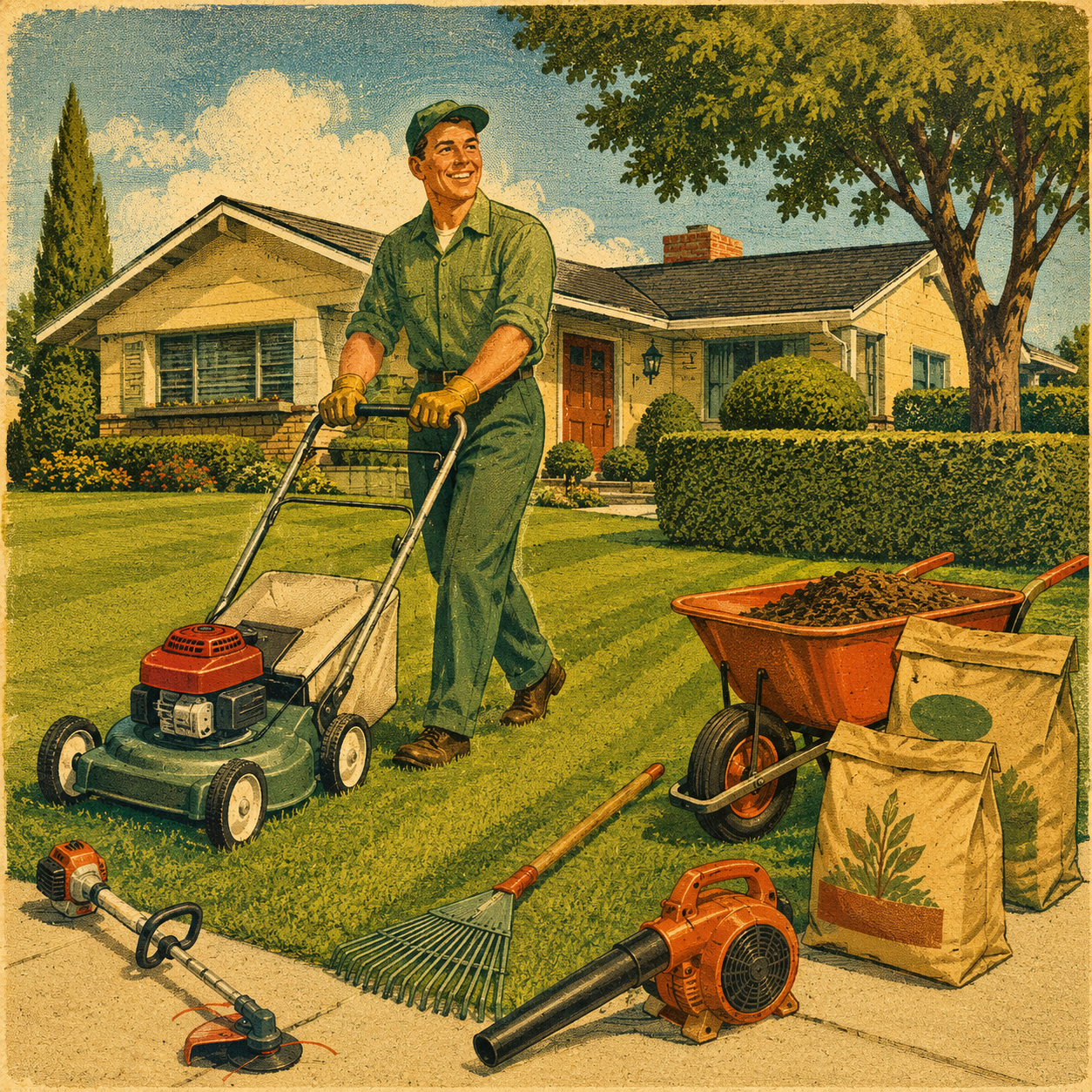
A basic starter setup can include:
- Lawn mower
- Trimmer or edger
- Leaf blower
- Gloves and safety gear
- A few cleanup tools
You can upgrade equipment gradually as route density and revenue improve.
🕒 It fits well around part-time availability
Many lawn care jobs can be scheduled in flexible work windows:
- Evenings
- Weekends
- Seasonal rush periods
- Short route blocks
- Weekly maintenance cycles
That flexibility makes it easier to start part-time before deciding whether to grow it further.
🤝 Recurring clients can make the income far more stable
One of the biggest advantages is that good service often turns into repeat work.
Common recurring outcomes include:
- Weekly mowing
- Biweekly maintenance
- Seasonal cleanup return jobs
- Easier scheduling
- Less constant prospecting
That repeat demand is what starts turning random yard jobs into a dependable business rhythm.
🌱 Most beginner services are easy to learn and repeat
Many entry-level services do not require advanced landscaping knowledge to begin safely.
Common starter services include:
- Mowing
- Edging
- Blowing debris
- Basic cleanup
- Leaf removal
That makes lawn care especially approachable for people who enjoy physical, outdoor work and visible results.
⚡ You can often get early clients through simple local outreach
Because this is neighborhood-based work, first customers often come from direct local visibility.
Common first-client channels include:
- Door knocking
- Facebook groups
- Nextdoor posts
- Intro offers
- Neighbor referrals
A few strong jobs in one neighborhood can create much more momentum than scattered leads across a whole city.
📈 Route density and add-ons can raise profit quickly
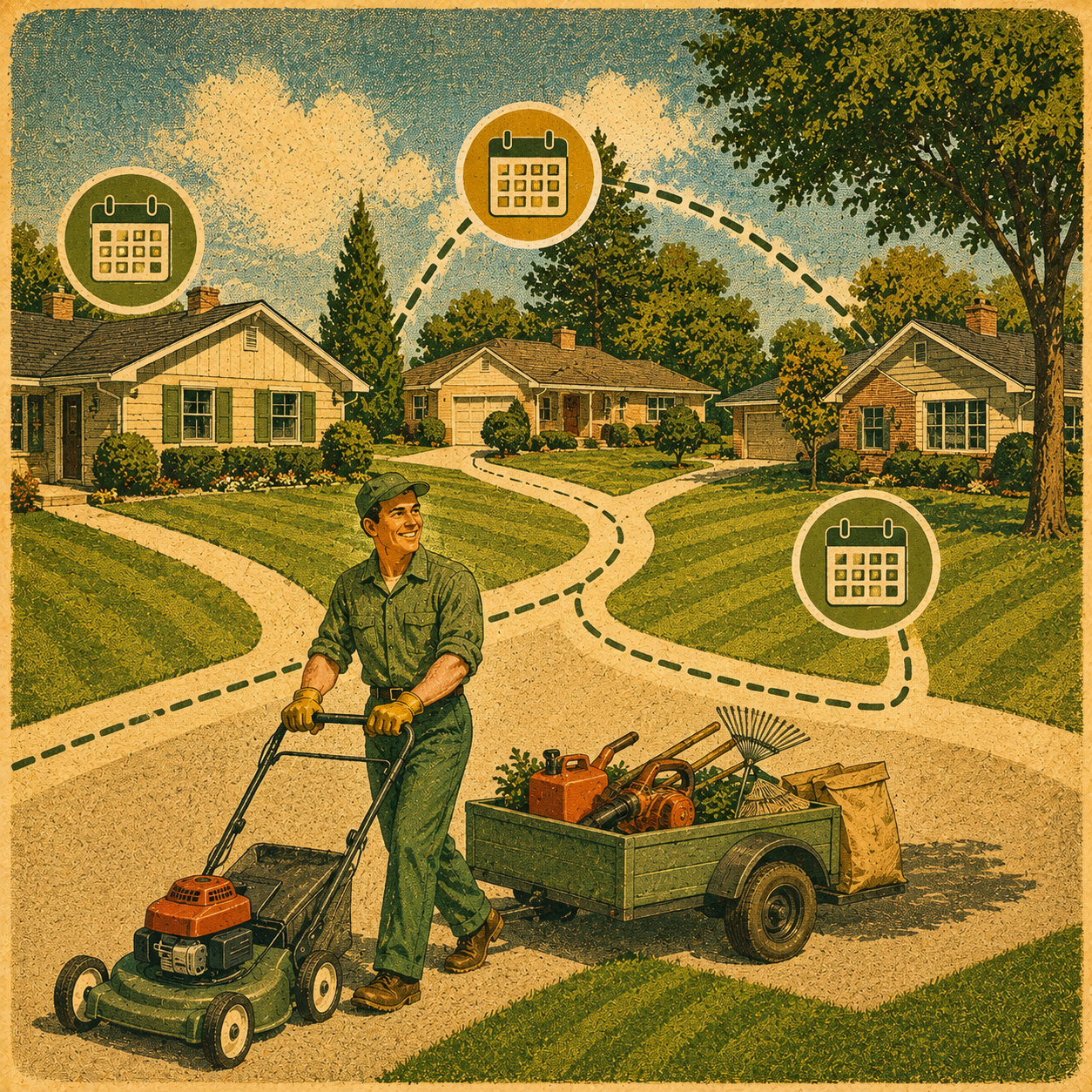
The business becomes stronger when you group nearby customers and increase revenue per stop.
Key growth levers include:
- Dense route planning
- Weekly service plans
- Spring and fall cleanups
- Mulching and trimming
- Leaf removal and extras
The more efficient your route becomes, the more each hour of work is worth.
🧪 It can expand into a broader outdoor service business
Once demand is steady, lawn care can open the door to larger or more valuable service lines.
Common next steps include:
- Landscaping services
- Commercial accounts
- Snow removal
- Crew-based operations
- Seasonal specialty work
It can begin as side income and grow into a more scalable local business over time.
3. Lawn Care & Yard Work Services You Can Offer
One of the advantages of starting a lawn care business is that you do not need to offer every outdoor service from day one. You can begin with a few simple jobs using basic equipment, then add more specialized and higher-value services as your skills, equipment, and customer base grow.
A good beginner strategy is to combine recurring services that create predictable work with one-time and seasonal services that increase the value of each customer.
Below are the main lawn care and yard work categories you can build your service menu around.
📝 QUICK NOTE
Examples on this page are general service descriptions, not guaranteed jobs or income. Equipment use carries real injury and property-damage risk, so follow manufacturer instructions, wear appropriate protective gear, and check local licensing, insurance, and chemical-use rules before taking paid work.
🌱 Routine Lawn Maintenance
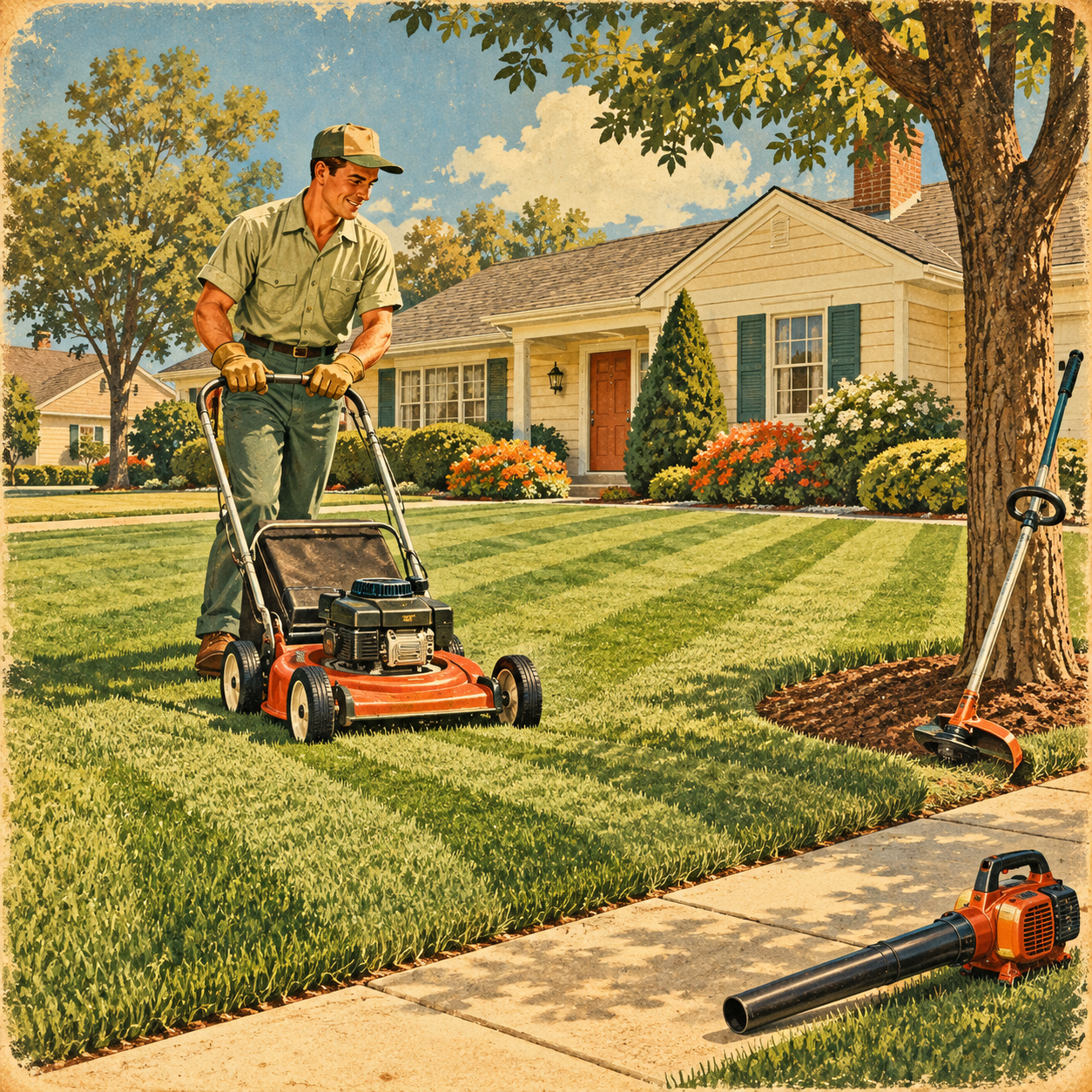
🚜 Lawn Mowing
- 🧰 Typical Work: Cutting grass, mowing around obstacles, basic property inspection, and blowing clippings from hard surfaces
- ⭐ Difficulty: ⭐⭐ Easy to moderate | 🔁 Repeat Potential: Very high
- 🛠️ Main Equipment: Lawn mower, blower, and safety gear
- 👥 Typical Customers: Homeowners, landlords, rental properties, and small businesses
- 🌟 Best for: Beginners who want to build a recurring weekly or biweekly customer route
✂️ Edging & String Trimming
- 🧰 Typical Work: Trimming around fences and trees, cleaning lawn edges, and defining sidewalks, driveways, and curbs
- ⭐ Difficulty: ⭐⭐ Easy | ➕ Add-On Potential: Very high
- 🛠️ Main Equipment: String trimmer, edger, and blower
- 👥 Typical Customers: Existing mowing clients and properties needing a cleaner finished appearance
- 🌟 Best for: Pairing with mowing to create a more complete recurring lawn service
💡 PRO TIP
Offer mowing, edging, and trimming as one recurring visit with a single price. Customers value a finished-looking lawn, and bundled stops are faster for you to run.
🌳 Trees, Shrubs & Plant Maintenance
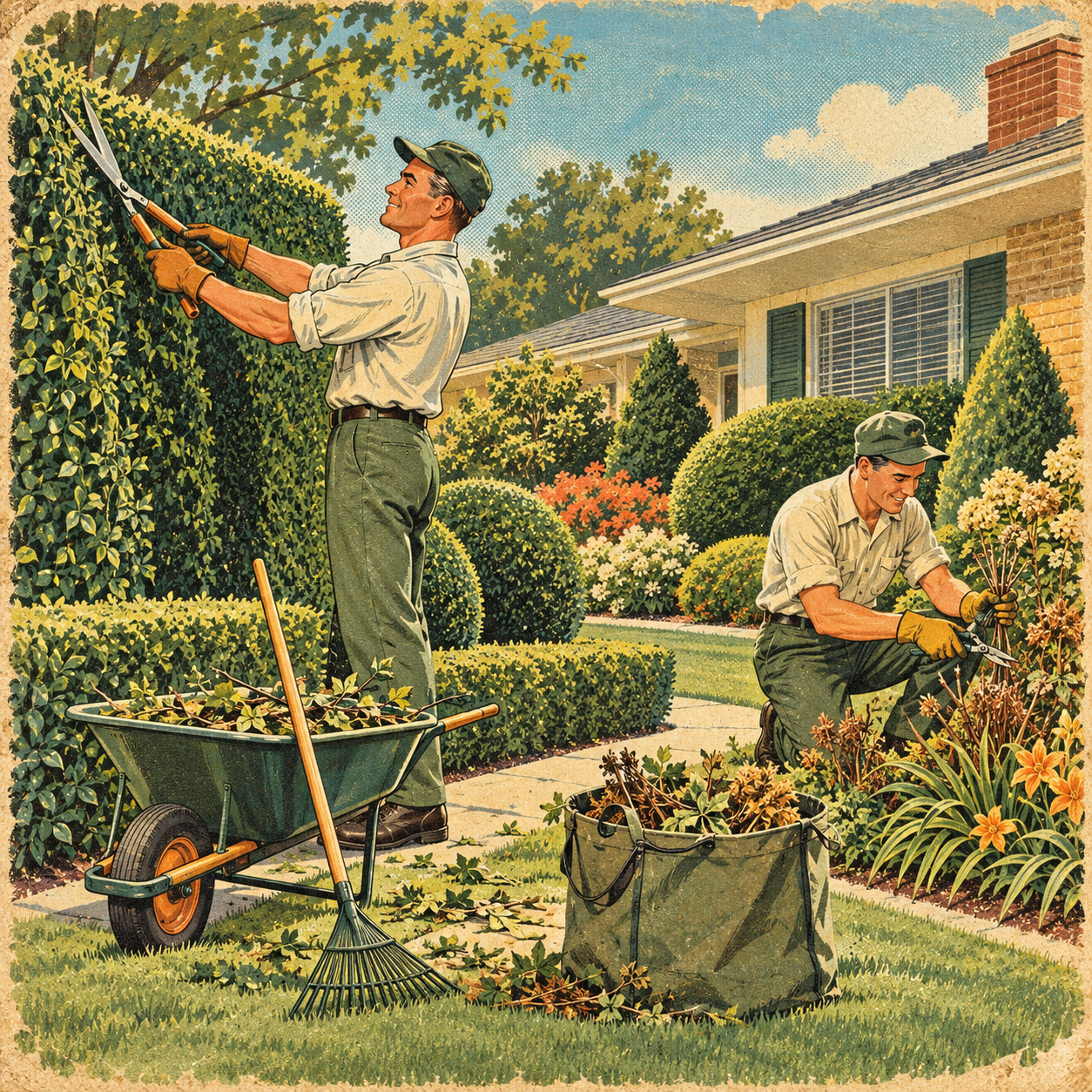
✂️ Hedge & Shrub Trimming
- 🧰 Typical Work: Shaping shrubs, trimming hedges, removing overgrowth, and maintaining plant appearance
- ⭐ Difficulty: ⭐⭐⭐ Moderate | 💰 Upsell Potential: High
- 🛠️ Main Equipment: Hedge trimmer, pruning shears, gloves, and cleanup tools
- 👥 Typical Customers: Homeowners, rental properties, and small commercial properties
- 🌟 Best for: Lawn care operators who want an easy add-on beyond mowing
🌿 Pruning & Plant Maintenance
- 🧰 Typical Work: Light pruning, removing dead growth, maintaining ornamental plants, and keeping planting areas tidy
- ⭐ Difficulty: ⭐⭐⭐ Moderate | 🧠 Knowledge Required: Moderate
- 🛠️ Main Equipment: Hand pruners, loppers, gloves, and cleanup tools
- 👥 Typical Customers: Properties with shrubs, ornamental plants, and established landscaping
- 🌟 Best for: Operators comfortable learning basic plant-care techniques and offering more detailed property maintenance
⚠ COMMON MISTAKE
Do not prune, remove, or treat plants you cannot identify. Cutting at the wrong time or using the wrong product can damage plants, so stick to work you are trained for and decline the rest.
🌼 Garden Bed & Landscape Maintenance
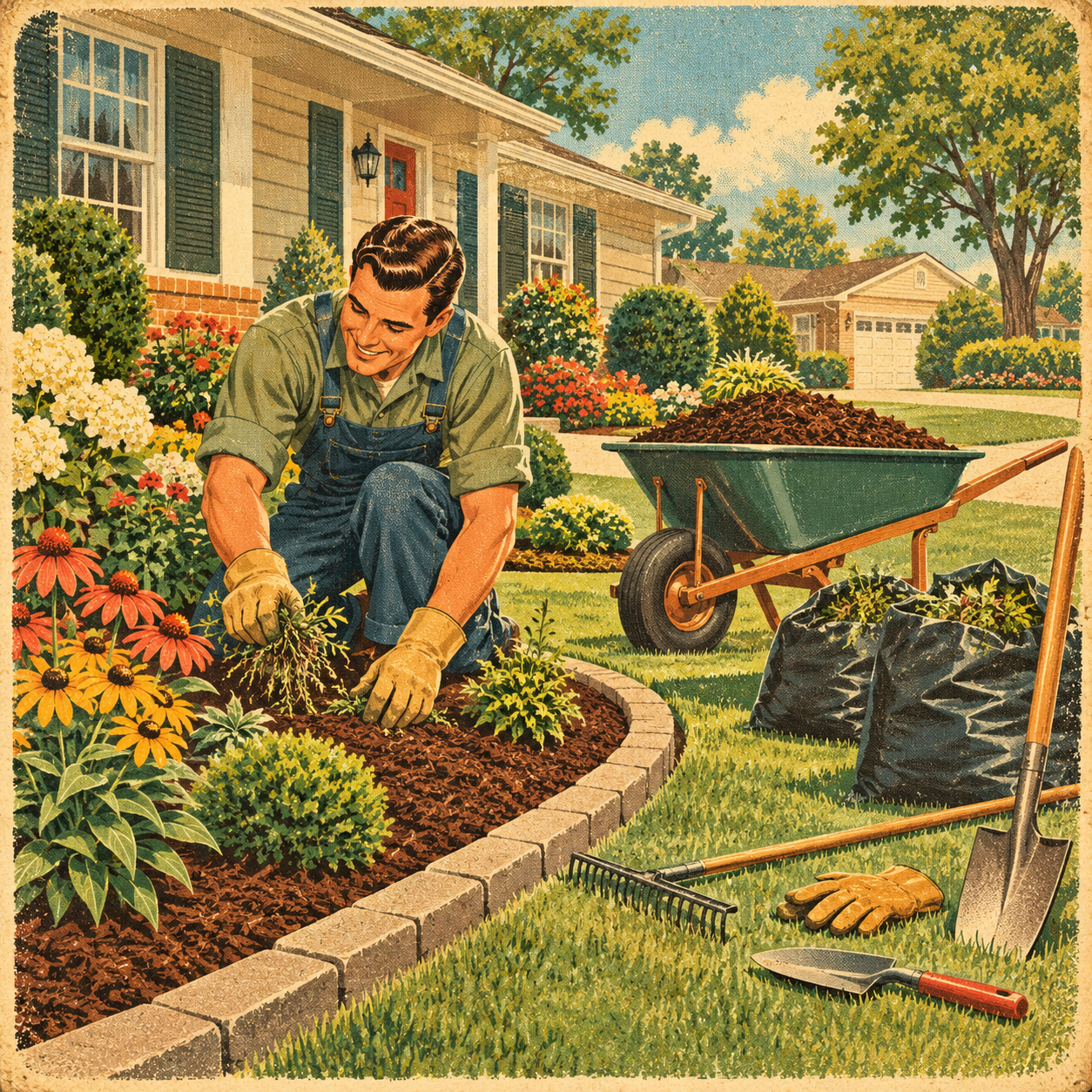
🌱 Weeding & Bed Maintenance
- 🧰 Typical Work: Pulling weeds, cleaning flower beds, removing unwanted growth, and maintaining bed edges
- ⭐ Difficulty: ⭐⭐ Easy | 🕒 Labor: Moderate
- 🛠️ Main Equipment: Hand tools, gloves, hoe, rake, and collection bags
- 👥 Typical Customers: Homeowners with flower beds, landscaped properties, and rental homes
- 🌟 Best for: Beginners looking for a service requiring relatively little specialized equipment
🪵 Mulching
- 🧰 Typical Work: Preparing beds, spreading mulch, refreshing landscaped areas, and creating a cleaner finished appearance
- ⭐ Difficulty: ⭐⭐ Easy to moderate | 💰 Project Value: Moderate to high
- 🛠️ Main Equipment: Wheelbarrow, shovel, rake, and transportation for materials
- 👥 Typical Customers: Homeowners wanting to refresh landscaping and improve curb appeal
- 🌟 Best for: Adding larger one-time projects to recurring lawn accounts
📋 REAL-WORLD EXAMPLE
After a regular mowing visit, you notice overgrown beds beside the walkway. Offer a one-time weeding and mulch refresh with a clear flat price. The customer gets a better yard, and you get a larger ticket from an existing account.
🍂 Cleanup & Property Reset Services
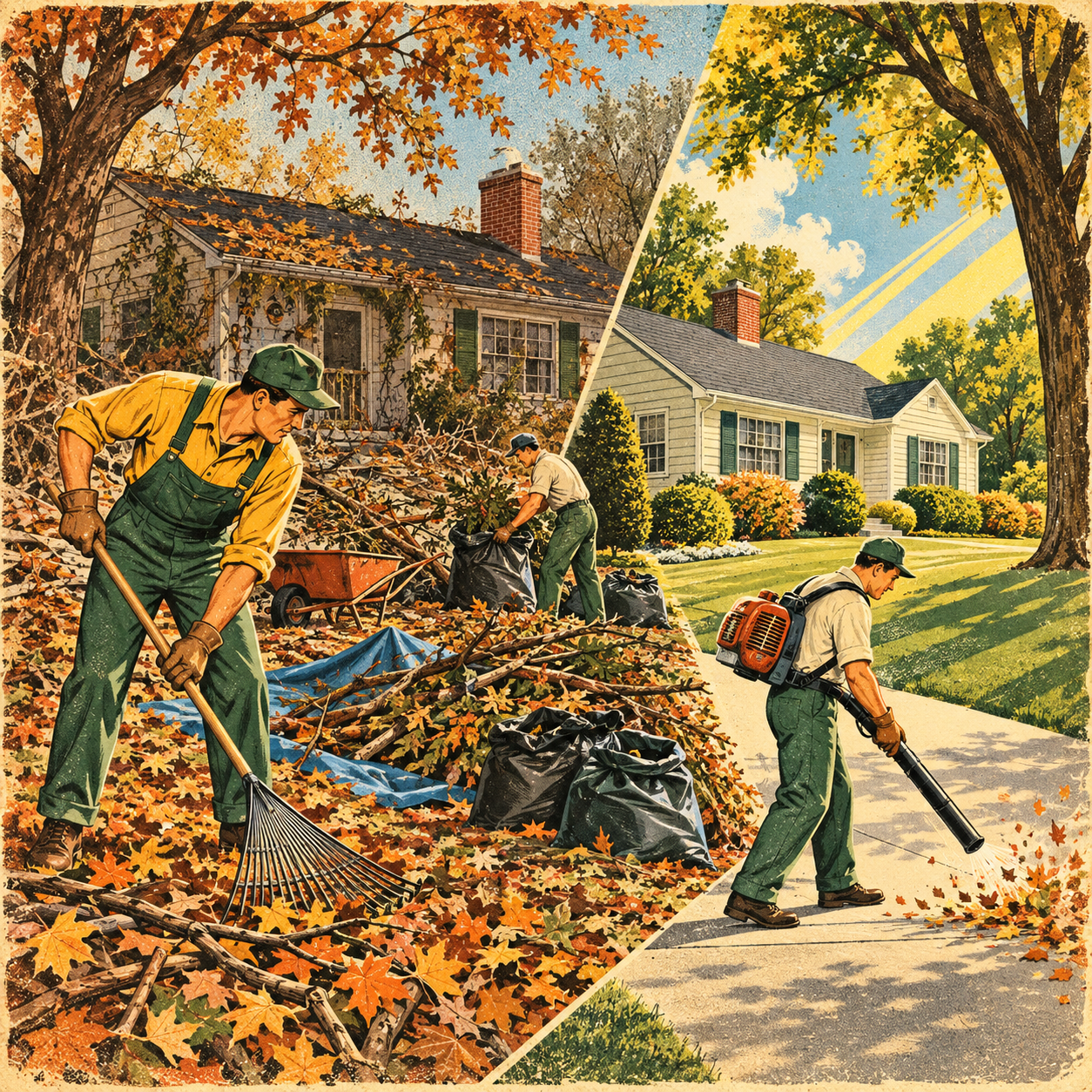
🧹 Yard & Debris Cleanup
- 🧰 Typical Work: Removing branches, leaves, and loose debris, clearing neglected areas, and tidying outdoor spaces
- ⭐ Difficulty: ⭐⭐ Easy to moderate | ⚡ Startup Friendly: Very high
- 🛠️ Main Equipment: Rake, blower, tarps, bags, and basic hand tools
- 👥 Typical Customers: Busy homeowners, landlords, rental-property owners, and people preparing a property for sale or move-in
- 🌟 Best for: Beginners looking for straightforward one-time jobs that can lead to recurring clients
🍁 Leaf Removal
- 🧰 Typical Work: Blowing, raking, collecting, and removing fallen leaves from lawns and landscaped areas
- ⭐ Difficulty: ⭐⭐ Easy | 🍂 Seasonality: High
- 🛠️ Main Equipment: Leaf blower, rake, tarps, bags, and hauling capacity
- 👥 Typical Customers: Properties with mature trees and existing lawn-care customers
- 🌟 Best for: Filling the fall schedule and generating additional revenue from existing mowing clients
💡 PRO TIP
Message your mowing customers early in the season with a leaf-cleanup price and available dates. Booking ahead keeps your fall schedule full before competitors reach them.
🌾 Lawn Improvement Services
🌱 Fertilization & Lawn Treatments
- 🧰 Typical Work: Applying appropriate lawn products according to product directions and local requirements
- ⭐ Difficulty: ⭐⭐⭐⭐ Moderate to advanced | 🧠 Knowledge Required: Higher
- 🛠️ Main Equipment: Spreader or appropriate application equipment and required protective equipment
- 👥 Typical Customers: Homeowners seeking healthier, thicker, or better-looking lawns
- 🌟 Best for: More experienced operators who understand the products they use and any applicable local licensing or application requirements
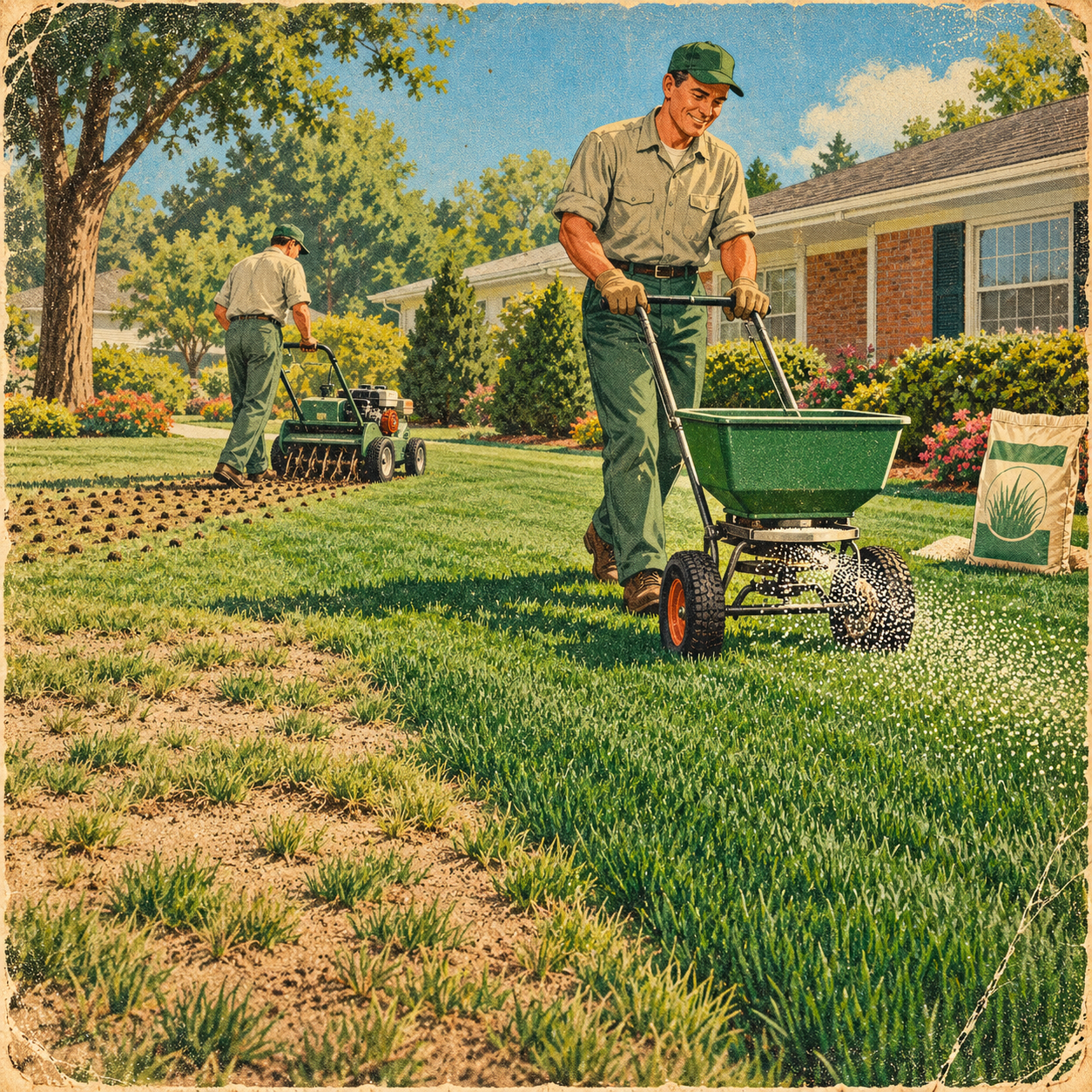
🌿 Aeration & Overseeding
- 🧰 Typical Work: Aerating compacted soil, distributing grass seed, and helping customers improve thin or stressed lawns
- ⭐ Difficulty: ⭐⭐⭐ Moderate | 💰 Add-On Potential: High
- 🛠️ Main Equipment: Aerator, spreader, seed, and cleanup equipment
- 👥 Typical Customers: Established lawns needing improvement or seasonal restoration
- 🌟 Best for: Operators ready to add higher-value seasonal lawn-improvement services
⚠ COMMON MISTAKE
Do not rent or buy aeration or seeding equipment before you have a customer commitment. Confirm demand, timing, and the cost of equipment and hauling first so that the job still pays after expenses.
🌦️ Seasonal Outdoor Services
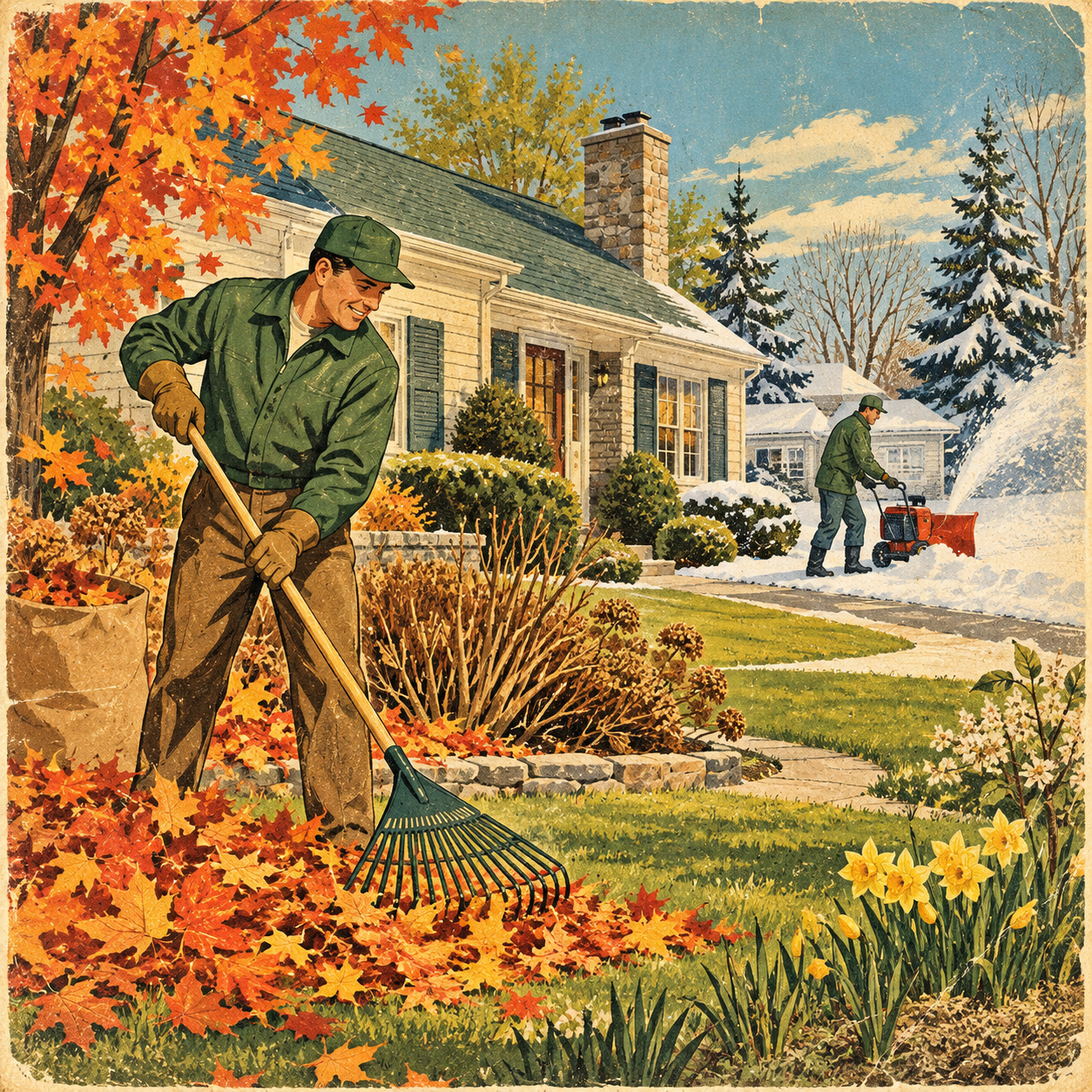
🌷 Spring & Fall Cleanups
- 🧰 Typical Work: Clearing seasonal debris, cutting back dead growth, cleaning beds, removing leaves, and preparing properties for the next season
- ⭐ Difficulty: ⭐⭐ Easy to moderate | 📅 Demand: Seasonal
- 🛠️ Main Equipment: Blower, rake, pruning tools, tarps, bags, and hauling equipment
- 👥 Typical Customers: Existing lawn clients and homeowners needing a full property reset
- 🌟 Best for: Increasing revenue at the beginning and end of the main mowing season
❄️ Winter & Weather-Related Services
- 🧰 Typical Work: Snow removal, ice-melt application, or storm-debris cleanup where climate and conditions create demand
- ⭐ Difficulty: ⭐⭐⭐ Varies by service | 🌦️ Demand: Location-dependent
- 🛠️ Main Equipment: Depends heavily on the service and local climate
- 👥 Typical Customers: Existing lawn clients, homeowners, and small commercial properties
- 🌟 Best for: Operators in markets where seasonal weather creates useful off-season work
💡 PRO TIP
Check local rules and insurance before offering snow, ice, or other weather-dependent work. Set a clear service scope and response window so storm days do not turn into unpaid, rushed jobs.
🎯 Build Your Beginner Yard-Care Menu
🎯 KEY TAKEAWAY
Start with lawn mowing, edging, string trimming, weeding, and basic yard cleanup. Add shrubs, mulch, leaf removal, and seasonal services as your equipment, knowledge, and customer base grow.
🚀 ACTION STEP
Write a focused first plan:
- Starter services: Choose tasks your equipment and skills can support safely.
- Property scope: Define area, access, waste disposal, and any excluded work.
- Requirements: Check local rules, insurance, and any treatment or pesticide restrictions.
- Quote & schedule: Set a visit price and realistic recurring route before adding services.
4. How Much Can You Earn & Pricing Strategies
Lawn care income grows when you stop thinking only in terms of “more lawns” and start thinking about route density, repeat revenue, and higher-value add-ons.
The same mower and the same number of hours can produce very different income depending on how your services are packaged and where your customers are located.
🧠 Reality Check (What Actually Raises Income)
Stronger earners usually:
- Build recurring weekly or biweekly routes
- Price by property and scope, not only by time
- Upsell cleanup and seasonal services
- Reduce drive time between jobs
- Improve speed without dropping quality
The business gets better when each stop becomes more profitable.
🎯 KEY TAKEAWAY
Denser routes and a suitable service mix can beat simply mowing more lawns. Protect your margins through clear scope, reliable scheduling, and realistic equipment costs.
🔑 Smart Pricing Shift
A common progression looks like:
🧾 Neighborhood & Property Pricing
- Start with competitive neighborhood pricing
- Move to per-property pricing
📦 Recurring Plans & Seasonal Services
- Add recurring plans
- Layer in seasonal and premium services
That is usually where income becomes more stable and scalable.
🎯 KEY TAKEAWAY
Price the complete visit—not just mowing minutes. Add recurring service or seasonal work only when the property, route, and workload make it worthwhile.
🧪 Real Example
📋 REAL-WORLD EXAMPLE
These scenarios illustrate gross revenue before fuel, equipment, labor, disposal, overhead, and taxes—not typical outcomes or guaranteed earnings. Scenario B uses a simplified four-week month. Visit frequency and seasonality change actual monthly revenue.
🌱 Scenario A: Small starter route
- $35 per lawn
- 20 lawns/month
- Around $700/month
🎯 Scenario B: Consistent route operator
- $50 per lawn
- 25 lawns/week
- Around $5,000/month
🚀 Scenario C: Route + seasonal add-ons
- Mowing plus mulch, hedge work, and cleanup
- Similar working hours
- Around $6,000–$10,000+/month
The difference usually comes from density, add-ons, and better packaging.
🎯 KEY TAKEAWAY
Use these scenarios to understand the model, not to predict your own income. Compare actual results and risks with your written plan.
🎯 What Actually Drives Income
🧮 Scope × Route Efficiency × Repeat Demand = Income Potential
This is a business framework, not a mathematical earnings forecast.
- Property size: Larger or more detailed yards command higher rates
- Frequency: Weekly and biweekly service stabilizes cash flow
- Route density: Nearby homes improve hourly profit
- Service mix: Add-ons usually raise margins more than extra mow-only jobs
- Equipment quality: Better tools increase speed and capacity
- Neighborhood fit: Good customers in one area often multiply through referrals
📈 Route Time & Property Scope (Pricing Reality)
📖 Read the Numbers in Context
Mowing area, slopes, gates, edging, obstacles, overgrowth, debris, travel, loading, and disposal can all change the real workload. Fuel, blades, maintenance, equipment wear, coverage, and weather interruptions affect what remains after the invoice.
🎯 KEY TAKEAWAY
Look beyond headline income: assess the complete economics, risks, and real cash available.
🚀 Build Your First Paid Lawn Care Offer
Start with one repeatable service, one compact neighborhood, a clear property checklist, and realistic visit pricing. Use a small route test to learn travel, workload, and costs before expanding equipment or service coverage.
🧭 Run a Disciplined Lawn Care Offer Test
- Choose work within your ability and equipment. Begin with a service you can perform safely and consistently using suitable equipment. Confirm business requirements, insurance, local noise or disposal rules, and any required authorization. Do not add pesticide applications, tree work, or other regulated or high-risk services without appropriate training and permission.
- Assess the property before quoting. Confirm area, slope, access width, obstacles, mowing condition, edging, debris, and disposal needs. Ask about pets, hidden hazards, and customer priorities. Separate overgrown first visits and seasonal cleanup from routine maintenance; photos may help, but inspect when conditions are uncertain.
- Define the package and service terms. Specify mowing, trimming, edging, blowing, clipping handling, and exclusions. Estimate total visit time including loading, travel, setup, work, and cleanup. Include direct costs and an equipment allowance. Agree pricing, payment, extra-work approval, and weather-rescheduling expectations in writing.
- Test a compact route for four weeks. Promote one neighborhood offer through a primary local channel or referrals. Group nearby properties where possible and leave buffers for weather and equipment issues. Use safe operating practices, appropriate protective equipment, and manufacturer instructions; do not trade safety or turf care for speed.
- Review before adding more stops. Track inquiries, quotes, bookings, collected pay, travel, onsite time, fuel, maintenance allowances, disposal, and rework. Compare first visits separately from routine jobs. Adjust future property quotes and route boundaries when actual costs exceed estimates; add recurring commitments only where capacity is reliable.
🎯 KEY TAKEAWAY
Denser routes and a suitable service mix can beat simply mowing more lawns. Protect your margins through clear scope, reliable scheduling, and realistic equipment costs.
💡 Example: A Four-Week Lawn Care Offer Test
- Customer: Homeowners in one nearby neighborhood with manageable, accessible yards
- Offer: A defined mowing, trimming, and cleanup visit after assessing each property
- Scope: State edging, clipping handling, disposal, and exclusions; quote overgrowth or heavy debris separately
- Cadence: Test a small group of properties over four weeks on a realistic seasonal schedule
- Route: Group neighboring stops and leave travel, weather, and equipment buffers
- Quote: Use property scope, full visit time, fuel, direct costs, and equipment allowance
- Signals: Compare actual contribution per total route hour, customer feedback, and recurring bookings
This is a route-learning plan, not a promise of demand or income. Seasonal revenue is not automatically a year-round monthly average. Materials, fuel, labor, equipment, disposal, overhead, and taxes reduce what you keep.
✍️ Write Your One-Line Earnings Test Plan
Use this structure to make the plan easy to review:
“For [neighborhood], I will offer [defined lawn service] for [test period], with [property scope and exclusions]. I will group [nearby stops], agree [weather and payment terms], and review [total route time, costs, collected pay, and repeat bookings].”
✅ Completed example
“In one nearby neighborhood, I will test a clearly scoped mowing-and-trimming service for four weeks after assessing each yard. I will group nearby stops, agree payment and weather-rescheduling terms, and track full route time, fuel and equipment costs, collected payments, and repeat bookings before expanding the route.”
🚀 ACTION STEP
Before starting:
Keep the first plan focused. Build a workable process before adding more complexity.

📋 Pricing & Revenue Planning Reference
Review the income stages, pricing models, and route economics alongside property condition, travel, seasonality, equipment costs, and repeat demand. Existing ranges are indicative references—not verified local rates or guaranteed earnings. Team revenue is not the owner’s take-home pay.
💵 What Lawn Care Services Can Earn
📊 Income Progression by Stage
🚀 Stage | Focus | 💰 Typical Monthly Income | ⏳ Timeline | 📌 What’s Changing |
Beginner | A few local lawns | $500–$2,000 | 0–3 months | First clients, basic equipment, early pricing tests |
Developing | Recurring weekly route | $2,000–$5,000 | 3–6 months | Better neighborhood density and referrals improve consistency |
Established | Solid route + add-ons | $5,000–$10,000 | 6–12 months | Upsells, route efficiency, and better pricing improve margins |
Advanced | Premium or larger properties | $10,000–$20,000+ | 12–24 months | Higher-value work and more efficient operations raise revenue |
Professional | Crew-based business | $20,000+/month | 2+ years | Multiple routes, stronger systems, and recurring contracts create scale |
🎯 KEY TAKEAWAY
The stages describe possible progression, not guaranteed income or a required timeline. Use your own capital or business records to plan realistically.
📊 Key Metrics & Margin Snapshot
📈 Route Time & Property Scope (Pricing Reality)
📊 What Your Route Is Actually Worth
Metric | What to Record |
Collected visit revenue | Separate routine visits, cleanup, add-ons, and materials |
Total route time | Include loading, travel, setup, work, cleanup, and disposal |
Direct costs and wear | Record fuel, supplies, fees, helper costs, and equipment allowance |
Contribution per route hour | Compare the full route rather than mowing minutes alone |
Seasonality and repeat demand | Track weather cancellations, rebookings, and off-season gaps |
🎯 KEY TAKEAWAY
A well-paid stop can still be weak work if travel and costs consume the margin. Compare the whole route and the full seasonal calendar.
💸 Lawn Care Pricing Models
🧾 Common Pricing Models
Model | Typical Range | Best Use |
Hourly | $25–$60+/hour | Irregular cleanup, uncertain scope, or debris-heavy jobs |
Per mow / service visit | $30–$100+ | Standard residential lawn maintenance |
Flat-rate package | $100–$500+ | Seasonal cleanup, mulching, and bundled work |
Monthly recurring plan | $120–$600+/month | Predictable route-based maintenance income |
Premium specialty work | $150–$1,000+ | Hedge trimming, leaf packages, larger cleanup projects |
🎯 KEY TAKEAWAY
Per-property and recurring prices work best when condition, inclusions, visit frequency, and change approvals are clear.
🧮 Check Your Lawn Care Economics
Route contribution = collected route revenue − route-specific costs and fees.
Divide contribution by total route time to compare work patterns. Account for equipment replacement, coverage, vehicle overhead, and non-working weather periods when assessing the business. Materials passed through to the customer increase the invoice without automatically increasing your earnings.
🚀 ACTION STEP
🗓️ Build a Monthly Lawn Care Revenue Snapshot
Use actual records and a sustainable plan—not projections alone—to decide what to continue.
5. Essential Tools & Equipment
🛠 TOOLS & RESOURCES
🚜 Startup Equipment (Budget: $500-$1,500)
Item | Budget Option | Cost | Notes |
🌱 Push Mower | Used residential | $100-$300 | Start here if testing |
✂️ String Trimmer | Gas or battery | $100-$200 | Essential for edging |
🍃 Leaf Blower | Gas or battery | $80-$150 | Cleanup efficiency |
🧰 Hand Tools | Rake, shovel, pruners | $50-$100 | Basics |
⛽ Gas Cans & Oil | Fuel storage | $30-$50 | If gas equipment |
🦺 Safety Gear | Glasses, gloves, ear protection | $40-$80 | Required |
🚗 Transportation | Personal vehicle | $0 | Truck/SUV ideal |
💰 Total Budget Start: $400-$880
🏆 Professional Equipment ($3,000-$8,000)
Item | Commercial Grade | Cost | Why Upgrade |
🚶 Commercial Walk-Behind Mower | 36" or 48" | $1,500-$4,000 | Faster, durable, better cut |
✂️ Commercial String Trimmer | Stihl, Echo, Husqvarna | $300-$500 | Power and reliability |
💨 Backpack Blower | Commercial grade | $300-$600 | Much more powerful |
🌿 Hedge Trimmer | Gas or battery | $200-$400 | Professional results |
🚚 Trailer | 5x8 or 6x10 | $800-$2,000 | Transport equipment |
📏 Edger | Dedicated tool | $200-$400 | Clean, professional edges |
📈 Scale-Up Equipment ($10,000-$30,000+)
Item | Purpose | Cost |
🚜 Zero-Turn Mower | 2-3x faster than walk-behind | $3,000-$10,000 |
🛻 Truck Upgrade | Crew cab, commercial use | $5,000-$25,000 used |
🚚 Enclosed Trailer | Weather protection, branding | $3,000-$8,000 |
👥 Multiple Crews Equipment | Duplicate setups | $3,000-$5,000 per crew |
🌾 Aerator | Own vs. rent | $1,000-$3,000 |
🧪 Fertilizer Spreader | Lawn treatment | $100-$500 |
🧠 Equipment Purchase Strategy
🌱 Month 1-3: Start minimal
- ✅ Use what you have or buy used
- ✅ Prove business model before investing
- ✅ Rent specialized equipment as needed
⚙️ Month 4-9: Upgrade as you earn
- ✅ Reinvest profits into better equipment
- ✅ Commercial mower = game changer, 2-3x faster
- ✅ Buy based on ROI: will it pay for itself in 3-6 months?
🚀 Year 2+: Scale for efficiency
- ✅ Zero-turn mower if doing 40+ properties
- ✅ Multiple equipment sets if hiring crew
- ✅ Own vs. rent for frequent services like aeration
6. Where to Find Customers
Combine neighborhood visibility, local search, referrals, and route density. Focus first on a small service area where every completed job can help win nearby customers.
📬 Direct Local Marketing for Dense Routes
Local marketing works extremely well for lawn care because your customers are concentrated by neighborhood. The tighter your service area, the easier it is to route jobs, reduce drive time, and increase profit.
📄 Door-to-Door Flyers
Flyers are one of the simplest ways to get your first lawn care customers.
🛠️ How to Use Them
- Target neighborhoods you want to serve
- Focus on homes with decent-sized yards
- Leave a flyer at each house
- Include your services, starting prices, phone number, and first-time discount
- Add a clear call-to-action: “Call or text for a free quote”
📊 Expected Results
Metric | Estimate |
Response Rate | 0.5%–2% |
Example | 100 flyers may generate 1–2 customers |
Cost | Around $20–$50 per 500 flyers |
💡 Best Approach: Saturate 2–3 target neighborhoods instead of spreading flyers randomly across town. This makes future routing easier and more profitable.
🪧 Yard Signs
Yard signs are powerful because neighbors can see your work and immediately know who did it.
🛠️ How to Use Them
- Ask customers for permission to place a sign after service
- Keep the sign simple and readable
- Include your business name and phone number
- Use a clear message like:
Lawn Care by [Your Name]Call/Text: [Number]
📊 Expected Results
Metric | Estimate |
Lead Potential | 1–5 leads per sign per month |
Cost | Around $3–$10 per sign |
💡 Pro Tip: Offer customers $10–$25 off for displaying your sign for a few weeks.
🚪 Door Knocking
Door knocking can feel uncomfortable, but it converts well because you are speaking directly with homeowners in neighborhoods where you already work.
💬 Simple Script
Hi, I’m doing your neighbor’s lawn today. I have time for 2–3 more properties this week. Would you like a free quote?
📊 Expected Results
Metric | Estimate |
Success Rate | 5%–15%, depending on area and timing |
Cost | Free, just your time |
🕒 Best Timing
- Saturday mornings
- Spring
- Early summer
- Right after mowing a nearby lawn
- When you can point to a clean before/after result
💡 PRO TIP
Door knock the houses next to or across from a current customer. Neighbors are much more likely to trust you when they can see your work nearby.
💻 Digital Channels for Local Visibility
Digital marketing helps homeowners find you when they need lawn care, yard cleanup, mowing, or seasonal maintenance.
🏘️ Nextdoor
Nextdoor works well for lawn care because it is neighborhood-based and trust-driven.
🛠️ How to Use It
- Join neighborhoods in your service area
- Post your services with clear before/after photos
- Respond to recommendation requests
- Offer a first-time customer discount
- Ask happy customers to recommend you
👍 Best For
- Local trust
- Neighborhood referrals
- Repeat customers
- Seasonal promotions
💡 Best Angle: Post helpful reminders like “Now is a good time to schedule spring cleanup before grass growth speeds up.”
👥 Facebook Groups
Facebook Groups are useful for reaching homeowners, neighborhood communities, and local business pages.
🛠️ How to Use Them
- Join neighborhood groups
- Join local business directories
- Search for posts asking for lawn care recommendations
- Comment helpfully instead of spamming
- Share before/after lawn photos when allowed
- Ask customers to tag you when someone asks for a recommendation
💡 Good Group Types
- Neighborhood groups
- City community groups
- Local business groups
- Buy/sell/trade groups
- Homeowner groups
- Local mom/parent groups
📋 Craigslist
Craigslist can still generate leads in some markets, especially for basic lawn mowing, cleanup, hauling, and handyman-style yard work.
🛠️ How to Use It
- Post weekly in the Services section
- Include real photos of your work
- List your service area
- Include basic pricing or “free quotes”
- Make it easy to call or text you
📊 Expected Results
Metric | Estimate |
Cost | Free in many areas; some cities may charge a small posting fee |
Lead Potential | Around 2–10 leads/week, depending on market |
📸 Instagram Business
Instagram is more advanced, but it can help you build credibility with before/after visuals.
🖼️ Best Content
- Before/after lawn photos
- Mowing stripes
- Yard cleanup transformations
- Mulch jobs
- Hedge trimming results
- Short videos of your process
- Customer testimonials
💸 Paid Ad Option
Use local ads only after you have good photos, reviews, and clear service packages.
Metric | Estimate |
Budget | $100–$500/month |
Cost Per Lead | Around $10–$40 |
Best For | Scaling quickly in specific ZIP codes |
⚠️ Ad Warning: Do not run ads before your offer, photos, service area, and follow-up process are ready. Paid traffic only works if you can convert the leads.
📍 Google Business Profile and Reviews
Google Business Profile is one of the highest-ROI tools for lawn care because homeowners often search “lawn care near me,” “mowing service near me,” or “yard cleanup near me.”
💡 Why It Matters
- Free business listing
- Shows up in Google Search and Maps
- Builds trust with reviews
- Helps people call you quickly
- Works 24/7 once established
- Great for high-intent local leads
☑️ Setup Checklist
- Add your business name
- Add phone number
- Add service area
- Add business hours
- Choose lawn care / landscaping categories
- Upload before/after photos
- List your services
- Add a short business description
- Add booking or contact link if available
🧠 Review Strategy
Ask every happy customer for a review, especially after:
- First mow
- Yard cleanup
- Mulch job
- Hedge trimming
- Seasonal cleanup
- Recurring service setup
🔍 Simple Review Request Text
Thanks again for choosing me for your lawn care. If you’re happy with the work, I’d really appreciate a quick Google review. It helps local customers find my business.
🚀 Best Early Goal
Get your first 10 Google reviews as quickly as possible. Reviews can dramatically improve trust and local conversion.
🗣️ Referrals for Compounding Neighborhood Growth
Referrals are one of the strongest ways to grow a lawn care business because homeowners trust recommendations from neighbors, friends, and family.
🤝 Referral Incentive Program
A simple referral program can turn your best customers into a sales team.
🤝 Example Referral Offer
- Existing customer gets $25–$50 credit for each referred customer
- Referred customer gets $10–$25 off first service
- Everyone wins: customer saves money, referral gets a discount, you get a warm lead
💡 Why It Works
- Referral leads already trust you
- They convert faster
- They are less price-sensitive
- They often live near existing customers
- They can improve route density
📊 Typical Conversion
Referral leads may convert at 60%–80% because trust is already built in.
🤝 Natural Referrals
Natural referrals happen when your work is visible.
🤝 How to Encourage Them
- Do excellent work every time
- Edge cleanly
- Blow off driveways and sidewalks
- Show up on schedule
- Communicate clearly
- Send before/after photos
- Ask for reviews and referrals
- Keep business cards or flyers ready
🌱 Referral Multiplier
One happy customer can generate 3–5 additional customers within a year, especially in the same neighborhood.
🏢 Commercial Accounts for Recurring Revenue
Commercial clients can be harder to land, but they can provide more predictable revenue and larger jobs than one-time residential customers.
🏢 Best Commercial Targets
- Property management companies
- HOAs
- Small offices
- Retail stores
- Churches
- Nonprofits
- Apartment complexes
- Duplex or rental property owners
- Real estate investors
- Small warehouses
- Daycare centers
- Medical offices
🤝 How to Approach Them
- Create a professional proposal
- Include proof of insurance if you have it
- Add references or reviews
- Offer clear service schedules
- Include photos of your work
- Explain reliability and communication
- Offer competitive pricing for recurring work
📦 Services to Offer
- Weekly mowing
- Edging and trimming
- Seasonal cleanup
- Mulch installation
- Weed control
- Hedge trimming
- Leaf removal
- Storm cleanup
- Snow removal, if relevant in your area
👍 Benefits
- Multiple properties from one relationship
- Weekly or monthly recurring income
- Less constant marketing
- Easier to grow into a crew-based business
- More predictable scheduling
⚠️ Pricing Note
Commercial accounts may have lower margins but higher volume. Make sure the route, equipment, time, and payment terms are still profitable.
🧭 Build a Balanced Customer-Finding System
The fastest path is to combine neighborhood marketing, local search, referrals, and route density.
📈 Beginner Growth Path
Stage | Main Goal | Best Channels |
Week 1–2 | Get visible locally | Flyers, Facebook Groups, Nextdoor, Google Business Profile |
Week 3–6 | Get first recurring customers | Door knocking, yard signs, referrals |
Months 2–3 | Build neighborhood density | Flyers, signs, referrals, Google reviews |
Months 3+ | Add larger accounts | Commercial clients, property managers, HOAs |
🚀 Start With These 5 Actions
- Create a Google Business Profile
- Print simple flyers or door hangers
- Post in Nextdoor and local Facebook Groups
- Ask every customer for a Google review
- Offer a referral credit for repeat customers
📦 Best First Services to Advertise
- Weekly mowing
- Biweekly mowing
- Edging
- Weed trimming
- Leaf removal
- Yard cleanup
- Mulch installation
- Hedge trimming
- Small debris removal
🔍 What to Track Weekly
- Flyers delivered
- Calls/texts received
- Quotes given
- Jobs booked
- Repeat customers
- Reviews collected
- Referral leads
- Revenue by neighborhood
- Profit by service type
🎯 KEY TAKEAWAY
The most profitable lawn care businesses build dense routes. Five customers in one neighborhood are usually better than five customers spread across town.
7. From First Quote to Recurring Route
🧭 Use the Workflow for Every Property
A first inquiry is only the beginning. The real job is to turn one property into work you can finish safely, on the quoted scope, and at a return that still makes sense after travel, time, and equipment costs.
Use the seven phase tabs in order, then reopen the phase you need during a real appointment. Your goal is not “Get as many lawns as possible.” It is “Build a small group of nearby properties you can service safely, reliably, and profitably.”
Start with a few suitable properties and use their records to improve the next route. Bookings and income are not guaranteed.
📌 Keep Safety Requirements and Customer Details in Context
📝 QUICK NOTE
This workflow supports—not replaces—equipment training, manufacturer instructions, local licensing, insurance, and noise or disposal rules. U.S. resources are linked below; use the relevant authorities where you live. Keep customer addresses, access codes, and payment details in a private tracker, not in this public guide.
🎯 PHASE 1 — Choose Suitable Work and a Compact Service Area
📋 Steps 1–3: Confirm what you can deliver safely, build a narrow starter menu, and set route boundaries. Start from your equipment, physical capacity, schedule, and coverage—not from the highest advertised lawn price.
✅ Ready to move on: You have a written starter menu, a tight service area, and know which jobs your equipment, coverage, and safety setup can handle.
🦺 Step 1: Confirm You Can Do the Work Safely
Choose services that match your equipment, physical capacity, schedule, and coverage. Do not start from the highest advertised lawn price.
Before you take paid work:
- Use equipment you can operate according to the manufacturer’s instructions
- Have personal protective equipment (PPE): eye protection, hearing protection, gloves, and sturdy closed-toe shoes
- Confirm local business, noise, and yard-waste rules
- Ask your insurer whether paid lawn work is covered; do not assume a personal policy is enough
- Decide what you will not do yet: pesticide applications, tree work, chainsaws, roofs, or other high-risk jobs
OSHA lists lawn and landscape maintenance hazards that include cuts and amputations, eye injury, hearing loss, chemical exposure, heat, and vehicle incidents. Keep clear of rotating mower and brush-cutting blades, wear ear protection with power equipment, and wear protective goggles when using blowers. [1]
⚠️ Common Mistake
⚠ COMMON MISTAKE
Buying commercial equipment, offering every outdoor service, or taking a steep, overgrown property before you have a safe beginner process. Approval from a neighbor is not proof the job fits your setup.
🧩 Step 2: Start With a Narrow Service Menu
Do not sell “full landscaping” on day one. Begin with a few jobs you can perform consistently with the equipment you already have.
🎯 KEY TAKEAWAY
Build a reputation around a few services you perform well before expanding the menu.
🌱 Strong Beginner Services
- Lawn mowing
- String trimming
- Basic edging
- Blowing hard surfaces
- Basic yard cleanup
- Leaf removal, when you can haul or dispose of it legally
🛠️ Add Services Later With Appropriate Training
- Hedge work you can reach from the ground
- Mulching and bed cleanup
- Seasonal reset packages
- Fertilizer or pesticide applications only after local applicator rules are met
- Tree work, chippers, or chainsaws only with proper training
📍 Step 3: Keep the Service Area Tight
Driving is part of the job, even though customers are not paying you to sit in traffic. Start with your own neighborhood, nearby streets, or areas already on your commute.
Five nearby lawns can be worth more than five lawns scattered across town: less fuel, less loading, easier weather makeups, and more properties in the same work window.
💡 PRO TIP
Route density is one of the strongest advantages you can build in lawn care. A slightly lower-priced property next door to three existing customers may fit better than a larger job across town.
Phase complete when: You have a narrow service menu, clear safety limits, and a compact service area that your equipment, schedule, and coverage can support.
🚀 Your First Three Suitable Properties: Five Actions
🚀 ACTION STEP
Complete these only with equipment and coverage you already have:
- Confirm fit: Check your menu, service area, personal protective equipment (PPE), insurance questions, and local rules before taking paid work.
- Assess and agree: Screen one manageable nearby property, inspect it, and confirm scope, price, access, payment, and weather terms in writing.
- Execute: Finish one assessed property: walkaround, scoped visit, safe closeout, and payment recorded. Repeat with up to two more suitable nearby properties as bookings allow.
- Review: Log time, costs, and quality. Offer recurring service only if the property fits the route.
- Decide before expanding: After your next visit, fill in the private tracker, choose one improvement, and make a continue / adjust / re-scope / stop decision before adding stops or equipment.
Three careful properties teach more than 15 scattered lawns with no notes. A job count is not proof you should buy a trailer or hire a crew.
Use the first 10 properties as a learning period—not a deadline or an equipment-purchase trigger:
Properties | Learning Focus |
1–3 | Learn the work with suitable equipment and safe, clearly scoped visits |
4–6 | Stabilize the system, estimates, and routine |
7–10 | See which neighborhoods and recurring customers are worth keeping |
Add commitments only when the records support them. Keep room for weather makeups, equipment maintenance, quotes, and seasonal work.
🔍 PHASE 2 — Screen the Lead and Inspect the Property
📋 Steps 4–6: Collect property and visit details, inspect uncertain conditions, and decide whether your setup can handle the work. Photos can support an estimate; they do not remove the need to inspect a steep, overgrown, gated, or unclear yard.
✅ Ready to move on: The inquiry is screened, uncertain conditions are inspected, and you have decided to accept, adjust, or decline.
📩 Step 4: Screen Every New Inquiry
Do not quote every lawn from a one-line text. Ask enough to know whether the property is even a candidate.
Photos can support an initial estimate on a straightforward yard. Inspect in person when the lawn is overgrown, unusually large, steep, gated, or hard to judge.
🏠 Ask About the Property
- Address or neighborhood
- Approximate lawn size
- When it was last mowed
- Current photos of front and back
- Gate width and whether your mower will fit
- Slopes, trees, beds, and obstacles
📅 Ask About the Visit
- One-time or recurring
- Edging, debris, or hauling expectations
- Pets, pet waste, and who will be home
- Parking and access
- What should happen to clippings
👀 Step 5: Assess the Property Before Committing
Every lawn is different. A small fenced yard with slopes, toys, and heavy edging can take longer than a larger open lawn.
Look at:
- Mowing area, grass height, and condition
- Terrain, slopes, wet spots, and holes
- Gate width, parking, and equipment access
- Trees, beds, fences, play equipment, and sprinkler heads
- Rocks, wire, hoses, and loose objects
- Edging, cleanup, and disposal needs
CPSC advises checking the lawn for debris before mowing because objects struck by the blade can be thrown and cause severe injury. Children should not be on or near the lawn while a rotary mower is in use, and young children should not operate a power mower. [2] [3]
🛑 Step 6: Decline Work Your Setup Cannot Handle
Accept when the property fits your equipment, skills, and route.
Clarify missing access, scope, or disposal details.
Re-scope overgrowth, hauling, or add-ons as a separate quote.
Decline when the slope, gate, debris, pets, or risk exceeds what you can do safely.
Phase complete when: You have assessed the property and made an accept, clarify, re-scope, or decline decision before committing.
⚠️ Common Mistake
⚠ COMMON MISTAKE
Taking a job your equipment, experience, or safety setup cannot handle because you do not want to lose the lead. Walking away is part of the business.
📋 PHASE 3 — Define the Visit and Price the Whole Workload
📋 Steps 7–9: Specify mowing, trimming, edging, cleanup, and exclusions. Use Chapter 4's pricing method to cover the full visit, then separate overgrown first cuts from recurring maintenance when necessary.
✅ Ready to move on: The visit scope, exclusions, and full-visit quote are written, with an overgrown first cut separated when needed.
📋 Step 7: Define the Visit Clearly
Do not sell “lawn service.” Write exactly what the customer receives.
🎯 KEY TAKEAWAY
A clear scope prevents the customer from expecting five services when you priced one.
✅ Example Recurring Mowing Visit
Included:
- Mow accessible lawn areas
- String trim around obstacles
- Edge agreed hard surfaces
- Blow clippings from driveway and walkways
- Basic final cleanup
🚫 Separate These From the Standard Visit
- Heavy overgrowth
- Leaf removal or debris hauling
- Hedge trimming or bed weeding
- Pet-waste cleanup
- Storm cleanup
- Fertilizer or lawn treatments
- Tree work
💵 Step 8: Quote the Complete Visit
Price the entire job, not only mower minutes. Use the method from Chapter 4.
Include:
- Travel, loading, and unloading
- Mowing, trimming, edging, blowing, and cleanup
- Fuel or battery use and equipment wear
- Disposal fees, if you haul debris
- Difficult access, slope, or property condition
Do not compete only on being cheapest. A visit that ignores travel, blades, and fuel is not a bargain—it is unpaid work.
🌾 Step 9: Separate the First Visit When Necessary
An overgrown lawn can take much longer than future maintenance. Quote an initial reset separately from recurring service instead of locking in a low weekly price that never covers the first cut.
Phase complete when: The customer can see the included tasks, exclusions, full visit price, and any separate first-visit reset price.
🧪 Example: A Four-Week Neighborhood Test
📋 REAL-WORLD EXAMPLE
“Confirming a four-week test in one nearby neighborhood: mow, trim, edge, and blow after assessing each yard. Overgrown first visits are quoted separately from recurring maintenance. I can take 3–4 nearby Saturday-morning properties. I will not mow wet grass, work with children or pets in the yard, or add pesticide or tree work. I’ll log travel, on-site time, fuel, and collected pay, then keep only properties that fit the route. This is a learning schedule, not an income forecast.”
📅 PHASE 4 — Confirm the Operating Rules and Prepare the Route
📋 Steps 10–12: Agree frequency, access, payment, and weather rules in writing. Leave room for delays and check equipment and protective gear before departing; a missing safety-critical item means the route does not start.
✅ Ready to move on: Frequency, access, payment, and weather terms are confirmed in writing, and the equipment and PPE check is complete.
🌦️ Step 10: Set Frequency, Access, Payment, and Weather Rules
Lawn care depends on conditions you cannot fully control. Agree on the operating rules before the property becomes recurring.
Confirm:
- Weekly, biweekly, or another appropriate frequency
- Normal service day and approximate window
- Gate, lockbox, or access instructions
- Pet arrangements and who will be home
- Payment method and when it is due
- Weather-delay policy and how you will communicate changes
If weather or unsafe ground prevents service, move the property to the next practical opening. Do not rush a wet or unstable lawn simply to stay on the calendar.
CPSC recommends not cutting wet grass: wet clippings can clog the discharge chute and jam the blade. Stop the blade completely before clearing a jam. [2]
✍️ Step 11: Confirm Terms in Writing
Send a short confirmation that restates scope, price, first-visit vs. recurring amounts, access, payment, and weather policy. Do not rely on a verbal “just mow it.”
💡 PRO TIP
Build buffer into the route. A schedule with zero room for rain, equipment problems, or an unusually difficult property will eventually break.
🧰 Step 12: Prepare Before You Leave
Do not discover at the first driveway that you forgot fuel, batteries, trimmer line, or eye protection.
CPSC says to fill the fuel tank before starting, never refuel a running or hot engine, keep safety devices on the mower, push a walk-behind mower forward rather than pulling it backward, and shut the engine down if you leave the operator position. [2]
🚀 ACTION STEP
Copy this checklist into your private route notes. If a safety-critical item is missing, do not start the route.
Phase complete when: Terms are confirmed, the route has practical buffers, and equipment, supplies, and protective gear pass the pre-route checklist.
🚜 PHASE 5 — Walk the Yard and Follow a Repeatable Visit System
📋 Steps 13–15: Recheck hazards every visit, complete the agreed tasks in a consistent order, and protect people, pets, turf, and equipment throughout. A familiar yard can change; being behind schedule is not a reason to skip safety.
✅ Ready to move on: The walkaround, service order, and safety checks are done for the visit.
🔎 Step 13: Walk the Property Before You Start
Do a walkaround every visit. Even a familiar yard can change.
Look for toys, rocks, branches, hoses, new landscaping, sprinklers, open gates, pets, vehicles, wet areas, and objects hidden in tall grass.
If something could be damaged—or damage your equipment—handle it before mowing. Pause if children, pets, or bystanders are in the work zone.
On slopes, CPSC says to mow across the slope with a walk-behind rotary mower, never up and down; with a riding mower, drive up and down, not across. Wear sturdy shoes with sure-grip soles, not sneakers, sandals, or bare feet. [2]
Follow the manufacturer’s slope limits and operating instructions for your exact machine. Decline terrain or access that exceeds those limits rather than applying a general slope rule to every mower.
🧹 Step 14: Follow the Same Service System
Create a repeatable visit so quality does not depend on memory.
- Inspect — identify hazards and changes
- Mow — cut the agreed lawn areas with techniques that fit the property and equipment
- Trim — clean areas the mower cannot reach
- Edge — edge the agreed driveways, sidewalks, curbs, or beds
- Blow — clear clippings from agreed hard surfaces
- Inspect again — missed strips, forgotten trimming, clippings, open gates, tools, and debris
Consistency matters more than rushing. The customer should know what quality to expect every time you arrive.
🛡️ Step 15: Protect People, Pets, and Yourself While You Work
Landscaping is outdoor physical work. OSHA lists landscaping among industries with heat-related illness risk and encourages water, rest, and shade. Heat stroke requires immediate cooling and emergency medical care. [4]
During the visit:
- Keep bystanders and pets out of the work zone
- Do not reach under a deck or into the discharge chute while the blade can move
- Stop the engine before adjusting height, clearing jams, or leaving the mower
- Use hearing protection with power equipment and eye protection with blowers
- Drink water, take shade breaks, and stop if you feel heat-illness symptoms
- Do not enter the house; you are there for the yard
Phase complete when: The agreed service is completed safely and the final inspection finds no missed work or unsecured access. If conditions become unsafe, stop and communicate instead of rushing the remaining tasks.
⚠️ Common Mistake
⚠ COMMON MISTAKE
Trading safety or turf care for speed: mowing wet grass, removing guards, working with children in the yard, or skipping PPE because the route is behind.
🔁 PHASE 6 — Close the Visit and Offer Suitable Repeat Work
📋 Steps 16–18: Finish the inspection, secure access, record payment, and tell the customer what was completed. Offer a maintenance cadence that fits local growth and use good-fit nearby referrals to strengthen the route—not merely to fill the calendar.
✅ Ready to move on: The visit is closed out and payment recorded; repeat service is offered only where the property fits the route.
✅ Step 16: Close Out the Visit
Before you leave:
- Complete the final inspection
- Close gates and secure access as agreed
- Remove your equipment and clean hard surfaces
- Take photos only when appropriate and permitted
- Collect or record payment
- Note anything unusual for the next visit
If the customer is away, a short completion message is enough:
“Your lawn service is complete. I finished the mowing, trimming, edging, and cleanup. Everything is secured, and I’ll see you on the next scheduled visit.”
🗓️ Step 17: Turn One Good Visit Into Recurring Service
Recurring customers are what make lawn care easier to schedule. After a successful first visit, offer the maintenance cadence that fits local growing conditions.
Simple approach:
“If you’d like me to keep it maintained, I can add the property to my recurring route so you don’t have to contact me each time.”
That may be weekly, biweekly, or another appropriate schedule. Establish the next date, price, and weather rule before you leave the conversation.
Do not pressure a one-time cleanup customer into a plan they did not ask for. Offer the option, then let the work and the fit decide.
🏘️ Step 18: Use Each Good Property to Densify the Neighborhood
Once you have a satisfied customer, that address is a foothold—not just a completed invoice.
You can:
- Ask for a review
- Ask for nearby referrals
- Leave permitted marketing only where the customer agrees
- Offer compatible service days to neighbors
The question for the next lead is not only “Will they pay?” It is: Does this property strengthen the route?
A nearby customer can be more valuable than a higher-priced customer far away.
Request honest reviews without pressure, and follow the relevant platform’s review and marketing rules. Confirm permission before displaying signs or using private-property photos publicly.
Phase complete when: Payment and visit status are recorded, the customer has a clear completion message, and any recurring visit has an agreed date, price, and weather rule.
🗺️ PHASE 7 — Use Private Route Records to Decide What to Repeat
📋 Steps 19–21: Record collected pay, full committed time, costs, property difficulty, and recurring fit. Review the route and make a continue, adjust, re-scope, or stop decision; a full calendar is not automatically a good schedule.
✅ Done when: The tracker is filled in, one improvement is chosen, and you have made a continue / adjust / re-scope / stop decision.
📊 Step 19: Track the Whole Property, Not Just the Invoice
After each job, record what actually happened.
Field | What to record |
Quote vs. collected | What you expected and what you actually received |
Travel and on-site time | Loading, driving, work, cleanup, and disposal |
Total route time | The real commitment for the window |
Direct costs | Fuel, supplies, fees, and an equipment-wear allowance |
Property difficulty | Access, slope, debris, and rework |
Recurring fit | One-time or repeating, and the next service date |
Visit contribution = collected pay − visit-specific costs. Divide by total committed time. That is a planning measure before taxes and equipment replacement—not a promised hourly wage.
Keep access codes, gate combinations, and customer photos out of a general earnings spreadsheet.
🔄 Step 20: Improve One Variable After Each Route
Review the last route before expanding the next one. Ask the questions below, then change one variable so you can tell whether the adjustment helped.
🔎 Review What Actually Happened
- Which lawns were easiest to service?
- Which quotes were too low?
- Where did travel erase the margin?
- Did weather, access, or equipment slow you down?
- Which customers want recurring service?
🛠️ Change One Variable
- Tighten the service area
- Separate overgrowth pricing
- Adjust frequency or service day
- Drop an unsafe or unprofitable stop
- Add a nearby property only if it densifies the route
Do not respond to a hard day by offering more services or buying equipment you cannot yet support.
⚖️ Step 21: Decide What to Repeat—and What to Stop
If this is true | Do this |
✅ The property fits the route, pays reliably, and is safe to service | Continue. Add it to the recurring day. |
🛠️ The customer is worth keeping, but price, scope, access, or frequency is off | Adjust. Change one variable. |
➕ You want a new service, a farther neighborhood, or more equipment | Re-scope. Finish the current test first. |
❌ The property is unsafe, repeatedly unprofitable, or a poor route fit | Stop or decline. A full schedule is not automatically a good schedule. |
Leave room for weather makeups, equipment maintenance, quotes, and seasonal work. Do not build a calendar that assumes every day will go perfectly.
Phase complete when: Your tracker is updated and one evidence-based decision has been made before adding stops, services, or equipment.
📁 Keep One Private Set of Templates
Keep one private set of templates:
The purpose is not extra paperwork. It is to stop rebuilding the same quality process from memory every Saturday.
🎯 Build a Dense, Safe Route You Can Repeat
Use the same cycle for every property:
Check Fit → Assess → Scope → Quote → Service Safely → Rebook → Record → Review
Your goal is not “Mow as many lawns as you can find.” It is “Build a dense, safe route you can repeat when the grass is growing and the weather is not perfect.”
- Know your limits.
- Assess before you quote.
- Write the scope.
- Price the whole visit.
- Walk the yard.
- Protect people and equipment.
- Close the job.
- Then change one thing.
🎯 KEY TAKEAWAY A dependable lawn care operator does not take every yard. They choose suitable properties, protect safety and margins, and let route records—not a full calendar—decide what to repeat.
8. Skills That Accelerate Success
Use this section to build trust, present your lawn care work professionally, communicate clearly, deliver consistently excellent service, market and upsell with purpose, specialize strategically, and avoid the mistakes that cost new lawn care operators customers, income, and energy. Chapter 7 gets you started; this chapter helps you look credible, price confidently, and keep customers coming back.
⭐ ADVANCED STRATEGY
1️⃣ Build Proof Before You Book 📁
Non-negotiable
Customers are letting you work on their property with powered equipment. Before you take regular paid work, show that you are skilled, safe, and reliable.
🛡️ Why Proof Builds Trust
Anyone can cut grass, so customers look for evidence that you will do it well and safely.
Why this matters:
- They are trusting you with their yard and sometimes their gates and pets
- A vague offer feels risky
- Photos, reviews, and clear scope prove you are organized
- Reliability matters as much as speed
- Clear examples help them say yes faster
☑️ Minimum Proof Checklist
- One clear starter service, such as mowing, trimming, and edging
- A written visit scope and a list of exclusions
- 3–5 before-and-after photo sets, shared with permission
- A short bio, service area, and starting price or pricing method
- At least one review or testimonial once you have it
- A phone number and a clear way to request a quote
- Local rules, equipment training, and insurance questions checked first
🛡️ How to Create Proof Before Your First Paid Customer
🌱 Option 1: Practice on Your Own or a Friend’s Yard
Build skill and speed before charging.
What to do:
- Practice safe mower handling and clean edging
- Time each step so you learn realistic visit lengths
- Take before-and-after photos
- Write your visit checklist as you go
- Label photos honestly as practice work
🏘️ Option 2: Start With Neighbors
A few nearby jobs build trust and route density.
What to do:
- Offer to do one or two nearby yards
- Confirm scope, price, and payment in writing
- Ask permission to take photos
- Ask for a short review afterward
- Ask who else nearby might need help
🎁 Option 3: Offer a Few Introductory First Jobs
Use a small number of reduced-price slots to earn real examples and reviews.
What to do:
- Offer 2–3 slots, clearly labeled as introductory
- Keep the same scope and terms you will use later
- Ask permission to share the photos
- Request a short testimonial
- Move to standard pricing when the batch is done
{cap("tip","A discount should shorten the trust gap, not set your long-term rate. Say clearly that it is a limited introductory offer.")}
🦺 Option 4: Get Ready to Work Safely
Prepare before your first paid job.
What to do:
- Learn safe equipment handling from the manufacturer’s instructions
- Gather eye and hearing protection, gloves, and sturdy shoes
- Check local business, noise, and yard-waste rules
- Ask your insurer whether paid lawn work is covered
- Decide what you will not do yet, such as pesticides or tree work
Avoid:
- Taking steep or overgrown yards before you are ready
- Showing a customer’s property without permission
2️⃣ Showcase Your Portfolio 🗂️
📸 What to Include in Your Portfolio
Portfolio Piece | What It Shows |
Before-and-after photos | The real change you create |
Clean edges and mowing lines | Your finish quality |
Mulch, hedge, and cleanup results | Your add-on skills |
Short videos of your process | How you work |
Reviews and testimonials | Other customers were happy |
Services and service area | What you offer and where |
Keep it tight:
- Show 3–5 strong sets, not every job
- Lead with the service closest to what the customer wants
- Take photos in good light
- Avoid showing addresses or personal information
🛡️ Where to Show Your Portfolio
Place | Best For |
Google Business Profile | Local search, photos, and reviews |
Nextdoor | Neighborhood trust and referrals |
Facebook page and groups | Local visibility and recommendation threads |
Instagram | Visual proof such as stripes and transformations |
Flyers and yard signs | Reaching neighbors near current jobs |
Quotes and proposals | Showing similar work to a prospect |
Photography tips:
- Photograph the wide shot and key details
- Ask permission before posting
- Label by service type
📣 Make Your Work Visible Locally
Channel | How to Use It |
Google Business Profile | Add services, area, photos, and ask for reviews |
Nextdoor | Post before-and-after photos and seasonal reminders |
Facebook groups | Help first and share photos where allowed |
Yard signs | Ask permission and keep the message simple |
Flyers | Concentrate on two or three target neighborhoods |
Instagram | Share transformations and process videos |
⚠️ Reality check: A strong portfolio helps, but it does not guarantee bookings. Results vary with your market, season, and whether customers rebook.
💡 PRO TIP
Door knock or send a note to homes next to or across from a current customer. Neighbors trust work they can see.
3️⃣ Be Recognizable and Honest ✨
Trust is built by what customers can see, repeat, and verify.
🪜 Position Yourself Clearly
Do not sell everything on day one. Pick 1–2 services and a compact area so customers know exactly what you do.
Beginner: “I mow lawns”
Better: “Weekly mowing and edging in my neighborhood”
Best: “I keep yards looking sharp with reliable weekly mowing, clean edging, and cleanup for homeowners in a few nearby neighborhoods.”
Why a tight focus wins:
- Easier to refer
- Better route density
- Faster, safer work
- Attracts better-fit customers
🌟 Reviews & Referrals Build Trust
Ask after a successful job while the customer is happy.
Ask for:
- A Google review, especially after a first mow, cleanup, or mulch job
- A short testimonial in their own words
- Permission to share photos
- A referral to neighbors
Aim for: your first 10 Google reviews as quickly as you can earn them honestly.
Never: pressure customers for five stars or post reviews that are not real.
💼 Make Your Presence Recognizable
- Use one name, phone number, and photo across platforms
- Keep your service area and availability up to date
- Show up on time and look professional
- Match your yard sign, flyer, and profile
Avoid:
- Mixing unrelated services in the same offer
- Vague claims like “I do everything”
🤝 Be Honest About Your Work
Do:
- Describe what is and is not included
- Be clear about your coverage and training
- Refer work outside your limits
- Follow local licensing rules for any applications or specialty work
Avoid:
- Promising results or timelines you cannot control
- Offering pesticide, tree, or other regulated work without proper authorization
- Hiding extra charges until after the job
4️⃣ Communicate Like a Professional 💼
Customers judge your reliability from your first reply and your first visit.
💬 Clear, Prompt Customer Service
Do:
- Reply to inquiries within a stated time, such as 24 hours
- Confirm job details before starting
- Show up on time and look professional
- Explain issues simply
- Follow up after service
- Message early about weather or schedule changes
Avoid:
- Going silent before a scheduled visit
- Over-promising what fits in the time quoted
- Starting without clear scope and access
😌 Handling Complaints and Changes
Do:
- Handle complaints calmly and listen first
- Fix real mistakes promptly
- Quote extra work separately before you do it
- Use the weather-delay rule you agreed to
Avoid:
- Arguing about a missed spot
- Changing scope without approval
- Rushing a wet or unsafe lawn to stay on schedule
📅 Availability Status
Status | What to Tell Customers |
Open | “I’m taking new properties. Send me your address area.” |
Limited spots | “I have a few openings on my route this month.” |
Waitlist | “My route is full. I can add you to my waitlist.” |
Weather delay | “Rain moved your visit to the next available day.” |
⏱ Response time: State your usual response time and service days so expectations are clear.
📝 QUICK NOTE
Only say spots are limited when they really are. Honest scarcity builds trust; fake scarcity damages it.
5️⃣ Quote & Follow-Up Templates 📝
✅ Quote and Booking Confirmation
Hi [Customer Name],

Thanks for reaching out! Here is your quote:

Service: [mow, trim, edge, blow]
Property: [address area]
Price: [amount] per visit
Frequency: [weekly / biweekly]
First visit: [date]
Not included: [exclusions]
Payment: [method and timing]
Weather: Rain delays move your visit to the
next available day.

Please reply to confirm.
[Your Name]
🏁 Visit Completion Message
Hi [Customer Name],

Your lawn service is complete. I finished the
mowing, trimming, edging, and cleanup.
Everything is secured, and I will see you on
the next scheduled visit.

[Your Name]
⭐ Review Request
Hi [Customer Name],

Thanks again for choosing me for your lawn
care. If you are happy with the work, I would
really appreciate a quick Google review. It
helps local customers find my business.

[link]

[Your Name]
🚪 Door-Knock or Neighbor Note
Hi, I am doing your neighbor's lawn today.
I have time for 2–3 more properties this
week. Would you like a free quote?

[Your Name] | [Phone]
🌧️ Weather Delay Message
Hi [Customer Name],

Because of [rain / wet grass], I am moving
your visit to [new date / window]. Thank you
for understanding.

[Your Name]
💰 Rate Update Message
Hi [Customer Name],

Thank you for being a customer. Starting
[date], my rate for your visit will be
[new amount]. I appreciate your business and
am happy to answer any questions.

[Your Name]
Give notice ahead of time and do not apologize for charging fairly.
📋 Terms to Cover in Writing
- Services, scope, and exclusions
- Price or pricing method and extra-work approval
- Frequency and service day or window
- Access instructions, gates, and pets
- Payment method and timing
- Weather and rescheduling policy
- Handling of clippings and debris
🔁 Follow-Up Habits
- Send a short message after the first visit
- Offer recurring service where it fits the route
- Ask for a review and a referral
- Send before-and-after photos when appropriate
- Note anything unusual for the next visit
🛠 TOOLS & RESOURCES
Save these as notes or text shortcuts so every customer gets the same clear, professional message.
6️⃣ Marketing Hook Mastery & Smart Upselling 🎣
Good work still needs a reason for neighbors to call you and for customers to add services.
🪝 Hooks That Get Attention
Hook Type | Example |
Before / after | A shaggy yard and the clean result |
Mowing stripes | A photo of crisp lines and edges |
Seasonal reminder | “Now is a good time to schedule spring cleanup” |
Neighbor | “Doing your neighbor’s lawn today” |
Quick tip | “How low to mow in hot weather” |
Referral | “Know a neighbor who needs help?” |
Use hooks in: Nextdoor, Facebook groups, Google Business posts, flyers, and yard signs.
🎯 Marketing Tactics That Work
- Post a before-and-after on Nextdoor and Google Business Profile
- Concentrate flyers in two or three target neighborhoods
- Ask every happy customer for a review and referral
- Reply quickly to every inquiry
- Stay consistent for at least a few months
Avoid:
- Spamming groups that forbid promotion
- Running ads before your offer and photos are ready
- Posting private information
💰 Sales & Upselling: Help, Not Pressure
Sales is not about being pushy. It is about noticing customer needs and offering helpful solutions.
➕ Profitable Add-Ons
- Weed control support
- Leaf cleanup
- Hedge trimming
- Yard cleanup
- Mulch installation
- Pressure washing, if you are equipped and covered
- Edging and bed cleanup
🗣️ How to Offer Them
- Recommend add-ons that fit what you see
- Offer seasonal packages and maintenance plans
- Explain the value clearly
- Present options instead of only one price
- Ask for recurring service after a good first visit
Impact: Add-ons can raise revenue per customer without finding a new lead, but quote each one separately.
🚀 ACTION STEP
Pick one hook from the table, post one before-and-after this week, and include your service area and a clear way to request a quote.
7️⃣ Service Quality Checklist ✅
Quality is what keeps customers coming back and referring you. Make sure your service is consistently excellent before you focus on growth.
🚜 Equipment Operation Skills
- Safe mower handling
- Efficient trimming patterns
- Clean edging technique
- Blower control and cleanup
- Basic mower and trimmer maintenance
- Proper fuel, battery, and blade care
Why it matters: Faster, safer work lets you complete more properties without sacrificing quality.
🎯 Quality Control Skills
- Clean edges and even mowing lines
- No missed patches
- Proper cleanup after each job
- Checking gates, hoses, toys, and obstacles
- Taking before-and-after photos
- Reviewing the property before leaving
Why it matters: Attention to detail creates repeat customers, better reviews, and more referrals.
🚦 Pre-Route Checklist
Check | What to Confirm |
Equipment | Mower, trimmer, and blower in working order |
Fuel and batteries | Charged or filled; extra trimmer line |
Safety devices | Guards and controls in place |
Protection | Eye and hearing protection, gloves, sturdy shoes |
Supplies | Water, first aid, phone, and charger |
Route | Addresses, order, and access details |
Disposal | Bags, tarps, or plan if hauling is included |
🔎 Every-Visit Routine
- Walk the property for hazards
- Mow the agreed areas
- Trim where the mower cannot reach
- Edge agreed surfaces
- Blow clippings from hard surfaces
- Inspect again and close gates
Safety:
- Keep people and pets out of the work zone
- Do not mow wet grass
- Stop the engine before clearing a jam
- Follow manufacturer limits on slopes
🛠 TOOLS & RESOURCES
Keep a reusable checklist in your notes app and run through it before every route.
8️⃣ Specialization & Pricing Strategy 🎯
Income varies widely with route density, pricing, and how you run the work, not just hours spent mowing.
⏰ Time Management & Efficiency
Time is a major profit driver. The faster you complete quality work, the more each hour is worth.
Build these habits:
- Route optimization
- Fast setup and breakdown
- A consistent mowing workflow
- Grouping nearby customers together
- Avoiding unnecessary trips
- Estimating job time accurately
{cap("tip","Five nearby lawns are usually better than five spread across town: less fuel, less loading, easier weather make-ups.")}
🌿 Lawn & Plant Knowledge
The more you understand lawns, the more valuable your advice becomes.
Learn:
- Grass type identification
- Proper mowing height
- Basic weed identification
- Lawn disease warning signs
- Seasonal lawn care needs
- Watering and fertilizing basics
- When to refer specialized work
Note: Fertilizer or pesticide work may require licensing where you live.
🔍 Generic vs. Specific
Generic | Specific |
“I mow lawns” | “Weekly mowing and edging for a few nearby streets” |
Price by guess | Price by property and scope |
Spread-out customers | Dense neighborhood route |
Mow-only jobs | Mowing plus seasonal add-ons |
💵 Pricing Models to Compare
Model | Typical Range | Best Use |
Hourly | $25–$60+/hour | Cleanup or uncertain scope |
Per visit | $30–$100+ | Standard lawn maintenance |
Flat package | $100–$500+ | Cleanups and mulching |
Monthly plan | $120–$600+/month | Predictable route income |
These ranges are indicative planning references, not verified local rates or guaranteed earnings.
🏆 The Skill Stack That Wins
⚡ Speed and 🎯 Quality
Speed: Work efficiently, plan better routes, and reduce wasted time.
Quality: Deliver clean, consistent results that customers notice.
💰 Sales and 💼 Systems
Sales: Offer recurring services, add-ons, and seasonal packages.
Systems: Track customers, payments, routes, expenses, and follow-ups.
Winning formula: Efficiency + Quality + Sales + Systems = Scalable Profit
⭐ ADVANCED STRATEGY
Raise prices when your calendar fills, your best work is in demand, or you are turning down jobs you would happily take at a higher rate. Price the whole visit, including travel, loading, fuel, wear, and disposal.
9️⃣ Common Mistakes: Pricing, Routes & Positioning ⚠️
❌ Undercharging Overgrown Yards
The trap: Locking in a low weekly price that never covers the first cut.
The reality: Overgrowth can take much longer than maintenance.
The fix: Quote an initial reset separately from recurring service.
❌ Unclear Packages
The trap: Selling “lawn service” without a written scope.
The reality: Customers may expect five services when you priced one.
The fix: List what is included and what is separate.
❌ Driving Too Far for Low Pay
The trap: Taking scattered jobs across town.
The reality: Travel and fuel can erase the margin.
The fix: Keep a compact service area and build route density.
❌ Treating Every Yard the Same
The trap: One flat price for every property.
The reality: Size, slope, obstacles, and condition change the workload.
The fix: Assess the property and quote by scope.
❌ Skipping Reviews and Referrals
The trap: Hoping happy customers will spread the word.
The reality: Many will not mention you unless asked.
The fix: Ask for a review and a referral after a good job.
❌ Free Debris Hauling
The trap: Including debris removal without planning for it.
The reality: Hauling and disposal cost time and fees.
The fix: Price hauling and disposal separately.
⚠ COMMON MISTAKE
A vague scope, a scattered route, and a flat price for every yard all make it harder to earn a fair return.
🔟 Common Mistakes: Contracts, Insurance, Safety & Business Systems ⚠️
❌ No Written Terms
The trap: Relying on a verbal “just mow it.”
The reality: Disputes about scope, payment, and weather are common.
The fix: Confirm scope, price, access, payment, and weather policy in writing.
❌ Skipping Insurance Checks
The trap: Assuming your personal policy covers paid lawn work.
The reality: A sprinkler head, window, or siding claim can be expensive.
The fix: Ask your insurer about liability coverage before regular paid work.
❌ Trading Safety for Speed
The trap: Mowing wet grass, removing guards, or skipping protective gear.
The reality: Cuts, thrown objects, hearing loss, and heat illness are real risks.
The fix: Follow manufacturer instructions, wear protection, and stop when conditions are unsafe.
❌ Taking Regulated or High-Risk Work
The trap: Adding pesticide, tree, or chainsaw work too soon.
The reality: It may need training, licensing, and coverage.
The fix: Decline or refer until you are qualified.
❌ No Business Systems
The trap: Running scheduling, invoices, and payments from memory.
The reality: Chaos grows with every new customer.
The fix: Track scheduling, invoices, payments, customer notes, expenses, follow-ups, and service history.
❌ Revenue Is Not Profit
The trap: Judging success by invoices alone.
The reality: Fuel, equipment, insurance, and taxes reduce what you keep.
The fix: Track profit margins, separate business and personal money, and set aside money for taxes.
❌ Hiring Too Early
The trap: Adding helpers before your systems and quality are steady.
The reality: Payroll, training, and quality control add real work.
The fix: Hire only when demand is consistent, with checklists and legal and tax guidance.
❌ Burning Out
The trap: Packing too many lawns into a day.
The reality: Heat, fatigue, and weather make the work physically demanding.
The fix: Pace your days, build buffer days, and stay hydrated.
🧰 Basic Business Skills to Build
💼 Everyday Systems
- Scheduling jobs
- Sending invoices
- Tracking payments
- Recording customer notes
- Managing expenses
- Following up with leads
- Keeping service history organized
📊 Business Management and Team Skills
- Tracking profit margins and monthly revenue
- Monitoring marketing results and customer acquisition cost
- Building repeat service routes
- Creating standard operating procedures
- Hiring and training reliable workers
- Assigning routes and checking finished work
🚀 ACTION STEP
This week, save your quote, completion, weather-delay, and review messages as templates, then set up one simple tracker for payments and expenses.
9. Learning, Templates & Resources
🛠 TOOLS & RESOURCES
Lawn Care & Yard Work brings together equipment safety, property assessment, quoting, and efficient recurring visits. You do not need to master everything at once. Choose resources that help you complete the next practical step.
🎓 Learning (Free & Paid)
Start with one source that fits your current level. Practice what it teaches before collecting more courses or tools.
🎬 Lawn Care Tutorials & YouTube
Watch equipment and yard-work demonstrations to understand techniques before seeking appropriate practice and safety instruction.
Watch Lawn Care Nut (YouTube Channel) for tutorials, examples, and practical ideas you can apply to lawn care and yard work.
🟢 Beginner
Watch Ryan Knorr Lawn Care (YouTube Channel) for tutorials, examples, and practical ideas you can apply to lawn care and yard work.
🟢 Beginner
Watch Brian’s Lawn Maintenance (YouTube Channel) for tutorials, examples, and practical ideas you can apply to lawn care and yard work.
🟡 Intermediate
Watch GCI Turf (YouTube Channel) for tutorials, examples, and practical ideas you can apply to lawn care and yard work.
🟡 Intermediate
Watch Stanley “Dirt Monkey” Genadek (YouTube Channel) for tutorials, examples, and practical ideas you can apply to lawn care and yard work.
🔴 Advanced
🆓 Free Lawn Care Learning
Start with equipment manuals, safe-work guidance, and the basics of a limited lawn-care service.

Use Penn State Turfgrass Advice to learn beginner concepts, examples, and workflows before starting lawn care and yard work.
🟢 Beginner

Use Texas A&M AgriLife Lawns & Turfgrass to learn beginner concepts, examples, and workflows before starting lawn care and yard work.
🟢 Beginner

Use Scotts Lawn Care Guides to learn beginner concepts, examples, and workflows before starting lawn care and yard work.
🟢 Beginner
Use The Home Depot Lawn & Garden Ideas to learn beginner concepts, examples, and workflows before starting lawn care and yard work.
🟢 Beginner

Use LawnStarter Blog to learn beginner concepts, examples, and workflows before starting lawn care and yard work.
🟡 Intermediate
💬 Lawn Care Communities & Forums
Compare routing and equipment experiences with other operators while verifying local rules independently.

Use r/lawncare to ask questions, study real examples, and network with people doing lawn care and yard work.
🟢 Beginner

Use r/landscaping to ask questions, study real examples, and network with people doing lawn care and yard work.
🟡 Intermediate

Use r/sweatystartup to ask questions, study real examples, and network with people doing lawn care and yard work.
🟡 Intermediate

Use The Lawn Forum to ask questions, study real examples, and network with people doing lawn care and yard work.
🟡 Intermediate
Use LawnSite to ask questions, study real examples, and network with people doing lawn care and yard work.
🔴 Advanced
💰 Paid Lawn Care Courses
Consider hands-on instruction for a specific service or required qualification before adding it to your offer.

Use Skillshare — Gardening & Landscaping for structured training, courses, or credentials that build confidence in lawn care and yard work.
🟢 Beginner

Use Udemy — Lawn Care Courses for structured training, courses, or credentials that build confidence in lawn care and yard work.
🟢 Beginner

Use LinkedIn Learning — Landscaping for structured training, courses, or credentials that build confidence in lawn care and yard work.
🟡 Intermediate

Use Penn State Turfgrass and Lawn Care Resources for structured training, courses, or credentials that build confidence in lawn care and yard work.
🟡 Intermediate

Use Penn State Turfgrass Certificates for structured training, courses, or credentials that build confidence in lawn care and yard work.
🔴 Advanced
📝 QUICK NOTE
Follow equipment instructions and local rules. Pesticide application, tree work, and other higher-risk services may require specific qualifications or permits; do not learn them by trial and error on a client’s property.
📝 What Should You Learn First?
Follow this order:
1️⃣ Safe starter services
Choose work within your training and check local requirements before offering regulated treatments.
2️⃣ Equipment operation
Learn guards, protective equipment, maintenance, and safe transport from manufacturer guidance.
3️⃣ Property assessment
Check terrain, obstacles, access, debris, pets, and weather-related risks.
4️⃣ Quotes & scheduling
Estimate labor, travel, disposal, and materials; define weather and cancellation arrangements.
5️⃣ Consistent service
Use a property-specific checklist and protect surrounding surfaces and plantings.
6️⃣ Route & cost review
Compare actual time and costs before adding clients or buying equipment.
🎯 KEY TAKEAWAY
Learn through a small, realistic practice task. Build confidence in the core workflow before adding more tools, paid courses, or commitments.
📄 Four Practical Starting Templates
Create these in a document, spreadsheet, or Notion page. They are working outlines—not ready-made legal agreements or professional advice. Use fictional data for practice and keep real records secure.
Property Assessment
Record: Area | Terrain | Obstacles | Access | Hazards | Service limits
Inspect before confirming a quote.
Service Quote
Record: Tasks | Frequency | Labor | Travel | Disposal | Weather policy | Price
Explain what a visit includes.
Visit Checklist
Record: Property | Tasks | Equipment checks | Completion | Issues | Client update
Keep recurring service consistent.
Route & Job Cost Log
Record: Date | Stops | Travel time | Work time | Fuel/materials | Revenue
Use actual costs to improve route planning.
🚀 ACTION STEP
Choose one learning resource and draft your Property Assessment. Use a small practice example to identify the next skill you need before taking on live work or spending more money.
🧰 Resources
Use these resources to put your lawn care & yard work learning into practice. Start with a small, dependable setup and add a tool only when its purpose, cost, and limitations are clear.
🦺 Lawn Care Safety & Licensing
Review safe practices and requirements for the services you plan to offer. Verify local rules before adding regulated treatments or higher-risk work.

Use OSHA Heat Safety to understand safety, compliance, and first-aid expectations before offering lawn care and yard work.
🟢 Beginner
Use EPA Pesticide Safety to understand safety, compliance, and first-aid expectations before offering lawn care and yard work.
🟡 Intermediate
Use NIOSH Outdoor Workers to understand safety, compliance, and first-aid expectations before offering lawn care and yard work.
🟡 Intermediate
Use OSHA Landscaping Safety to understand safety, compliance, and first-aid expectations before offering lawn care and yard work.
🟡 Intermediate

Use Pesticide Applicator Certification to understand safety, compliance, and first-aid expectations before offering lawn care and yard work.
🔴 Advanced
💼 Lawn Care Job Platforms
Explore local lawn-care leads and recurring-service opportunities. Compare lead costs and travel requirements before accepting bookings.
Use Taskrabbit to find paid opportunities, pitch services, or connect with clients for lawn care and yard work.
🟢 Beginner
Use Facebook Groups to find paid opportunities, pitch services, or connect with clients for lawn care and yard work.
🟢 Beginner

Use Nextdoor to find paid opportunities, pitch services, or connect with clients for lawn care and yard work.
🟢 Beginner
Use LawnStarter for Pros to find paid opportunities, pitch services, or connect with clients for lawn care and yard work.
🟡 Intermediate
Use Thumbtack to find paid opportunities, pitch services, or connect with clients for lawn care and yard work.
🟡 Intermediate
🧰 Lawn Care Equipment & Tools
Choose equipment suited to your starter services and properties. Learn operation, protective measures, maintenance, and transport requirements first.

Use Home Depot to compare, buy, or organize the tools and supplies needed for lawn care and yard work.
🟢 Beginner
Use Lowe’s to compare, buy, or organize the tools and supplies needed for lawn care and yard work.
🟢 Beginner
Use EGO Power+ to compare, buy, or organize the tools and supplies needed for lawn care and yard work.
🟡 Intermediate
Use Toro to compare, buy, or organize the tools and supplies needed for lawn care and yard work.
🟡 Intermediate
Use Scag Power Equipment to compare, buy, or organize the tools and supplies needed for lawn care and yard work.
🔴 Advanced
📣 Marketing & Client Outreach
Reach nearby customers with clear service boundaries and examples. Prioritize a workable local route over scattered leads.
Use Facebook Pages to promote your offer, capture leads, and build an audience around lawn care and yard work.
🟢 Beginner

Use Instagram to promote your offer, capture leads, and build an audience around lawn care and yard work.
🟢 Beginner

Use Canva / Canva Mockups to promote your offer, capture leads, and build an audience around lawn care and yard work.
🟢 Beginner

Use Google Business Profile to promote your offer, capture leads, and build an audience around lawn care and yard work.
🟡 Intermediate

Use Yelp for Business to promote your offer, capture leads, and build an audience around lawn care and yard work.
🟡 Intermediate
⚙️ Lawn Care Business Management
Coordinate routes, repeat visits, and property notes. Keep weather changes and missed-visit follow-ups visible.
Use Google Calendar to schedule appointments, availability, and work reminders for Lawn Care & Yard Work.
🟢 Beginner

Use Google Sheets to organize project information and maintain spreadsheet-based trackers for Lawn Care & Yard Work.
🟢 Beginner
Use Trello to organize assignments, checklists, and project stages on task boards for Lawn Care & Yard Work.
🟢 Beginner
Use Yardbook to organize lawn-care jobs, schedules, customer details, and estimates for Lawn Care & Yard Work.
🟡 Intermediate
Use Jobber to organize service requests, quotes, scheduling, and client job administration for Lawn Care & Yard Work.
🔴 Advanced
💳 Payments, Quotes & Invoicing
Prepare itemized quotes and record payments. Include disposal, materials, and approved extras rather than pricing labor alone.
Use PayPal Business to handle payments, invoices, income tracking, or taxes for your lawn care and yard work work.
🟢 Beginner
Use Wave to handle payments, invoices, income tracking, or taxes for your lawn care and yard work work.
🟢 Beginner
Use Square Invoices to handle payments, invoices, income tracking, or taxes for your lawn care and yard work work.
🟡 Intermediate

Use Stripe to handle payments, invoices, income tracking, or taxes for your lawn care and yard work work.
🟡 Intermediate

Use Quickbooks to handle payments, invoices, income tracking, or taxes for your lawn care and yard work work.
🟡 Intermediate
10. Your First 6 Months Lawn Care & Yard Work Plan
Your first 6 months in lawn care and yard work should be focused on building basic equipment, reliable service quality, local trust, and repeat customers.
The goal is to move from:
Services → Equipment → First Jobs → Reviews → Repeat Clients → Seasonal Growth
By the end of 6 months, you should know what yard services you can offer, how to price jobs, which neighborhoods or clients are best, and how to turn one-time yard work into steady recurring income.
🎯 6-Month Goal
By the end of your first 6 months, aim to have:
✅ A clear list of lawn care and yard work services
✅ Basic tools and safety gear
✅ Simple pricing for common jobs
✅ A local service flyer, profile, or booking page
✅ 5–20 yard jobs completed
✅ Before-and-after photos with permission
✅ Customer reviews or testimonials
✅ A repeatable quoting and scheduling process
✅ A plan to grow with recurring mowing, seasonal cleanups, or higher-value services
🎯 KEY TAKEAWAY
Lawn care grows best when customers trust you to show up consistently and keep their yard looking good without being reminded.
📅 Month 1: Choose Your Services & Prepare Your Equipment
🎯 Main Goal
Decide what lawn care and yard work services you can safely offer and prepare your basic setup.
✅ What to Do
- Choose the services you want to start with
- Research local lawn care prices
- Gather basic tools and safety gear
- Decide your service area
- Learn safe equipment handling
- Create a simple service list
- Set your availability
- Practice estimating job time and difficulty
🏁 Month 1 Success Looks Like
- You know what services you will offer
- You know what jobs you will avoid
- Your basic tools are ready
- You understand safety basics
- You can explain your services clearly
⚠️ Beginner Mistake: Taking jobs before knowing the yard size, condition, access, equipment needed, and whether debris hauling is included.
📦 Beginner-Friendly Yard Services
Service Type | Examples |
Lawn mowing | Basic mowing for small or medium yards |
Edging | Clean sidewalk, driveway, and curb edges |
Weed trimming | Fence lines, corners, and tight areas |
Leaf cleanup | Raking, bagging, and hauling leaves |
Yard cleanup | Branches, debris, weeds, and clutter |
Hedge trimming | Light shaping and maintenance |
Mulch spreading | Flower beds, trees, and landscape areas |
Seasonal cleanup | Spring refresh or fall cleanup |
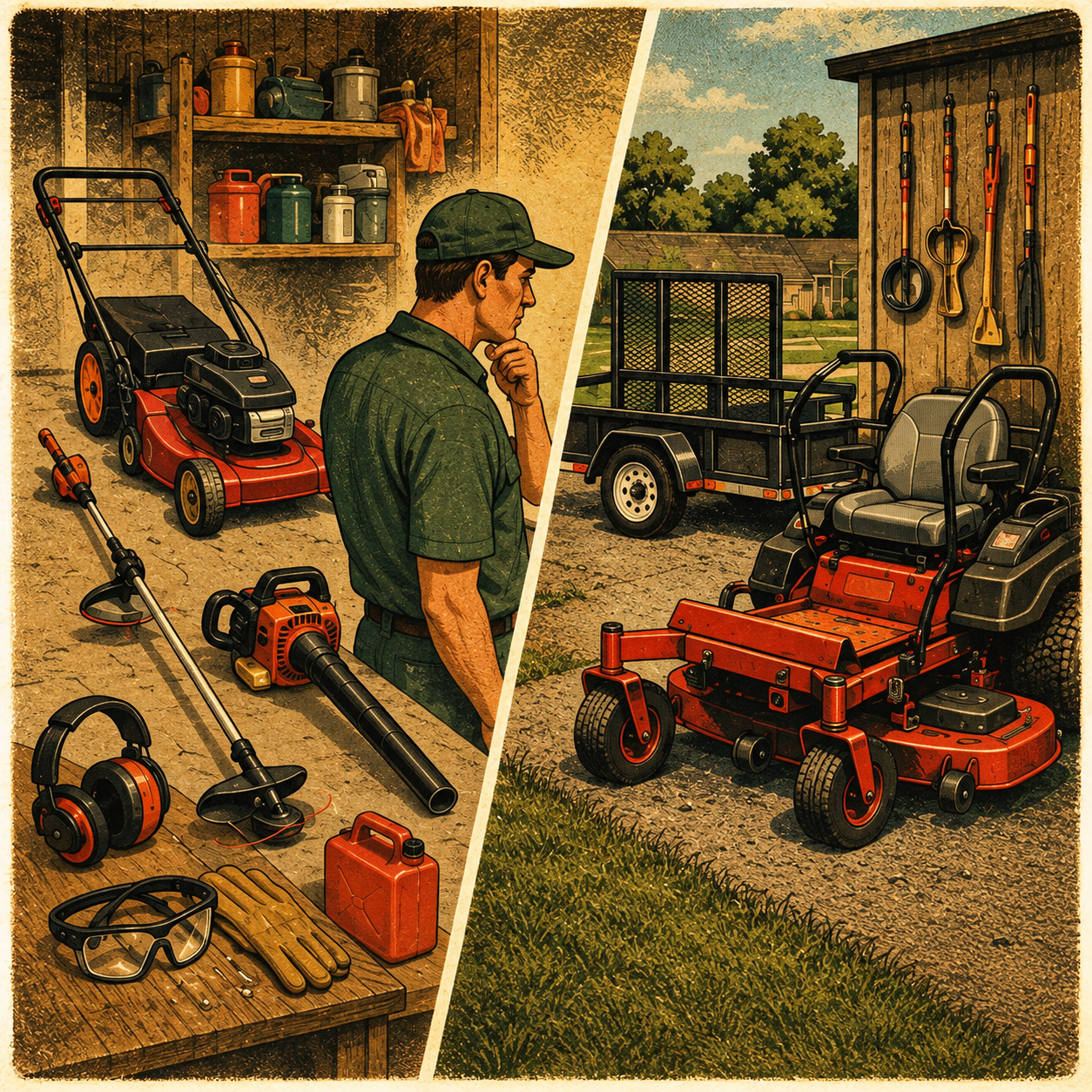
📅 Month 2: Create Your Local Lawn Care Offer
🎯 Main Goal
Make your yard work service easy for local customers to understand, price, and book.
✅ What to Do
- Create a simple flyer or digital service post
- List your services clearly
- Set starting prices or estimate ranges
- Create a customer intake form
- Ask customers for yard photos before quoting
- Post in local groups where allowed
- Tell neighbors, friends, coworkers, and family you are available
- Offer a few limited first-time service spots
📦 What to Include in Your Offer
- Services provided
- Service area
- Starting price or estimate range
- Availability
- How payment works
- How to request a quote
- Whether debris hauling is included
- Whether customer must provide access
🏁 Month 2 Success Looks Like
- Your service is visible locally
- Customers know what you offer
- Your pricing is easier to explain
- You have a basic quote process
- You are ready to book first jobs
🎯 KEY TAKEAWAY
Lawn care customers want clarity. Tell them exactly what is included so they know whether they are paying for mowing only, mowing plus edging, or full yard cleanup.
📦 Simple Lawn Care Packages
Package | What It Includes |
Basic Mow | Mowing only |
Mow + Edge | Mowing, edging, and basic trimming |
Yard Cleanup | Debris, leaves, weeds, and light cleanup |
Weekly Lawn Care | Recurring mowing and edging |
Biweekly Lawn Care | Every-other-week yard maintenance |
Seasonal Cleanup | Spring or fall yard refresh |
Mulch Refresh | Mulch spreading and bed cleanup |

📅 Month 3: Complete First Jobs & Collect Proof
🎯 Main Goal
Start completing lawn care jobs, learn how long they take, and collect proof of your work.
✅ What to Do
- Start with small yards or simple cleanup jobs
- Confirm the job scope before arriving
- Take before-and-after photos with permission
- Track time, fuel, mileage, supplies, and profit
- Communicate if the job is larger than expected
- Clean up clippings or debris as agreed
- Ask for a review or referral
- Save customer details for future follow-up
🏁 Month 3 Success Looks Like
- You completed your first yard jobs
- You learned how long services really take
- You collected photos or testimonials
- You understand which services are easiest to sell
- You are building confidence with local customers
🎯 KEY TAKEAWAY
A clean first job can lead to recurring mowing, seasonal cleanup, or referrals to neighbors.
☑️ First Job Checklist
Step | Why It Matters |
Confirm yard size | Helps estimate time and price |
Ask for photos | Helps you prepare equipment |
Confirm services included | Avoids unpaid extras |
Check gate/access | Prevents delays |
Confirm pet waste or obstacles | Keeps work safer |
Bring safety gear | Protects you while working |
Take after photos | Builds proof for future clients |
Ask for review | Helps attract more local customers |

📅 Month 4: Build a Repeatable Lawn Care System
🎯 Main Goal
Create a simple system for quoting, scheduling, completing, and following up on yard work.
✅ What to Do
- Create message templates for quotes
- Use a calendar for mowing schedules
- Create a weekly route plan
- Track each job in a spreadsheet or Notion
- Create an equipment checklist
- Build a fuel and maintenance routine
- Follow up with past customers
- Offer recurring weekly or biweekly service
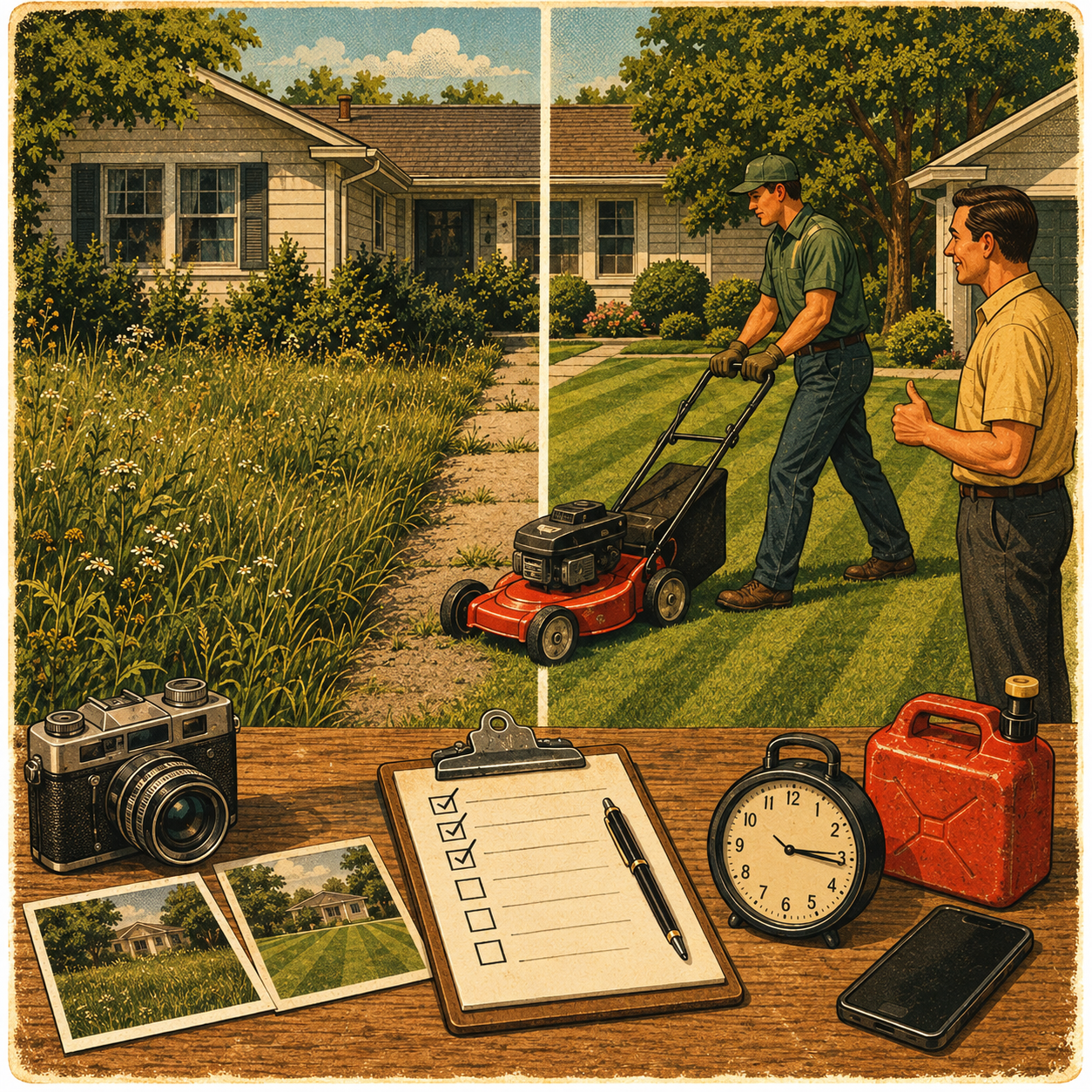
🏁 Month 4 Success Looks Like
- Your schedule is more organized
- You can quote jobs more confidently
- You are tracking real profit
- You have started recurring service conversations
- Your workflow feels repeatable
⚠️ Scale Smart: Route planning matters. Group nearby jobs together so you waste less time and fuel driving across town.
🗓️ Simple Weekly Workflow
Day | Task |
Monday | Reply to inquiries and schedule jobs |
Tuesday | Complete mowing route |
Wednesday | Quote new jobs and maintain equipment |
Thursday | Complete cleanup or mulch jobs |
Friday | Follow up with past customers |
Weekend | Finish overflow jobs and post photos |
🔄 Simple Lawn Care Workflow
Step | What Happens |
Inquiry | Customer asks about lawn care or yard work |
Details | Customer sends yard size, address area, photos, and needs |
Quote | You provide estimate, service details, and schedule options |
Schedule | You confirm date, time, and access |
Prep | You check tools, fuel, safety gear, and supplies |
Service | You complete mowing, edging, trimming, or cleanup |
Payment | Customer pays after service or as agreed |
Follow-up | You ask about recurring service or future yard needs |
📅 Month 5: Improve Pricing, Reviews & Recurring Clients
🎯 Main Goal
Use early experience to improve your prices, collect reviews, and create steadier income.
✅ What to Do
- Review which jobs paid best
- Review which jobs took too long
- Adjust prices for large yards or heavy cleanup
- Ask happy customers for reviews
- Offer weekly or biweekly maintenance
- Create seasonal packages
- Build a referral message
- Track which neighborhoods or clients are most profitable
🏁 Month 5 Success Looks Like
- You have reviews or testimonials
- Your pricing is more realistic
- You know your best services
- You have recurring clients or strong leads
- You are getting better at estimating time and profit
🎯 KEY TAKEAWAY
Recurring lawn care is more valuable than random one-time jobs because it gives you predictable work and easier scheduling.
📦 Recurring Service Options
Service | Why It Helps |
Weekly mowing | Creates predictable income |
Biweekly mowing | Good for lower-maintenance yards |
Monthly yard cleanup | Helps customers maintain curb appeal |
Seasonal cleanup | Higher-value spring and fall jobs |
Hedge trimming | Useful add-on service |
Mulch refresh | Increases job value |
Weed control support | Helps improve yard appearance |
Neighbor route package | Saves travel time and fuel |

📅 Month 6: Review, Specialize & Grow Locally
🎯 Main Goal
Review your first 6 months and decide which lawn care services are worth focusing on long term.
✅ What to Do
- Review every completed job
- Identify your most profitable services
- Identify your most requested services
- Review where customers came from
- Remove services that are too hard, risky, or low-paying
- Update your pricing and service list
- Create a referral plan
- Build a 90-day plan for months 7–9
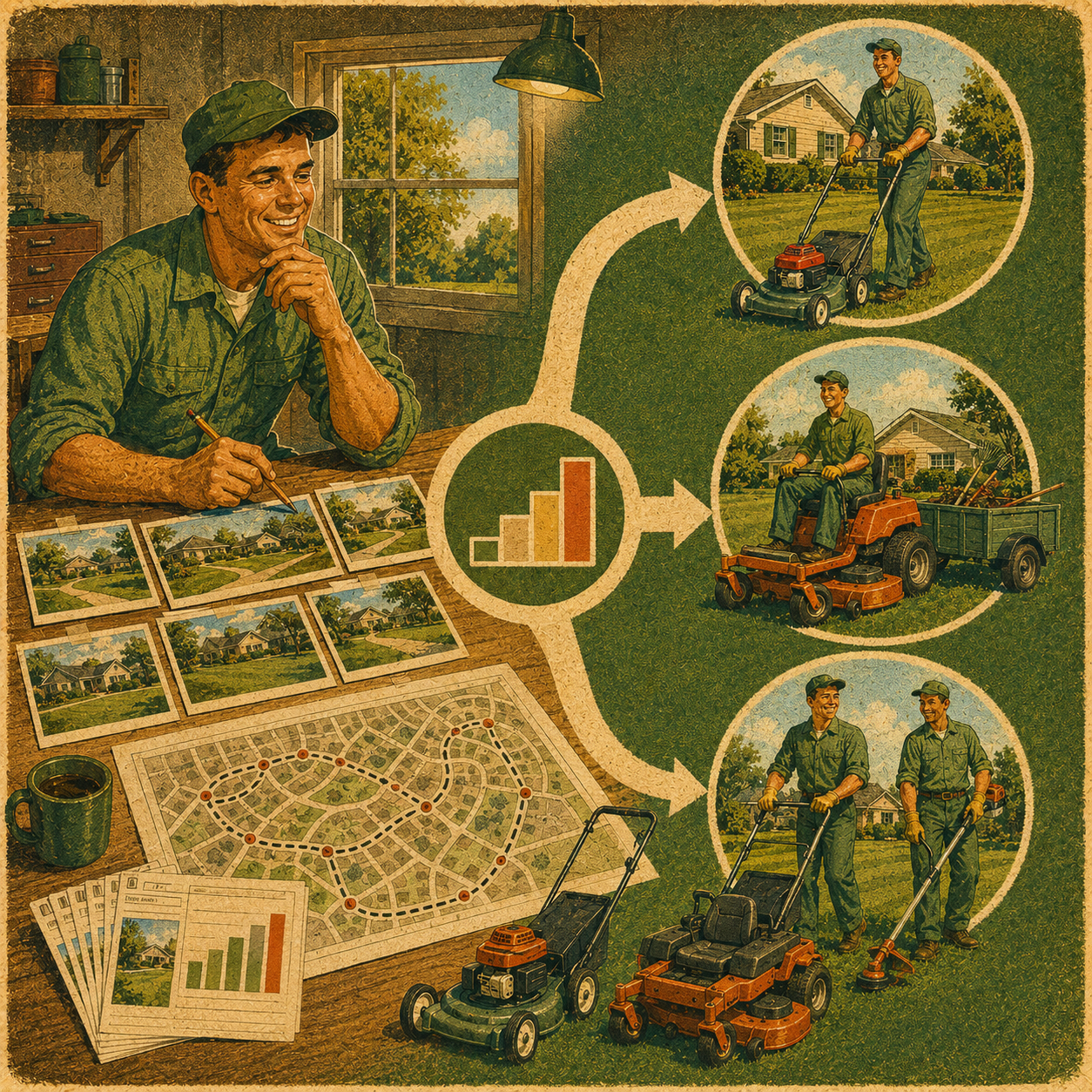
🏁 Month 6 Success Looks Like
- You know your strongest yard services
- You have reviews and work photos
- You understand your pricing better
- You have a repeatable scheduling system
- You have a 90-day plan to grow with better clients and recurring work
🎯 KEY TAKEAWAY
Lawn care becomes more profitable when you focus on repeat routes, realistic pricing, and customers who value consistent service.
📊 Decision Table
If This Happens | Do This |
Mowing gets the most repeat requests | Build weekly and biweekly routes |
Cleanup jobs pay better | Promote seasonal cleanups |
Large yards take too long | Adjust pricing by yard size |
Travel time hurts profit | Narrow your service area |
Neighbors ask after one job | Offer neighborhood route discounts |
Equipment slows you down | Reinvest in better tools carefully |
Reviews are strong | Use them in flyers and local posts |
You are fully booked | Raise rates or limit service slots |
❓ 6-Month Review Questions
- Which jobs paid best for the time required?
- Which services did customers request most?
- Which yards were easiest to maintain?
- Which jobs required too much fuel, time, or supplies?
- Which neighborhoods worked best?
- Which customers asked for recurring service?
- What equipment would make work faster?
- What should you stop offering?
- Are you ready to raise prices?
✅ 6-Month Success Checklist
By the end of 6 months, check whether you have:
✅ Chosen lawn care and yard work services
✅ Gathered basic tools and safety gear
✅ Created a service list
✅ Researched local pricing
✅ Created a quote process
✅ Completed first yard jobs
✅ Tracked time, fuel, mileage, supplies, and profit
✅ Collected reviews or testimonials
✅ Saved before-and-after photos with permission
✅ Built a repeatable schedule
✅ Offered recurring service options
✅ Created a plan for the next 90 days
⚠️ What Not to Do During the First 6 Months
Avoid these mistakes:
❌ Taking jobs without seeing the yard condition
❌ Forgetting fuel, mileage, and equipment costs
❌ Undercharging for overgrown yards
❌ Offering unclear mowing packages
❌ Including debris hauling for free without planning it
❌ Ignoring safety gear
❌ Working with damaged or unsafe equipment
❌ Driving too far for low-profit jobs
❌ Skipping reviews and referral requests
❌ Treating every yard like it takes the same amount of time
⚠️ Reminder: Yard work is physical and time-sensitive. Price honestly, protect your equipment, and build routes that make sense.
🧭 Simple 6-Month Milestone Tracker
Month | Main Focus | Target Output |
Month 1 | Services & equipment | Service list, tools, basic pricing |
Month 2 | Local offer | Flyer, profile, quote process |
Month 3 | First jobs | 3–5 jobs completed |
Month 4 | Job system | Schedule, route plan, tracking |
Month 5 | Reviews & recurring clients | Testimonials and package updates |
Month 6 | Review & grow | 90-day growth plan created |
🚀 Final 6-Month Strategy
Your first 6 months should follow this simple path:
Month 1: Choose your services and prepare equipment
Month 2: Create your local lawn care offer
Month 3: Complete first jobs and collect proof
Month 4: Build a repeatable lawn care system
Month 5: Improve pricing, reviews, and recurring clients
Month 6: Review results and grow locally
The lawn care side hustles that grow fastest are built on reliable service, clear pricing, smart routes, and customers who trust you enough to book again.
11. Get the Lawn Care Business Starter Kit
🎁 Your Lawn Care Business Toolkit
The Lawn Care & Yard Work Starter Kit provides 12 browser-based workspaces for equipment readiness, quoting, customer intake, routes, billing, maintenance, marketing and seasonal planning.
The 12 components:
✅ 1. Lawn Care Equipment Checklist — Review essential tools, supplies and equipment readiness.
✅ 2. Job Pricing Calculator — Estimate service prices using your labor, supply and travel costs.
✅ 3. Local Marketing Flyer Builder — Draft accurate local flyers that explain your lawn care services.
✅ 4. Customer Intake & Booking Form — Record property details, service requests and customer expectations before confirming a booking.
✅ 5. Route & Daily Job Planner — Arrange customer visits into a realistic daily route and work schedule.
✅ 6. Invoice & Payment Tracker — Prepare billing records and manually track customer payments.
✅ 7. Seasonal Service Price List — Organize prices for seasonal services and define the job scope each price covers.
✅ 8. 90-Day Marketing Plan — Organize three months of local outreach and follow-up goals.
✅ 9. Job Safety & Hazard Checklist — Check site risks and personal protective equipment needs before starting work.
✅ 10. Equipment Maintenance Log — Record equipment inspections, servicing and repair needs.
✅ 11. Customer Retention Toolkit — Plan repeat-service offers and customer follow-ups.
✅ 12. Weather & Seasonal Planner — Plan work around weather conditions and seasonal workload using forecasts you check independently.
Also included in the editable master: A Lawn Care dashboard, Start Here instructions and supporting field guides are included in the editable master.
The editable master is an editorial QA review package, not an approved retail release. Tools do not provide live forecasts, book customers or replace safety training, licenses, insurance or local pesticide rules.

12. Frequently Asked Questions
💵 How much money do I need to start?
You can start with $300–$800 if you already have transportation.
Basic setup:
- 🚜 Used residential mower: $100–$300
- 🌿 Trimmer: $100–$200
- 💨 Blower: $80–$150
- 🧰 Hand tools: $50–$100
- 🥽 Safety gear: $40–$80
💡 Many businesses start this way. Upgrade to commercial equipment only after the route can support it.
⏳ How long until I make decent money?
Early months vary. Some operators book a handful of lawns; others take longer to fill a route.
Typical range, not a promise:
- 🌱 First month: extra cash is possible with a few local jobs
- 📈 Later months: higher totals depend on route density, hours, and rebooks
- 🧩 Part-time weekends: income still depends on weather, season, and booked stops
👉 Growth depends on marketing effort, service quality, and local demand.
📜 Do I need a business license or insurance?
Requirements vary by location.
Most cities require a business license, usually around $50–$200/year.
Liability insurance is highly recommended, usually around $300–$800/year, to protect against property damage claims.
💡 Some clients, especially commercial clients, may require proof of insurance.
⏰ Can I do this part-time with a full-time job?
Yes! Lawn care is perfect for evenings and weekends.
Example:
- 📅 Mow Saturday–Sunday
- 🏡 A weekend route can work if nearby properties fit
- 💰 Earnings still depend on jobs booked, weather, and expenses
💡 Many operators start part-time before deciding whether to grow further.
🌧️ What if it rains?
Reschedule to the next available day.
Never mow wet grass because it can:
- 🌱 Produce poor results
- 🚜 Damage the lawn
- ⚠️ Create safety risks
👉 Build buffer days into your schedule. Most customers understand weather delays if you communicate proactively.
💳 How do I handle customers who don't pay?
Require payment immediately after service or before service whenever possible.
Best practices:
- 💵 Use prepaid service for new clients
- 📄 Set payment expectations upfront
- ⏳ Stop service if recurring clients are 2 weeks late
- ⚖️ Use small claims court only for larger unpaid amounts
👉 Screen customers carefully and avoid chronic non-payers.
🎯 Should I specialize or offer everything?
Start with mowing because it has the highest demand and recurring potential.
Then add services as you get requests and gain experience.
High-margin add-ons can include:
- 🌱 Fertilization
- 🌳 Landscaping
- 🍂 Leaf cleanup
- 🌼 Mulching
💡 Specializing can be very profitable, but some services may require more expertise or licensing.
🍂 What about seasonal income fluctuations?
Peak season, usually April–October, provides 70–80% of annual income.
Plan ahead:
- 💰 Save aggressively during peak season
- ❄️ Add winter services if applicable
- 🎄 Consider holiday lighting
- 🚜 Offer fall cleanup or leaf removal
👉 Some operators take winter off, while others add snow removal in cold climates.
🏁 How do I compete with established companies?
Don’t compete on price alone.
Compete on:
- ⏰ Reliability
- 💬 Communication
- 🏆 Quality
- 🤝 Personal service
- 🏘️ Neighborhood focus
💡 Big companies are often less responsive. You can provide white-glove service that justifies premium pricing.
👥 When should I hire help?
Consider hiring when:
- 🏡 You’re consistently at 40–50 properties
- 📈 You’re turning down good work
- 💪 The physical workload is too much
- 🚀 You want to scale beyond solo income
Starting pay for helpers is often around $12–$18/hour.
👉 Make sure helpers are reliable, have transportation, and share your quality standards.
⚠️ What if I damage something?
This is why insurance is critical.
Common damages include:
- 💦 Hitting a sprinkler head
- 🪟 Breaking a window with a rock
- 🏠 Damaging siding
- 🌱 Tearing up turf
Best response:
- 🛑 Own the mistake immediately
- 💬 Communicate honestly
- 🔧 Fix it promptly
- 🛡️ Use insurance for major damage
💡 Most customers appreciate honesty.
💰 Can I really make six figures doing lawn care?
Some crew-based operations reach higher annual totals, but that is not typical for a new solo route.
Illustrative ranges, not promises:
- 🧍 Solo operator: income depends on lawns, rates, season, and expenses
- 👥 Crew-based business: higher revenue is possible, and profit is usually much lower than gross billings
A larger operation serving many properties can scale, but it requires:
- ⚙️ Systems
- 👥 Management skills
- 📅 Scheduling
- 🧾 Payroll
- 🏆 Quality control
13. Important Considerations
Before starting, understand the realities:
💪 Physically Demanding Work
- 🏡 6–10 lawns/day is exhausting
- ☀️ Heat, humidity, and fatigue are real
- 💧 Hydration and pacing matter
👉 This is not hands-off income.
🌧️ Weather Impacts Income
- 🌧️ Rain = no work that day
- 🌵 Drought = slower grass growth and less mowing
- 📅 Weather delays can disrupt your schedule
👉 Always build buffer days into your week.
🔧 Equipment Will Break
- 🚜 Mowers fail
- 🌿 Trimmers wear out
- 💨 Blowers need maintenance
- 🧰 Repairs are part of the business
👉 Maintenance is mandatory.
📅 Seasonal Income Fluctuation
- 🌱 70–80% of income comes during peak season
- ❄️ Winter can be slow depending on your area
- 💰 Budgeting during peak months is essential
👉 You must budget accordingly.
😤 Customer Challenges Exist
You may deal with:
- 💳 Late payments
- 😠 Unrealistic expectations
- 🧾 Scope creep
- 🚩 Difficult clients
👉 Learn to fire bad customers early.
⚠️ Liability Risks
Common risks include:
- 🪟 Property damage
- 💦 Sprinkler damage
- 🚑 Injury risks
- 🏠 Damage to siding, fences, or landscaping
👉 Insurance is strongly recommended.
🏁 Growth Requires Hiring
- 🧍 Solo limit: around 40–60 properties
- 👥 Scaling requires managing people
- ⚙️ Growth requires systems
👉 Not everyone wants this, and that’s okay.
💸 Cash Flow Discipline Matters
Ongoing expenses include:
- ⛽ Gas
- 🔧 Tools
- 🚜 Equipment maintenance
- 🧾 Taxes
- 🛡️ Insurance
👉 Profit ≠ revenue. Set aside 25–30% for taxes.
💡 Final Reality Check
This is:
✔ ⚡ A fast cash-flow business
✔ 📈 Recurring routes can support higher monthly totals when demand and capacity allow
✔ 🚀 Scalable with systems
But also:
❌ Physically demanding
❌ Requires consistency
❌ Requires business discipline
🚀 The people who succeed aren’t the most skilled — they’re the most consistent and reliable.
14. Your Next Steps
🚀 ACTION STEP
📍 Today
- 📦 View the starter kit above
- 🧰 Assess what equipment you already have
- 🔍 Research local market rates using Craigslist, Facebook, and neighbor quotes
- 🏘️ Identify 2–3 target neighborhoods
📅 This Week
- 🚜 Acquire or test your basic equipment
- 📝 Create a simple flyer with services and pricing
- ☎️ Set up a Google Voice number for business
- 🌱 Practice on your own lawn or a friend’s yard to get efficient
- 💵 Decide on your pricing structure
🗓️ This Month
- 📣 Distribute 300–500 flyers in target neighborhoods
- 📱 Post on Nextdoor, Facebook groups, and Craigslist
- 🏷️ Offer a first-time discount to get initial customers
- 🏡 Book and complete your first 8–15 properties
- ⭐ Request reviews from satisfied customers
- 🎯 Goal: complete a small set of jobs with time, cost, and review records
🚀 Months 2–6
- 📈 Continue marketing to add 5–10 customers per month
- 📅 Build a weekly recurring schedule
- 🚜 Upgrade equipment as you earn
- 🍂 Add seasonal services, such as spring cleanup, mulching, and fall leaves
- 🗺️ Optimize routes for efficiency
- 🎯 Goal: a denser route, seasonal add-ons, and a clearer picture of which stops are worth repeating
15. The Bottom Line
🎯 KEY TAKEAWAY
Lawn care is a practical local side hustle — visible work, a modest equipment setup, and a path from one-off jobs toward recurring routes.
🙋 If you:
✔ Show up reliably every week
✔ Price fairly and communicate proactively
✔ Ask happy customers for reviews and referrals
✔ Reinvest in better equipment as you earn
🏗️ You can build:
💰 Earnings that vary with jobs, rates, hours, season, and whether clients rebook — not a set monthly ladder
🔁 Recurring clients can make income more predictable
🏘️ A local brand with referral-driven growth if the work stays reliable
🚀 Once people trust you, they may book again — and they may refer neighbors.
16. Recommended Websites & Tools
🛠 TOOLS & RESOURCES
You do not need every resource listed below. This directory brings together the major platforms, tools, and resources from this guide, along with additional research and learning options, so you can find them in one place when you need them.
Start with the essentials. Add tools only when your lawn care business develops a specific need for them.
📍 Local Marketing & Customer-Finding Platforms
- Google Business Profile — Free local business listing for appearing in Google Search and Maps when homeowners search for lawn care, mowing, or yard cleanup nearby.
- Nextdoor — Neighborhood platform for posting lawn care services, responding to local recommendations, and building trust with nearby homeowners.
- Facebook — Social platform for sharing before-and-after photos, posting services, connecting with local customers, and building referrals.
- Facebook Groups — Group page for finding neighborhood groups, local business groups, homeowner groups, and community recommendation threads.
- Craigslist — Local classifieds platform for posting mowing, yard cleanup, hauling, and seasonal lawn care services.
- Instagram for Business — Business resource for using Instagram to showcase lawn transformations, before-and-after photos, seasonal offers, and local credibility.
💡 PRO TIP
Flyers still work for lawn care. A few hundred flyers in the right neighborhoods can fill your first month — target streets where you already have a customer.
⭐ Reviews, Local Search & Online Presence
- Google Business Profile — Key local SEO tool for collecting reviews, listing your service area, showing photos, and helping high-intent customers contact you.
- Nextdoor — Referral-friendly local platform where neighbors often ask for lawn care, mowing, cleanup, and seasonal yard work recommendations.
- Facebook — Useful for building a basic business presence, collecting social proof, answering messages, and sharing service updates.
📝 QUICK NOTE
Ask for the Google review right after a job well done — happy customers say yes most when the fresh-cut lawn is in front of them.
📞 Client Communication & Business Phone Setup
- Google Voice — Phone number tool for separating lawn care calls and texts from your personal number while managing customer communication professionally.
- Facebook Groups — Useful for answering local service requests, replying to recommendation posts, and building trust inside neighborhood communities.
- Craigslist — Simple lead source where customers can call, text, or message about lawn mowing, cleanup, and one-time yard work jobs.
📸 Visual Marketing & Before/After Content
- Instagram for Business — Visual marketing resource for posting mowing stripes, hedge trimming results, mulch jobs, cleanup transformations, and short process videos.
- Facebook — Platform for sharing photos, testimonials, seasonal reminders, and service availability with local customers.
- Nextdoor — Neighborhood-focused place to share helpful seasonal reminders, local offers, and visible proof of your lawn care work.
🎯 KEY TAKEAWAY
You do not need every tool on this page. A flyer, a Google Business Profile, and a business phone number are enough to book your first customers.
🧭 How to Use This Directory
🧰 Start With a Simple Setup
Do not start by creating accounts with every service listed above. For most beginners, a simple setup is enough:
- One way to reach neighbors
- A Google Business Profile
- One business phone number
- One way to take payment
That is enough to start building. Add tools only when you can name the specific problem they will solve.
🎯 KEY TAKEAWAY
Tools support the business. They are not the business.
Your biggest advantages will come from:
Showing up every week → Doing quality work → Collecting reviews → Earning referrals
17. Explore Similar Side Hustles
 House Cleaning & Organization: Make Money Creating Clean, Tidy Spaces — Serve the same neighborhoods indoors with recurring weekly or monthly clients.
 Handyman & Fix-It Services: Turn Your Skills into Cash — Add simple repair and maintenance jobs for the customers on your route.
 Pet Sitting & Dog Walking: Earn Money Caring for Pets — Offer pet care to the same local homeowners who trust you with their yards.
 Gig Economy Apps: Earn Money on Your Schedule Using Your Phone — Fill weather days and schedule gaps with flexible on-demand work.
 Product Flipping — Buy used outdoor equipment cheap, service it, and resell it for a profit.
 Investing & Dividend Income: Grow Your Wealth with Smart Investments — Put your seasonal profits to work so income keeps growing through winter.