

Affiliate disclosure: Some links in this guide may be paid referral links. If you purchase or sign up through one, One Stop Side Hustles may earn a commission. How our affiliate links work.
HOUSE CLEANING & ORGANIZATION STARTER GUIDE
Learn how house cleaning and organization services work—including landing early clients, quoting clearly, and growing from one-time jobs toward recurring local work.
1. What Are House Cleaning & Organization Services?
2. Why House Cleaning & Organization Is a Great Side Hustle
3. House Cleaning & Organization Services You Can Offer
4. How Much Can You Earn & Pricing Strategies
5. What You Actually Need to Start
7. How to Start: Your Beginner Roadmap
8. Building Your Business & Growing
9. Learning, Templates & Resources
10. Your First 6 Months House Cleaning & Organization Plan
11. Get the House Cleaning & Organization Starter Kit
12. Frequently Asked Questions
Quick Snapshot
Earn: Highly variable — standard cleans and organizing projects are common starting points; later rates depend on home size, market, and recurring bookings
Work: Short jobs booked around your own schedule
Start: Low cost — basic supplies (clients often provide)
Best for: Reliable, detail-oriented people who like visible results
Grow: One-time cleans → recurring clients → crew business
1. What Are House Cleaning & Organization Services?
House cleaning and organization services involve making homes cleaner, more organized, and more livable. You help busy people reclaim their spaces through targeted cleaning, decluttering, and organizing systems.
Unlike general construction or repair work, cleaning and organizing are highly accessible skills that people desperately need but often can't or won't do themselves.
🔄 How It Works (Simple 4-Step Process)
- Get client inquiry (person contacts you with their needs)
- Provide estimate (visit space, assess work, quote price)
- Complete service (clean/organize on agreed date)
- Build recurring income (many become repeat monthly clients)
🎯 KEY TAKEAWAY
Your main competitors are other service providers, not DIY. People who hire cleaners have already decided they want professional help—your job is being reliable and thorough.

2. Why House Cleaning & Organization Is a Great Side Hustle
House cleaning and organization is a strong side hustle because it combines steady local demand, low startup friction, and services that can become repeat income once clients trust you.
💰 The income can become steady surprisingly fast
People already need help with cleaning, resets, and clutter reduction, so the demand is usually practical rather than optional.
Common early income paths include:
- One-time cleanings
- Recurring maintenance visits
- Deep-clean add-ons
- Organization projects
That makes it easier to turn a few early jobs into a real monthly base.
🤝 Recurring clients can make income more predictable
One of the biggest advantages is that satisfied clients often need ongoing help.
Common repeat services include:
- Weekly or biweekly cleanings
- Monthly resets
- Airbnb turnovers
- Office upkeep
- Seasonal deep cleans
That repeat demand can reduce how often you need to keep chasing new leads.
💻 It is relatively easy to start lean
Most beginners can begin with a simple setup:
- Basic cleaning products
- Cloths, gloves, and trash bags
- Vacuum, broom, or mop
- A few organizing supplies when needed
You can upgrade tools, products, and systems gradually instead of needing a large investment upfront.

🕒 It works well around a part-time schedule
Many jobs fit into manageable time blocks:
- Weekday mornings
- Afternoons
- Evenings
- Weekends
- School-hour windows
That flexibility makes it easier to build income without needing a full-time calendar immediately.
🧠 Trust and consistency matter more than credentials
Most clients care less about formal certification and more about how dependable the experience feels.
What usually matters most:
- Reliability
- Attention to detail
- Respect for the home
- Clear communication
- A repeatable system
That makes this side hustle especially strong for organized people who deliver calm, dependable service.
⚡ You can often get first clients through simple local outreach
Early customers often come from places that do not require complicated marketing.
Common first-client paths include:
- Friends and family
- Local Facebook groups
- Nextdoor posts
- Before-and-after photos
- Referral requests
That means momentum can start with a few trustworthy relationships instead of a big audience.
📈 Packages and systems make the business easier to scale
Income usually improves when you make the work easier to repeat and price confidently.
Useful growth levers include:
- Flat-rate packages
- Deep-clean upsells
- Move-out services
- Room-by-room organization offers
- Better checklists and workflows
The more structured the service becomes, the easier it is to improve speed and profit.
🧪 It can grow into a broader local service business
Cleaning and organization can lead to larger opportunities once demand becomes consistent.
Possible expansion paths include:
- Airbnb turnover work
- Commercial accounts
- Premium organization projects
- Team-based service
- Higher-end specialty packages
It can begin as side income and later become a more durable local business model.
3. House Cleaning & Organization Services You Can Offer
One of the best things about starting a cleaning and organization business is that you can build your service menu around the type of work you enjoy and the customers you want to serve.
You do not need to offer every cleaning or organizing service from day one. A better beginner strategy is to start with a few straightforward services you can perform consistently, then add specialized, higher-value, and recurring options as your experience and customer base grow.
📝 QUICK NOTE
Examples on this page are general service descriptions, not guaranteed jobs or income. Confirm any licensing, insurance, and safety requirements for your area, and use products appropriate for each surface. Never mix cleaning chemicals, and agree on the scope of work in writing before you start.
🧹 Routine Home Cleaning
🏠 Standard House Cleaning
- 🧽 Typical Work: Cleaning kitchens and bathrooms, dusting surfaces, vacuuming, mopping floors and handling routine household cleaning
- ⭐ Difficulty: ⭐⭐ Beginner-friendly | 🔥 Demand: Very high
- 🧰 Main Supplies: Vacuum, mop, microfiber cloths, brushes and general cleaning products
- 👥 Typical Customers: Busy professionals, families, seniors and households that need help maintaining their homes
- 🌟 Best for: Beginners who want straightforward jobs that can turn into repeat customers
🔁 Recurring Cleaning
- 🧽 Typical Work: Providing scheduled weekly, biweekly or monthly cleaning using a consistent checklist and routine
- ⭐ Difficulty: ⭐⭐ Beginner-friendly | 🔁 Repeat Potential: Very high
- 🧰 Main Supplies: Standard residential cleaning kit and a reliable scheduling system
- 👥 Typical Customers: Busy households, professionals, families and long-term residential clients
- 🌟 Best for: Building predictable income and reducing the need to constantly find new customers
💡 PRO TIP
Use one written checklist for every visit and share it with the client. A consistent routine makes your work easy to repeat, easy to price, and hard to replace.
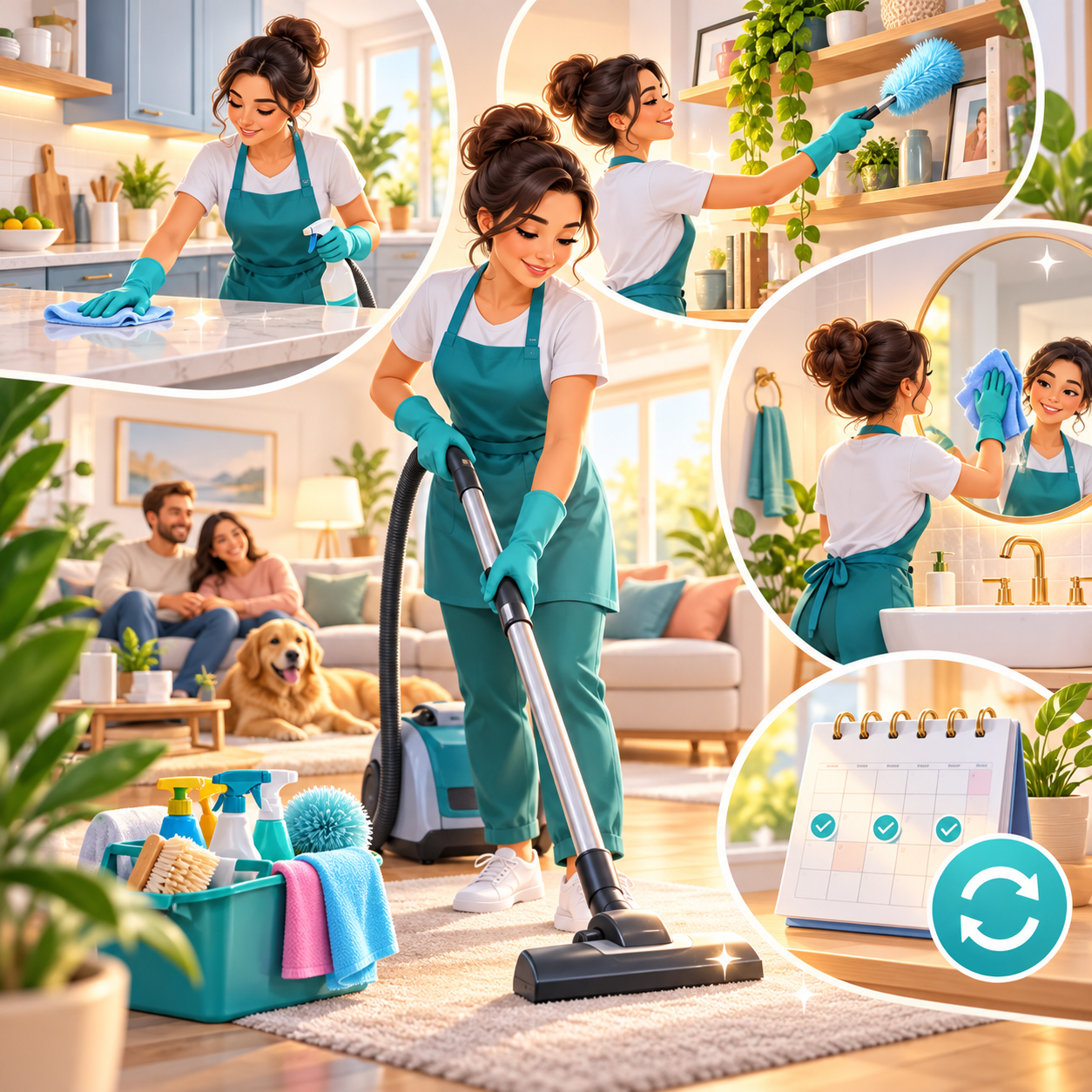
✨ Detailed & Deep Cleaning
🧽 Deep Cleaning
- 🧽 Typical Work: Detailed cleaning, removing buildup, cleaning baseboards, tackling neglected areas and handling work beyond a normal maintenance visit
- ⭐ Difficulty: ⭐⭐⭐ Moderate | 💰 Job Value: Higher
- 🧰 Main Supplies: Standard supplies plus detail brushes, scrubbers and products appropriate for the surfaces being cleaned
- 👥 Typical Customers: Homes needing an occasional reset or customers booking their first professional cleaning
- 🌟 Best for: Increasing the value of individual appointments with more intensive work
🍳 Kitchen & Bathroom Detail Cleaning
- 🧽 Typical Work: Detailed cleaning of kitchens or bathrooms, including fixtures, surfaces, buildup and other agreed-upon problem areas
- ⭐ Difficulty: ⭐⭐⭐ Moderate | 👀 Visible Results: Very high
- 🧰 Main Supplies: Scrub brushes, microfiber cloths, appropriate surface cleaners and detail tools
- 👥 Typical Customers: Homeowners who want specific high-use rooms thoroughly cleaned
- 🌟 Best for: Offering a focused service or adding higher-value detail work to a larger cleaning appointment
⚠ COMMON MISTAKE
Do not quote a deep clean from a photo alone. Confirm buildup, appliances, and room count first, or a “quick” job can quietly turn into a half-day at a standard rate.

📦 Move & Property Transition Cleaning
🚚 Move-In / Move-Out Cleaning
- 🧽 Typical Work: Cleaning empty homes or apartments, kitchens, bathrooms, floors, surfaces and other areas before or after a move
- ⭐ Difficulty: ⭐⭐⭐ Moderate | 💰 Project Value: High
- 🧰 Main Supplies: Full cleaning kit suitable for tackling multiple rooms and surfaces
- 👥 Typical Customers: Renters, homeowners, landlords and people relocating
- 🌟 Best for: Larger one-time jobs with a clearly defined goal and deadline
🔑 Rental Turnover Cleaning
- 🧽 Typical Work: Cleaning and resetting rental properties between occupants or guests
- ⭐ Difficulty: ⭐⭐⭐ Moderate | 🔁 Repeat Potential: High
- 🧰 Main Supplies: Portable cleaning kit, reset checklist and reliable scheduling system
- 👥 Typical Customers: Landlords, property managers and short-term rental operators
- 🌟 Best for: Cleaners who work quickly, follow consistent checklists and want repeat property-based work
📋 REAL-WORLD EXAMPLE
A short-term rental host may book a turnover after every checkout. A repeatable reset checklist, timestamped photos, and a quick supply-restock note can turn one property into steady weekly work.

🧺 Home Organization
👕 Closet & Room Organization
- 🧽 Typical Work: Sorting belongings, organizing closets and bedrooms, grouping similar items and creating practical storage systems
- ⭐ Difficulty: ⭐⭐⭐ Moderate | ✨ Transformation: High
- 🧰 Main Supplies: Labels, bins, dividers, bags and basic organizing supplies as appropriate to the project
- 👥 Typical Customers: Busy households, families and people struggling with cluttered spaces
- 🌟 Best for: People who enjoy turning messy spaces into functional systems
🥫 Pantry & Kitchen Organization
- 🧽 Typical Work: Sorting pantry or kitchen items, grouping categories and improving how frequently used items are stored
- ⭐ Difficulty: ⭐⭐ Easy to moderate | 📸 Before/After Potential: Excellent
- 🧰 Main Supplies: Labels and organizational containers selected for the client's space when needed
- 👥 Typical Customers: Families, homeowners and people wanting a more functional kitchen
- 🌟 Best for: Organizers who enjoy highly visual projects with clear before-and-after results
💡 PRO TIP
Photograph each space before you start and after you finish (with the client’s permission). Strong before-and-after results are your best portfolio and referral tool.

🗂️ Decluttering & Reset Services
♻️ Decluttering Assistance
- 🧽 Typical Work: Helping clients sort possessions, create keep/donate/discard groups and reduce clutter in targeted areas
- ⭐ Difficulty: ⭐⭐⭐ Moderate | 🤝 Client Interaction: High
- 🧰 Main Supplies: Sorting containers, donation bags, labels and basic organizational supplies
- 👥 Typical Customers: Overwhelmed homeowners, families and people preparing for a move or major home reset
- 🌟 Best for: Patient organizers who are comfortable helping clients make decisions about their belongings
🏡 Whole-Space Reset
- 🧽 Typical Work: Combining decluttering, organization and light cleaning to make a room or small area functional again
- ⭐ Difficulty: ⭐⭐⭐ Moderate | 💰 Bundle Potential: High
- 🧰 Main Supplies: Cleaning supplies plus bins, labels and sorting materials
- 👥 Typical Customers: Busy households or clients whose spaces need more than cleaning alone
- 🌟 Best for: Combining your cleaning and organization skills into a higher-value transformation service
⚠ COMMON MISTAKE
Do not decide what to keep or discard for the client. Agree on categories and keep, donate, and trash rules first, and confirm any sensitive items or paperwork before moving them.

🏢 Specialty & Commercial Cleaning
🏢 Small Office Cleaning
- 🧽 Typical Work: Cleaning floors, surfaces, break areas, restrooms and other agreed-upon areas in small workplaces
- ⭐ Difficulty: ⭐⭐⭐ Moderate | 🔁 Repeat Potential: Very high
- 🧰 Main Supplies: Commercial-appropriate cleaning kit based on the space and agreed scope
- 👥 Typical Customers: Small offices and local businesses
- 🌟 Best for: Cleaners looking for scheduled recurring work outside residential homes
🛍️ Small Business & Studio Cleaning
- 🧽 Typical Work: Routine cleaning for salons, studios, local shops and other small commercial spaces
- ⭐ Difficulty: ⭐⭐⭐ Varies by property | 🌙 Scheduling: Often flexible
- 🧰 Main Supplies: Depends on the surfaces, business type and agreed service
- 👥 Typical Customers: Salons, studios, local shops and other small businesses
- 🌟 Best for: Expanding beyond residential cleaning while still working with manageable properties
💡 PRO TIP
Before taking commercial work, confirm access hours, keys or alarm codes, insurance requirements, and the exact scope in writing. Start with one small space before adding more.

🎯 Build Your Beginner Cleaning Menu
🎯 KEY TAKEAWAY
Start with routine home cleaning or a focused organization service you can deliver consistently. Add deep cleaning, move-related work, and commercial services only when your scope, supplies, scheduling, and coverage are ready.
🚀 ACTION STEP
Write a focused first plan:
- Core offer: Choose a routine cleaning or organization service you can deliver consistently.
- Scope: Write a room-by-room checklist, exclusions, and what supplies are included.
- Site check: Confirm surfaces, access, pets, hazards, and the condition of the space before quoting.
- Booking terms: Set your service area, visit length, starting price, and cancellation policy.
4. How Much Can You Earn & Pricing Strategies
Cleaning and organization income improves when you move beyond random one-time jobs and create a service mix that balances recurring clients, clear packages, and premium upgrades.
Clients are usually paying for more than a clean room — they are paying for time saved, less stress, and a home that feels easier to live in.
🧠 Reality Check (What Actually Raises Income)
Strong earners usually:
- Create clear service packages
- Build recurring clients quickly
- Upsell deep cleans or organizing
- Improve speed with checklists and systems
- Deliver a reliable, trust-building experience
The more repeatable your service becomes, the easier it is to price confidently.
🎯 KEY TAKEAWAY
Repeat clients and clearer packages can matter more than simply taking more one-time jobs. Build around consistent quality, realistic visit times, clear boundaries, and sustainable scheduling.
🔑 Smart Pricing Progression
A practical path is:
🧾 Starter Rates & Job Timing
- Start with hourly or starter flat rates
- Track how long common jobs really take
📦 Repeat Packages & Add-Ons
- Create simple packages for repeat services
- Add higher-ticket add-ons and organizing projects
That shift usually improves both income and schedule stability.
🎯 KEY TAKEAWAY
Recurring bookings improve predictability only when the checklist, property condition, visit frequency, and price fit the actual workload.
🧪 Real Example
📋 REAL-WORLD EXAMPLE
These are illustrative scenarios, not verified typical outcomes or earnings guarantees. Actual demand, total working time, costs, and taxes vary. Treat the listed monthly amounts as gross revenue illustrations before costs, overhead, and taxes; Scenario A uses a simplified four-week month.
🌱 Scenario A: Basic hourly cleaner
- $30/hour
- 20 hours/week
- Around $2,400/month
🎯 Scenario B: Flat-rate recurring clients
- $120–$180 per visit
- Several repeat homes per week
- Around $2,500–$4,500/month
🚀 Scenario C: Cleaning + organization mix
- Recurring cleans plus premium room resets
- Around $4,000–$7,000+/month
🎯 KEY TAKEAWAY
The same service base can produce different revenue when scope, pricing, efficiency, and repeat demand change. Revenue alone does not show profitability.
🎯 What Actually Drives Income
🧮 Quality × Scope × Repeat Demand = Income Potential
This is a positioning framework, not a mathematical earnings forecast.
- Service type: Organizing and deep cleans often pay more than basic maintenance
- Home size and condition: Larger or heavier jobs increase scope
- Frequency: Repeat clients smooth out income
- Speed: Better systems raise effective hourly earnings
- Neighborhood and market: Some locations support stronger pricing
- Professionalism: Trust, communication, and consistency keep people rebooking
📈 Visit Time & Scope (Pricing Reality)
📖 Read the Numbers in Context
Home size and condition, visit frequency, clutter, buildup, product needs, travel, and customer priorities all affect the workload. Track service type, speed, local demand, and professionalism without letting faster work reduce quality or safety.
🎯 KEY TAKEAWAY
Use actual collected pay, complete working time, and realistic costs to judge what you keep.
🚀 Build Your First Paid Cleaning & Organization Offer
Start with one core service, one customer type, a small service area, and a written checklist. Use a focused booking test to learn realistic visit times and costs before adding deep cleans, room resets, or a larger recurring schedule.
🧭 Run a Disciplined Cleaning Offer Test
- Choose a focused service and customer. Start with standard residential cleaning or a defined organization zone you can handle confidently. Set a practical service radius and booking capacity. Check business requirements and appropriate coverage before taking regular paid work.
- Assess the space and define scope. Confirm rooms, size, condition, surfaces, pets, sensitivities, access, and customer priorities. Use photos or a walkthrough when needed. Write inclusions and exclusions; separate first-time or deep cleaning from maintenance visits. For organizing, agree how decisions, supplies, donations, and disposal will be handled.
- Build a quote and booking process. Estimate travel, setup, service, cleanup, laundry or supply restocking, and client communication. Include products, fees, and any approved add-ons. Confirm who supplies equipment, payment terms, cancellation rules, and how extra work is approved before the visit.
- Run a small four-week booking test. Promote one package through a primary local channel or referrals. Use a few manageable weekly slots, follow the same checklist, and leave travel and recovery buffers. Use products appropriate to each surface and follow labels; never mix cleaning chemicals. Refer hazardous cleanup outside your training and coverage.
- Review quality and economics before expanding. Track inquiries, bookings, collected payments, total time, supplies, travel, rework, and rebookings. Compare first visits separately from maintenance cleans. Adjust future quotes when condition or scope requires more time. Offer recurring slots only when you can maintain quality and realistic margins.
🎯 KEY TAKEAWAY
Repeat clients and clearer packages can matter more than simply taking more one-time jobs. Build around consistent quality, realistic visit times, clear boundaries, and sustainable scheduling.
💡 Example: A Four-Week Cleaning Offer Test
- Customer: Nearby busy households seeking routine maintenance cleaning
- Offer: A defined kitchen, bathroom, dusting, and floor checklist for an assessed home
- Assessment: Confirm property size and condition, surfaces, access, pets, sensitivities, and priority rooms
- Boundaries: Exclude unagreed laundry, dishes, oven interiors, decluttering, high-access work, and hazardous cleanup
- Supplies: Confirm equipment and product responsibilities; obtain approval for any separately purchased organizing supplies
- Cadence: Test a small number of weekly visits for four weeks, with travel and recovery buffers
- Quote: Base the initial quote on assessed scope, total visit time, and costs; quote a heavier first clean separately if needed
- Signals: Track actual time, collected revenue, supply and travel costs, feedback, rework, and recurring bookings
This is a learning plan, not a promise of bookings or income. A fuller calendar is useful only if work quality and margins hold up. Revenue is not profit after products, equipment, travel, fees, labor, overhead, and tax obligations.
✍️ Write Your One-Line Earnings Test Plan
Use this structure to make the test easy to evaluate:
“For [local customer], I will offer [cleaning checklist or organization zone] within [service area] for [test period]. I will confirm [condition, supplies, exclusions, and terms] and review [actual time, costs, feedback, and rebookings] before expanding.”
✅ Completed example
“For nearby busy households, I will test a standard maintenance-cleaning package for four weeks through referrals. I will assess the home and agree a checklist, exclusions, supplies, and payment terms before booking, then track total visit time, supply and travel costs, feedback, and repeat bookings before offering more recurring slots.”
🚀 ACTION STEP
Before starting your first test:
Keep the first test focused. Improve the core workflow before adding more platforms, services, or commitments.

📋 Pricing & Revenue Planning Reference
Review the work stages, pricing models, and visit economics alongside property condition, service scope, recurring frequency, supply needs, and actual costs. Existing ranges are indicative planning references, not verified local rates or guaranteed earnings. Team business revenue is not the owner’s take-home pay.
💵 What Cleaning & Organization Services Can Earn
📊 Income Progression by Stage
🚀 Stage | Focus | 💰 Typical Monthly Income | ⏳ Timeline | 📌 What’s Changing |
Beginner | One-time basic cleanings | $500–$1,500 | 0–3 months | Learning the workflow, collecting first reviews, testing pricing |
Developing | Repeat homes and better packages | $1,500–$4,000 | 3–6 months | Scheduling improves and referrals start to build |
Established | Recurring clients + premium jobs | $4,000–$8,000 | 6–12 months | Higher rates, better systems, and more confident offers |
Advanced | Niche organizing or team support | $8,000–$15,000+ | 12–24 months | Higher-ticket projects and stronger client retention |
Professional | Team-based or premium local business | $15,000+/month | 2+ years | Delegation, contracts, and repeat demand create scale |
🎯 KEY TAKEAWAY
Recurring demand and consistent systems can support steadier revenue, but no stage or timeline guarantees a particular income.
📊 Key Metrics & Margin Snapshot
📈 Visit Time & Scope (Pricing Reality)
📊 What Your Work Is Actually Worth
Metric | What to Record |
Collected service revenue | Separate visits, add-ons, and supply reimbursements |
Total visit time | Include prep, travel, cleaning, cleanup, and rework |
Visit-specific costs | Track products, fees, travel costs, and direct labor |
Contribution per total hour | Compare return with the full workload, not just cleaning time |
Quality and retention | Record feedback, rework, cancellations, and recurring bookings |
🎯 KEY TAKEAWAY
Compare contribution after direct costs with the full workload. Track business overhead and personal taxes separately before judging take-home income.
💸 Cleaning & Organization Pricing Models
🧾 Common Pricing Models
Model | Typical Range | Best Use |
Hourly | $25–$60+/hour | Unclear jobs, organizing projects, first-time cleanings |
Per cleaning visit | $80–$300+ | Standard residential cleaning |
Flat-rate package | $150–$1,000+ | Deep cleans, move-out jobs, and room resets |
Room / zone pricing | $50–$250+ per area | Closets, kitchens, pantries, offices |
Recurring monthly plans | $200–$2,000+/month | Stable repeat income and ongoing maintenance |
🎯 KEY TAKEAWAY
Packages should make the service easier to understand while protecting time, quality, and scope—not make every extra task free.
🧮 Check Your Cleaning Economics
Visit contribution = collected service revenue − supplies, travel-related costs, direct labor, fees, and other visit-specific costs.
Compare contribution with total visit time, including preparation, travel, cleanup, and rework. Account for equipment, coverage, scheduling, and other overhead when evaluating the business. Client-funded organizing containers are not automatically service profit.
🚀 ACTION STEP
🗓️ Build a Monthly Cleaning Revenue Snapshot
Use collected revenue, actual costs, and total working time—not invoice totals or advertised rates alone—to decide what to repeat.

5. What You Actually Need to Start
🛠 TOOLS & RESOURCES
🧽 Essential Cleaning Supplies
Supply | Purpose | Estimated Cost | Priority |
Vacuum Cleaner | Carpets, rugs, floors, pet hair | $50-$200 | 🔥 Essential |
Mop & Bucket | Hard floors, kitchens, bathrooms | $20-$50 | 🔥 Essential |
Broom & Dustpan | Quick floor cleanup and debris removal | $10-$20 | 🔥 Essential |
Scrub Brushes | Showers, sinks, grout, tough stains | $15-$30 | 🔥 Essential |
Squeegee | Windows, mirrors, glass shower doors | $10-$20 | ⭐ High |
Microfiber Cloths / Rags | Dusting, polishing, wiping surfaces | $15-$30 | 🔥 Essential |
Trash Bags | Removing waste and organizing cleanup | $10-$25 | 🔥 Essential |
Estimated cost: $120-$350 depending on what you already own.
🧴 Cleaning Solutions
Product | Best For | Estimated Cost | Priority |
All-Purpose Cleaner | Counters, tables, general surfaces | $5-$15 | 🔥 Essential |
Disinfectant Spray | High-touch areas, bathrooms, kitchens | $5-$15 | 🔥 Essential |
Glass Cleaner | Windows, mirrors, glass surfaces | $5-$10 | ⭐ High |
Bathroom Cleaner | Tubs, showers, sinks, tile | $5-$15 | 🔥 Essential |
Toilet Bowl Cleaner | Toilets and bathroom sanitation | $5-$10 | 🔥 Essential |
Dish Soap | Handwashing, degreasing, light cleaning | $3-$8 | ⭐ High |
Laundry Supplies | If offering laundry add-ons | $10-$20 | Optional |
Estimated cost: $40-$100, usually lasting 1-2 months depending on job volume.
🦺 Safety & Personal Gear
Gear | Purpose | Estimated Cost | Priority |
Gloves | Protect hands from chemicals and messes | $10-$20 | 🔥 Essential |
Masks / Respirators | Dust, odors, pet hair, strong cleaners | $10-$20 | 🔥 Essential |
Apron / Protective Clothing | Keeps clothes clean and professional | $15-$30 | ⭐ High |
First Aid Kit | Small cuts, scrapes, and accidents | $15-$25 | 🔥 Essential |
Step Ladder | Reaching cabinets, shelves, ceiling fans | $30-$60 | ⭐ High |
Knee Pads | Comfort for baseboards, floors, bathrooms | $15-$30 | Medium |
Estimated cost: $80-$155
📦 Organization Supplies
Supply | Purpose | Estimated Cost | Buy When |
Clear Storage Bins | Decluttering closets, pantries, garages | $30-$60 | Project-based |
Hanging Organizers | Closets, doors, bedrooms, laundry rooms | $20-$40 | Project-based |
Label Maker & Labels | Organizing bins, shelves, drawers | $20-$50 | ⭐ High |
Drawer Dividers | Kitchens, bathrooms, offices, dressers | $15-$30 | Project-based |
Hangers & Closet Accessories | Closet resets and wardrobe organization | $20-$50 | Project-based |
Trash / Donation Bags | Decluttering, donation piles, haul-away prep | $10-$25 | 🔥 Essential |
Estimated cost: $105-$230, but you can buy these only when a project requires them.
📱 Technology & Client-Finding Tools
Tool / Platform | Purpose | Cost | Priority |
Show up in local searches and collect reviews | Free | 🔥 Essential | |
Post in local groups and community pages | Free | 🔥 Essential | |
Neighborhood visibility and local referrals | Free | ⭐ High | |
Find cleaning and organizing jobs locally | Commission-based | ⭐ High | |
Cleaning job marketplace | Commission-based | Medium | |
Simple Website | Services, pricing, photos, testimonials | $0-$30/mo | Optional |
Client communication and booking | Free | Medium |
📅 Scheduling & Payment Tools
Tool | Purpose | Cost | Best Use |
Track appointments and recurring clients | Free | Beginner scheduling | |
Let clients book cleaning estimates or calls | Free-$12/mo | More professional booking | |
Digital invoices and payments | Transaction fees | Simple client payments | |
Card payments and invoices | Transaction fees | In-person or online payments | |
Quick payments from local clients | Free / fees vary | Small jobs | |
Google Sheets | Track clients, jobs, expenses, and supplies | Free | Starter business tracking |
✅ Your Minimal Startup
Need | Starter Option | Estimated Cost |
Basic cleaning tools | Vacuum, mop, broom, scrub brushes, microfiber cloths | $120-$350 |
Cleaning solutions | All-purpose cleaner, disinfectant, bathroom cleaner, glass cleaner | $40-$100 |
Safety gear | Gloves, mask, apron, first aid kit | $80-$155 |
Organization basics | Bins, labels, dividers, bags | $105-$230 |
Scheduling | Free | |
Client leads | Free | |
Payments | Pay per transaction |
Total to launch: $350-$750 if buying everything new.
Budget version: $150-$300 if buying used, borrowing equipment, or starting with basic cleaning jobs only.
Reality: You probably already own many of the basics, so your actual out-of-pocket startup cost may be closer to $100-$200.

💡 PRO TIP
Start with basic residential cleaning before offering full organization packages. Cleaning jobs require fewer supplies, create faster cash flow, and help you build trust before pitching higher-priced decluttering or home organization services.
6. Finding Your First Clients
Use marketplaces for early momentum, local search for high-intent leads, and referrals for recurring work. Build proof on every job so each client can help generate the next one.
🧹 TaskRabbit and Handy for a Fast Start
🧭 Platform Playbook
⚙️ How it works:
- 📸 Create profile with photos and services
- ✅ Get background check
- 📋 Customers post cleaning/organizing tasks
- 💰 You bid on tasks or get matched
- 🧼 Complete work, platform handles payment
- 💸 Platform takes 20-30% commission
👍 Pros: Large client base, built-in payment protection, steady stream of gigs
👎 Cons: High commission eats into earnings, competitive, customer reviews critical
🎯 Best for: Getting first 10-20 clients quickly to build experience and reviews
💵 Reality: After commission, expect $15-25/hour effective rate (less than direct clients)
🏘️ Nextdoor for Neighborhood Trust
👥 Community Playbook
⚙️ How it works:
- 📢 Post about your services
- 🤝 Neighbors find you, trust from community
- 📍 Very local-focused, builds community reputation
- 💬 Engaged neighborhood users
👍 Pros: Highly local, community trust, built-in word-of-mouth
👎 Cons: Smaller pool than other platforms, app-only
🎯 Best for: Building loyal local customer base and steady recurring work
💡 PRO TIP
Offer Nextdoor neighbors a 10% discount to encourage referrals
📍 Google Business Profile for Local Search
🧠 Profile Playbook
⚙️ How it works:
- 🆓 Create free business listing
- 🔎 Show up in Google local search
- 🏠 Customers find you searching "house cleaner [city]"
- ⭐ Reviews build visibility
- 📞 Direct calls and inquiries
👍 Pros: Free, critical for local visibility, builds credibility
👎 Cons: Takes 3-6 months to build visibility and reviews
🚀 What to do: Get 5-10 Google reviews from early clients by requesting them
🛒 Craigslist and Facebook for Direct Leads
🧠 Channel Playbook
⚙️ How it works:
- 📸 Post your services with clear description and rates
- 📞 People contact you directly
- 🚫 No middleman, no commission
- 🤝 Build direct relationships and recurring clients
👍 Pros: No commission, direct client relationships, easier to build repeat business
👎 Cons: Requires screening, no payment protection, takes time to build presence
🎯 Best for: Building direct client base and long-term recurring work
🛡️ Safety tips:
- ☀️ Meet clients in their home during daytime
- 📝 Get job details in writing
- 💵 Ask for upfront payment (cash or digital)
- 📍 Tell someone where you'll be
- 🚨 Trust your instincts about clients
📣 Direct Local Marketing That Builds Visibility
🧠 Local Marketing Playbook
🧠 Tactics:
- 📰 Flyers - Post in grocery stores, coffee shops, community centers ($50 for 500)
- 🚪 Door hangers - Leave in neighborhood ($50 for 500)
- 👥 Facebook groups - Post in neighborhood groups, ask for referrals
- 📌 Community bulletin boards - Libraries, gyms, yoga studios
- 🌱 Lawn sign - Advertise where you're working (with permission)
- 💼 Business cards - Distribute everywhere, give to clients for referrals
💸 Cost: $100-300 total for physical marketing materials
💡 PRO TIP
Include referral bonus on flyers ("$50 off next cleaning for each referral")
📢 Referrals for Compounding Local Growth
🤝 Referral Playbook
🔄 Generate referrals:
- ⭐ Do excellent work (most important factor)
- 🗣️ Ask directly: "I'd love if you know anyone who needs cleaning help"
- 💵 Offer referral bonus ($25-50 per referred client)
- 💼 Give clients easy business cards to share
- ✉️ Follow up thank-you note
- ⭐ Get Google reviews
- 📸 Post before/after photos with permission
7. How to Start: Your Beginner Roadmap
🧭 Use This Roadmap for One Well-Run Appointment
You do not need every cleaning package, every organizing specialty, or a packed calendar to start. Begin with one core service, a written checklist, and one well-run appointment.
Use the seven tabs in order. Cleaning-only visits use Phase 4 and skip Phase 5; organizing-only visits use Phase 5 and only the light cleaning explicitly agreed. Combined visits use both, in the order that suits the space.
Confirm each checkpoint before adding deep cleans, move-outs, or a full recurring route. Bookings are not guaranteed.
Your first goal: Turn one clearly scoped home into one paid visit you would stand behind—and that the client would book again.
📩 PHASE 1 — Check the Inquiry and the Space Before Quoting
📋 Steps 1–4: Learn enough to decide whether the home, service, timing, and conditions are a fit. Do not send a price the moment someone texts; a vague “How much to clean my house?” is a screening question, not a confirmed job.
✅ Ready to move on: You know the home, service, timing, and conditions—or you have declined or referred the job.
🏠 Step 1: Ask the Core Intake Questions
Use an intake checklist—the details you collect before quoting. Ask:
- What type of property is it?
- About how large is the space?
- How many bedrooms and bathrooms?
- Standard cleaning, deep cleaning, organizing, or something else?
- When was it last professionally cleaned?
- Are there pets?
- Allergies, sensitivities, or product preferences?
- Is there heavy clutter?
- Are any rooms off-limits?
- Is there a deadline?
- Where is the property?
- Will you or the client provide supplies?
Check the address against your service area and the requested date against your availability. Clarify access and parking before confirming a visit.
💡 PRO TIP The better your questions are before the job, the fewer surprises you will have during it.
📦 Step 2: Clarify Organizing Goals and Client Decisions
For an organizing request, also ask:
- Which area needs organizing?
- What is not working about the current setup?
- Will the client be present to make keep / donate / discard decisions?
- Are bins, labels, or shelves already available?
- Who buys any new organizing products?
Define a practical result: a usable pantry, an accessible closet, or a clear workspace—not an entire home transformed in an unspecified time.
If the client will be unavailable, agree on a decision method and leave uncertain items for approval. You cannot decide what is sentimental, valuable, or disposable for them.
After intake, quote only if the job is simple and clear. Otherwise request photos or a walkthrough, or decline if it is outside your service, schedule, or safety limits.
👀 Step 3: Inspect Unfamiliar Spaces Before Committing
Simple repeat cleanings may eventually be quoted from known details. For unfamiliar, heavily soiled, cluttered, large, or complex spaces, get photos, a video, or a walkthrough first.
Look for:
- Overall condition; number and type of rooms
- Heavy buildup and pet hair or pet-related mess
- Clutter and fragile belongings
- Delicate surfaces
- Stairs and access limits
- Parking and high or hard-to-reach areas
- Special requests
- Anything that adds time or supplies
Use a daytime walkthrough when practical, tell someone where you will be, and trust your instincts about unsafe situations. Request only useful photos and protect the client's privacy.
⚠️ COMMON MISTAKE Quoting a “standard clean” from a one-line text without photos, condition, or a room count. That is how a two-hour visit becomes five unpaid hours.
🛑 Step 4: Decline or Refer Work Outside Your Limits
Decline or refer:
- Mold remediation
- Pest infestations
- Biohazard cleanup
- Significant bodily fluids
- Hoarding-level conditions
- Hazardous materials
- Unsafe access
- Work needing specialized training or protective equipment
You do not have to accept every job. If conditions are unsafe or outside your training, equipment, insurance, or service menu, say no. Ordinary cleaning products do not make a hazardous job suitable for a beginner.
Check local business requirements and appropriate coverage before regular paid work; confirm limits with the relevant provider or authority rather than assuming every job is covered.
Phase complete when: Property, condition, service, timing, pets, access, and supply responsibilities are clear enough to scope safely—or you have requested more information or declined.
🚀 Your First 30 Days: Five Practical Actions
🚀 ACTION STEP
- Days 1–3 — Choose and scope: Select one core service and write your checklist plus exclusions. Keep the initial service area and appointment size manageable.
- Days 4–7 — Prepare: Set up supplies, intake questions, policies, and a quote template. Check product safety, appropriate coverage, and your service limits before accepting paid work.
- Days 8–14 — Promote and screen: Use one local channel or referrals from Chapter 6. Assess inquiries and book small, clearly scoped jobs only when conditions and terms are confirmed.
- Days 15–26 — Deliver and refine: Complete visits and track time, costs, feedback, and rework during Days 15–21. Tighten scope, quoting, and your in-home system during Days 22–26.
- Days 27–30 — Follow up: Contact satisfied clients, request honest reviews or referrals, and offer recurring service where useful and sustainable.
Start with the first action now. These are planning windows, not a promise of bookings; do not skip assessment or safety checks to stay on a calendar.
📋 PHASE 2 — Write the Checklist, Quote the Visit, and Get a Yes
📋 Steps 5–9: Replace “full house cleaning” with a specific checklist and exclusions. Use Chapter 4's pricing system to set the number; here, make the quote understandable and get a written yes before reserving the slot.
✅ Ready to move on: A room-by-room checklist, exclusions, a quote with terms, and a written booking confirmation.
🧹 Step 5: Build a Room-by-Room Cleaning Checklist
Choose the agreed rooms and tasks from this standard-cleaning example. Match them to the assessed condition and time; heavier first cleans may need a separate scope.
Area | Included Tasks |
Kitchen | Wipe counters; clean exterior appliance surfaces; clean sink; wipe cabinet fronts as needed; sweep or vacuum; mop floor |
Bathrooms | Clean sink and counters; clean toilet; clean tub or shower surfaces; clean mirrors; sweep and mop |
Living Areas & Bedrooms | Dust accessible surfaces; vacuum carpets and rugs; sweep or mop hard floors; empty agreed-upon trash; light surface straightening |
Confirm priorities and any omitted rooms. Do not imply a deep clean or interior-appliance service when you are quoting routine maintenance.
Give the client a checklist they can understand—and that you can finish in the time you quoted.
🚫 Step 6: Write Exclusions and an Add-On Approval Rule
Leave these out, or price them as approved add-ons where you can safely perform them:
- Inside ovens
- Inside refrigerators
- Interior windows
- Laundry
- Dishes
- Heavy decluttering
- Wall washing
- High-access work
- Furniture moving
- Hazardous cleanup
Hazardous or specialist work stays outside your service even if a client offers extra money. An add-on is not permission to work beyond your training or coverage.
🎯 KEY TAKEAWAY If it is not on the checklist, it is not in the price. Extra rooms, extra mess, and extra tasks get a new quote and approval before you perform them.
Clear scope protects both sides: the client knows what they bought, and you know what you must deliver.
🗂️ Step 7: Define the Organizing Zone and Handling Permissions
For organizing, specify whether the appointment includes:
- Sorting only or setting up a working storage system
- Light cleaning of agreed shelves or surfaces
- Measuring and selecting products
- Purchasing bins, labels, or other supplies
- Preparing donation bags or actually hauling donations
- A short maintenance walkthrough with the client
Set the zone, session length, priorities, and who will make decisions. Agree how to handle unfinished areas if the time limit is reached.
Confirm a budget and approval before purchasing products. Reuse existing containers when practical; do not promise shelves or installations outside your service.
Agree on what can be moved and where donation or discard groups will wait. Do not dispose of belongings without client approval. Client-funded containers are separate from your service fee.
💵 Step 8: Quote the Full Visit and State the Terms
Every quote should include:
- Service type, areas, and tasks included
- Tasks excluded and optional add-ons
- Who provides supplies
- Price or pricing method
- Date or arrival window
- Approximate duration when useful
- Payment terms and cancellation policy
Estimate the full workload: travel, preparation, service, cleanup, cloth laundering or restocking, and communication—not only time in the home.
Example: Standard Home Cleaning
Includes kitchen, two bathrooms, three bedrooms, living room, dusting, vacuuming, and floor cleaning.
Not included: Inside appliances, interior windows, laundry, dishes, deep decluttering, or hazardous cleanup.
Price / add-ons / payment: Stated before you book the visit.
💡 PRO TIP A professional quote does not need to be long. It needs to prevent “I thought that was included.”
✍️ Step 9: Confirm the Booking in Writing Before You Go
Get a written yes on:
- Address, date, and arrival window
- Service, scope, and price
- Supplies and special requests
- Access, pets, and parking
- Payment method and timing
- Cancellation terms
Text, email, a booking confirmation, or a service agreement can document the agreement. Use the required booking and payment process if a platform is involved.
You're booked for [service] on [date]. The agreed price is [price] and includes [short scope]. Please let me know before the appointment if the condition or requested work changes.
Agree on deposits or upfront payment where applicable; do not assume payment timing. Avoid surprise charges after starting. If the home is substantially different from what was described, discuss the change before doing extra work.
Phase complete when: You have a written yes on scope, price, schedule, supplies, and payment before loading the car.
🧰 PHASE 3 — Pack Safely and Recheck the Home on Arrival
📋 Steps 10–13: The job starts before you leave. Prepare the approved kit and access details, then do a short arrival walkthrough; being on site is not a reason to accept changed or unsafe work.
✅ Ready to move on: Your kit and access details are ready, product labels are checked, and the arrival walkthrough is agreed.
✅ Step 10: Restock Your Kit and Plan the Visit
Before you leave:
Keep clean cloths separate from used ones and carry products securely in their labeled containers. Do not overbook your first route; physical work needs realistic breaks.
🧴 Step 11: Check Product Labels and Surface Compatibility
Follow product labels and the surface manufacturer's care instructions. Choose the correct product, amount, ventilation, and method.
- Do not mix cleaning products. Bleach with ammonia or acids can create dangerous gases.
- Use products suitable for the surface; do not assume an all-purpose cleaner is safe everywhere.
- Test in an inconspicuous spot when recommended and approved, especially on unfamiliar finishes.
- Follow dilution, protective-equipment, and contact-time directions when relevant.
- Keep products away from children, pets, food, and personal belongings.
- If a product, surface, or condition is unfamiliar, pause and ask rather than experimenting.
More product does not automatically mean cleaner. Strong odors or inadequate ventilation are reasons to stop and reassess—not to push through.
🏠 Step 12: Walk the Home With the Client Before Starting
Do a short walkthrough before unpacking everything. Confirm:
- Priority areas
- Changes since the quote
- Fragile or valuable items
- Rooms you should not enter
- Pet arrangements
- Where supplies or trash should go
- Anything the client wants you to notice
Check surfaces, safe access, and any existing damage relevant to the work. Document concerns with permission and notify the client before touching them.
Ask permission before moving personal items. Keep keys or access codes secure; use them only for the agreed visit.
For organizing, reconfirm that the decision-maker is available and identify the approved sorting area.
💬 Step 13: Resolve Changed Conditions Before Doing Extra Work
If the condition is dramatically different, stop and discuss it before starting.
You may need to:
- Keep the price but reduce scope with the client's agreement
- Approve extra time and a revised price
- Reschedule a larger job
- Decline unsafe or out-of-scope work
Confirm the change in writing and update your checklist. If the client does not approve extra work, stay within the original safe, achievable scope or agree on a reschedule; do not add surprise charges afterward.
⚠️ COMMON MISTAKE Starting immediately because you are already there when the home is far messier than described. That is how a quoted visit becomes unpaid overtime.
Phase complete when: Your kit and access are ready, actual conditions match the agreement, and any change is approved before work begins.
🧹 PHASE 4 — Follow One Repeatable Cleaning Order
📋 Steps 14–17: Use this phase for the cleaning tasks you sold; skip it for an organizing-only appointment except agreed light cleaning. Work systematically rather than randomly so quality stays consistent and you finish on time.
✅ Ready to move on: The agreed cleaning tasks are done in order and each room is reset.
🧺 Step 14: Reset the Agreed Area and Set Out Supplies
Start with a short reset:
- Gather obvious, agreed-upon household trash.
- Move only the items the client has approved.
- Set out the supplies you need without blocking walkways.
- Keep personal belongings and valuables safe.
- Separate cleaning tasks from clutter decisions.
Do not treat papers, medications, keepsakes, or uncertain possessions as trash. Leave those for the client to decide.
Keep heavy furniture moving, dishes, laundry, and decluttering outside the visit unless explicitly included and safe. If clutter prevents access to a quoted surface, agree on what can realistically be done.
⬇️ Step 15: Work High to Low and Room by Room
Use the same order whenever practical:
- Dust higher accessible surfaces first.
- Clean counters and furniture.
- Finish with floors.
Complete one area before moving on when practical. Follow your checklist rather than bouncing between unfinished rooms. Leave enough time for the final inspection.
“High to low” does not mean taking on unsafe ladder work or out-of-scope high-access tasks. Use only safe access within the agreed service.
If something will prevent completion, tell the client early and confirm priorities. A repeatable system helps you work faster without rushing; the client should see a process, not random activity.
🧽 Step 16: Clean Each Surface and Keep Tools Separate
Work through the room-by-room checklist from Step 5. Use the approved product and method for each surface.
- Keep bathroom cloths and tools separate from kitchen and living-area tools.
- Use clean cloths as they become soiled; do not spread contamination between rooms.
- Clean food-contact areas with products and any rinsing steps appropriate to that surface.
- Complete the included sink, counter, fixture, mirror, and accessible-surface tasks.
- If disinfection is included, follow the label's preparation and required wet contact time; a quick wipe is not automatically disinfection.
- Stop if you encounter damage, a hazard, or a finish you cannot safely clean.
Do not scrape, soak, or use stronger chemicals just to force a result. Explain any safe limits to the client and document unfinished or excluded tasks.
🧼 Step 17: Finish Floors and Reset the Room
After higher surfaces are finished:
- Vacuum or sweep the appropriate surfaces.
- Mop suitable hard floors using the correct product and amount of moisture.
- Keep people and pets away from wet or slippery areas until safe.
- Replace approved items in their agreed positions.
- Remove agreed trash to the designated location.
- Pack supplies and check that nothing is left behind.
Avoid excessive water on moisture-sensitive flooring. Do not hide a spill or damage; stop, make the area safe, and tell the client promptly.
Phase complete when: The included cleaning tasks are finished and checked. If organizing is included, continue to Phase 5; otherwise proceed directly to Phase 6 for final inspection and closeout.
📦 PHASE 5 — Build a System the Client Can Maintain
📋 Steps 18–21: Use this phase only for organizing included in the booking. Organization is not “cleaning with bins”; it requires client decisions. Follow Sort → Decide → Group → Assign a Home → Label → Maintain rather than rearranging everything for a one-day photo.
✅ Ready to move on: Each zone is sorted with client approvals, grouped, labeled, and the simple reset is taught.
🗃️ Step 18: Sort One Manageable Zone at a Time
Start with the agreed closet, pantry, drawer, shelf, or room—not every storage area at once.
- Create a clear sorting area without blocking exits or walkways.
- Work in batches small enough to finish or safely contain within the session.
- Group similar items so the client can see what they have.
- Use clear temporary categories: keep, donate, sell, relocate, discard.
- Keep uncertain, private, and sentimental items separate for decisions.
Do not empty an entire home when there is only time to reset one shelf. Keep the client informed about progress and preserve safe access to the space.
🤲 Step 19: Get Approval for Every Disposal or Relocation Decision
The client decides what stays and what leaves. Do not throw away, donate, relocate, or dispose of personal belongings without the client's approval.
- Let the client decide on sentimental or valuable items.
- Confirm each group's destination and label approved bags clearly.
- Keep undecided items in a designated holding area.
- Separate preparing donation bags from transporting them; hauling must be explicitly agreed.
- Confirm permission before removing anything from the home.
If the client is unavailable, use the approved decision process or pause uncertain decisions. Do not turn your preference for less clutter into authority over someone else's belongings.
Treat sorting and disposal as distinct tasks: placing an item in a pile is not automatic permission to take it away.
🏷️ Step 20: Group Items and Assign Practical Storage Homes
Give each retained category a usable home:
- Put frequently used items where the client can reach them easily.
- Group related items according to the household's actual routines.
- Reuse suitable bins or dividers already available.
- Check measurements before buying new containers.
- Get approval for product costs before purchasing.
- Avoid overfilled storage that the client cannot put back easily.
Choose function over a matching-bin photograph. Do not place heavy items where they create unsafe lifting or unstable storage.
If new shelves, fixtures, or other installations are needed, treat them as a separate service or referral rather than promising work outside your skills and scope.
🔄 Step 21: Label the System and Teach the Simple Reset
Use labels the client understands and materials suitable for the storage surface. Ask before applying adhesive labels to furniture or finishes.
Walk through:
- Where each category lives
- How to return items after use
- Where new or undecided items should wait
- Which donation, sale, or discard groups are approved and who handles them
- What remains unfinished or outside the session
Example: A pantry reset should let the household find everyday items and put them back without a new sorting session every week.
A successful organizing project creates a system the client can maintain—not just a photo for one day.
Phase complete when: The agreed zone is usable, belongings have approved homes, and the client understands how to maintain it. Continue to Phase 6.
✅ PHASE 6 — Check the Work, Collect Payment, and Record the Visit
📋 Steps 22–25: Do not rush out when the last room looks done. Compare the result with the agreed checklist, make client review easy, and record the real workload so the next visit is better informed.
✅ Ready to move on: Included tasks are inspected, the client walkthrough is done, payment is collected, and the workload is logged.
🔎 Step 22: Inspect Every Included Task Before Leaving
Run a final check:
Recheck small missed details while your kit is still available. Confirm windows, doors, lights, pets, and access instructions as agreed; do not invent a lock-up routine the client has not authorized.
Note exclusions, unresolved issues, or work the client approved for a later visit. Do not mark a task complete simply because the visit time is over.
🙋 Step 23: Walk the Finished Space With the Client
When possible, ask:
“Is there anything you’d like me to take another look at before I leave?”
- Review the agreed rooms and priorities.
- Fix reasonable missed items immediately.
- Explain unfinished, excluded, or newly discovered issues honestly.
- For organizing, confirm item placement and the maintenance routine.
- If the client asks for a new task, distinguish it from correcting a missed included task.
If the client is absent, send a concise completion note through the agreed channel with a way to give feedback. Include photos only with permission.
If something was damaged, notify the client promptly, record what happened, and follow the appropriate agreement or coverage process; do not hide it.
💳 Step 24: Collect the Agreed Payment and Send the Record
Collect payment at the agreed time. Send a receipt for payment received or an invoice for the amount due, using the agreed payment method or platform process.
Record:
- Service date, property, and completed scope
- Agreed price and any approved add-ons
- Supply purchases or reimbursements listed separately
- Amount received, balance due, and payment due date
Do not charge for unapproved extras. An invoice is not the same as collected payment; record overdue balances and follow up professionally under your agreed terms.
Keep payment confirmations with the visit record. Do not claim a recurring booking is confirmed unless the client has accepted the next scope, price, and date.
📝 Step 25: Log the Actual Workload and Client Preferences
After the visit, record:
- Actual service time plus travel, setup, cleanup, and communication
- Products used and relevant supply or travel costs
- Unusual issues, missed items, and rework
- Collected payment and any balance due
- Client preferences, priorities, sensitivities, and approved scope changes
- Before-and-after photos only with permission
Ask separately before using private-home photos in marketing. Avoid addresses, faces, documents, valuables, or personal information; protect keys and access codes.
Those notes make the next visit faster and more personal. Restock your kit and clean or launder reusable cloths according to appropriate care instructions before the next job.
Phase complete when: The checklist and client review are complete, payment status is recorded, and any unresolved issue has an agreed next action.
🔁 PHASE 7 — Follow Up and Build Sustainable Repeat Visits
📋 Steps 26–29: Make the next visit easy for satisfied clients and compare what actually happened with what you quoted. Grow through trust and a repeatable process—not by packing more homes into an already exhausting route.
✅ Done when: A review or referral ask is sent, the next slot is confirmed without overbooking, and one improvement is chosen.
⭐ Step 26: Follow Up and Ask for an Honest Review or Referral
Thank the client and ask whether the result still feels right after they use the space. Address reasonable concerns about the agreed work before pitching more service.
- Invite an honest review with a direct link to your review page where available.
- Ask whether they know someone who needs the same service.
- Make the request optional and easy to answer.
- Follow the platform's review rules; do not buy positive reviews or pressure the client.
- Use testimonials or marketing photos only with the required permission.
Example: “Thank you for booking. How is the space working for you? If you’d like to share an honest review or know someone who needs cleaning help, I’d appreciate it.”
Reviews and referrals help build proof; they do not guarantee the next booking.
🗓️ Step 27: Offer a Recurring Schedule That Fits the Home
If the client is happy, do not make them figure out the next step.
If you’d like to keep the home at this level, I also offer weekly, biweekly, and monthly maintenance visits.
Frequency | Possible Fit |
Weekly | Busy homes, families, pets, or higher-maintenance spaces |
Biweekly | A strong fit for many routine residential clients |
Monthly | Lighter-use homes or clients who maintain between visits |
Do not force a package. Make the next booking easy for clients who already want ongoing help.
For organizing, offer a focused maintenance reset only if useful; not every project needs a standing appointment. Confirm which tasks repeat and whether condition or frequency changes the quote.
📍 Step 28: Confirm the Next Slot Without Overbooking
Before reserving a recurring visit, confirm:
- Date or repeat frequency and arrival window
- Maintenance checklist, exclusions, and priorities
- Price, supplies, access, and payment terms
- Cancellation or rescheduling rules
- How changed conditions or new tasks will be assessed
Leave travel and recovery buffers. Group nearby appointments when practical, but do not rush the last client to squeeze in another home.
If the client wants to wait, record when a respectful follow-up would be useful; a suggestion is not a confirmed booking.
Protect service quality and your wellbeing. Decline future work that remains unsafe, unreasonable, or unsustainable.
📊 Step 29: Review Visit Economics and Improve the Next Quote
After several similar visits, compare:
- Quoted versus actual time
- Supply and travel costs
- Collected payment
- Rework and feedback
- Rebookings and physical strain
Use Chapter 4's economics checks. Compare first-time cleans separately from maintenance visits; client-funded containers are not automatically service profit.
⭐ ADVANCED STRATEGY Adjust future quotes for underquoted work, decline jobs that drain you, and keep services that finish cleanly and come back. Discuss changes before the next booking rather than changing an agreed price after service.
Tighten one checklist, intake question, or time estimate at a time. Expand into deep cleans, move-outs, or a fuller route only when scope, supplies, coverage, and capacity are ready.
Cycle complete when: You have logged the real workload and payment, asked for a review, referral, or recurring slot, and chosen one improvement for the next visit.
🎯 Turn the Roadmap Into One Visit Cycle
🎯 KEY TAKEAWAY
You do not need to clean as many houses as possible. You need a process clients trust:
Inquiry → Screen → Assess → Scope → Quote → Confirm → Prepare → Clean or Organize → Inspect → Get Paid → Rebook
Start with a clear scope. Use a repeatable checklist. Respect the home. Track what actually happens. Then turn great one-time jobs into recurring relationships when the client wants them and the workload is sustainable.
📁 Keep One Reusable Client and Visit Record
After you can run a dependable appointment, keep these working tools together:
- Intake and assessment checklist
- Service scope, exclusions, and quote template
- Booking confirmation and approved changes
- Product and supply checklist
- Room-by-room routine or organizing-zone plan
- Inspection, payment, and follow-up record
- Client preferences, photo permissions, and rebooking details
Keep access information secure and separate from public marketing files. Reuse templates without copying one household's preferences into another's instructions.
🔄 Review the Route Before Expanding It
Batch restocking, cloth care, quote follow-ups, and visit-record updates when practical. Review actual time, costs, quality, rework, rebookings, and physical load across similar jobs.
Use the evidence to:
- Improve the intake questions that missed important conditions
- Refine visit lengths and travel buffers
- Adjust future scope or prices with advance agreement
- Retain good-fit recurring clients
- Stop services that remain unsafe or unsustainable
Keep detailed growth and hiring decisions in Chapter 8. The operating system should protect reliable service—not automate away assessment, permission, or final inspection.
8. Building Your Business & Growing
Use this section to build trust, present your cleaning and organizing work professionally, communicate clearly, deliver consistently excellent service, market with purpose, specialize strategically, and avoid the mistakes that cost new cleaners and organizers clients, income, and energy. Chapter 7 gets you started; this chapter helps you look credible, charge confidently, and keep clients coming back.
⭐ ADVANCED STRATEGY
1️⃣ Build Proof Before You Book 📁
Non-negotiable
Clients are letting you into their homes and around their belongings. Before you take regular paid work, show that you are careful, prepared, and reliable.
🛡️ Why Proof Builds Trust
Clients want evidence that you will do the work well and respect their space, not just a promise.
Why this matters:
- They are trusting you with their home and belongings
- A vague or empty profile feels risky
- Photos, reviews, and clear scope prove you are organized
- Reliability matters as much as speed
- Clear examples help them choose a service faster
☑️ Minimum Proof Checklist
- One clear core service, such as routine cleaning or a defined organizing zone
- A written room-by-room checklist and list of exclusions
- 3–5 before-and-after photo sets, shared with permission
- A short bio, service area, and starting price or pricing method
- At least one review or testimonial once you have it
- A contact method and booking terms
- Appropriate liability coverage checked before regular paid work
🛡️ How to Create Proof Before Your First Paid Client
🏠 Option 1: Practice and Document Your Own Spaces
Show your process on spaces you control.
What to do:
- Clean or organize a closet, pantry, or room of your own
- Take before-and-after photos in natural light
- Time each step so you learn realistic visit lengths
- Write down your checklist as you go
- Label photos honestly as your own space
🌐 Option 2: Start With a Marketplace Profile
Use TaskRabbit or Handy to get first jobs and reviews.
What to do:
- Add clear photos and a simple service description
- Complete the background check and any required setup
- Start with small, clearly scoped jobs
- Ask for honest reviews after each successful job
- Expect commission to reduce what you keep
🎁 Option 3: Offer a Few Introductory First Visits
Use a small number of reduced-price slots to earn real examples and reviews.
What to do:
- Offer 2–3 slots to people you know or nearby neighbors
- Keep the same checklist, exclusions, and terms you will use later
- Ask permission to take photos and share them
- Request a short review or testimonial afterward
- Move to standard pricing when the batch is done
{cap("tip","A discount should shorten the trust gap, not set your long-term rate. Say clearly that it is a limited introductory offer.")}
🧰 Option 4: Get Ready to Work Safely
Prepare before you take your first paid visit.
What to do:
- Check local business requirements
- Ask about liability coverage for regular paid work
- Pack supplies and protective gear
- Read product labels and surface care guidance
- Write your decline-or-refer list for unsafe or specialist jobs
Avoid:
- Waiting months before showing any real work
- Showing clients’ homes without permission
- Taking jobs outside your training or coverage
2️⃣ Showcase Your Portfolio 🗂️
📸 What to Include in Your Portfolio
Portfolio Piece | What It Shows |
Before-and-after photo sets | The real change you create |
Wide shots of the full area | The overall result |
Detail shots of key improvements | Your care and attention to detail |
Organized by room or service | Easy-to-find, relevant examples |
Reviews and testimonials | Other clients were happy |
Services and service area | What you offer and where |
Keep it tight:
- Show 3–5 strong sets, not every job
- Lead with the service closest to what the client wants
- Photograph every project before and after, with permission
- Use natural light when possible
- Avoid showing private items, addresses, or personal information
🛡️ Where to Show Your Portfolio
Place | Best For |
Google Business Profile | Local search, photos, and reviews |
Facebook page or groups | Neighborhood visibility and referrals |
Nextdoor | Local trust and word of mouth |
Simple website | One home base for services, prices, and photos |
Estimates and proposals | Showing similar work to a specific prospect |
Printed flyers or cards | In-person handouts and referrals |
Label photos professionally:
- Use the room or service type as the label
- Add one line about the scope
- Retire older photos when stronger ones replace them
📣 Use Your Photos Everywhere It Helps
Where | How to Use It |
Website portfolio | Gallery sorted by room or service |
Social media posts | One before-and-after with a short caption |
Google Business Profile | Fresh photos with each new project |
Facebook posts | Share results in local groups where allowed |
Estimates and proposals | Show similar work to future customers |
Marketing materials | Flyers, cards, and door hangers |
⚠️ Reality check: A strong portfolio helps, but it does not guarantee bookings. Photos work best alongside clear scope, honest pricing, and reliable service.
💡 PRO TIP
Photos sell the result faster than words. A clean before-and-after can build trust before a customer reads your description.
3️⃣ Be Recognizable and Honest ✨
Trust is built by what clients can see, repeat, and verify.
🪜 Position Yourself Clearly
Do not try to offer everything forever. Pick 1–2 services so clients know exactly what you do and why to hire you.
Beginner: “I clean houses”
Better: “Move-out cleaning and closet organizing”
Best: “I help busy families in [area] reset their homes with recurring cleaning and room-by-room organizing, with clear checklists and written quotes.”
Why specializing helps:
- Customers understand your value faster
- You become easier to refer
- Marketing gets simpler
- You attract better-fit clients
🌟 Reviews & Testimonials Build Trust
Ask for reviews after every successful job while the client is still happy.
After every job:
- Ask if they are satisfied
- Request a Google review with a direct link
- Say it only takes about 2 minutes
- Ask what they liked most
- Use their exact words in testimonials, with permission
- Ask permission to take before-and-after photos
- Thank them for choosing you
The review math (rough guide):
- 5 reviews: local visibility starts
- 15–20 reviews: a competitive advantage
- 50+ reviews: can support stronger local visibility
Results vary by market and platform.
💼 Make Your Presence Recognizable
- Use one name, photo, and short bio across platforms
- Keep your service area and availability up to date
- Match your portfolio, profile, and posts to the same focus
- Dress and act professionally on every visit
Avoid:
- Mixing unrelated services in one profile
- Vague claims like “I do everything”
🤝 Be Honest About Your Work
Do:
- Label photos honestly and get permission to share them
- Use only reviews from real clients
- Describe what is and is not included
- Be clear about your coverage, training, and limits
Avoid:
- Promising timelines or outcomes you cannot control
- Taking hazardous jobs you are not trained for
- Hiding extra charges until after the job
4️⃣ Communicate Like a Professional 💼
Clients judge your reliability from your first reply and your first minute in their home.
💬 Clear, Prompt Communication
Do:
- Reply to inquiries within a stated time, such as 24 hours
- Confirm the address, date, scope, and access before you arrive
- Explain what you are doing
- Ask permission before moving personal items
- Message early if you will be late or need to reschedule
- Follow up after the job to make sure they are satisfied
Avoid:
- Going silent before an appointment
- Over-promising what fits in the time quoted
- Starting with unclear or incomplete details

🔁 Feedback, Fixes, and Sensitivities
Do:
- Ask about allergies and product sensitivities before the visit
- Ask before using scented products or stronger cleaners
- Fix mistakes without extra charge
- Listen to feedback and respond calmly
- Quote extra rooms or tasks before you do them
Avoid:
- Assuming every client wants the same products
- Arguing about a missed spot
- Changing scope without approval
📅 Availability Status
Status | What to Tell Clients |
Open | “I’m taking new clients. Send me your details.” |
Limited spots | “I have a few openings this month.” |
Waitlist | “I’m fully booked. I can add you to my waitlist.” |
Away | “I’m unavailable until the date on my profile.” |
⏱ Response time: State your response time and typical booking lead time on your profile so expectations are clear.
📝 QUICK NOTE
Only say spots are limited when they really are. Honest scarcity builds trust; fake scarcity damages it.
5️⃣ Booking & Follow-Up Templates 📝
✅ Booking Confirmation
Hi [Client Name],

You are booked for [service] on [date],
arriving [window].

Scope: [short checklist summary]
Not included: [exclusions]
Price: [amount or method]
Supplies: [who provides them]
Payment: [method and timing]
Cancellation: [terms]

Please tell me before the visit if the
condition or requested work changes.

[Your Name]
📲 After-Visit Follow-Up and Review Request
Hi [Client Name],

Thank you for having me today! I hope
everything looks great.

If you were happy with the service, would you
mind leaving a quick Google review? It helps
small businesses like mine a lot, and it only
takes about 2 minutes: [link]

If anything needs a touch-up, let me know and
I will fix it.

[Your Name]
⏰ Running Late or Reschedule
Hi [Client Name],

I am running about [number] minutes behind
for today’s visit and expect to arrive by
[time]. If that does not work, I can move us
to [new date / time].

Thank you for your patience.
[Your Name]
🤝 Referral Ask
Hi [Client Name],

It was a pleasure working with you. If you
know anyone who needs cleaning or organizing
help, I would be grateful for an introduction.

[Optional: referral thank-you offer, if you
choose to provide one]

[Your Name]
💰 Rate Increase Message
Hi [Client Name],

Due to increased demand and continued
improvements to my service, my rates will be
increasing on [Date].

I appreciate your support and would love to
continue helping with your cleaning and
organizing needs.

[Your Name]
Do not apologize for charging fairly. Present it professionally and give notice ahead of time.
📋 Terms to Cover in Writing
- Service, rooms, tasks, and exclusions
- Price or pricing method and any add-on approval rule
- Date, arrival window, and access instructions
- Who provides supplies and equipment
- Payment method and timing
- Cancellation and rescheduling terms
- Pets, allergies, and product preferences
- What happens if conditions differ from what was described
🛠 TOOLS & RESOURCES
Save these as reusable templates in your notes app or Google Docs, and use a simple scheduling and invoicing tool so every booking follows the same steps.
6️⃣ Marketing Hook Mastery 🎣
Clean work still needs a reason for people to stop scrolling and book you.
🪝 Hooks That Get Attention
Hook Type | Example |
Before / after | A one-room result with a short caption |
Quick tip | “3 things I clean first in every bathroom” |
Checklist | “My room-by-room reset checklist” |
Seasonal | Spring reset or holiday-ready home |
Move-out | “Move-out cleaning checklist for renters” |
Referral | “Know someone who needs help? Send them my way” |
Use hooks in: Google Business posts, Facebook groups, Nextdoor, flyers, and your website.
🎯 Marketing Tactics That Work
- Post a before-and-after on Google Business Profile and Facebook
- Ask every satisfied client for a review and a referral
- Share useful cleaning or organizing tips in local groups
- Reply quickly to every inquiry
- Hand out cards or flyers where the rules allow it
- Stay consistent for at least 3–6 months
Avoid:
- Posting in groups that forbid promotion
- Showing private information in photos
- Selling in every post
🚀 ACTION STEP
Pick one hook from the table, post one before-and-after this week, and include your service area and a clear way to book.
7️⃣ Service Quality Checklist ✅
Quality work is the main thing that keeps clients coming back and referring you. Make sure your service is consistently excellent before you focus on growth.
✅ The Non-Negotiables
- Show up on time every time
- Dress professionally and act professionally
- Clean thoroughly, not just surface-level
- Respect the client’s home
- Use floor, furniture, and surface protection when needed
- Ask permission before moving personal items
- Explain what you are doing
- Clean up your own mess before you leave
- Fix mistakes without extra charge
- Follow up after the job to make sure they are satisfied
🚦 Pre-Visit Checklist
Check | What to Confirm |
Booking | Address, date, arrival window, and access |
Scope | Checklist and exclusions reviewed |
Supplies | Cloths, gloves, bags, and approved products |
Labels | Products suit the surfaces; never mix chemicals |
Protective gear | Gloves, mask, and anything the products require |
Phone | Charged, with client contact details |
Timing | Travel, setup, and recovery time allowed |
🏁 Post-Visit Checklist
- Walk through the agreed checklist
- Photograph the result, with permission
- Leave the space tidy and your tools packed
- Confirm anything left undone and why
- Send a short thank-you and follow-up message
- Log time, costs, and feedback
🛡️ Safety and Limits
- Follow product labels and surface care guidance
- Never mix cleaning chemicals
- Decline or refer mold, pest, biohazard, hoarding, and hazardous jobs
- Use a ladder safely and take breaks
- Tell someone where you will be on a first visit
- Trust your instincts about unsafe situations
🛠 TOOLS & RESOURCES
Keep a reusable checklist in your notes app and run through it before every visit. One bad review can hurt; one excellent review can bring referrals and repeat work.
8️⃣ Specialization & Pricing Strategy 🎯
Specialization helps you become known for a specific type of work. Use your first few years to test, refine, and focus.
🌱 Year 1: Test Multiple Services
Start broad so you can learn what customers want and what you enjoy doing.
Test:
- General cleaning
- Home organizing
- Move-in or move-out cleaning
- Deep cleaning
- Room-by-room organizing
- Bathroom and kitchen cleaning
- Decluttering support
Goal: Learn what pays best, what customers request most, and what you want to keep doing.
🌿 Year 2: Specialize
Once you know what works, focus on 1–2 high-demand services.
Strong specialties include:
- Closet organizing
- Move-out cleaning
- Deep cleaning
- Decluttering
- Bathroom detail cleaning
- Kitchen organization
- Airbnb turnover cleaning
- Laundry and reset services
Why it helps: Specializing can support higher rates when demand and proof of work are there, and it makes you easier to refer.
🌳 Year 3+: Premium Positioning
Become more selective and charge for the value you deliver.
Focus on:
- Premium specialty services
- Better-fit clients
- Repeat customers
- Maintenance packages
- Hiring or subcontracting help, with appropriate legal and tax guidance
- Higher-profit services
- Becoming known for a specific result
Goal: Stop competing on price and start competing on quality, reliability, and specialization.
🔍 Generic vs. Specific
Generic | Specific |
“I clean houses” | “Recurring cleaning for busy families in my area” |
Quote by guess | Quote from an assessed scope |
Any client, any job | Selective, better-fit clients |
Compete on price | Compete on quality and reliability |
💰 Raising Your Rates
Raising your rates is part of growing a serious business. As your skill, demand, reviews, and confidence increase, your pricing should increase too.
✅ When to Raise Rates
- You have been consistently booked for 6–12 months
- You have 20–30 positive reviews
- You are turning down work
- You are offering specialty services
- You have repeat clients
- Your quality has improved
- Your costs have increased
- You are getting referrals regularly
📊 How Much and How
A reasonable increase is usually 15–25% per rate increase.
How to do it:
- Keep some long-term clients at the old rate temporarily as goodwill
- Raise prices for new clients first
- Announce changes ahead of time with a clear effective date
- Explain that demand and service quality have grown
- Be confident in your pricing
⭐ ADVANCED STRATEGY
Raise prices when your calendar fills, your best work is in demand, or you are turning down projects you would happily have taken at a higher rate. Cover time, supplies, travel, taxes, and profit.
9️⃣ Common Mistakes: Pricing, Referrals & Positioning ⚠️
❌ Underpricing to Get Work
The trap: Cutting prices to win jobs.
The reality: Low prices attract price-sensitive customers and start a race to the bottom.
The fix: Charge enough to cover time, supplies, travel, taxes, and profit.
❌ Taking Every Client
The trap: Saying yes to every inquiry.
The reality: Difficult clients can drain your time, energy, and confidence.
The fix: Be selective and decline or refer jobs that do not fit.
❌ Not Asking for Referrals
The trap: Hoping happy clients will spread the word.
The reality: Many will not think to mention you unless asked.
The fix: Ask satisfied customers if they know anyone else who may need help.
❌ Giving Up Too Soon
The trap: Quitting after a slow first month.
The reality: It can take time to build momentum.
The fix: Commit to consistent marketing, reviews, and service improvement for at least 3–6 months.
❌ No Systems or Routines
The trap: Doing every visit from memory.
The reality: You waste time and lose efficiency.
The fix: Create checklists, supply lists, room-by-room routines, and follow-up messages.
❌ Not Treating It Professionally
The trap: A casual approach to bookings and payment.
The reality: It attracts casual clients and lower pay.
The fix: Treat it like a real business from the beginning.
⚠ COMMON MISTAKE
A cluttered portfolio, unclear pricing, and a vague niche all make it harder for clients to say yes.
🔟 Common Mistakes: Contracts, Insurance & Burnout ⚠️
❌ Not Getting Agreements in Writing
The trap: Relying on verbal agreements.
The reality: It can lead to disputes about scope, payment, and expectations.
The fix: Confirm the job details, price, and scope in writing before starting.
❌ Not Having Liability Insurance
The trap: Working without checking coverage.
The reality: One accident, broken item, or damage claim can become expensive.
The fix: Look into liability insurance before taking on regular paid work.
❌ Burning Out on Physical Work
The trap: Overbooking to hit an income number.
The reality: Cleaning and organizing are physically demanding, and quality drops when you are exhausted.
The fix: Cap your weekly visits, allow travel and recovery time, and take rest days.
❌ Ignoring Product Allergies or Sensitivities
The trap: Using the same products for every home.
The reality: Some customers may be sensitive to scented products, chemicals, or certain cleaners.
The fix: Ask before using scented products or stronger cleaning supplies.
❌ Accepting Unsafe or Specialist Jobs
The trap: Saying yes to mold, biohazard, or hoarding-level work.
The reality: It can be unsafe and may be outside your training and coverage.
The fix: Decline or refer the job.
❌ Vague Payment and Cancellation Terms
The trap: Leaving payment timing and cancellations unclear.
The reality: It leads to late payments and unpaid time.
The fix: State payment method, timing, and cancellation terms before booking.
🚀 ACTION STEP
This week, save your booking, follow-up, referral, and rate-increase messages as reusable templates, then use them with every client.
9. Learning, Templates & Resources
🛠 TOOLS & RESOURCES
House Cleaning & Organization brings together safe methods, agreed service scope, repeatable checklists, and client trust. You do not need to master everything at once. Choose resources that help you complete the next practical step.
🎓 Learning (Free & Paid)
Start with one source that fits your current level. Practice what it teaches before collecting more courses or tools.
🎬 House Cleaning Tutorials & YouTube
Watch surface-care and organizing demonstrations when comparing methods for a task you plan to offer.
Watch Clean My Space (YouTube Channel) for tutorials, examples, and practical ideas you can apply to cleaning and organizing services.
🟢 Beginner
Watch The Minimal Mom for decluttering ideas and home-organization routines that can inform cleaning and organizing services.
🟢 Beginner
Watch ClutterBug (YouTube Channel) for tutorials, examples, and practical ideas you can apply to cleaning and organizing services.
🟡 Intermediate
🆓 Free Cleaning & Organization Learning
Learn product-label basics, surface compatibility, and repeatable cleaning routines before visiting a client.
Ask a House Cleaner is Angela Brown’s cleaning-advice show for learning practical methods, client communication, and cleaning-business habits. Beginners can use episodes to build repeatable service checklists, ask better intake questions, and handle routine customer expectations in a house-cleaning side hustle.
🟢 Beginner
Use CDC Cleaning and Disinfecting to learn beginner concepts, examples, and workflows before starting cleaning and organizing services.
🟢 Beginner
Use EPA Safer Choice to learn beginner concepts, examples, and workflows before starting cleaning and organizing services.
🟢 Beginner
That Practical Mom shares household organization, decluttering, and productivity ideas that beginners can adapt when planning home-organizing services. Use the routines to develop practical checklists and maintenance suggestions for clients; it is personal home-management education, not professional cleaning or organizing certification.
🟢 Beginner
Use American Cleaning Institute to learn beginner concepts, examples, and workflows before starting cleaning and organizing services.
🟢 Beginner

Use OSHA Cleaning Industry Safety to learn beginner concepts, examples, and workflows before starting cleaning and organizing services.
🟡 Intermediate
Use ISSA Resources to learn beginner concepts, examples, and workflows before starting cleaning and organizing services.
🟡 Intermediate
💬 Cleaning & Organization Communities
Compare practical workflows and equipment experiences, but check chemical and surface-care guidance with authoritative sources.
Use r/CleaningTips to ask questions, study real examples, and network with people doing cleaning and organizing services.
🟢 Beginner
Use r/declutter to ask questions, study real examples, and network with people doing cleaning and organizing services.
🟢 Beginner
Use r/konmari to ask questions, study real examples, and network with people doing cleaning and organizing services.
🟢 Beginner
Use r/organization to ask questions, study real examples, and network with people doing cleaning and organizing services.
🟢 Beginner
Use ISSA Resources & Community to ask questions, study real examples, and network with people doing cleaning and organizing services.
🟡 Intermediate
💰 Paid Cleaning & Organizing Courses
Consider focused cleaning or organizing instruction when it teaches a service you have validated rather than a speculative expansion.

Use Skillshare — Organization Classes for structured training, courses, or credentials that build confidence in cleaning and organizing services.
🟢 Beginner

Use Udemy — House Cleaning Courses to study cleaning methods, safety basics, checklists, and cleaning-business workflows; review individual course content before buying.
🟢 Beginner

Use IAP Career College — Professional Organizer for structured training, courses, or credentials that build confidence in cleaning and organizing services.
🟡 Intermediate

Use LinkedIn Learning — Cleaning Business for structured training, courses, or credentials that build confidence in cleaning and organizing services.
🟡 Intermediate
Use ISSA Cleaning Management Institute for structured training, courses, or credentials that build confidence in cleaning and organizing services.
🔴 Advanced
📝 QUICK NOTE
Follow product labels and safety guidance. Do not discard a client’s belongings without explicit approval; keep keys, entry details, and private household information secure.
📝 What Should You Learn First?
Follow this order:
1️⃣ Safety & surfaces
Learn product labels, ventilation, protective equipment, and surface compatibility; never mix cleaning chemicals.
2️⃣ A focused service
Define routine cleaning, deep cleaning, or organizing and what each excludes.
3️⃣ Walkthrough & estimate
Assess size, condition, access, pets, supplies, and realistic completion time.
4️⃣ Client agreement
Confirm tasks, rates, cancellations, valuables, and rules for handling belongings.
5️⃣ Consistent delivery
Work from a room-by-room checklist and confirm priorities when time is limited.
6️⃣ Review & repeat bookings
Use feedback and actual job time to improve checklists and scheduling.
🎯 KEY TAKEAWAY
Learn through a small, realistic practice task. Build confidence in the core workflow before adding more tools, paid courses, or commitments.
📄 Four Practical Starting Templates
Create these in a document, spreadsheet, or Notion page. They are working outlines—not ready-made legal agreements or professional advice. Use fictional data for practice and keep real records secure.
Client Walkthrough
Record: Rooms | Priorities | Surfaces | Products to avoid | Access | Pets
Complete before preparing a quote.
Service Scope
Record: Included tasks | Exclusions | Frequency | Supplies | Price | Confirmation
Set expectations for each visit.
Room Checklist
Record: Room | Task | Method/product | Done | Exceptions
Use during the job to avoid missed tasks.
Visit & Cost Log
Record: Date | Hours | Supplies | Travel | Payment | Feedback | Next visit
Review costs and recurring service needs.
🚀 ACTION STEP
Choose one learning resource and draft your Client Walkthrough. Use a small practice example to identify the next skill you need before taking on live work or spending more money.
🧰 Resources
Use these resources to put your house cleaning & organization learning into practice. Start with a small, dependable setup and add a tool only when its purpose, cost, and limitations are clear.
🧴 Cleaning Products & Supplies
Select suitable products and understand their labels. Check surface compatibility and safety precautions before using them in a client’s home.
Use Dawn to compare, buy, or organize the tools and supplies needed for cleaning and organizing services.
🟢 Beginner
Use Method to compare, buy, or organize the tools and supplies needed for cleaning and organizing services.
🟢 Beginner
Use Scrub Daddy to compare, buy, or organize the tools and supplies needed for cleaning and organizing services.
🟢 Beginner
Use The Pink Stuff website to review its cleaning-product range and usage guidance when choosing appropriate supplies for cleaning work.
🟢 Beginner
Use Zep to compare, buy, or organize the tools and supplies needed for cleaning and organizing services.
🟡 Intermediate
🧰 Cleaning Tools & Equipment
Choose equipment that fits your services and transport capacity. Learn safe use and maintenance before expanding the kit.
Use Bissell to compare, buy, or organize the tools and supplies needed for cleaning and organizing services.
🟢 Beginner
Use O-Cedar to compare, buy, or organize the tools and supplies needed for cleaning and organizing services.
🟢 Beginner
Use Shark to compare, buy, or organize the tools and supplies needed for cleaning and organizing services.
🟢 Beginner
Use Hoover Commercial to compare, buy, or organize the tools and supplies needed for cleaning and organizing services.
🟡 Intermediate
Use Rubbermaid Commercial to compare, buy, or organize the tools and supplies needed for cleaning and organizing services.
🟡 Intermediate
💼 Cleaning & Organizing Job Platforms
Explore cleaning and organizing leads. Check platform charges and job expectations before committing to a visit.
Use Taskrabbit to explore offering eligible cleaning and organizing services to local clients, subject to platform requirements and available demand.
🟢 Beginner
Use Facebook Groups to find paid opportunities, pitch services, or connect with clients for cleaning and organizing services.
🟢 Beginner

Use Care.com House Cleaning Jobs to find paid opportunities, pitch services, or connect with clients for cleaning and organizing services.
🟢 Beginner

Use Nextdoor to find paid opportunities, pitch services, or connect with clients for cleaning and organizing services.
🟢 Beginner
📣 Marketing & Client Outreach
Explain your services and service area to local clients. Use referrals and permission-cleared before-and-after examples where appropriate.
Use Facebook Pages to promote your offer, capture leads, and build an audience around cleaning and organizing services.
🟢 Beginner

Use Instagram to promote your offer, capture leads, and build an audience around cleaning and organizing services.
🟢 Beginner

Use Canva / Canva Mockups to promote your offer, capture leads, and build an audience around cleaning and organizing services.
🟢 Beginner
⚙️ Cleaning Business Management
Coordinate recurring visits, client preferences, and job records. Use a system that keeps access information secure.
Use Google Calendar to schedule cleaning appointments, organize recurring work, and set job reminders.
🟢 Beginner
Use Google Docs to draft, edit, and share project documents with authorized collaborators for House Cleaning & Organization.
🟢 Beginner
Use Google Drive to store, organize, and share project files with authorized recipients for House Cleaning & Organization.
🟢 Beginner
Use Thumbtack to find paid opportunities, pitch services, or connect with clients for cleaning and organizing services.
🟡 Intermediate
Use Jobber to organize service requests, quotes, scheduling, and client job administration for House Cleaning & Organization.
🔴 Advanced
📋 Cleaning Checklists & Templates
Build room-by-room routines and clear service checklists. Adapt examples to the property rather than promising every task in every visit.
Use Google Forms to organize clients, files, schedules, communication, or repeatable workflows for cleaning and organizing services.
🟢 Beginner

Use Canva Templates to organize clients, files, schedules, communication, or repeatable workflows for cleaning and organizing services.
🟢 Beginner
Use Trello to organize clients, files, schedules, communication, or repeatable workflows for cleaning and organizing services.
🟢 Beginner
Use Jotform to organize clients, files, schedules, communication, or repeatable workflows for cleaning and organizing services.
🟡 Intermediate
Use HoneyBook to organize clients, files, schedules, communication, or repeatable workflows for cleaning and organizing services.
🔴 Advanced
💳 Payments & Invoicing
Create invoices and reconcile payments. Keep quoted scope, extras, and receipts together for each job.
Use PayPal Business to handle payments, invoices, income tracking, or taxes for your cleaning and organizing services work.
🟢 Beginner
Use Wave to handle payments, invoices, income tracking, or taxes for your cleaning and organizing services work.
🟢 Beginner
Use Square Invoices to handle payments, invoices, income tracking, or taxes for your cleaning and organizing services work.
🟡 Intermediate

Use Stripe to handle payments, invoices, income tracking, or taxes for your cleaning and organizing services work.
🟡 Intermediate

Use Quickbooks to handle payments, invoices, income tracking, or taxes for your cleaning and organizing services work.
🟡 Intermediate
10. Your First 6 Months House Cleaning & Organization Plan
Your first 6 months in house cleaning and organization should be focused on building trust, consistent service quality, clear pricing, and repeat local clients.
The goal is to move from:
Services → Supplies → First Clients → Reviews → Repeat Cleanings → Steady Income
By the end of 6 months, you should know what cleaning or organizing services you offer, how to price them, how long jobs take, where to find clients, and how to turn one-time cleanings into recurring income.
🎯 6-Month Goal
By the end of your first 6 months, aim to have:
✅ A clear list of cleaning or organization services
✅ Basic supplies and safety practices
✅ Simple pricing for common jobs
✅ A local service profile, flyer, or booking page
✅ 5–15 cleanings or organization jobs completed
✅ Before-and-after photos with permission
✅ Reviews or testimonials
✅ A repeatable quote, cleaning, and follow-up process
✅ A plan to grow with recurring clients, packages, or higher-value services
🎯 KEY TAKEAWAY
Cleaning businesses grow fastest when customers trust you enough to invite you back regularly.
📅 Month 1: Choose Your Services & Prepare Your Supplies
🎯 Main Goal
Decide what cleaning or organizing services you will offer and prepare your basic setup.
✅ What to Do
- Choose your service type
- Decide whether you will focus on cleaning, organizing, or both
- Research local cleaning rates
- Create a basic supplies checklist
- Learn safe use of cleaning products
- Decide your service area
- Create a simple service list
- Write down your availability
🏁 Month 1 Success Looks Like
- You know what services you will offer
- You have basic supplies ready
- You understand product safety
- You have a simple service list
- You know your target customer and service area
⚠️ Beginner Mistake
Taking every cleaning request without knowing the size of the home, condition, pets, supplies needed, and customer expectations.
📦 Beginner-Friendly Service Options
Service Type | Examples |
Standard cleaning | Kitchens, bathrooms, dusting, floors |
Deep cleaning | Baseboards, appliances, buildup, detailed cleaning |
Move-in/move-out cleaning | Empty homes, apartments, rental turnovers |
Room organization | Closets, bedrooms, pantries, offices |
Decluttering help | Sorting, donation piles, storage setup |
Recurring cleaning | Weekly, biweekly, or monthly visits |
Rental/Airbnb cleaning | Turnover cleaning and reset |
Small business cleaning | Offices, salons, studios, local shops |

📅 Month 2: Create Your Local Cleaning Offer
🎯 Main Goal
Make your service easy for people to understand, price, and book.
✅ What to Do
- Create a simple flyer, profile, or service page
- List your cleaning or organizing services
- Set starting prices or estimate ranges
- Create a customer intake form
- Decide your minimum job fee
- Create a basic cleaning checklist
- Post in local groups where allowed
- Tell friends, family, neighbors, and coworkers you are available
📦 What to Include in Your Offer
- Services provided
- What is not included
- Service area
- Starting rate or estimate range
- Minimum booking length or fee
- Supplies provided or customer-provided
- Availability
- How to request a quote
🏁 Month 2 Success Looks Like
- Your service is visible locally
- Customers know what you offer
- Your pricing is easier to explain
- You have a quote process
- You are ready to book first clients
🎯 KEY TAKEAWAY
Clear packages help customers choose faster and reduce confusion about what is included.
📦 Simple Cleaning Packages
Package | What It Includes |
Standard Clean | Basic kitchen, bathroom, dusting, and floors |
Deep Clean | More detailed cleaning and buildup removal |
Move-Out Clean | Empty home or apartment cleaning |
Room Reset | One room cleaned and organized |
Closet Refresh | Declutter, sort, and organize clothing |
Pantry Organization | Sort, clean, label, and arrange food storage |
Recurring Maintenance | Weekly, biweekly, or monthly cleaning |

📅 Month 3: Complete First Jobs & Build Trust
🎯 Main Goal
Start completing jobs, learning how long they take, and collecting proof of your work.
✅ What to Do
- Start with smaller jobs you can handle confidently
- Confirm expectations before arriving
- Take before-and-after photos with permission
- Track time, supplies, mileage, and profit
- Ask customers what matters most to them
- Communicate if a job takes longer than expected
- Clean up and reset the space neatly
- Ask for a review or referral after successful jobs
🏁 Month 3 Success Looks Like
- You completed your first cleaning or organizing jobs
- You learned how long jobs really take
- You collected feedback or photos
- You understand which services customers request most
- You are building confidence with local clients
🎯 KEY TAKEAWAY
A clean home is good. A customer who feels heard, respected, and comfortable booking again is even better.
☑️ First Job Checklist
Step | Why It Matters |
Confirm rooms and tasks | Prevents scope confusion |
Ask about pets | Helps with safety and allergies |
Ask about surfaces | Prevents product damage |
Confirm supplies | Ensures you are prepared |
Confirm price or estimate | Avoids payment issues |
Take photos if allowed | Builds proof for future clients |
Do final walkthrough | Catches missed details |
Ask for feedback | Improves future service |

📅 Month 4: Build a Repeatable Cleaning System
🎯 Main Goal
Create a consistent process for quoting, scheduling, cleaning, and following up.
✅ What to Do
- Create message templates for inquiries
- Use a calendar for scheduling
- Build a room-by-room checklist
- Track each job in a spreadsheet or Notion
- Create a supplies restock routine
- Set boundaries for extra tasks
- Follow up with past customers
- Offer recurring cleaning options

🏁 Month 4 Success Looks Like
- Your jobs are organized
- Your cleaning process is consistent
- You are quoting more confidently
- You have started offering recurring cleanings
- You know which jobs are worth repeating
⚠️ Scale Smart: Do not let “just one extra thing” turn into unpaid work. Extra rooms, heavy messes, laundry, dishes, or organization should be priced clearly.
🗓️ Simple Weekly Workflow
Day | Task |
Monday | Reply to inquiries and schedule jobs |
Tuesday | Complete cleaning jobs |
Wednesday | Restock supplies and quote new clients |
Thursday | Complete organizing or deep cleaning jobs |
Friday | Follow up with past customers |
Weekend | Post photos, update services, review profit |
🔄 Simple Cleaning Workflow
Step | What Happens |
Inquiry | Customer asks about cleaning or organizing |
Intake | Customer shares home size, rooms, needs, and photos if possible |
Quote | You provide estimate, rate, and service details |
Schedule | You confirm date, time, address, and access |
Prep | You gather supplies and review checklist |
Service | You clean or organize the agreed areas |
Walkthrough | Customer reviews work if available |
Payment | Customer pays after service or as agreed |
Follow-up | You ask for feedback, review, or recurring booking |
📅 Month 5: Improve Pricing, Reviews & Recurring Clients
🎯 Main Goal
Use your early experience to improve pricing, collect reviews, and build repeat income.
✅ What to Do
- Review which jobs paid best
- Review which jobs took too long
- Raise prices if your time or supplies are underpriced
- Ask happy customers for reviews
- Create recurring cleaning packages
- Offer discounts only when they support repeat bookings
- Improve your flyer, profile, or service page
- Create a referral message for past customers
🏁 Month 5 Success Looks Like
- You have reviews or testimonials
- You know your most profitable services
- Your prices are more realistic
- You are getting repeat bookings
- You have a clearer path to steady income
🎯 KEY TAKEAWAY
Recurring clients are the foundation of a cleaning business. One repeat customer can be worth more than several one-time jobs.
📦 Recurring Service Options
Service | Why It Helps |
Weekly cleaning | Highest consistency |
Biweekly cleaning | Common household maintenance option |
Monthly cleaning | Good for lighter upkeep |
Seasonal deep clean | Bigger one-time service |
Move-out clean | Higher-value project |
Airbnb turnover | Repeat work if reliable |
Office cleaning | Potential recurring local contract |

📅 Month 6: Review, Specialize & Grow
🎯 Main Goal
Review your first 6 months and decide which cleaning or organization services are worth focusing on long term.
✅ What to Do
- Review every completed job
- Identify your most requested service
- Identify your most profitable service
- Review where customers came from
- Remove services that are too stressful or low-paying
- Update your pricing and checklist
- Create a referral plan
- Build a 90-day plan for months 7–9

🏁 Month 6 Success Looks Like
- You know your strongest service
- You have reviews and proof of work
- You understand your pricing better
- You have a repeatable client system
- You have a 90-day plan to grow with better clients and recurring income
🎯 KEY TAKEAWAY
House cleaning and organization becomes more profitable when you stop guessing, track job details, and focus on repeatable services customers already want.
📊 Decision Table
If This Happens | Do This |
Standard cleanings book often | Build weekly and biweekly packages |
Deep cleans pay better | Promote seasonal and move-out deep cleans |
Organization jobs get attention | Create room-specific organization packages |
Jobs take longer than quoted | Adjust pricing or require photos first |
Customers ask for recurring service | Offer fixed schedule slots |
Supplies cost too much | Add supply cost into pricing |
Reviews are strong | Use them in flyers and profiles |
You are fully booked | Raise rates or limit service area |
❓ 6-Month Review Questions
- Which jobs paid best for the time required?
- Which services did customers request most?
- Which clients booked again?
- Which jobs were too physically demanding?
- Which homes required extra time or supplies?
- Which platforms or referrals brought the best clients?
- What should you stop offering?
- Are you ready to raise prices?
- Can you turn one-time jobs into recurring packages?
✅ 6-Month Success Checklist
By the end of 6 months, check whether you have:
✅ Chosen cleaning or organization services
✅ Built a basic supplies kit
✅ Created a service list
✅ Researched local pricing
✅ Created an intake and quote process
✅ Completed first jobs
✅ Tracked time, supplies, mileage, and profit
✅ Collected reviews or testimonials
✅ Saved before-and-after photos with permission
✅ Built a repeatable cleaning checklist
✅ Offered recurring service options
✅ Created a plan for the next 90 days
⚠️ What Not to Do During the First 6 Months
Avoid these mistakes:
❌ Taking jobs without knowing the home size or condition
❌ Using harsh products on surfaces without checking
❌ Undercharging for deep cleaning
❌ Forgetting travel time and supply costs
❌ Offering unclear packages
❌ Letting extra tasks become unpaid work
❌ Ignoring pet, allergy, or safety concerns
❌ Skipping final walkthroughs
❌ Failing to ask for reviews
❌ Treating one-time jobs as the only income source
⚠️ Reminder
Cleaning and organization are trust-based services. Consistency, respect, and clear expectations turn first-time customers into repeat clients.
🧭 Simple 6-Month Milestone Tracker
Month | Main Focus | Target Output |
Month 1 | Services & supplies | Service list, supplies, basic pricing |
Month 2 | Local offer | Profile, flyer, quote process |
Month 3 | First jobs | 3–5 jobs completed |
Month 4 | Job system | Checklist, scheduling, tracking |
Month 5 | Reviews & recurring clients | Testimonials and package updates |
Month 6 | Review & grow | 90-day growth plan created |
🚀 Final 6-Month Strategy
Your first 6 months should follow this simple path:
Month 1: Choose your services and prepare supplies
Month 2: Create your local cleaning offer
Month 3: Complete first jobs and build trust
Month 4: Build a repeatable cleaning system
Month 5: Improve pricing, reviews, and recurring clients
Month 6: Review results and grow strategically
The cleaning and organization services that grow fastest are built on reliable work, clear pricing, strong communication, and customers who trust you enough to book again.
11. Get the House Cleaning & Organization Starter Kit
🎁 Your Cleaning Business Toolkit
The House Cleaning & Organization Starter Kit includes 12 interactive, browser-based workspaces for service planning, estimates, customer communication, organization projects, scheduling and safer operations.
The 12 components:
✅ 1. Cleaning Checklist — Plan cleaning tasks, document scope and track completed work.
✅ 2. Service Pricing Calculator — Estimate service costs, pricing and potential margins using your own figures.
✅ 3. Cleaning Package Builder — Build customizable cleaning packages and define the tasks included in each tier.
✅ 4. Client Intake Form — Gather customer service requests and job details before planning the work.
✅ 5. Estimate & Invoice Builder — Itemize service charges, prepare estimates and invoices, and record payments.
✅ 6. Local Marketing Toolkit — Draft accurate flyers, service descriptions and social posts for local customers.
✅ 7. Organization Project Planner — Plan room-by-room organizing work, supplies and customer handoffs.
✅ 8. Before & After Photo Guide — Document actual cleaning and organizing results with customer permission.
✅ 9. Review Request Builder — Draft requests for honest customer feedback and track outreach manually.
✅ 10. Referral Program Planner — Plan fair referral incentives and monitor referral activity.
✅ 11. Client Scheduling Calendar — Organize client appointments, staffing needs and potential time conflicts.
✅ 12. Safety & Liability Checklist — Review job hazards, relevant precautions and incident follow-up tasks.
Also included in the editable master: A kit dashboard and Start Here instructions are also present in the editable master.
This is a planning and recordkeeping toolkit; it does not book clients, process payments or provide insurance. Review licensing, safety, products and liability requirements independently. Customer-release testing may still be required.

12. Frequently Asked Questions
🛡️ Do I need insurance?
Once you are working regularly, consider general liability insurance. Costs vary; it can help with damage or injury claims, but it is not a substitute for careful work.
💡 Some platforms, such as TaskRabbit, may require coverage.
💰 Can I really make full-time income?
Some people do, after they have recurring clients and a schedule they can keep up. Full-time income varies widely with hours, rates, expenses, and whether you work alone or with help—not a set monthly ladder.
♿ What if I have physical limitations?
Focus on organizing rather than physical cleaning, or work slowly with frequent breaks.
💡 Many successful cleaners modify their approach to fit their abilities.
😤 How do I handle clients who are picky or demanding?
Set clear expectations upfront. Define exactly what’s included.
If a client becomes unreasonable, you can decline future work.
👉 Your wellbeing matters more than any job.
🎯 Should I specialize or offer everything?
Start by offering 2–3 services.
After 20 jobs, specialize in what pays best and what you enjoy most.
💡 Specialization can support higher rates when demand and proof of work are there.
🧰 Can I combine this with other work?
Yes, many people do.
Examples:
- 🧼 Cleaning + organizing
- 🧺 Cleaning + laundry services
- 🔧 Cleaning + handyman work
💡 Bundle services for higher margins.
💳 What if a client doesn’t pay?
Get payment upfront for first-time clients.
Use secure payment methods, such as:
- PayPal
- Square
- Stripe
- Cash App
For regular clients, invoice with clear payment terms.
👉 Include a late payment policy in your agreement.
🔥 How do I prevent burnout?
Cap your client load at a sustainable number.
Do this:
- 🚫 Say no to jobs that don’t fit
- ⏰ Take breaks between appointments
- 🧠 Protect your energy
- ⭐ Focus on quality over volume
💡 Five excellent clients often pay better than ten mediocre ones.
13. Important Considerations
Before starting, understand what separates successful cleaners from beginners.
⏳ It Takes 3–6 Months to Build Momentum
- 🐢 Early income is low
- 🔁 Growth comes from consistency
👉 Most people quit too early
💸 Underpricing Can Hurt You
- ⚠️ Attracts low-quality clients
- 📉 Makes it harder to scale
👉 Price fairly, not cheaply
🧠 Not All Clients Are Good Clients
- 😤 Some clients are overly demanding
- ⏳ Some are not worth the time
👉 Be selective as you grow
⚖️ You Need Clear Agreements
- 📄 Scope, pricing, and expectations must be defined
- 🛑 Prevents disputes
- 💬 Keeps communication clear
🛡️ Liability & Safety Matter
You’re working in people’s homes, and accidents can happen.
👉 Consider:
- 🛡️ Liability insurance
- 🧤 Safe cleaning practices
- 📄 Written agreements
⏱️ Physical Work Can Lead to Burnout
- 🔥 Overworking reduces quality
- 📉 Limits long-term growth
👉 Pace yourself and build systems
⭐ Reputation Is Everything
- ⚠️ One bad review can hurt
- 🌟 Strong reviews drive most business
👉 Focus on:
✔ ⏰ Reliability
✔ 🧼 Thorough work
✔ 💬 Professional communication
🔁 This Is Not Hands-Off Income
- 🧹 You must perform the service
- ⏳ Income depends on effort
👉 But it can evolve into:
- 👥 A team-based business
- 🔁 Recurring income streams
💡 Final Reality Check
This is:
✔ 🚪 A practical local side hustle to start lean
✔ 📈 High demand and flexible
✔ 🏗️ Scalable into a real business
But also:
❌ Requires consistency
❌ Requires professionalism
❌ Requires physical effort
🚀 The people who succeed aren’t the fastest — they’re the most reliable and consistent.
14. Your Next Steps
🚀 ACTION STEP
Once you’ve completed your first 30 days, here’s a practical way to improve the work you already have.
📈 Step 1: Focus on What Pays Best
After around 10–20 jobs:
- 🔍 Identify your most profitable services
- ❌ Drop low-paying or difficult work
- 🎯 Focus on services clients value most
👉 Example:
- General cleaning → move-out cleaning or organizing
⭐ Step 2: Build Your Reputation
- 🌟 Aim for 10–20 reviews
- 🗣️ Ask every client for:
- Google review
- Referral
Reviews are often a strong driver of new local clients.
💰 Step 3: Raise Your Rates
- 📈 Increase prices every 6–12 months
- 🚀 Raise 15–25% when demand increases
- 🤝 Keep long-term clients at lower rates if needed
👉 Higher demand = higher pricing power.
🔁 Step 4: Build Recurring Income
Offer:
- 🗓️ Weekly cleaning
- 📆 Bi-weekly plans
- 🧾 Monthly packages
💡 This is how you create predictable income.
🧠 Step 5: Specialize for a Big Income Jump
Specialization can support higher rates when demand and proof of work are there.
Examples:
- 🧽 Deep cleaning specialist
- 👗 Closet organization expert
- 📦 Move-in/out cleaning
- 🧺 Laundry add-on services
🚀 Step 6: Scale, Optional
Options:
- 👥 Add more clients
- 🤝 Hire help
- 🏗️ Turn it into a business
💡 The fastest growth comes from:
Great work → reviews → referrals → repeat clients
15. The Bottom Line
🎯 KEY TAKEAWAY
House cleaning & organization is a practical local side hustle — no certifications required, a modest supply setup, and work you can start without years of experience.
🙋 If you:
✔ Show up reliably and do thorough work
✔ Ask every client for a review and a referral
✔ Build recurring weekly or monthly plans
✔ Specialize and raise your rates as demand grows
🏗️ You can build:
💰 Earnings that vary with jobs, rates, hours, and whether clients rebook — not a set monthly ladder
🔁 Recurring clients can make income more predictable
🏗️ A service that can grow if demand and capacity allow
🚀 Once people trust you, they may book again — and they may refer others.

16. Recommended Websites & Tools
🛠 TOOLS & RESOURCES
You do not need every resource listed below. This directory brings together the major platforms, tools, and resources from this guide, along with additional research and learning options, so you can find them in one place when you need them.
Start with the essentials. Add tools only when your cleaning business develops a specific need for them.
📍 Local Lead Generation & Client-Finding Platforms
- Google Business Profile — Free local business listing for showing up in local cleaning searches, collecting reviews, and building trust with nearby clients.
- Facebook — Social platform for posting cleaning services, sharing before-and-after photos, joining local groups, and getting referrals.
- Facebook Groups — Group discovery page for finding neighborhood groups, parent groups, community groups, and local service-request posts.
- Facebook Marketplace — Local marketplace for posting cleaning, organizing, move-out cleaning, and decluttering services.
- Nextdoor — Neighborhood platform for building local visibility, earning referrals, and connecting with nearby homeowners.
- Craigslist — Classifieds platform for posting house cleaning, move-out cleaning, organizing, and local service ads.
- TaskRabbit — Local task marketplace for finding cleaning, organizing, decluttering, and home-help jobs.
- Handy — Cleaning and home services marketplace for finding residential cleaning jobs and local service clients.
💡 PRO TIP
Set up your Google Business Profile first — it’s free, and local searches plus reviews are the #1 driver of new cleaning clients.
💬 Client Communication & Booking
- Facebook Messenger — Messaging tool for answering client questions, confirming details, sending reminders, and managing simple local bookings.
- Google Calendar — Calendar tool for tracking cleaning appointments, recurring clients, estimates, reminders, and service schedules.
- Calendly — Booking tool for letting clients schedule estimates, walkthroughs, calls, and cleaning appointments based on your availability.
💳 Payments, Invoices & Money Collection
- PayPal — Payment platform for digital invoices, cleaning deposits, one-time jobs, and client payments.
- Square — Payment and invoicing platform for accepting card payments in person or online after cleaning jobs.
- Venmo — Quick payment option for small local cleaning jobs, repeat clients, and simple neighborhood services.
📝 QUICK NOTE
Get payment upfront for first-time clients, and invoice regulars with clear terms and a late-payment policy.
📊 Business Tracking & Organization
- Google Sheets — Spreadsheet tool for tracking clients, recurring jobs, expenses, supplies, pricing, and cleaning income.
- Notion — Workspace for organizing client notes, cleaning checklists, service packages, job tracking, and business systems.
🎯 KEY TAKEAWAY
You do not need every tool on this page. A Google Business Profile, one way to book, and one way to get paid are enough to start.
🧭 How to Use This Directory
🧰 Start With a Simple Setup
Do not start by creating accounts with every service listed above. For most beginners, a simple setup is enough:
- One lead platform
- A Google Business Profile
- One payment tool
- One way to track clients
That is enough to start building. Add tools only when you can name the specific problem they will solve.
🎯 KEY TAKEAWAY
Tools support the business. They are not the business.
Your biggest advantages will come from:
Reliability → Thorough work → Reviews → Referrals → Recurring clients
17. Explore Similar Side Hustles
 Handyman & Fix-It Services: Turn Your Skills into Cash — Add simple repair and mounting work for the same local clients.
 Lawn Care & Yard Work: Earn Money Maintaining Outdoor Spaces — Build an outdoor service route with recurring weekly clients.
 Pet Sitting & Dog Walking: Earn Money Caring for Pets — Care for pets for clients who already trust you in their homes.
- Babysitting & Childcare: Flexible Side Hustle Caring for Kids — Flexible care work for families already in your client base.
 Gig Economy Apps: Earn Money on Your Schedule Using Your Phone — Fill schedule gaps with on-demand task work from your phone.
 Product Flipping — Resell undervalued finds you spot while organizing garages, closets, and estates.