
Affiliate disclosure: Some links in this guide may be paid referral links. If you purchase or sign up through one, One Stop Side Hustles may earn a commission. How our affiliate links work.
PET SITTING & DOG WALKING STARTER GUIDE
Learn how pet sitting and dog walking services work—including choosing starter visits, meeting owners, pricing clearly, and building a local route. Results vary with your market, hours, travel, and whether owners rebook.
1. What Are Pet Sitting & Dog Walking Services?
2. Why Pet Sitting & Dog Walking Is a Great Side Hustle
3. Pet Sitting & Dog Walking Services You Can Offer
4. How Much Can You Earn & Pricing Strategies
7. From Meet-and-Greet to Repeat Client
8. Build Trust & Improve Results
9. Learning, Templates & Resources
10. Your First 6 Months Pet Sitting & Dog Walking Plan
11. Get the Pet Sitting & Dog Walking Starter Kit
12. Frequently Asked Questions
Quick Snapshot
Earn: Highly variable — walk and overnight rates depend on your area, hours, travel, and whether owners rebook
Work: Walks, drop-ins, and overnights around your schedule
Start: Low cost — a leash, waste bags, and basic supplies
Best for: Reliable animal lovers who build owner trust
Grow: Occasional walks → recurring clients → pet care business
1. What Are Pet Sitting & Dog Walking Services?
Pet sitting and dog walking services involve caring for pets when owners are at work, traveling, or need assistance with their animals' daily needs.
📦 Core services:
- Dog walking (30-60 minute walks)
- Pet sitting (daily visits or overnight stays)
- Feeding and medication administration
- Playtime and exercise
- Pet taxi (vet/grooming transport)
- House sitting with pet care
- Yard waste cleanup
- Pet photography and updates
- Basic training reinforcement
You handle: Pet care, safety, communication with owners, scheduling, building trust
🎯 KEY TAKEAWAY
You're not just walking dogs—you're providing peace of mind to pet owners, keeping animals healthy and happy, and becoming a trusted part of families' lives. Reliable pet care is invaluable to busy professionals and travelers.

2. Why Pet Sitting & Dog Walking Is a Great Side Hustle
Pet sitting and dog walking is a strong side hustle because it combines steady local demand, simple service offers, and a clear path from one-time bookings into recurring route income.
💰 Simple services can add up into real income
Pet care often starts with straightforward services, but the income can become meaningful once bookings repeat.
Common revenue drivers include:
- Dog walks
- Drop-in visits
- Overnight care
- Holiday bookings
- Extra pet fees
As your schedule fills with repeat clients, the side hustle can become much more predictable.
🧰 The startup cost is relatively low
Most beginners can get started without renting space or buying expensive equipment.
A practical starter setup usually includes:
- Leash backups
- Waste bags
- Treat pouch
- Phone for updates
- Basic safety supplies
That makes pet care one of the simpler service businesses to test before investing heavily.
🌍 Neighborhood demand stays steady
Pet owners consistently need help when they work long hours, travel, or want backup support.
Common needs include:
- Midday walks
- Vacation care
- Drop-in visits
- Cat care
- Overnight sitting
Because pets need care year-round, dependable local providers can keep finding opportunities.
🕒 You can build the schedule around your availability
Pet care offers a lot of flexibility because different services happen at different times of day.
Common work windows include:
- Morning walks
- Midday check-ins
- Evening visits
- Weekend bookings
- Holiday travel periods
That flexibility makes it easier to start part-time and expand only when you are ready.

🤝 Trust turns one booking into repeat business
Pet care is highly personal, so reliability and communication matter just as much as the actual service.
Repeat business often comes from:
- Showing up on time
- Sending photo updates
- Following instructions carefully
- Keeping pets safe
- Making owners feel at ease
Happy owners often become your best referral source.
📈 Better routing and service mix improve the income
This side hustle becomes more efficient when you organize clients by area and add higher-value services carefully.
Common growth levers include:
- Recurring walking routes
- Vacation packages
- Extra pet fees
- Holiday pricing
- Overnight sitting
That means you are not only earning more per booking — you are also wasting less unpaid travel time.
🎯 Reliability is what helps you stand out
Many owners are not looking for the most complicated offer — they are looking for someone they trust.
That trust usually comes from:
- Calm pet handling
- Safety awareness
- Clear communication
- Respect for the home
- Consistent care routines
Professional habits can separate you quickly from casual, less dependable sitters.
🚀 It can grow into a larger pet-care business
What starts as walking dogs or doing drop-ins can expand into broader services over time.
Possible next steps include:
- Overnight sitting
- Pet taxi services
- Senior pet care
- Boarding
- Team-based routes
So even though it is easy to start small, it still has room to grow into something bigger.
3. Pet Sitting & Dog Walking Services You Can Offer
Build your service menu around what you can deliver safely, consistently, and within your available hours. Start with one or two core services, add useful extras, then introduce specialized care as your skills and systems improve.
A clear offer tells owners: what is included, how long it lasts, where care takes place, what it costs, and what updates they receive.
📝 QUICK NOTE
The rates below are illustrative starting points, not verified local quotes or take-home earnings. Research comparable providers in your area and account for travel, platform fees, supplies, insurance, and taxes before setting your prices.
🦮 Core Walking Services
📦 Standard Dog Walks — A Focused Starter Offer
A scheduled neighborhood walk with a bathroom break, exercise suited to the dog, and a short owner update.
- Define the visit: Offer a specific duration, such as 30 minutes, and explain whether entry, leashing, and cleanup count toward that time.
- Include: Secure leash handling, waste pickup, fresh water when requested, and a photo or walk summary.
- Best fit: Owners needing regular help during workdays and dogs whose temperament and physical needs you can safely manage.
- Illustrative rate: $15–$35 per walk; price additional dogs and extra time separately.
🥾 Extended & Adventure Walks — Add After Building Experience
Longer outings for dogs that can comfortably handle additional exercise.
- Define the visit: A 60-minute neighborhood walk or a clearly scoped park or trail outing.
- Confirm first: The dog’s fitness, reactivity, approved route, weather limits, and whether transport is required.
- Best fit: Suitable active dogs and owners seeking a longer exercise session.
- Illustrative rate: $30–$60 per walk; quote transport or a longer outing separately.
💡 PRO TIP
Start with one dog at a time. Group walks require compatible dogs, owner permission, compliance with local rules, and handling skills—not just extra leashes. Do not promise off-leash exercise as a beginner.

🏠 Core Pet Sitting Services
🚪 Drop-In Visits — Short Care Visits in the Owner’s Home
A time-limited visit for feeding, water, litter or potty care, companionship, and an owner update.
- Define the visit: State the visit length, number of pets, arrival window, and agreed tasks.
- Best fit: Cat care, small-animal routines you understand, midday check-ins, and vacation visits with an appropriate care schedule.
- Illustrative rate: $20–$50 per visit, depending on duration and care requirements.
- Set expectations: A drop-in is not continuous supervision. Agree on enough visits for the animal’s needs rather than selling one generic schedule to every owner.
🌙 Overnight Sitting — Care in the Owner’s Home
You stay overnight while maintaining the pet’s agreed routine.
- Define the stay: Arrival and departure times, walks or visits included, daytime absences, and any household tasks.
- Best fit: Pets that benefit from a familiar environment and owners who want overnight presence.
- Illustrative rate: $50–$150 per night; near-continuous care requires a separate quote and realistic availability.
🏠 Boarding — Hosting a Pet in Your Home
Boarding is a separate service, not simply overnight sitting at a different address.
- Check before offering: Local licensing or zoning requirements, lease or HOA rules, insurance coverage, secure spaces, and compatibility with resident pets.
- Define the stay: Drop-off and pickup windows, feeding and exercise routines, separation arrangements, and pets accepted.
- Illustrative rate: $35–$75 per pet per night; state the billing period and late-pickup policy.

🩺 Specialized Pet Care — Match the Job to Your Skills
🐶 Puppy & Senior Pet Visits
These visits need a plan tailored to the animal, rather than a standard walk with a premium label.
- Puppy care: Frequent potty breaks, feeding, cleanup, and reinforcement of the owner’s routine. Confirm age-appropriate outing and vaccination guidance with the owner and their veterinarian.
- Senior care: Gentle activity, accessible routes, routine monitoring, and any mobility assistance you are trained to provide.
- Illustrative extra: $5–$20+ per visit when additional time or care is required; explain exactly what the extra covers.
💊 Special-Needs & Medication Support
Offer only tasks you can perform competently and that local rules and your insurance allow.
- Obtain written care instructions, medication details, emergency contacts, and the owner’s veterinary escalation plan.
- Confirm the routine during a meet-and-greet; record each agreed medication task when completed.
- Do not diagnose illness, change doses, or accept injections or complex procedures without appropriate training and authorization.
- Illustrative extra: $15–$30+ for additional care, subject to the actual time and skill involved.
🚐 Pet Taxi — Transport With Clear Boundaries
Transport to a veterinarian, groomer, or daycare can complement an existing client relationship.
- Use suitable restraints or carriers and confirm your vehicle insurance covers the activity.
- Agree on pickup, destination, handoff, waiting time, return travel, and emergency authorization.
- Illustrative rate: $20–$60 per trip; define whether the quote is one-way or round-trip and what mileage or waiting time is included.

➕ Add-On Services — Increase Value Without Overcomplicating Care
➕ Simple Extras That Fit Your Existing Visits
Choose two or three extras you can deliver without rushing the core service.
- Additional pets: Extra feeding, litter care, or walking time for compatible pets in the same household.
- Extended visits: More companionship, playtime, or a longer walk for an agreed additional duration.
- Travel-home check-ins: Plant watering, mail collection, or other small tasks agreed in advance.
- Yard waste cleanup: Define the area, expected condition, and disposal arrangements before quoting.
🎓 Skill-Based Extras to Add Later
Basic brushing, nail trimming, training reinforcement, or dedicated pet photography may fit your business—but only when you have the skills, equipment, owner consent, and appropriate coverage.
- Reinforcing an owner’s training cues is different from selling behavior modification or professional training.
- Confirm allergies and dietary restrictions before offering treats.
- Keep basic owner updates included in your core service; charge for a dedicated photo session only when it is a separate, clearly defined offer.
- Get permission before using pet photos publicly, and avoid revealing home addresses or access details.
⚠ COMMON MISTAKE
Agreeing to “just one more thing” without adjusting the time or price. Write down what is included, what costs extra, and what you do not provide before confirming the booking.
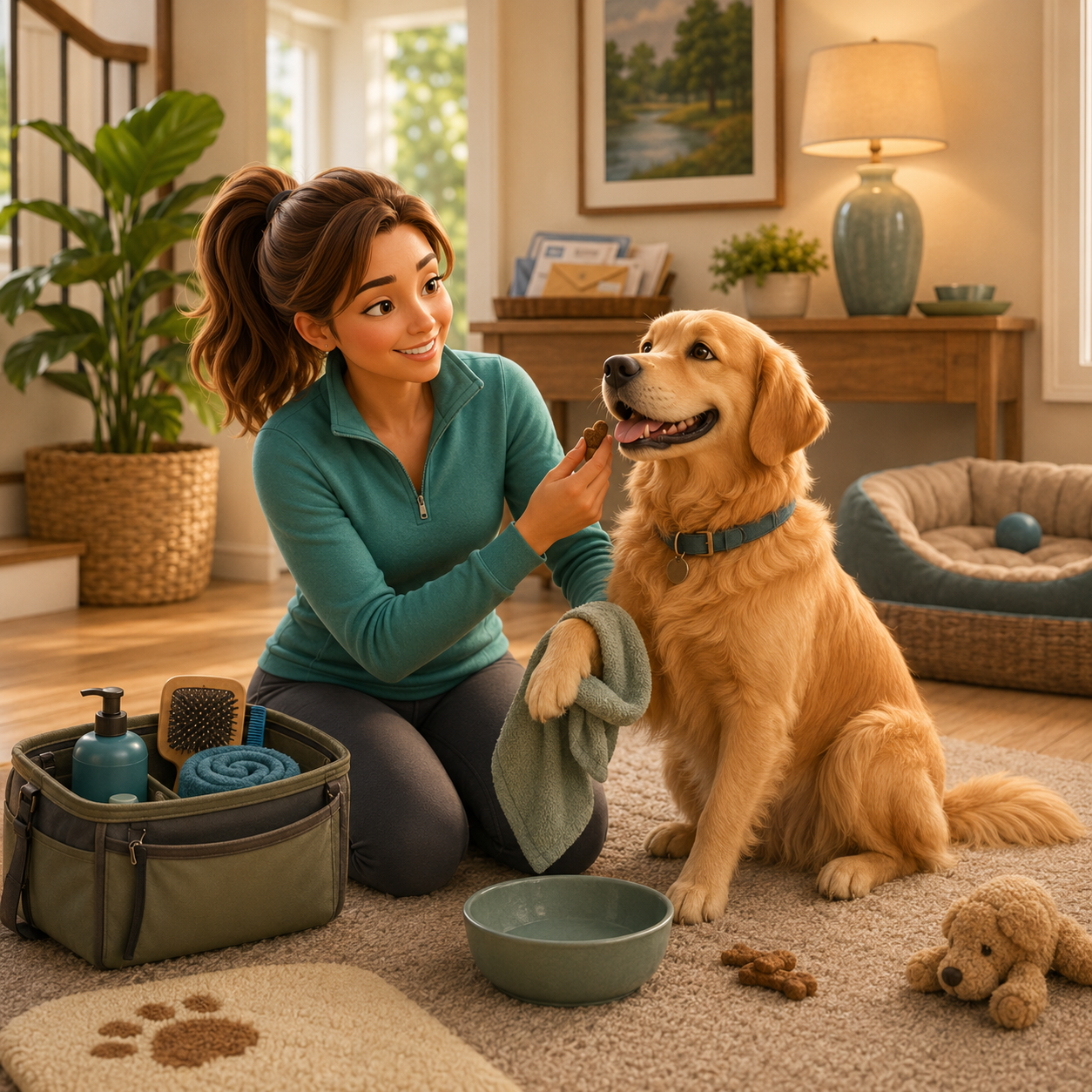
📦 Recurring & Vacation Packages — Sell a Defined Care Plan
🔁 Recurring Walking Plans
Offer fixed weekly slots for clients who need consistent help.
- Specify the number of walks, duration, days, arrival windows, and service area.
- Price the actual number of visits included—not an undefined “month of walks.”
- State payment, cancellation, holiday, and unused-visit terms.
- Use any discount carefully; a package should still cover travel and leave a worthwhile margin.
📦 Vacation & Puppy Visit Packages
Bundle care around a specific schedule rather than promising unlimited availability.
- Vacation plan: Confirm trip dates, daily visits, tasks, updates, access arrangements, and what happens if the owner’s return is delayed.
- Puppy plan: Agree on visit frequency and timing appropriate to the puppy’s needs; confirm your route can support that schedule.
- Pricing approach: Number of visits × visit rate, plus clearly disclosed extras. Quote overnight stays separately unless included explicitly.
📋 REAL-WORLD EXAMPLE
Illustrative walking package: 12 scheduled 30-minute walks at $25 each = $300 gross booking revenue before fees, expenses, and taxes. The offer states the exact dates, one dog, agreed arrival windows, and a photo update after each walk.

🎯 Build Your Beginner Service Menu
🎯 KEY TAKEAWAY
Start with one clearly defined dog-walking offer and one drop-in offer for pets you can safely handle. If your schedule cannot support walks, a focused cat-care or drop-in service is a valid starting point.
Add overnights, boarding, transport, or complex care only after checking your availability, skills, setup, and coverage. A small dependable menu is better than a long list you cannot consistently deliver.
🚀 ACTION STEP
Write your first two service descriptions:
- Name & duration: What is the service, and how long does it last?
- Included tasks: What care and owner updates are covered?
- Availability & fit: Where, when, and for which pets will you offer it?
- Price & boundaries: What is the starting rate, what costs extra, and what will you decline?
Before accepting a booking, complete an intake and meet-and-greet, confirm emergency contacts, and check applicable local requirements and insurance coverage.
4. How Much Can You Earn & Pricing Strategies
Use this chapter to connect recurring bookings, service mix, owner trust, and pricing to your pet care plan.
🧠 Reality Check (What Actually Separates Earners)
- Most beginners start with a few small local clients
- Not because pet care does not pay
- 👉 Many underprice to get early bookings
- 👉 Or they treat it like occasional side cash instead of a repeat-service business
- The sitters and walkers who earn more typically:
- Build recurring weekly dog-walking clients
- Offer higher-value pet sitting and overnight care
- Communicate well and send reliable updates
- Earn referrals because owners deeply value trust
💡 PRO TIP
In pet care, owners are not just paying for a walk or visit. They are paying for peace of mind, reliability, and loving care.
🎯 KEY TAKEAWAY
Reliable care, owner trust, and a manageable route matter more than stacking as many bookings as possible. Animal welfare always comes before revenue.
🔑 Smart Pricing Strategy
🐾 Recurring Walks & Premium Sitting
- Start with competitive local pricing to build reviews
- Move quickly toward:
- Recurring weekly walking plans
- Premium overnight rates
- Holiday / weekend pricing
➕ Pet Care Add-Ons
- Offer add-ons:
- Extra pet fees
- Medication administration
- Extended visits
- Pet taxi / special care
🎯 KEY TAKEAWAY
Quote the whole visit or stay, including travel and care responsibilities. Add extra-pet, holiday, or special-care fees only where the service is safe, agreed, and within your competence.
🧪 Real Example
📋 REAL-WORLD EXAMPLE
📌 Same Time, Different Outcomes
These scenarios illustrate possible gross booking revenue, not verified typical results or guaranteed earnings. They omit travel, supplies, fees, overhead, and taxes. Similar booked service time does not imply identical total workload, especially when overnight care is included.
🌱 Scenario A: Occasional walker
- A few part-time walks each week
- Low entry pricing
- Income: $600/month
🎯 Scenario B: Recurring dog walker
- Several weekly clients on repeat schedules
- Better pricing and route density
- Income: $2,000–$3,500/month
🚀 Scenario C: Walker + sitter
- Recurring walks plus weekend sitting / overnights
- Similar total work time
- Income: $4,000–$6,000+/month
💡 Same general service category. Big difference in service mix, pricing, and repeat client base.
🎯 KEY TAKEAWAY
Use these scenarios to understand the model, not to predict your own income. Compare actual results and risks with your written plan.
🎯 What Actually Drives Income
🧮 Owner Trust × Repeat Bookings × Route Fit = Income Potential
This is a business framework, not a mathematical earnings forecast.
📊 Key Income Drivers
- Type of service
- Dog walking = steady recurring income
- Overnight care = higher payout per booking
- Number of pets
- Multiple pets often justify higher rates
- Location
- Higher-income neighborhoods usually support stronger pricing
- Schedule density
- Clients close together increase hourly efficiency
- Trust and communication
- Photo updates, reliability, and professionalism drive repeat bookings
💡 PRO TIP
In pet care, strong client trust often matters just as much as the service itself.
📈 Visit Rates & Care Responsibilities (Pricing Reality)
📖 Read the Numbers in Context
Travel, handovers, updates, cleaning, supplies, and platform fees reduce earnings beyond the advertised walk or visit rate. An overnight fee can involve many hours of responsibility. Medication, transport, boarding, and difficult animal handling require appropriate competence, consent, coverage, and applicable permissions.
🎯 KEY TAKEAWAY
Look beyond headline income: assess the complete economics, risks, and real cash available.
🚀 Build Your First Recurring Pet Care Offer
Start with one service you can provide safely, a compact service area, detailed pet instructions, and clear booking terms. Use a small four-week trial to learn the route, care needs, and real cost of each visit.
🧭 Run a Focused Pet Care Route Test
- Choose a safe service and service area. Begin with a walk or drop-in service suited to your experience. Check local business, boarding, lease, platform, and insurance requirements where relevant. Do not accept animals or tasks you cannot handle safely; home boarding and pet transport need separate consideration.
- Meet the owner and assess care needs. Arrange a meet-and-greet and gather written feeding, walking, behavior, health, access, and emergency instructions. Confirm secure equipment, escape risks, interactions with other animals, weather limits, and an authorized emergency contact and veterinarian. Decline or refer work outside your ability.
- Define the booking and quote. State visit length, pets included, service area, updates, exclusions, additional fees, cancellation, and payment terms. Include travel, handover, and cleanup in your estimate. Agree emergency authorization, key handling, and any medication instructions; only perform tasks you are trained and authorized to provide.
- Test a small four-week route. Schedule a limited number of nearby bookings with enough travel and care buffers. Follow the owner’s instructions and safe handling practices; do not improvise off-leash walks or mix unfamiliar dogs. Send agreed updates and log problems promptly. Keep home access and owner details secure.
- Review quality and route economics. Track care time, travel, collected pay, fees, supplies, cancellations, incidents, feedback, and repeat requests. Evaluate overnights separately from short visits. Add recurring work only when the animal’s needs, owner expectations, route, and your capacity fit.
🎯 KEY TAKEAWAY
Reliable care, owner trust, and a manageable route matter more than stacking as many bookings as possible. Animal welfare always comes before revenue.
💡 Example: A Four-Week Pet Care Offer Test
- Customer: Nearby owners of dogs you can safely handle
- Offer: A clearly scoped individual walk after a meet-and-greet
- Instructions: Written route, behavior, equipment, emergency contacts, and weather limits
- Schedule: A small set of nearby bookings over four weeks with travel buffers
- Terms: Visit length, updates, fees, cancellations, access, and payment agreed beforehand
- Boundaries: No unfamiliar group walks or specialist care beyond your competence
- Signals: Care quality, owner feedback, travel time, contribution, and repeat bookings
This is a route and care-quality test, not a promise of income. Holiday and overnight demand may be seasonal. A higher booking price does not justify unsafe workload, unsupported medical care, or inadequate supervision.
✍️ Write Your One-Line Earnings Test Plan
Use this structure to make the plan easy to review:
“For [service area], I will provide [safe, defined pet service] for [pilot period], with [care instructions and booking terms]. I will review [care quality, total route time, costs, collected pay, and repeat requests] before expanding.”
✅ Completed example
“In one nearby neighborhood, I will pilot individual dog walks for four weeks after meet-and-greets and written care instructions. I will agree visit length, updates, emergency authorization, payment, and cancellation terms, then review care quality, travel time, costs, collected pay, and repeat requests before expanding.”
🚀 ACTION STEP
Before starting:
Keep the first plan focused. Build a workable process before adding more complexity.
📋 Pricing & Revenue Planning Reference
Use the existing stage and pricing ranges as illustrative planning references, not verified local rates or guaranteed earnings. Care complexity, travel, booking length, fees, capacity, and seasonality change results. Overnight revenue is not comparable with short-visit hourly pay without considering all responsibilities.
💵 What Pet Care Services Can Earn
📊 Income Progression by Stage
🚀 Stage | 🐾 Service Level | 💰 Typical Monthly Income | ⏳ Timeline | 📌 What’s Happening |
Beginner | A few walks / drop-ins | $400–$1,000 | 0–3 months | Building reviews, first repeat clients |
Developing | Regular local clients | $1,000–$3,000 | 3–6 months | Better rates + more consistent bookings |
Established | Mix of walks + sitting | $3,000–$6,000 | 6–12 months | Strong referrals and fuller schedule |
Advanced | Premium pet care / overnight mix | $6,000–$8,000+ | 12–24 months | Higher-value bookings + efficient routing |
Professional | Full schedule / small team | $8,000+/month | 2+ years | Multiple daily clients or expanded services |
🎯 KEY TAKEAWAY
The stages describe possible progression, not guaranteed income or a required timeline. Use your own capital or business records to plan realistically.
📊 Key Metrics & Margin Snapshot
📈 Visit Rates & Care Responsibilities (Pricing Reality)
📊 What Your Pet Care Route Is Actually Worth
Metric | What to Record |
Collected booking revenue | Separate walks, drop-ins, sitting, and add-ons |
Total route and care time | Include travel, handovers, updates, and cleanup |
Service obligations | Record visit lengths, overnight duties, and care complexity |
Quality and repeat demand | Track feedback, incidents, cancellations, and rebookings |
Costs and capacity | Record supplies, fees, coverage, and safe scheduling limits |
🎯 KEY TAKEAWAY
A dense route is only valuable when you can provide each animal’s agreed care safely and reliably.
💸 Common Pet Care Pricing Models
🧾 Common Pet Care Pricing Models
💡 Pricing Model | 💰 Typical Rates | 📈 Best Use Case |
🚶 Per dog walk | $15–$35+ | Daily or weekly recurring clients |
🏠 Drop-in visits | $15–$30+ per visit | Feeding, potty breaks, check-ins |
🌙 Overnight pet sitting | $50–$150+ per night | Higher-value premium service |
📅 Monthly recurring walking plan | $200–$1,000+/month | Stable income |
➕ Add-ons | $5–$25+ extra | Extra pets, meds, holidays, late visits |
🎯 KEY TAKEAWAY
Use clear service boundaries and obtain approval for additional fees. Specialist care and boarding are not automatic upsells.
🧮 Check Your Project & Revenue Economics
Pet care contribution = collected booking revenue − booking-specific travel, supplies, platform fees, and payment costs.
Compare contribution with all route and care time. Account for insurance, broader overhead, and taxes separately. Review overnight duties, supervision requirements, and seasonal gaps rather than treating each overnight fee as one hour of work.
🚀 ACTION STEP
🗓️ Build a Monthly Pet Care Revenue Snapshot
Use actual records and a sustainable plan—not projections alone—to decide what to continue.
5. Essential Tools & Setup
🛠 TOOLS & RESOURCES
🐾 Basic Equipment (Get Started)
Item | Cost | Why You Need It |
Sturdy Leashes | $15-$30 each | Control different sized dogs safely |
Waste Bags (bulk) | $15-$30 ($500-$1000 count) | Essential for every walk |
Treat Pouch | $10-$20 | Training rewards, emergency distraction |
Pet First Aid Kit | $30-$50 | Handle minor injuries immediately |
Spare Leashes/Collars | $30-$50 | Backup for broken/forgotten equipment |
Water Bottle for Dogs | $15-$25 | Portable water on walks |
Portable Water Bowl | $10-$15 | Collapsible, easy to carry |
Reflective Vest/Gear | $20-$40 | Safety for evening walks |
Flashlight/Headlamp | $15-$30 | Early morning/evening visibility |
Total basic startup: $150–$300
🚗 Vehicle & Transportation
Requirements for pet taxi/sitting:
- Reliable vehicle
- Pet safety restraints ($20–$60)
- Seat covers ($30–$80)
- Cleaning supplies for accidents
- Vehicle insurance disclosure to provider
📱 Software & Apps
Tool | Cost | Purpose |
Free (takes 20% commission) | Find clients, booking, payment | |
Free (takes 40% commission) | Dog walking clients | |
$35-$50/month | Multi-service platform | |
$25-$50/month | Scheduling, invoicing, client management | |
$10-$25/month | Booking and scheduling | |
$5-$15/month | GPS walk tracking | |
Free (2.9% transaction fee) | Payment processing |
Recommendation: Start with Rover (free, large user base) while building direct clients
🏆 Professional Setup (Scale Up)
Item | Cost | Purpose |
Business Liability Insurance | $200-$500/year | Protect against injury/damage claims |
Bonding Insurance | $100-$300/year | Protect client property |
Pet CPR/First Aid Certification | $30-$80 | Professional credibility, emergency preparedness |
Business Cards/Flyers | $50-$150 | Marketing materials |
Professional Website | $100-$500/year | Booking, credibility (or free with Wix/Squarespace) |
Scheduling Software | $10-$30/month | Time To Pet, Pet Sitter Plus, etc. |
GPS Tracking App | $5-$15/month | Show owners walk routes (many free options) |
Backup Keys Lockbox | $20-$40 | Secure client key storage |
Total professional investment: $500–$1,500 first year

6. Where to Find Clients
Pet sitting clients come from a mix of marketplace visibility, local trust, referrals, and partnerships. Use this chapter to choose channels that fit your services, build reviews safely, and turn early bookings into a dependable direct-client pipeline.
🐾 Pet Care Platforms — Fastest Start
Pet care platforms are usually the easiest way to get your first bookings because pet owners are already searching for sitters, walkers, and vacation care.
Platform | Commission / Cost | Volume | Best For |
20% commission | High | Building initial reputation | |
40% commission | Medium | Dog walking and quick bookings | |
Subscription-based | Medium | Comprehensive pet care services | |
Around 19% commission | Low-Medium | International and vacation care |
🧩 Best Platform Fit
🧠 Platform Strategy
- 📸 Create a compelling profile with professional photos
- 🐶 Use friendly photos of you with pets, if available
- 💵 Start with competitive pricing that matches your local market
- ⚡ Respond to inquiries within 30 minutes
- ✅ Accept most reasonable bookings at first to build reviews
- 📲 Send photo and video updates during every booking
- 🌟 Ask for honest reviews after strong bookings; the number and timing will vary






⏱️ Timeline: Building a reputation on platforms can take months. Shift repeat clients toward direct bookings only when the relationship and platform rules allow it.
📍 Local Marketing — Build Long-Term Trust
Pet care is highly trust-based. Many owners prefer hiring someone nearby who feels familiar, reliable, and recommended by the community.
📨 Neighborhood Outreach
Location | How to Use It |
Dog Parks | Network with owners and hand out cards naturally |
Pet Stores | Leave flyers or cards with permission |
Vet Clinics | Build relationships and leave professional materials |
Grooming Salons | Create cross-referral opportunities |
Coffee Shops | Use community bulletin boards |
Apartment Complexes | Ask about posting flyers for residents |
Local Events | Attend pet adoption events or community markets |
📄 What to Put on Flyers or Cards
- Your name or business name
- Dog walking / pet sitting services
- Service area
- Phone number or booking link
- “Free meet-and-greet” offer
- Short trust statement, such as insured, experienced, reliable
- QR code to your profile, website, or Google Business Profile
📦 Good Local Offer
New client special: Free meet-and-greet + $10 off your first dog walk or pet sitting visit.
📌 Success Rate: Flyers may only convert around 2–5%, but clients who do convert can become loyal repeat customers.
🌐 Digital Marketing — Get Found Locally
Digital marketing helps you show up when local pet owners need help with walks, drop-ins, overnight sitting, boarding, or vacation care.
🏘️ Nextdoor
Join Nextdoor, an app for neighborhoods where you can get local tips, buy and sell items, and more
- Post your services in your neighborhood
- Join local pet-related discussions
- Respond to “need recommendations” posts
- Share helpful pet care tips
- Ask happy clients to recommend you
Best for: Local trust, neighborhood referrals, repeat pet care clients
👥 Facebook Groups
- Join local pet owner groups
- Join neighborhood and community groups
- Avoid spamming your service
- Provide value first by answering pet care questions
- Respond to posts from people needing help
- Share availability when group rules allow
Best for: Warm leads, community visibility, local recommendations
- Post photos of dogs you walk or pets you care for with permission
- Use local hashtags like #YourCityDogs
- Tag local parks and pet-friendly places
- Use Stories to show your day-to-day routine
- Share client testimonials and pet updates
- Create Highlights for services, reviews, pricing, and FAQs
Best for: Credibility, visual proof, personality-based trust
📍 Google Business Profile
Get Listed on Google - Google Business Profile
- Free business listing
- Helps you appear in “dog walker near me” searches
- Collect and display reviews
- Add service area, hours, photos, and contact info
- Critical for local SEO
Best for: High-intent local search traffic
💡 Best Digital Strategy: Set up Google Business Profile first, then use Nextdoor and Facebook Groups for local trust while Instagram builds proof and personality.
🗣️ Referrals — Turn Trust Into Growth
Referrals are one of the strongest ways to grow because pet owners usually know other pet owners. A trusted recommendation can convert faster than a cold ad or platform listing.
🤝 Referral Incentives
- Give existing clients a $20–$30 credit for each referral
- Give the referred friend $10–$20 off their first booking
- Keep the offer simple
- Mention the referral program after a successful booking
- Add the referral note to follow-up texts or emails
🤝 Ask for Referrals Directly
After 3–4 successful bookings, say:
Do you know anyone else who might need help with their pets?
Or:
I’m currently accepting a few new dog walking and pet sitting clients. If you know another pet owner who needs reliable help, I’d really appreciate the referral.
🛠️ Build a Reputation Worth Referring
- Exceed expectations every time
- Send unprompted photo and video updates
- Arrive on time
- Follow pet care instructions carefully
- Leave small treats or toys occasionally
- Remember pet birthdays
- Send quick “all done” updates after each visit
- Make clients feel like their pets are genuinely cared for
💡 Referral Multiplier: A happy owner may refer other pet owners, especially in apartments, dog parks, and neighborhood groups. Referrals help, but they are not automatic.
🤝 Partnerships — Build a Local Referral Network
Partner with businesses and professionals who already work with pet owners. These relationships can send you better leads than random online posts.
🤝 Potential Partners
Partner | Referral Opportunity |
Veterinarians | Pet sitting, medication visits, senior pet care |
Pet Groomers | Dog walking, sitting, vacation care |
Dog Trainers | Walks, drop-ins, daily care after training |
Pet Photographers | Package deals and shared audiences |
Travel Agents | Vacation pet care referrals |
Real Estate Agents | House sitting during showings, moves, or travel |
Apartment Managers | Dog walking for residents |
Pet Stores | Flyers, cards, local recommendations |
🧰 Useful Pet-Related Businesses & Resources
📨 Simple Partnership Pitch
Hi [Name], I offer local dog walking and pet sitting services for pet owners in [area]. I’m currently building relationships with pet-focused businesses and would love to leave a few cards for customers who ask about reliable pet care. I’d also be happy to refer clients to you when they need grooming, vet care, or pet supplies.
💡 Best Partnership Strategy: Start with groomers, trainers, and apartment communities. They interact with pet owners often and can refer repeat clients.
🧭 Client-Finding Strategy — Build a Balanced Pipeline
The best approach is to use platforms for fast bookings, then build direct local channels so you reduce commissions and increase repeat income.
🚀 Phase 1: Fast Start
Start with platforms to get your first bookings.
- Join Rover, Wag!, Care.com, or PetBacker
- Build a strong profile
- Price competitively
- Respond quickly
- Focus on reviews first
📍 Phase 2: Build Local Visibility
Once you have some experience, start becoming visible locally.
- Post on Nextdoor
- Create a Google Business Profile
- Join Facebook Groups
- Leave flyers in pet-friendly local spots
- Network at dog parks, pet stores, and grooming salons
- Start posting pet care content on Instagram
🎯 Phase 3: Move Toward Direct Clients
After you have reviews and trust signals, focus on direct bookings.
- Ask happy clients for referrals
- Offer referral credits
- Build partnerships with groomers, vets, and trainers
- Create simple direct booking options
- Keep repeat clients organized
- Gradually reduce reliance on commission-heavy platforms
🧠 Best Overall Strategy
Stage | Main Goal | Best Channels |
Month 1–2 | Get first clients and reviews | |
Month 2–4 | Build local reputation | Nextdoor, Facebook Groups, Google Business Profile |
Month 4+ | Increase profit and direct bookings | Referrals, partnerships, repeat clients |
🔍 What to Track Weekly
- Platform inquiries
- Bookings completed
- Reviews collected
- Repeat clients
- Referral leads
- Best service type
- Best neighborhood
- Revenue by platform
- Direct vs. platform bookings
⚡ Key Insight: Platforms help you start, but trust, reviews, referrals, and local partnerships are what turn pet care into a steady business.
7. From Meet-and-Greet to Repeat Client
Pet owners are trusting you with more than a booking. They are trusting you with an animal they care about, access to their home, personal instructions, and sometimes the responsibility to notice when something is not right.
That means your service needs a repeatable process.
Use this cycle:
Screen → Meet → Document → Confirm → Prepare → Care → Update → Secure → Follow Up → Rebook
Your goal is not simply to complete a walk or visit. Your goal is to make the owner feel confident asking you to care for their pet again.
Use the seven phase tabs in order. Keep the care plan and checklists open while working. Start with pets and visit types you can handle safely; Chapters 5–6 cover tools and finding clients.
🐾 PHASE 1 — Screen the Booking & Meet the Pet
📋 Steps 1–2: Decide whether the animal, schedule, location, and care requirements fit you before you say yes. Then use a meet-and-greet to observe the pet and walk through the real routine. Finish with a clear go / ask more / decline decision.
✅ Ready to move on: You have seen the pet, the access path, and the care routine, and made a go / ask more / decline decision.
🐾 Step 1: Screen the Booking Before Saying Yes
Do not accept a pet-care request based only on the service type and price.
A meet-and-greet is a short in-person meeting to see the pet, the home, and the routine before care starts. First, determine whether the animal, schedule, location, and care requirements fit your experience and availability.
Ask about:
- 🐶 Pet type, breed, age, and approximate size
- 🧠 Temperament
- 🦮 Walking behavior
- ⚠️ Reactivity toward people or animals
- 🚨 Bite or escape history
- 🩺 Medical conditions
- 💊 Medication requirements
- 🐾 Mobility limitations
- 🥣 Feeding routine
- 🚽 Bathroom routine
- 💛 Separation concerns
- 🐕 Other pets in the home
- 📅 Service dates and times
- 📍 Location and travel distance
- 🔑 Access arrangements
- 📞 Emergency contacts
🤔 Check Whether You Can Safely Handle This Pet
Ask yourself:
Can I safely handle this pet? Do I understand the care being requested? Can my schedule support the required timing? Is anything outside my experience or service scope?
If something does not feel manageable, ask more questions or decline the booking.
🎯 KEY TAKEAWAY
Do not accept a risky pet simply because you want the booking. Good screening protects you, the owner, and the animal.
⚠ COMMON MISTAKE
A paid booking is not worth a safety risk you cannot control.
Ready for Step 2 when: The pet, timing, location, and care needs look like a fit, or you have declined.
🤝 Step 2: Hold a Meet-and-Greet
For new recurring clients, sitting jobs, or pets with more involved care needs, a meet-and-greet can prevent a lot of problems.
Use the meeting to observe the pet and walk through the routine with the owner. Seeing the routine once is often more useful than trying to decode it later from a text message.
🐾 Review the Pet
Watch:
- 👀 How the pet reacts to you
- ⚡ Normal energy level
- 🤲 Handling preferences
- ⚠️ Known triggers
- 🦮 Leash or harness setup
- 🥣 Feeding routine
- 💊 Medication routine, if applicable
🏠 Review the Home
Walk through:
- 🚪 Entry and exit process
- 🔒 Gates
- 🐾 Crates
- 🥣 Food and supplies
- 🧼 Cleaning supplies
- 🚽 Litter or potty areas
- 🚨 Alarm system
- 🚫 Areas that are off-limits
🦮 Confirm the Service Details
Agree on:
- ⏱️ Visit length
- 🗺️ Walk route
- 🥣 Feeding expectations
- 💧 Water
- 🎾 Playtime
- 🧹 Cleanup
- 📸 Photos or updates
- 🏠 Household tasks included
👀 Watch the Owner Demonstrate
If a routine matters, ask the owner to show you.
That may include:
- 🦮 Putting on the harness
- 🔒 Locking a specific gate
- 🥣 Preparing food
- 🐾 Using a crate
- 💊 Giving an agreed medication
- 🚨 Operating an alarm
💡 PRO TIP
Ask the owner to demonstrate once. A 30-second demo beats a long text thread later.
Ready for Phase 2 when: You have seen the pet, the access path, and the care routine you would be following.
🧪 Your First 5 Bookings
🚀 ACTION STEP
Use your first five completed bookings as a learning period. Focus on executing the workflow safely—not on filling the calendar. Five careful bookings teach more than a packed week with no notes.
🗺️ Booking 1 — Learn the Workflow
💬 Booking 2 — Improve Communication
🛡️ Booking 3 — Improve Safety
⚡ Booking 4 — Improve Efficiency
📊 Booking 5 — Review the Whole System
A job count is not proof you should add boarding, group walks, or a second neighborhood.
📋 PHASE 2 — Write the Care Plan & Confirm the Booking
📋 Steps 3–6: Turn the meeting into written instructions, an emergency plan, an exact service list, and a confirmation both sides can keep. Finish with dates, tasks, price, access, and contacts in writing—not in memory.
✅ Ready to move on: The care plan, emergency plan, exact tasks, dates, price, and access notes are confirmed in writing.
📋 Step 3: Create a Written Pet Care Plan
Do not rely on memory. Create a record for every recurring pet or household.
Pet Profile
- 🐾 Pet Name: ____________________
- 🐶 Species / Breed: ____________________
- 🎂 Age: ____________________
- 🧠 Normal Temperament: ____________________
- ⚠️ Known Triggers: ____________________
- 🚨 Escape Risks: ____________________
- 🥣 Feeding Instructions: ____________________
- 🦮 Walk / Potty Routine: ____________________
- 💊 Medication Instructions: ____________________
- 🩺 Veterinarian: ____________________
- 📞 Emergency Contact: ____________________
- 👤 Owner Contact: ____________________
- 🚑 Approved Emergency Plan: ____________________
🔑 Record Home & Access Notes
Keep this with the pet profile, and keep it private.
- 🔑 Entry Method: ____________________
- 🚨 Alarm Instructions: ____________________
- 🚪 Gate / Door Notes: ____________________
- 🧰 Supplies Located: ____________________
- 🚫 Restricted Areas: ____________________
- 🔐 Key Return Plan: ____________________
Keep sensitive access information secure and share it only with people who legitimately need it.
🔐 QUICK NOTE
A pet-care business handles both animal information and home-access information. Treat both as confidential.
🚨 Step 4: Agree on an Emergency Plan
Do not wait until something goes wrong to decide what to do.
Before care begins, confirm:
- 👤 Primary owner contact
- 📞 Backup contact
- 🩺 Veterinarian
- 🏥 Preferred emergency veterinary facility when applicable
- 🚗 Transportation instructions
- 💳 Spending or authorization expectations where appropriate
- 🩺 Known medical issues
- 💊 Medication information
- 🚨 What situations require immediate owner contact
⚠️ QUICK NOTE
Written emergency instructions are especially important when the owner will be traveling or difficult to reach.
⚠️ Follow Observe → Protect → Contact
If something seems wrong, your role is to:
Observe → Protect → Contact → Follow the agreed emergency plan
Do not diagnose a condition yourself or change medication instructions on your own.
If an emergency appears immediate, prioritize the animal's safety and follow the agreed plan and appropriate veterinary guidance.
Ready for Step 5 when: Contacts, vet details, and “call immediately if…” situations are written down.
🦮 Step 5: Confirm the Exact Service
Do not leave the service as:
“Take care of Max.”
Write down exactly what the booking includes. Use Chapter 4 for pricing. Chapter 7 should make sure everyone understands what is actually being delivered.
🦮 Example: 30-Minute Dog Walk
📋 REAL-WORLD EXAMPLE
Included:
- 🔑 Secure entry
- 🦮 Leash or harness setup
- 🗺️ Agreed walk
- 💩 Waste pickup
- 💧 Water check
- 📧 Short owner update
- 🏠 Secure return to the home
🏠 Example: Drop-In Visit
📋 REAL-WORLD EXAMPLE
A drop-in is a short visit to feed, check on, and spend time with the pet in the home—not an overnight stay.
Included:
- 🥣 Feeding
- 💧 Fresh water
- 🚽 Potty break or litter care
- 🎾 Agreed play or companionship
- 🧹 Basic cleanup related to the visit
- 📸 Photo and update
- 🔐 Secure home check before leaving
➕ Confirm Add-Ons Separately
Confirm separately, with price and timing, before the visit:
- 🐕 Additional pets
- 💊 Medication
- ⏱️ Extended care
- 🏠 Household tasks
- 🪴 Plant watering
- 🚗 Transportation
- 🕒 Additional visit time
📅 Step 6: Confirm the Booking in Writing
Before the first service, confirm:
- 📅 Dates
- 🔁 Visit frequency
- 🕒 Arrival window
- 🐾 Service type
- 🐕 Pets included
- 📋 Tasks included
- 💰 Price
- 💳 Payment terms
- 🔄 Cancellation terms
- 🔑 Access
- 👤 Owner contact
- 📞 Emergency contact
- 📝 Special instructions
📧 Copy a Simple Confirmation Message
“You're confirmed for [service] for [Pet Name] on [dates/times]. I'll follow the care instructions we reviewed, send an update after each visit, and contact you promptly if anything unusual comes up.”
Now both sides know what to expect.
Ready for Phase 3 when: The care plan, emergency plan, exact tasks, dates, price, and access notes are confirmed in writing.
🎒 PHASE 3 — Prepare for the Visit & Arrive Safely
📋 Steps 7–9: A professional visit starts before you arrive. Pack what you need, check weather, then use a slow arrival and departure routine so the pet cannot slip out. Finish with the pet where the owner expects and the home secured.
✅ Ready to move on: You can enter and leave without creating an escape path, and you know where the pet should be when you go.
🎒 Step 7: Prepare Before Every Visit
A professional visit starts before you arrive.
Before leaving, check:
- 🔋 Phone battery
- 📅 Schedule
- 📍 Address
- 🔑 Access instructions
- 📝 Pet notes
- 🧰 Required supplies
- 💩 Waste bags
- 🌦️ Weather
- 🧥 Appropriate clothing
- 💧 Water when needed
- 🦮 Backup leash or agreed safety gear
- 📞 Emergency contacts
🌦️ Check Weather Before You Leave
Heat, cold, storms, ice, poor air quality, or dangerous pavement can affect the safety of outdoor activity.
Adjust the service appropriately rather than forcing the original plan when conditions are unsafe.
If outdoor time is unsafe, follow the owner's written backup: a shorter potty break, indoor play, or a reschedule—do not invent a new routine on the sidewalk.
Ready for Step 8 when: You have the address, access notes, supplies, and a weather-safe plan for this visit.
🚪 Step 8: Use a Safe Arrival Routine
Arrivals and departures are major escape-risk moments. Do not rush through them.
Before opening a door or gate:
- 👀 Check where the pet is
- 🐕 Confirm other pets are secured appropriately
- 🦮 Prepare the leash or equipment
- ⚠️ Watch for open doors
- 📋 Follow the owner's entry instructions
- 🔑 Keep keys and access devices secure
🔐 Step 9: Use a Safe Departure Routine
Before leaving:
- 🐾 Confirm the pet is where the owner expects
- 🚪 Check doors
- 🔒 Check gates
- 🐾 Check crates when applicable
- 🪟 Check windows you interacted with
- 💧 Confirm water and agreed care tasks
- 🏠 Verify the home is secured
🎯 KEY TAKEAWAY
A perfect walk followed by an unsecured gate is not a successful visit.
Ready for Phase 4 when: You can enter and leave without creating an escape path, and you know where the pet should be when you go.
🐕 PHASE 4 — Follow This Pet's Care Plan
📋 Steps 10–12: Do the walk or drop-in exactly as written for this pet—not the last pet you cared for. Treat medication as a high-attention task. Finish the visit having followed the approved routine, not an improvised one.
✅ Ready to move on: The agreed walk or drop-in tasks are done, and any medication was given exactly as written or reported immediately.
🦮 Step 10: Follow the Agreed Walk Plan
Do not improvise simply because another pet you cared for had a different routine. Follow the instructions for this pet.
During a walk, pay attention to:
- 🔒 Leash security
- 🚗 Traffic
- 🐕 Other animals
- 🌡️ Heat or cold
- ⚠️ Signs of stress
- 🗺️ Approved route
- 💩 Waste cleanup
- 💧 Water needs
- 👀 The dog's normal behavior
Do not introduce unfamiliar dogs, use off-leash areas, or substantially change the routine without appropriate permission and safe conditions.
🏠 Step 11: Follow the Drop-In Sequence
During a drop-in, follow the agreed sequence. A checklist makes it much harder to forget something when your schedule gets busy.
For example:
Enter → Locate Pet → Potty/Litter → Food → Water → Play/Companionship → Cleanup → Update → Secure Home
Stay inside the booked visit length. If the pet needs more time than agreed, contact the owner rather than silently extending every stop.
💊 Step 12: Treat Medication as a High-Attention Task
Only agree to medication tasks you are competent and permitted to perform.
Use the owner's written instructions.
Confirm:
- 💊 Medication name
- 📏 Amount
- ⏰ Timing
- 📋 Method
- 🗄️ Storage
- ❓ What to do if the pet refuses it
- ⚠️ What to do if a dose may have been missed
- 📞 Who to contact with questions
Record the medication task when completed.
🚫 Never Improvise Medication
Never:
- 🚫 Change the amount yourself
- 🚫 Substitute medication
- 🚫 Repeat a dose because you are unsure whether it was given
- 🚫 Diagnose symptoms
- 🚫 Guess when instructions are unclear
If you are uncertain, stop and contact the appropriate person rather than improvising.
Ready for Phase 5 when: The agreed walk or drop-in tasks are done, and any medication was given exactly as written or reported immediately.
📸 PHASE 5 — Update the Owner, Record Problems & Finish the Visit
📋 Steps 13–16: Communication is part of the service. Send a short update, report important problems with facts, record incidents, and run the final care check before you leave. Finish with the pet safe, the home secure, and the owner informed.
✅ Ready to move on: The pet is where the owner expects, the home is secured, the update is sent, and any problem is reported with facts.
📸 Step 13: Send an Update After Every Service
For pet owners, communication is part of the service. A useful update can be very short.
Include:
- ✅ What you completed
- 🐾 How the pet behaved
- 🥣 Bathroom or feeding information when relevant
- ⚠️ Anything unusual
- 📸 One or two good photos
- 🔐 Confirmation that the pet and home are secure
💬 Copy a Simple Visit Update
📋 REAL-WORLD EXAMPLE
“All done with Luna's visit! She ate her dinner, had fresh water, went outside for her potty break, and we played for about 10 minutes. She was relaxed and happy when I left. Everything is locked and secure. Photos attached.”
That message answers the owner's biggest question:
“Is my pet okay?”
⚠️ Step 14: Report Problems Immediately With Facts
Do not wait until the end of the day to report something important.
Contact the owner promptly when you notice things such as:
- 🩹 Injury
- 🩺 Illness signs
- 🧠 Unexpected behavior change
- 🚨 Escape attempt
- 🦮 Damaged leash, collar, or harness
- 🔎 Missing pet
- 💊 Medication problem
- 🤢 Vomiting or diarrhea that is unusual for the pet
- 🥣 Refusal to eat when relevant to the care plan
- 🔑 Home-access problem
- 🏠 Damage inside the home
- ⚠️ Another safety concern
📝 Report What You Observed
Say what you observed. Avoid pretending to know the medical cause.
📋 REAL-WORLD EXAMPLE
“Max vomited once at approximately 2:15 PM and is currently alert and resting. I have stopped activity and am following the emergency instructions we discussed. Please let me know how you'd like me to proceed.”
Clear facts are more useful than speculation. In a true emergency, follow the agreed plan instead of waiting for a reply.
📝 Step 15: Document Incidents Honestly
If something significant happens, keep a basic record.
Record:
- 📅 Date
- 🕒 Time
- 🐾 Pet
- 📍 Location
- 📝 What happened
- 👀 What you observed
- 🛠️ Action taken
- 📞 Who was contacted
- 📋 Instructions received
- ✅ Final outcome
This is useful for safety, communication, and improving your procedures.
Do not hide mistakes. Prompt, accurate communication is almost always better than hoping the owner will never notice.
✅ Step 16: Complete a Final Care Check Before Leaving
Before leaving, mentally run through the booking. Make this routine automatic.
Use the three groups below: pet, home, and client communication.
🐾 Check the Pet
🏠 Check the Home
👤 Check Client Communication
Ready for Phase 6 when: The pet is where the owner expects, the home is secured, the update is sent, and any problem has been reported with facts.
🔑 PHASE 6 — Protect Access & Invite Suitable Repeat Care
📋 Steps 17–19: Home access is a major responsibility. Handle keys and codes professionally, invite recurring care only when the pet and route fit, and record the details that make the next visit smoother. Finish with secure access and notes you can actually use.
✅ Ready to move on: Keys and codes are handled as agreed, suitable rebooking was offered or skipped on purpose, and useful pet details are written down.
🔑 Step 17: Handle Keys & Access Professionally
Home access is a major responsibility. Use a system.
Good practices:
- 🏷️ Avoid labeling a key with a full home address
- 🔒 Keep keys secured
- 🚫 Do not make copies without permission
- 🚫 Do not share codes unnecessarily
- 🔑 Follow the agreed key-return process
- 🔄 Update access records when codes change
- 🚨 Report a lost key or device immediately
For direct clients, decide before the booking how access will work. Do not figure it out five minutes before the first visit.
🔁 Step 18: Invite Suitable Recurring Care
If the owner is happy and you enjoyed caring for the pet, make the next booking easy.
For dog walking: “If you'd like, I can reserve a regular Tuesday and Thursday walk for Max so you don't have to request it each week.”
For vacation care: “Whenever you know your next travel dates, feel free to send them early and I'll let you know whether I can reserve the same care schedule.”
Recurring care works best when the pet is a good fit, the owner communicates well, the route makes sense, the schedule is sustainable, and the service remains safe and worthwhile.
Not every good one-time booking needs to become recurring.
🧠 Step 19: Record Details You Should Remember
Pet owners notice when you remember details. Record useful, appropriate information so the next visit does not depend on memory.
🐶 Example: Max
📋 REAL-WORLD EXAMPLE
- 🦮 Uses blue harness
- 🛹 Nervous around skateboards
- 🗺️ Loves sniffing on the east route
- 💧 Water bowl is in kitchen
- 🚫 No treats without permission
🐱 Example: Luna
📋 REAL-WORLD EXAMPLE
- 👀 Hides when sitter enters
- 🥣 Food stored in pantry
- 🧹 Litter scoop under sink
- 🎾 Prefers play after eating
Ready for Phase 7 when: Keys and codes are handled as agreed, suitable rebooking has been offered or skipped on purpose, and the pet's useful details are written down.
📊 PHASE 7 — Track Bookings & Choose Better-Fit Clients
📋 Steps 20–21: Your first bookings should teach you which clients and services fit. Track the real workload, then keep, adjust, train for, or decline the next request. Finish each booking with one decision and one improvement—not a fuller calendar at any cost.
✅ Done when: Each booking ends with one keep / adjust / train / decline decision and one improvement.
📊 Step 20: Track Every Booking
Your first bookings should teach you which clients and services fit your business best.
Track | Why It Matters |
🐾 Service Type | Shows which work you actually perform |
🚗 Travel Time | Reveals route efficiency |
⏱️ Care Time | Shows the real workload |
🧩 Pet Complexity | Helps identify good-fit bookings |
💬 Owner Communication | Affects how smoothly the service runs |
⚠️ Incidents / Issues | Shows safety patterns |
🔁 Repeat Booking? | Measures client fit |
⭐ Review / Referral | Measures trust |
💰 Actual Costs | Helps evaluate the booking |
📅 Next Visit | Keeps recurring care organized |
🎯 Judge Value by Fit, Not Price Alone
🎯 KEY TAKEAWAY
A high-priced booking is not automatically your best client.
A nearby, predictable, recurring dog walk with a great owner may be much more valuable to your business.
Ready for Step 21 when: You can describe the visit's travel, care time, complexity, communication, and whether you would repeat it.
🚦 Step 21: Decide What to Keep, Adjust, Train For or Decline
After several bookings, classify your recurring opportunities. Discuss any change before the next booking. A full calendar is not worth compromising animal welfare or safety.
✅ KEEP
A safe pet, reasonable care plan, good owner communication, manageable route, and sustainable schedule.
🛠️ ADJUST
The relationship is worth keeping, but something needs to change.
Possibilities include:
- 🕒 Visit timing
- ⏱️ Service duration
- 📋 Scope
- 🔑 Access
- 📝 Pet-care instructions
- 📍 Travel radius
- 💬 Communication process
📚 TRAIN FIRST
The type of care interests you, but you need more knowledge or skill first.
Examples could include:
- 🧠 More advanced behavior handling
- 🐾 Specialized pet care
- 💊 Complex medication
- 🐕 Multi-dog handling
- 🚗 Transport
Build competence before adding the service.
❌ DECLINE
Decline when the situation cannot be made safe or workable.
Examples may include:
- ⚠️ Animal you cannot safely control
- 🚩 Owner withholding important behavior history
- 📋 Care outside your qualifications
- 🏠 Unsafe home conditions
- 📅 Impossible schedule
- 🔑 Repeated access problems
- 🚫 Expectations outside the agreed service
Workflow complete when: The visit is logged, one keep / adjust / train / decline decision is made, and one improvement is noted before the next booking.
As you learn, create reusable tools. Your systems should make care safer and more consistent, not more complicated.
Keep animal information and home-access information confidential. Store keys, codes, and addresses in a private tracker—not in a public note.
👤 Before Booking
- ❓ Inquiry questionnaire
- 🐾 Pet profile
- 🤝 Meet-and-greet checklist
- 📄 Service agreement
- 🚨 Emergency information form
🎒 Before Each Visit
- 📋 Care instructions
- 🔑 Access notes
- 🧰 Supplies checklist
- 🌦️ Weather check
- 🗺️ Route schedule
🐾 During Care
- ✅ Walk or visit checklist
- 💊 Medication log when applicable
- 📝 Incident form
- 📸 Photo-update template
📧 After Care
- ✅ Completion checklist
- 💬 Client update
- 📝 Booking notes
- ⭐ Review request
- 📅 Next-service reminder
🔄 Use Your Repeatable Pet Care Workflow
Use the same basic process:
Screen → Meet → Document → Confirm → Prepare → Care → Update → Secure → Follow Up → Rebook
The more consistent this becomes, the easier it is to care for several clients without forgetting the small details that matter.
🎯 Become the Sitter Owners Trust With Their Pets
Your goal is not:
“Accept as many pet-care jobs as possible.”
It is:
“Become the person a small group of owners completely trusts with their pets.”
- Choose pets you can safely care for.
- Learn their routines.
- Document the details.
- Protect their homes.
- Communicate clearly.
- Handle problems honestly.
- Make every visit consistent.
- Then earn the next booking.
🎯 KEY TAKEAWAY
In pet care, repeat business begins with trust—and trust is built one safe visit at a time.
8. Build Trust & Improve Results
Use this section to build proof before you scale, showcase your pet care profile, stay recognizable and honest, communicate like a professional, use ready-made templates, master the habits that earn repeat clients and referrals, check every visit before you leave, choose a service mix and pricing path, and avoid the mistakes that cost new sitters clients, safety, and income. Chapter 7 walks through the meet-and-greet-to-repeat-client process; this chapter helps you earn trust and keep improving. Animal welfare always comes before revenue, and results vary with your market, route, and whether owners rebook.
⭐ ADVANCED STRATEGY
1️⃣ Build Proof Before You Scale 📁
Non-negotiable
Owners are trusting you with an animal they love and with access to their home. Build real evidence that you handle pets safely and reliably before you add clients, services, or a second neighborhood.
🛡️ Why Proof Builds Trust
Owners cannot watch you work, so they rely on evidence.
Why this matters:
- Experience and training show you can handle animals safely
- Reviews show you arrive on time and follow instructions
- Photo updates show care actually happened
- References from neighbors, friends, or past clients reduce perceived risk
- Clear terms and records show you run a professional service
☑️ Minimum Proof Checklist
- A clear description of the animals and visits you can safely handle
- Evidence of experience: your own pets, volunteering, or previous care
- Pet first aid or CPR training, if you choose to complete it
- Coverage and local requirements checked
- A complete profile with friendly photos
- A few honest reviews or references (with permission)
- A written service agreement and emergency plan template
🛡️ How to Create Proof From Scratch
🐕 Option 1: Document Your Experience
Show what you have actually done.
What to do:
- List the pets you have cared for and for how long
- Note volunteer work at shelters or rescues
- Gather references from neighbors, friends, or family
- Be accurate; never overstate your experience
🎓 Option 2: Add Training and Coverage
Make your safety practices visible.
What to do:
- Consider pet first aid or CPR certification
- Check local business, lease, and platform rules
- Review insurance options and confirm what they cover
- Prepare an emergency plan template
🌱 Option 3: Start With a Small, Nearby Trial
Prove your process on a compact route.
What to do:
- Choose one walk or drop-in service for pets you can handle
- Offer a meet-and-greet before every new client
- Keep a short visit log and send an update after each visit
- Ask for honest reviews after strong bookings
💡 PRO TIP
Your first five bookings are a learning period. Focus on safe, well-documented care and clear updates, not on filling the calendar.
🤝 Option 4: Learn From Experienced Sitters
Peers can help you avoid common mistakes.
What to do:
- Join local pet sitter or dog walker communities
- Ask experienced sitters how they screen bookings
- Learn local rules and typical expectations
- Review your platform's safety guidance
Avoid:
- Fake reviews or exaggerated credentials
- Taking pets or tasks beyond your ability
- Sharing home access details publicly
2️⃣ Showcase Your Pet Care Like a Pro 🗂️
🖼️ What to Include in Your Pet Care Profile
What to Show | Why It Matters |
Clear service menu with visit lengths | Shows exactly what is included and what costs extra |
Friendly photos of you with animals | Builds comfort and trust (with permission for other people's pets) |
Reviews and references (with permission) | Social proof from real owners |
Experience and training | Shows you can handle animals safely |
Service area and availability | Helps owners see whether you fit their schedule |
Coverage and booking terms | Shows you run a professional, accountable service |
Meet-and-greet offer | Lowers the barrier to a first booking |
Keep it tight:
- Lead with the service and the pets you handle best
- Keep rates, service area, and cancellation terms visible
- Use real photos and recent reviews
- Remove claims you cannot support
🛡️ Where to Showcase Your Services
Place | Best For |
Pet care platform profile | Fastest first bookings and reviews |
Google Business Profile | High-intent local searches like “dog walker near me” |
Simple website or booking page | Direct clients and clear terms |
Nextdoor and local Facebook groups | Neighborhood trust and recommendations |
Instagram | Visual proof and personality, with owner permission |
Protect your clients:
- Get permission before posting any pet or owner photo
- Never reveal home addresses, access codes, or schedules
- Do not post that a client's home is empty
- Follow platform rules on off-platform contact
💡 PRO TIP
Set up your Google Business Profile first, then use Nextdoor and local groups for trust while Instagram builds visual proof.
3️⃣ Be Recognizable and Honest ✨
Trust is built by being specific about what you offer and honest about what you cannot do.
🎨 Make Your Service Instantly Recognizable
- Write the offer in one sentence, such as “Reliable 30-minute dog walks and drop-ins for busy owners in [neighborhood]”
- Use the same name, photo, and service menu across platforms and your website
- Use the same visit routine every time: arrive text, care, update, secure, leave text
- Be known for reliability and clear communication
- Start with one or two services you can deliver consistently
Why it works:
- Owners understand your offer in seconds
- A small dependable menu is easier to price and refer
- A consistent routine makes visits easier to review
🧱 Core Principles
- Welfare first: Animal safety always comes before revenue
- Know your limits: Decline pets or tasks outside your ability
- Write it down: Care plans, emergency plans, and terms belong in writing
- Over-communicate: Updates build trust and prevent surprises
- Protect access: Home keys and codes are confidential
🤝 Be Honest With Owners
Do:
- Describe your experience and training accurately
- State what is included, what costs extra, and what you decline
- Say when you cannot take a booking
- Disclose coverage accurately and only claim what you actually have
- Report problems or incidents promptly
Avoid:
- Claiming to be insured, certified, or experienced when you are not
- Promising continuous supervision during short drop-ins
- Hiding mistakes or missed tasks
🔐 Respect Privacy and Property
Do:
- Keep keys, codes, and alarm details secure
- Share access information only with people who legitimately need it
- Get permission before posting pet photos publicly
- Follow platform and local rules for business activity
Avoid:
- Posting home addresses, door codes, or travel dates
- Entering areas the owner marked off-limits
- Giving anyone else access without the owner's consent
4️⃣ Communicate Like a Professional 💼
Professional sitters are punctual, communicative, careful, and easy to reach.
📲 Over-Communicate
Do:
- Text when you arrive and leave
- Send a photo or short video after each visit when agreed
- Report mood, bathroom habits, and behavior
- Note anything unusual immediately
- Respond to new inquiries quickly, ideally within 30 minutes on platforms
Avoid:
- Going silent during a booking
- Sending updates only when something goes wrong
- Sharing photos without agreement
- Leaving questions unanswered
🎁 Little Extras and Remembered Details
Do:
- Play an extra five minutes when you can
- Wipe muddy paws and tidy bowls and leashes
- Remember pet preferences: favorite toy, route, routine
- Note pet birthdays and owner travel dates
- Confirm allergies and dietary limits before giving treats
Prevent problems by:
- Agreeing on updates and emergency steps beforehand
- Keeping written care notes for every pet
- Confirming any extra before adding it
🟢 Follow a Visit Rhythm
When | What to Do |
Before the first visit | Hold a meet-and-greet, collect written instructions, and confirm terms |
On arrival | Text that you've arrived and confirm the plan |
During the visit | Follow the care plan and note anything unusual |
Before you leave | Check doors, gates, crates, and locks |
Right after | Send a photo or short update and an “all done” note |
Within 24 hours | Reply to owner questions and log visit notes |
⏱ Keep Your Schedule Sustainable
- Leave travel and care buffers between visits
- Group clients by neighborhood
- Use scheduling software to avoid double-booking
- Fill recurring slots first, then one-offs
- Never sacrifice welfare for speed
📝 QUICK NOTE
If something seems wrong, follow Observe → Protect → Contact. Do not diagnose or change medication instructions on your own.
5️⃣ Ready-to-Use Pet Care Templates 📝
✉️ Inquiry Reply Template
Send this when an owner reaches out:
Subject: Re: Pet care inquiry

Hi [Owner name],

Thanks for reaching out! I offer [service] in
[area]. I'd love to learn about [pet name].

Next step: a free meet-and-greet to meet [pet],
see the routine, and agree on details.
I'm available [times].

Rate and terms: [rate, visit length,
cancellation, payment].

[Your Name]
📋 Meet-and-Greet Intake Template
Use this to document the pet, home, and plan:
Meet-and-Greet Intake

Pet name, species, breed, age: [details]
Temperament and triggers: [details]
Bite or escape history: [yes / no, details]
Feeding and bathroom routine: [details]
Medical conditions or medications: [details]
Other pets in the home: [details]
Vet and emergency contact: [name, phone]
Emergency plan: [who to call, what's authorized]
Access and alarm notes: [kept private]
Decision: [go / ask more / decline]
Keep this private and secure.
📸 Visit Update Template
Send this after each visit:
Visit Update

Hi [Owner name],

Just finished [walk/visit] with [pet].
Arrived: [time]  Left: [time]
Food and water: [done]
Bathroom: [details]
Mood and behavior: [notes]
Anything unusual: [none / details]
Doors, gates, locks checked: [yes]

[photo]
[Your Name]
📝 Service Terms Template
Put this in writing before the first booking:
Service Terms

Service: [walk / drop-in / overnight]
Dates and times: [schedule]
Pets included: [names]
Tasks included: [list]
Extras (and fee): [list]
Rate and payment: [amount, due date]
Cancellation and holidays: [policy]
Emergency authorization: [details]
Photos and updates: [what and when]
Signed: [owner / sitter / date]
Consider having a professional review your contract.
🌟 Review & Referral Request
Ask after 3–4 successful bookings:
Subject: Thank you!

Hi [Owner name],

It's been a pleasure caring for [pet]. If you've
been happy with the service, would you share an
honest review on [platform/Google]?

I also have a few openings this month. If you
know another pet owner who needs reliable help,
I'd appreciate the introduction.

[Your Name]
📌 Use Your Templates Every Time
- Save each template in Notion or your scheduling app
- Personalize the first line before sending
- Keep access details out of shared notes
- Update the care plan after each visit
- Track which messages lead to rebookings
💡 PRO TIP
Ask the owner to demonstrate any routine that matters, such as the harness or gate, once during the meet-and-greet. A 30-second demo beats a long text thread later.
6️⃣ Retention & Referral Mastery 🎣
Owners rebook and refer when they feel confident, informed, and cared for.
🪝 Retention Habits That Build Loyalty
Retention Habit | How to Do It |
Arrive and leave texts | Short message with the time and a quick status |
Photo or video update | One clear photo of the pet after each visit, when agreed |
Notes on mood and routine | Mention appetite, bathroom, energy, and anything unusual |
Remembered details | Favorite toy, route, birthday, and owner travel dates |
Proactive rebooking | Offer holiday and travel dates ahead of time |
Direct referral ask | “I have a few openings this month. Do you know anyone who needs help?” |
🤝 Referral Habits
Referral Step | What to Do |
Earn it first | Deliver reliable care for 3–4 bookings |
Ask directly | Use a short, friendly ask after a good visit |
Offer a simple incentive | For example, a small credit for each referral |
Add a note | Include the referral line in follow-up texts or emails |
Thank them | Send a quick thank-you whether or not a referral books |
💡 PRO TIP
Referrals are easier to close because trust is already built, but they are not automatic. Keep the offer simple and honest.
🐾 Where Growth Comes From
📲 Great Communication
- Clients often say communication matters as much as the care itself
- Send updates the same way every time
- Report concerns immediately, not later
- Answer questions in your stated window
Result: Owners feel confident and are more likely to rebook.
🗣️ Referrals & Partnerships
- Ask satisfied clients directly after 3–4 bookings
- Offer a simple credit or discount where it makes sense
- Build partnerships with groomers, trainers, and apartment communities
- Keep partner relationships honest and mutually helpful
Result: A local network that sends warmer leads than cold ads.
📍 Local Visibility
- Set up your Google Business Profile
- Join Nextdoor and local pet groups helpfully, without spamming
- Share pet care tips and honest recommendations
- Use Instagram for visual proof with owner permission
Result: People searching for “dog walker near me” can find you.
🚀 ACTION STEP
Pick one retention habit and use it on every visit for the next two weeks. Then ask your happiest client for one referral.
🎁 Little Touches That Matter
- An occasional treat, only after confirming allergies and diet
- An extra five minutes of play when possible
- A tidy home and neatly folded leash
- A card or small note for a pet's birthday
Keep it sincere: Small touches build loyalty when care quality is already strong.
7️⃣ Visit Quality Checklist ✅
Before and after each visit, check that the pet, the home, and the plan are all secure.
✅ Pre-Visit Checklist
Check | What to Verify |
Care plan | Feeding, walking, bathroom, medication, and behavior notes reviewed |
Access | Keys, codes, and alarm instructions confirmed and kept secure |
Equipment | Leash, backups, waste bags, water, and first-aid kit ready |
Weather and route | Conditions suitable; approved route planned |
Emergency plan | Owner, backup, vet, and authorization on hand |
Timing | Buffer between visits so no one is rushed |
Fit | Pet and task still within your ability |
🚪 Before-You-Leave Checklist
Before You Leave | What to Do |
Doors and gates | Confirm all are locked or latched |
Crates and areas | Return the pet and supplies as instructed |
Food and water | Refresh as agreed |
Cleanup | Waste picked up and any messes handled |
Update | Send the photo and visit note |
Records | Log time, tasks, and anything unusual |
🐾 During the Visit
- Follow the owner's written instructions
- Use safe handling and secure equipment
- Do not improvise off-leash walks
- Do not mix unfamiliar dogs without permission
- Watch for signs of illness or stress
🧭 Quality Check
- Was the full agreed time delivered?
- Did I follow every instruction?
- Is everything locked and secure?
- Did I note anything unusual?
- Would I be comfortable showing this care record to the owner?
📈 Weekly Review
- Review incidents, near-misses, and feedback
- Check travel time and route efficiency
- Look at cancellations and rebookings
- Compare effective earnings to total time
- Plan one improvement for next week
🚀 ACTION STEP
Copy this checklist into your notes and use it on every visit for the next four weeks. Add anything you notice yourself forgetting.
8️⃣ Service Mix & Pricing Strategy 🎯
Specialize first. Price the full visit. Build a route you can deliver safely.
📈 Start Competitive, Then Raise
Stage | Pricing Approach |
Early on | Match local market rates until you have proof |
After solid reviews | Consider a modest increase if demand holds |
As repeat bookings grow | Review rates against travel time and care complexity |
With a full, trusted roster | Premium pricing is possible, not automatic |
Always | Position on reliability and care quality, not review-count formulas |
Higher demand can support higher rates, but only if you can still deliver safe care.
💰 Pricing Models & Ranges
Pricing Model | Typical Range (see Chapter 4) | Best Use |
Per dog walk | $15–$35+ | Recurring daily or weekly clients |
Drop-in visit | $15–$30+ | Feeding, potty breaks, check-ins |
Overnight sitting | $50–$150+ per night | Higher-value premium service |
Monthly walking plan | $200–$1,000+/month | Stable recurring income |
Add-ons | $5–$25+ | Extra pets, medication, holidays, late visits |
Ranges are illustrative, not guaranteed. Travel, handovers, and supplies reduce earnings.
🎄 Holiday & Peak Season Premiums
Peak Season | How It Can Affect Pricing |
Thanksgiving | Some sitters charge a holiday premium |
Christmas and New Year | Often the highest demand |
Spring break | Extra travel care may support higher rates |
Summer vacation | Demand can rise with travel |
Last-minute bookings | A rush fee is optional if you still have capacity |
📦 Package Discounts
Package Idea (Example) | Notes |
5 walks per week: about 10% off | Rewards commitment; check it still covers travel |
10 prepaid visits: about 15% off | Prepaid visits are an obligation you still owe |
Monthly plan: about 20% off | Only if the margin still works after fees and travel |
Discounts can lock in regular clients, but they should still cover travel and leave a worthwhile margin.
🗺️ Route Optimization & Efficiency
- Group clients by neighborhood
- Morning route in Area A, evening route in Area B
- Minimize drive time between appointments
- Use same-time recurring bookings for a predictable schedule
- Fill recurring slots first, then one-off bookings
Use technology:
- Scheduling software to avoid double-booking
- GPS walk tracking where owners agree
- Automated reminders and digital contracts
🧭 5-Step Service Plan
1. Pick one or two services
- Choose pets and visits you can handle safely
2. Collect proof
- Reviews, references, and training
3. Build a compact route
- Keep travel short and buffers realistic
4. Add recurring plans
- Offer fixed weekly slots
5. Review and raise rates
- Raise when demand holds and your schedule supports it
⭐ ADVANCED STRATEGY
The biggest efficiency gains come from route density, recurring slots, and a service mix you can deliver safely. Review contribution per total hour, including travel and handovers, before adding discounts or new services. Ranges and discounts are illustrative and results vary.
9️⃣ Common Mistakes: Pricing, Routes & Positioning ⚠️
Avoid the mistakes that make pet care harder to price, harder to route, and harder to grow.
❌ Overbooking
The trap: “More bookings means more income.”
The reality: Overbooked schedules lead to late, rushed, less reliable visits.
The fix: Leave buffers, cap your roster, and measure contribution per total hour.
❌ Underpricing Forever
The trap: “Low rates keep me busy.”
The reality: Starter rates help earn reviews, but staying low can leave little after travel, supplies, and platform fees.
The fix: Start competitive, then review rates against travel time and care complexity.
❌ Scattered Routes
The trap: “I'll take clients wherever they are.”
The reality: Long drives eat unpaid time and make visits harder to schedule.
The fix: Group clients by neighborhood and use recurring same-time slots.
❌ Discounting Too Deeply
The trap: “Big package discounts will lock in clients.”
The reality: Deep discounts can cancel out your margin and leave you owing prepaid visits.
The fix: Test modest discounts, track true contribution, and set clear expiry terms.
❌ Vague Service Menu
The trap: “I'll do whatever the owner asks.”
The reality: Agreeing to “just one more thing” without adjusting time or price creates resentment and risk.
The fix: Write what is included, what costs extra, and what you decline before confirming.
❌ Relying Only on Platforms
The trap: “The app will keep sending clients.”
The reality: Platforms take commissions and may control the client relationship.
The fix: Use platforms for early reviews, then build referrals, local visibility, and direct bookings where platform rules allow.
⚠ COMMON MISTAKE
Taking every booking to fill the calendar. A paid booking is not worth a safety risk or an unreliable schedule.
🔟 Common Mistakes: Safety, Liability & Burnout ⚠️
Protect the animals, the homes you enter, and your own energy.
❌ Walking Too Many Dogs at Once
The trap: “More dogs per walk means more money.”
The reality: Group walks need compatible dogs, owner permission, compliance with local rules, and real handling skill.
The fix: Start with one dog at a time and mix pets only with explicit permission.
❌ Forgetting Doors, Gates, or Locks
The trap: “I'm in a hurry, it's probably fine.”
The reality: An unsecured home or gate is a serious safety and liability risk.
The fix: Use a before-you-leave checklist for doors, gates, crates, and locks every time.
❌ Ignoring Signs of Illness
The trap: “It's probably nothing.”
The reality: Delayed reporting can harm the animal and your reputation. You are not a veterinarian.
The fix: Observe, protect, contact the owner, and follow the agreed emergency plan. Do not diagnose or change medication.
❌ Skipping Coverage, Contracts, and Records
The trap: “Nothing will go wrong.”
The reality: Injuries, damage, and disputes happen, and unclear terms make them harder to resolve.
The fix: Review local requirements, consider appropriate insurance, use written terms, keep visit records, and consider professional advice. Coverage and costs vary.
❌ Accepting a Risky Pet
The trap: “I need the booking.”
The reality: A bite, escape, or injury risk you cannot control is not worth the fee.
The fix: Screen every booking, hold a meet-and-greet, and decline or refer when it is not a fit.
❌ Burning Out on Availability
The trap: “I'll say yes to every holiday and last-minute request.”
The reality: Constant availability leads to fatigue, mistakes, and cancelled visits.
The fix: Set boundaries, build buffers, and use premium rates for peak demand only when you can deliver safe care.
🚀 ACTION STEP
Before your next new client, review your service terms, emergency plan, coverage, and local requirements, and decide in advance what you will decline.
9. Learning, Templates & Resources
🛠 TOOLS & RESOURCES
Pet Sitting & Dog Walking brings together safe handling, owner instructions, reliable visits, and emergency readiness. You do not need to master everything at once. Choose resources that help you complete the next practical step.
🎓 Learning (Free & Paid)
Start with one source that fits your current level. Practice what it teaches before collecting more courses or tools.
🎬 Pet Sitting Tutorials & YouTube
Watch handling and visit-routine demonstrations while using qualified guidance for safety and first aid skills.
Watch McCann Dog Training (YouTube Channel) for tutorials, examples, and practical ideas you can apply to pet sitting and dog walking.
🟢 Beginner
Watch Zak George’s Dog Training Revolution (YouTube Channel) for tutorials, examples, and practical ideas you can apply to pet sitting and dog walking.
🟢 Beginner
Watch Jackson Galaxy (YouTube Channel) for tutorials, examples, and practical ideas you can apply to pet sitting and dog walking.
🟡 Intermediate
Watch Kikopup (YouTube Channel) for tutorials, examples, and practical ideas you can apply to pet sitting and dog walking.
🟡 Intermediate
🆓 Free Pet Care Learning
Learn animal behavior, safe handling, and owner communication before agreeing to care for unfamiliar pets.
Use ASPCA Pet Care to learn beginner concepts, examples, and workflows before starting pet sitting and dog walking.
🟢 Beginner
Use Humane Society Pet Resources to learn beginner concepts, examples, and workflows before starting pet sitting and dog walking.
🟢 Beginner
Victoria Stilwell’s Positively resources introduce reward-based training and dog-behavior education. Pet sitters and dog walkers can use them to notice behavioral signals, plan humane owner-approved routines, and communicate observations clearly—without treating articles as professional certification or a substitute for hands-on training.
🟢 Beginner
Use Rover Blog to read pet-care guidance and service-preparation ideas for pet-sitting and dog-walking work; use the marketplace separately to seek bookings.
🟢 Beginner
Use American Kennel Club to learn beginner concepts, examples, and workflows before starting pet sitting and dog walking.
🟢 Beginner
💬 Pet Care Communities & Forums
Discuss visit routines and general care scenarios without sharing owner access details or relying on peers for diagnosis.

Use r/dogwalking to ask questions, study real examples, and network with people doing pet sitting and dog walking.
🟢 Beginner

Use r/petsitting to ask questions, study real examples, and network with people doing pet sitting and dog walking.
🟢 Beginner
Use r/RoverPetSitting to ask questions, study real examples, and network with people doing pet sitting and dog walking.
🟢 Beginner
Use r/dogs to read dog-care discussions and understand owner concerns that may inform pet-sitting and dog-walking client communication.
🟡 Intermediate
💰 Paid Pet Care Courses
Look for appropriate pet-care or first aid instruction that matches the animals and services you intend to accept.

Use Skillshare — Pet Care Classes to learn beginner concepts, examples, and workflows before starting pet sitting and dog walking.
🟢 Beginner

Use Udemy — Pet Sitting Courses for structured training, courses, or credentials that build confidence in pet sitting and dog walking.
🟢 Beginner
Use Pet Sitters International Certification for structured training, courses, or credentials that build confidence in pet sitting and dog walking.
🟡 Intermediate
Use National Association of Professional Pet Sitters for structured training, courses, or credentials that build confidence in pet sitting and dog walking.
🔴 Advanced
📝 QUICK NOTE
Follow the owner’s written instructions and professional veterinary guidance. Do not diagnose or improvise treatment; keep home access details and pet records private.
📝 What Should You Learn First?
Follow this order:
1️⃣ Service limits & safety
Choose species and services you can manage safely and check local and insurance requirements.
2️⃣ Animal behavior
Learn stress signals, safe handling, and escape prevention before accepting bookings.
3️⃣ Meet-and-greet
Review routines, behavior, access, feeding, veterinary contacts, and owner expectations.
4️⃣ Emergency planning
Agree on escalation contacts and veterinary authorization; seek appropriate first aid training.
5️⃣ Visits & updates
Use a pet-specific checklist and communicate anything unusual promptly.
6️⃣ Scheduling & review
Allow for travel and realistic capacity, then review visits and repeat bookings.
🎯 KEY TAKEAWAY
Learn through a small, realistic practice task. Build confidence in the core workflow before adding more tools, paid courses, or commitments.
📄 Four Practical Starting Templates
Create these in a document, spreadsheet, or Notion page. They are working outlines—not ready-made legal agreements or professional advice. Use fictional data for practice and keep real records secure.
Pet & Owner Intake
Record: Contacts | Vet | Routine | Behavior | Allergies | Instructions
Complete securely before care begins.
Meet-and-Greet Checklist
Record: Handling | Walk routine | Access | Hazards | Equipment | Suitability
Confirm the booking is safe and appropriate.
Visit Log
Record: Time | Feeding/water | Walk | Care completed | Observations | Owner update
Document each agreed visit and any concerns.
Booking & Emergency Plan
Record: Dates | Services | Backup contact | Vet authorization | Escalation | Payment
Agree on responsibilities before accepting care.
🚀 ACTION STEP
Choose one learning resource and draft your Pet & Owner Intake. Use a small practice example to identify the next skill you need before taking on live work or spending more money.
🧰 Resources
Use these resources to put your pet sitting & dog walking learning into practice. Start with a small, dependable setup and add a tool only when its purpose, cost, and limitations are clear.
🐾 Pet Care Platforms
Explore booking platforms and their service expectations. Check fees, care responsibilities, screening, and coverage details directly.
Use Wag! to find pet sitting or dog walking bookings and manage local pet care clients.
🟢 Beginner
Use Meowtel to find pet sitting or dog walking bookings and manage local pet care clients.
🟡 Intermediate

Use Care.com Pet Care to find pet sitting or dog walking bookings and manage local pet care clients.
🟡 Intermediate
Use Fetch! Pet Care to find pet sitting or dog walking bookings and manage local pet care clients.
🔴 Advanced
📍 Local Pet Care Marketing
Reach nearby owners with a clear service area and care offer. Build trust through accurate information and relevant references.
Use Facebook Groups to find paid opportunities, pitch services, or connect with clients for pet sitting and dog walking.
🟢 Beginner

Use Instagram to find paid opportunities, pitch services, or connect with clients for pet sitting and dog walking.
🟢 Beginner

Use Canva / Canva Mockups to create project visuals, presentation materials, and marketing assets for Pet Sitting & Dog Walking.
🟢 Beginner
Use Nextdoor to find paid opportunities, pitch services, or connect with clients for pet sitting and dog walking.
🟢 Beginner

Use Google Business Profile to find paid opportunities, pitch services, or connect with clients for pet sitting and dog walking.
🟡 Intermediate
🛟 Pet Safety & First Aid
Prepare for safe handling and appropriate emergency responses. Use qualified training and veterinary guidance rather than improvising treatment.
Use Rover to understand safety, compliance, and first-aid expectations before offering pet sitting and dog walking.
🟢 Beginner
Use Pet Poison Helpline to understand safety, compliance, and first-aid expectations before offering pet sitting and dog walking.
🟡 Intermediate
Use Red Cross Cat & Dog First Aid to learn pet first-aid awareness and emergency-preparation practices for pet-care work.
🟡 Intermediate

Use Pet Sitters International to understand safety, compliance, and first-aid expectations before offering pet sitting and dog walking.
🟡 Intermediate
Use Fear Free Pets to understand safety, compliance, and first-aid expectations before offering pet sitting and dog walking.
🔴 Advanced
📋 Business & Client Management
Organize owner instructions, visits, and emergency contacts. Keep home access and animal records securely restricted.

Use Google Calendar to schedule appointments, availability, and work reminders for Pet Sitting & Dog Walking.
🟢 Beginner
Use Google Forms to collect structured intake details, requests, and feedback through online forms for Pet Sitting & Dog Walking.
🟢 Beginner

Use Google Sheets to organize project information and maintain spreadsheet-based trackers for Pet Sitting & Dog Walking.
🟢 Beginner

Use Notion to organize project notes, documents, tasks, and reusable workflows in one workspace for Pet Sitting & Dog Walking.
🟢 Beginner
Use Time To Pet to organize pet-care scheduling, client information, and service administration for Pet Sitting & Dog Walking.
🔴 Advanced
💳 Payments & Invoicing
Confirm rates and keep booking and payment records. Agree on cancellations and extra services before care starts.
Use PayPal Business to handle payments, invoices, income tracking, or taxes for your pet sitting and dog walking work.
🟢 Beginner

Use Wave to handle payments, invoices, income tracking, or taxes for your pet sitting and dog walking work.
🟢 Beginner
Use Square Invoices to handle payments, invoices, income tracking, or taxes for your pet sitting and dog walking work.
🟡 Intermediate

Use Stripe to handle payments, invoices, income tracking, or taxes for your pet sitting and dog walking work.
🟡 Intermediate

Use Quickbooks to handle payments, invoices, income tracking, or taxes for your pet sitting and dog walking work.
🟡 Intermediate
🧰 Pet Care Supplies & Gear
Choose safe, suitable equipment for the animals you accept. Check fit, condition, and owner instructions before each visit.

Use poop bags to collect and dispose of dog waste responsibly during pet-sitting visits and dog walks.
🟢 Beginner
Use Treat Pouch to compare, buy, or organize the tools and supplies needed for pet sitting and dog walking.
🟢 Beginner
Use Pet Carrier to compare, buy, or organize the tools and supplies needed for pet sitting and dog walking.
🟡 Intermediate
Use Pet First Aid Kit to compare, buy, or organize the tools and supplies needed for pet sitting and dog walking.
🟡 Intermediate

Use a properly fitted slip lead as an authorized dog-handling or backup tool only when appropriate for the dog and within your training.
🟡 Intermediate
10. Your First 6 Months Pet Sitting & Dog Walking Plan
Your first 6 months in pet sitting and dog walking should be focused on building trust, pet safety, reliable scheduling, clear pricing, and repeat clients.
The goal is to move from:
Services → Safety → First Clients → Reviews → Repeat Bookings → Steady Income
By the end of 6 months, you should know what pet services you offer, what animals you are comfortable caring for, how to price your work, and how to turn one-time visits into recurring walks, sitting jobs, and referrals.
🎯 6-Month Goal
By the end of your first 6 months, aim to have:
✅ A clear list of pet sitting or dog walking services
✅ Basic pet safety knowledge
✅ A simple service profile, flyer, or booking page
✅ A basic rate sheet
✅ A pet owner intake form
✅ 3–10 completed walks, visits, or sitting jobs
✅ Reviews, testimonials, or references
✅ A repeatable scheduling and communication process
✅ A plan to grow with recurring clients, referrals, or higher-value services
🎯 KEY TAKEAWAY
Pet owners hire people they trust. Reliability, safety, communication, and genuine care matter more than just loving animals.
📅 Month 1: Choose Your Services & Learn Pet Safety Basics
🎯 Main Goal
Decide what pet services you can safely offer and prepare your basic process.
✅ What to Do
- Choose the animals you are comfortable caring for
- Decide whether to offer dog walking, drop-in visits, sitting, or boarding
- Learn basic pet safety and leash handling
- Research local pet care rates
- Create a simple service list
- Decide your service area and availability
- Create a pet owner intake form
- Learn what questions to ask before accepting a booking
🏁 Month 1 Success Looks Like
- You know what pet services you will offer
- You know what pets or situations you will avoid
- You have researched local rates
- Your intake questions are ready
- You understand basic safety expectations
⚠️ Beginner Mistake: Accepting a pet care job without asking about behavior, medical needs, feeding instructions, emergency contacts, and leash habits.
📦 Beginner-Friendly Pet Services
Service Type | Examples |
Dog walking | 15, 30, or 60-minute walks |
Drop-in visits | Feeding, water, potty breaks, playtime |
Pet sitting | Care while owner is away |
Cat sitting | Feeding, litter, water, basic companionship |
Puppy visits | Short potty breaks and check-ins |
Senior pet care | Gentle walks, medication reminders if comfortable |
Vacation pet care | Multiple visits while owner travels |
Basic pet transport | Vet or grooming drop-off if appropriate |
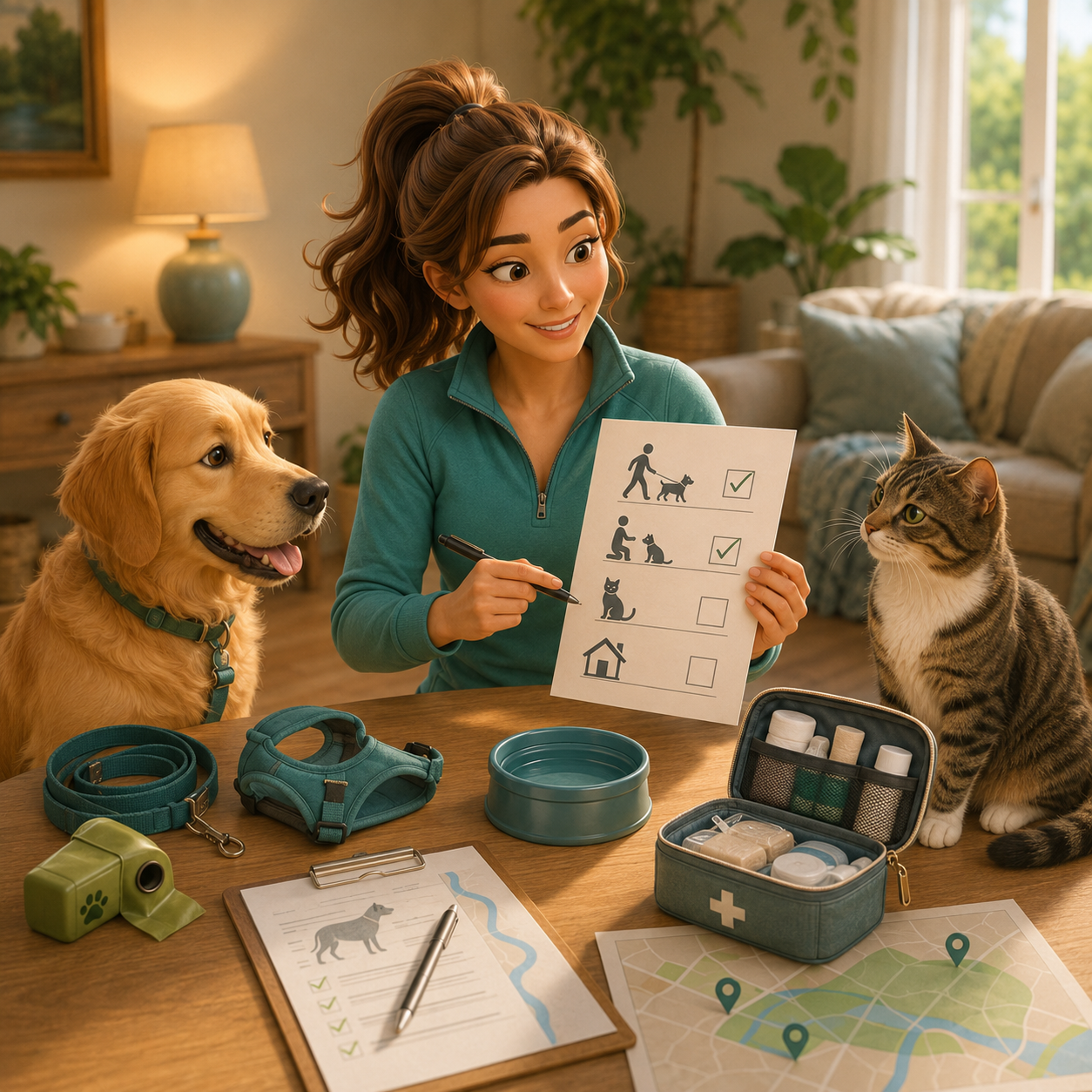
📅 Month 2: Create Your Pet Care Offer
🎯 Main Goal
Make your pet sitting or dog walking service easy for owners to understand, trust, and book.
✅ What to Do
- Create a simple pet care profile
- Add your services, rates, and availability
- Create a flyer or digital post
- Set up a booking and payment process
- Create message templates for inquiries
- Post in local groups where allowed
- Tell neighbors, friends, coworkers, and family you are available
- Create a simple meet-and-greet checklist
🏁 Month 2 Success Looks Like
- Your pet care service is visible
- Owners know what you offer
- Your rates are written down
- Your booking process is simple
- You are ready for first meet-and-greets
🎯 KEY TAKEAWAY
Pet owners want peace of mind. Clear services, updates, and safety questions make your service feel more professional.
📦 Simple Pet Care Packages
Package | What It Includes |
Quick Dog Walk | Short walk and potty break |
Standard Dog Walk | 30-minute walk and update |
Long Walk | Longer exercise session |
Drop-In Visit | Food, water, potty break, and playtime |
Cat Care Visit | Food, water, litter, and check-in |
Vacation Visit Package | Multiple visits while owner is away |
Weekend Pet Sitting | Care during short trips |
📦 What to Include in Your Offer
- Services provided
- Animals accepted
- Service area
- Availability
- Starting rate
- Visit length
- What updates owners receive
- How to request a booking

📅 Month 3: Complete First Walks, Visits & Sitting Jobs
🎯 Main Goal
Start serving pet owners, build trust, and collect proof through reviews and repeat bookings.
✅ What to Do
- Start with pets that match your comfort level
- Complete meet-and-greets before longer jobs
- Confirm feeding, walking, and medication instructions
- Send photo or message updates after visits
- Track time, mileage, supplies, and earnings
- Ask owners for feedback
- Request a review or referral after successful jobs
- Save notes about each pet’s routine
🏁 Month 3 Success Looks Like
- You completed your first pet care jobs
- Owners received clear updates
- You learned which services fit you best
- You collected feedback or testimonials
- You started building owner trust
🎯 KEY TAKEAWAY
A good update message can turn a one-time booking into a repeat client. Owners like knowing their pet is safe, comfortable, and cared for.
☑️ Pet Owner Intake Checklist
Detail | Why It Matters |
Pet name, age, and breed | Helps understand care needs |
Behavior notes | Prevents safety issues |
Feeding schedule | Keeps routine consistent |
Leash/walking habits | Helps avoid problems during walks |
Medical needs | Important for pet safety |
Vet information | Needed for emergencies |
Emergency contact | Backup if owner cannot respond |
Home access instructions | Prevents delays or lockouts |
🔍 What to Track First
- Time spent per booking
- Mileage and travel time
- Supplies used
- Pet routines and behavior notes
- Owner preferences and follow-up needs
- Referral or review opportunities

📅 Month 4: Build a Repeatable Pet Care System
🎯 Main Goal
Create a simple system for booking, scheduling, caring for pets, and following up with owners.
✅ What to Do
- Use a calendar to manage bookings
- Create a pet profile for each client
- Build a visit checklist
- Create standard update messages
- Track payments and expenses
- Set cancellation and late-booking policies
- Follow up with past clients
- Offer recurring walks or regular drop-in visits
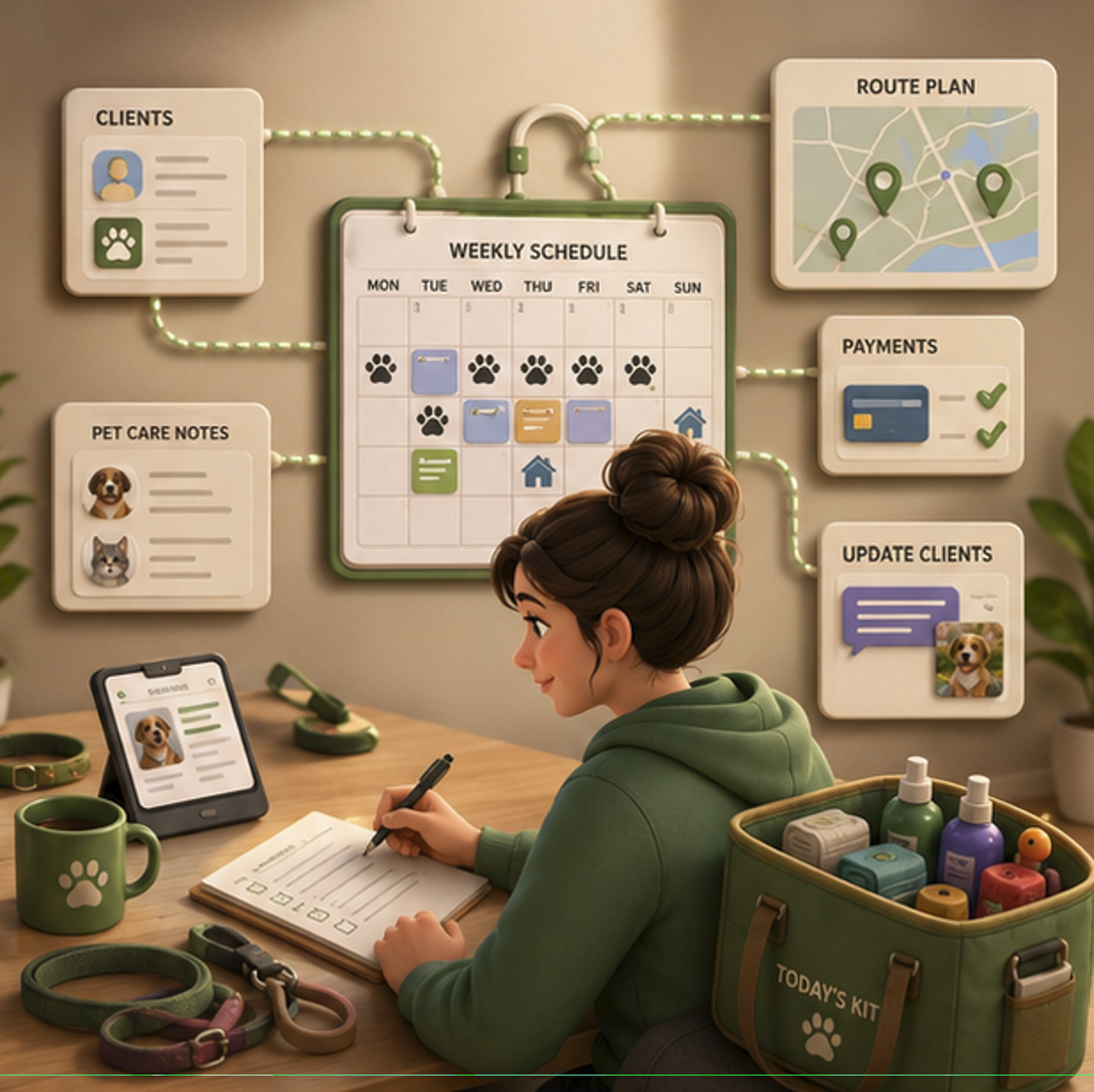
🏁 Month 4 Success Looks Like
- Your schedule is organized
- You have pet notes for each client
- Your updates are consistent
- Owners know what to expect
- You are starting to get repeat bookings
⚠️ Scale Smart: Do not accept too many pets or overlapping bookings. Pet care depends on timing, safety, and attention to detail.
🗓️ Simple Weekly Workflow
Day | Task |
Monday | Update availability and confirm bookings |
Tuesday | Complete walks or drop-in visits |
Wednesday | Follow up with interested owners |
Thursday | Complete recurring visits |
Friday | Confirm weekend pet sitting |
Weekend | Complete bookings and request reviews |
🔄 Simple Pet Care Workflow
Step | What Happens |
Inquiry | Owner asks about pet care |
Intake | Owner shares pet details, schedule, and care needs |
Meet-and-greet | You meet the pet and review instructions |
Booking | Date, time, price, and access are confirmed |
Service | You complete walk, visit, or sitting job |
Update | You send notes and photos if appropriate |
Payment | Owner pays after service or as agreed |
Follow-up | You ask about future care needs or referrals |
📅 Month 5: Build Reviews, Referrals & Recurring Clients
🎯 Main Goal
Turn happy pet owners into repeat customers and referral sources.
✅ What to Do
- Ask satisfied owners for reviews
- Offer recurring weekly walking slots
- Create vacation care packages
- Follow up before holidays or travel seasons
- Improve your profile with testimonials
- Add photos of happy pets with permission
- Create a referral message
- Raise rates slightly for new clients if demand grows
🏁 Month 5 Success Looks Like
- You have reviews or testimonials
- You have repeat clients or recurring walks
- Your profile looks more trustworthy
- You understand your best service type
- You are building predictable pet care income
🎯 KEY TAKEAWAY
Recurring pet care is more valuable than random one-time bookings because owners often need reliable help every week or every time they travel.
📈 Ways to Add Value
Value Add | Why It Helps |
Photo updates | Reassures pet owners |
Walk summaries | Shows what happened during the visit |
Recurring walk schedule | Creates steady income |
Holiday pet care | Helps owners during travel seasons |
Pet routine notes | Makes care feel personalized |
Flexible drop-ins | Helps busy pet owners |
Meet-and-greet | Builds trust before booking |
Referral program | Encourages word-of-mouth growth |
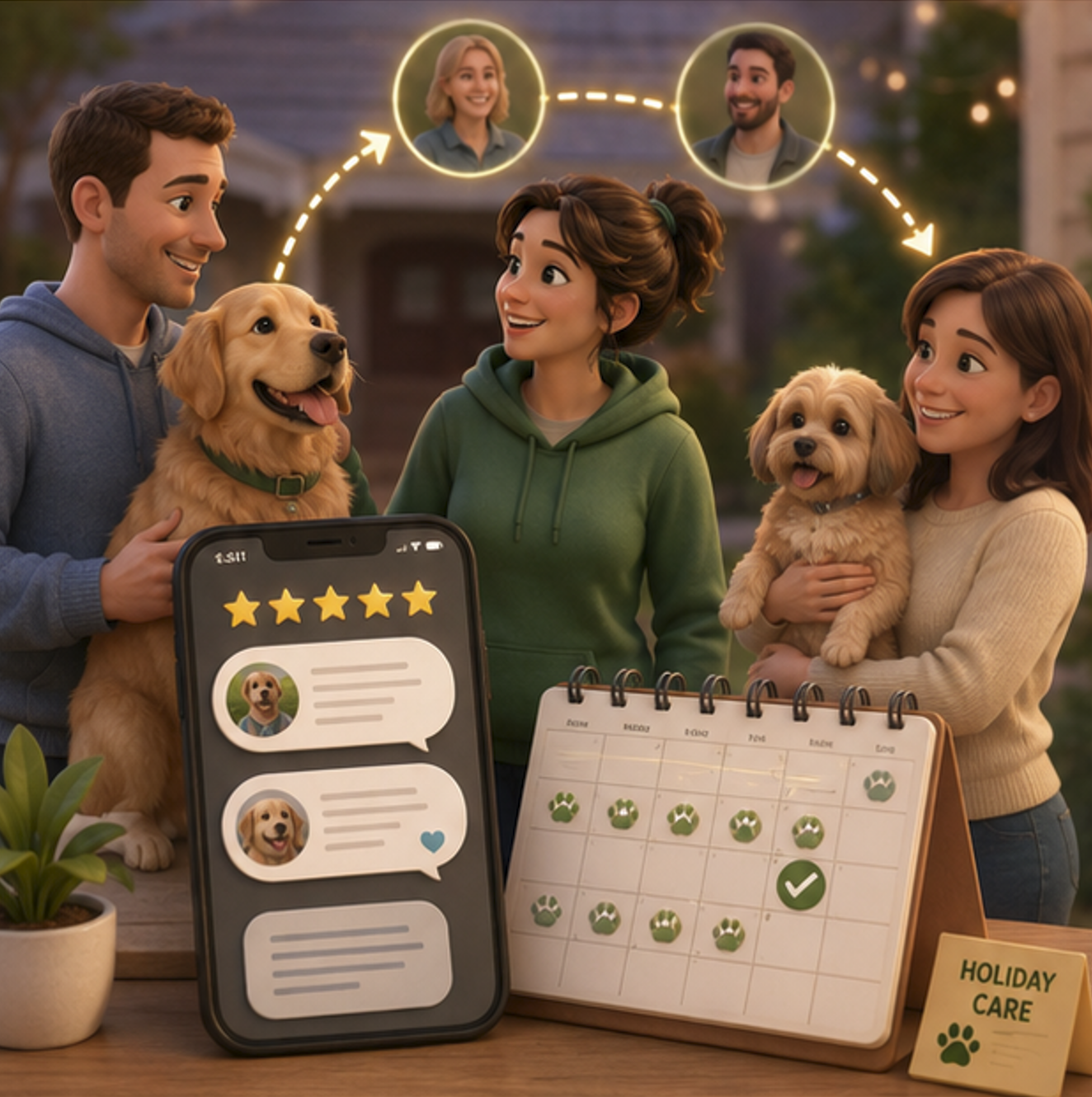
📅 Month 6: Review, Specialize & Grow
🎯 Main Goal
Review your first 6 months and decide which pet services, client types, and schedule patterns are worth focusing on.
✅ What to Do
- Review every booking
- Identify your most requested service
- Identify your most profitable service
- Review where clients came from
- Remove services that are stressful or unsafe
- Update your rates and policies
- Build a referral plan
- Create a 90-day plan for months 7–9
❓ 6-Month Review Questions
- Which pet services did owners request most?
- Which bookings paid best for the time required?
- Which pets or situations were easiest to manage?
- Which clients booked again?
- Which services caused stress or scheduling issues?
- Which platform or referral source worked best?
- What should you stop offering?
- Are you ready to raise rates?
- Can you build recurring weekly pet care slots?
🏁 Month 6 Success Looks Like
- You know your strongest pet care service
- You have reviews and repeat clients
- You understand your pricing better
- You have a repeatable booking system
- You have a 90-day plan to grow safely and consistently
🎯 KEY TAKEAWAY
Pet sitting and dog walking grows best when owners trust you enough to re-book and recommend you to other pet owners.
📊 Decision Table
If This Happens | Do This |
Dog walking gets repeat demand | Build weekly walking packages |
Vacation visits sell best | Promote holiday and travel care |
Cat sitting is easy to schedule | Create cat care visit packages |
Travel time hurts profit | Narrow your service area |
Owners ask for recurring help | Offer fixed weekly slots |
Pet behavior feels unsafe | Decline or require professional support |
Reviews are strong | Use them in profiles and local posts |
You are fully booked | Raise rates or limit availability |
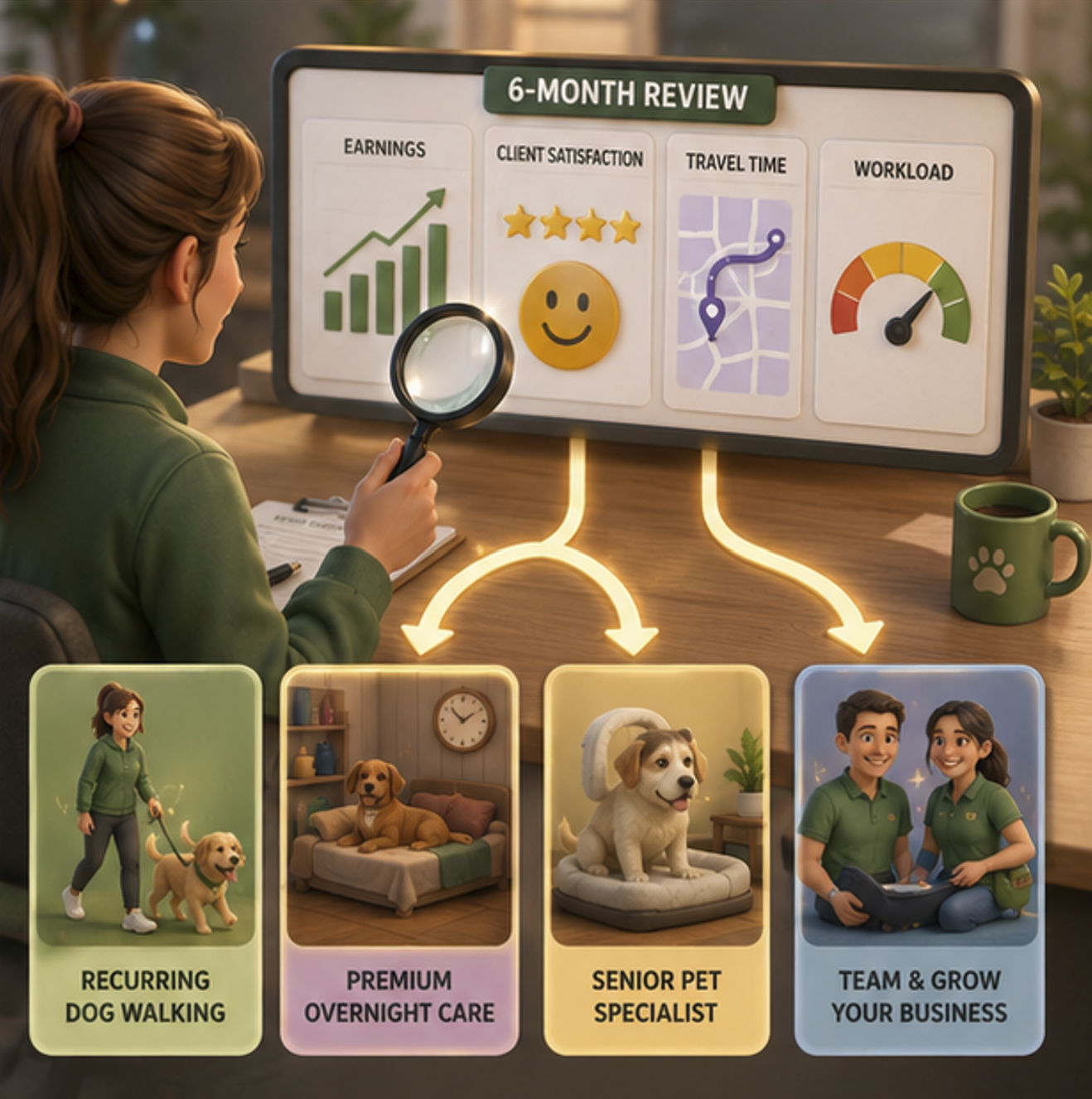
✅ 6-Month Success Checklist
By the end of 6 months, check whether you have:
✅ Chosen pet sitting or dog walking services
✅ Researched local rates
✅ Created a pet care profile or flyer
✅ Built a pet owner intake form
✅ Completed meet-and-greets
✅ Finished first pet care jobs
✅ Sent owner updates
✅ Tracked time, mileage, and earnings
✅ Collected reviews or testimonials
✅ Built a repeatable scheduling process
✅ Offered recurring service options
✅ Created a plan for the next 90 days
⚠️ What Not to Do During the First 6 Months
Avoid these mistakes:
❌ Accepting pets without behavior information
❌ Walking dogs without understanding leash habits
❌ Ignoring medical needs or feeding instructions
❌ Taking unsafe or aggressive pet situations
❌ Overbooking walks or visits
❌ Forgetting emergency contacts
❌ Entering homes without clear access instructions
❌ Skipping owner updates
❌ Undercharging for travel time
❌ Treating pet care casually when owners are trusting you with their animals
⚠️ Reminder: Pet care is a trust-based service. Safety, communication, and reliability are what turn first bookings into repeat clients.
🧭 Simple 6-Month Milestone Tracker
Month | Main Focus | Target Output |
Month 1 | Services & safety | Service list, intake questions, rates researched |
Month 2 | Local offer | Profile, flyer, booking process |
Month 3 | First clients | 3–5 walks, visits, or sitting jobs |
Month 4 | Pet care system | Calendar, pet notes, update templates |
Month 5 | Reviews & repeat clients | Testimonials and recurring service offers |
Month 6 | Review & grow | 90-day growth plan created |
🚀 Final 6-Month Strategy
Your first 6 months should follow this simple path:
Month 1: Choose your services and learn pet safety basics
Month 2: Create your pet care offer
Month 3: Complete first walks, visits, and sitting jobs
Month 4: Build a repeatable pet care system
Month 5: Build reviews, referrals, and recurring clients
Month 6: Review results and grow safely
The pet sitters and dog walkers who grow fastest are reliable, careful, communicative, and trusted by owners to care for pets like family.
11. Get the Pet Sitting & Dog Walking Starter Kit
🎁 Your Pet Care Business Toolkit
The starter kit has 12 browser-based workspaces for intake, pet care, walking records, pricing, client communications and launch planning.
The 12 components:
✅ 1. Pet Care Client Intake Form — Record pet needs, care instructions and emergency contacts.
✅ 2. Pet Sitting Service Agreement — Draft pet-care terms and responsibilities for independent legal review.
✅ 3. Pet Care Checklist — Plan daily tasks and document services completed.
✅ 4. Pet Emergency Response Plan — Prepare emergency contacts and an incident-response plan based on owner instructions and veterinary guidance.
✅ 5. Dog Walking Route Tracker — Keep walk and route records, including details to share with owners.
✅ 6. Pet Care Business Card Builder — Create customizable business card drafts with your pet-care services and contact details.
✅ 7. Service Pricing Calculator — Estimate pet-care fees using your time, travel and cost assumptions.
✅ 8. New Client Onboarding Guide — Organize meet-and-greets and prepare for a new client’s first visits.
✅ 9. Pet Photo Update Builder — Prepare owner-approved pet photo updates and accompanying messages.
✅ 10. Referral Flyer Builder — Create flyer drafts that explain your pet-care services and referral offer.
✅ 11. Income & Expense Tracker — Log pet-care business income and expenses.
✅ 12. 90-Day Pet Care Launch Plan — Organize and track your first three months of pet-care business startup tasks.
Also included in the editable master: A dashboard and Start Here guide are also included.
The kit is not pet-care certification, veterinary advice, insurance, or an automated booking service. Confirm safety, permissions and local requirements yourself; customer-release testing may still be required.

12. Frequently Asked Questions
🐾 Do I need experience or certification to start?
Most platforms do not require a formal certification. Local business, boarding, or insurance rules can still apply.
Helpful starting points:
- 🐶 Care for friends’ or neighbors’ pets
- 📸 Build trust with photos and updates
- 🧠 Learn basic pet behavior
- 🚑 Consider Pet First Aid certification
💡 Pet First Aid certification, usually around $35–$80, adds credibility but is not required.
💰 How long until I can make decent money?
Some sitters book paid visits in the first month; others take longer to get traction.
Typical range, not a promise:
- 🌱 First month: extra cash is possible with a few local jobs
- 📈 Later months: higher totals depend on repeat owners and route density
- 🚀 Part-time: income still depends on hours, travel, and cancellations
- 🏆 Full-time: only if the roster, schedule, and care quality hold up
👉 Growth depends on reliability, reviews, referrals, and local demand.
🚨 What if a pet gets injured or runs away?
This is why insurance is critical, usually around $200–$500/year.
Prevent issues by:
- 🦮 Using secure leashes
- 🚪 Checking doors, gates, and fences
- 🧠 Avoiding risky situations
- 📍 Keeping pets in controlled environments
- 📸 Documenting care
If an emergency happens:
- 🚑 Get immediate vet care if needed
- 📞 Contact the owner right away
- 📝 Document everything
- 💬 Communicate honestly
💡 Honest communication is essential.
⏰ Can I do this part-time with a full-time job?
Yes, many people start around another job.
Dog walking often fits common windows:
- 🌅 Early morning: 6–8 AM
- 🌇 Evening: 5–7 PM
- 🗓️ Weekends for overnight sitting, if you can stay available
Part-time totals still depend on booked visits, travel, and whether owners rebook — not a set monthly amount.
🏠 What about liability if I'm in someone's home?
Get bonding and liability insurance, usually around $300–$800/year total.
Best practices:
- 📄 Use contracts
- 🔐 Use lock boxes for keys
- 🚫 Never keep client keys loosely at home
- 📸 Document home condition upon arrival
- 🚪 Lock doors, gates, and windows carefully
💡 You are being trusted with both pets and property.
😤 How do I handle aggressive or difficult dogs?
Use the meet-and-greet to assess temperament before accepting the job.
Watch for warning signs:
- 🐕 Growling
- ⚠️ Raised hackles
- 🧍 Stiff body posture
- 🦷 Snapping
- 🚫 Poor leash control
If you feel uncomfortable, decline the client.
👉 Never take dogs you cannot physically control.
Bring treats for distraction, know when to cut a walk short, and contact the owner if needed.
🐕 Can I walk multiple dogs at once?
Yes, but start with one dog at a time until confident.
Once experienced, many walkers handle:
- 🐕 2 compatible dogs
- 🐕🐕🐕 3 dogs if trained and manageable
- 🚫 Never more than you can physically control
Use multi-dog leash systems if needed.
💡 Charge $5–$10 per additional dog.
🤒 What if I can't work due to illness or emergency?
Build a backup plan before you need it.
Options:
- 🤝 Build a network of 2–3 trusted backup walkers/sitters
- 🔁 Trade coverage with other pet care professionals
- 📱 Use platform reassignment options when available
- 📞 Give clients as much notice as possible
👉 Help arrange alternative care whenever possible.
📱 Should I work through Rover or go direct?
Start with Rover because it gives you:
- 👥 Easier access to clients
- 💳 Built-in payments
- 🛡️ Some platform protections
- ⭐ Review-building credibility
After you have reviews and trust, some owners may book you directly if platform rules allow it.
A practical mix:
- 📱 Keep a platform for new leads and schedule gaps
- 🤝 Move repeat owners to direct booking only when it is allowed and both sides prefer it
🧾 What about taxes and business structure?
You’re self-employed, so plan for taxes.
Best practices:
- 💰 Set aside 25–30% for taxes
- 📊 Track all income and expenses
- 🚗 Track mileage
- 🧾 Deduct supplies, insurance, certifications, and mileage
- 🏢 Consider an LLC as income and risk grow; rules vary by location
💡 Formation costs vary by state. Consult a tax or legal professional before changing your business structure.
🚩 How do I deal with demanding or difficult clients?
Set clear boundaries from the start.
Use:
- 📄 Contracts
- 💬 Clear communication
- 🧾 Written service expectations
- ⏰ Defined hours and availability
- 💳 Clear payment terms
Red flags include:
- ❌ Asking for unpaid extras
- ❌ Late payments
- ❌ Rude behavior
- ❌ Unrealistic demands
- ❌ Poor treatment of pets
👉 It’s okay to fire difficult clients. They are not worth the stress.
🚀 Can this become a full-time income?
Some people do, but it is not typical for a new part-time roster.
Illustrative paths, not promises:
- 🧍 Solo premium pricing: higher per-visit rates if owners trust you and the route stays manageable
- 📅 Full-time volume: more bookings only if you can still deliver safe, on-time care
- 👥 Team business: hiring help can raise revenue, and profit is usually much lower than gross billings
💡 The path depends on whether you want to stay solo or build a larger service business.
13. Important Considerations
Before you take on your first pet, understand these key realities — caring for animals is rewarding, but it is a responsibility-based business built on trust.
💪 Physical Demands Are Real
Walking 4–6 dogs daily can mean 8–12 miles of walking.
This work may include:
- 🚶 Long walks
- ☀️ Heat and humidity
- ❄️ Cold or snow
- 🛌 Interrupted sleep during overnight sitting
- 🐕 Handling strong or energetic dogs
💡 This work is active, which is great if you want exercise, but challenging if you have mobility issues.
🌧️ Weather Doesn't Stop
Dogs still need care in:
- 🌧️ Rain
- ❄️ Snow
- ☀️ Heat
- 🥶 Cold
- 💨 Wind
Invest in:
- 🧥 Quality rain gear
- 🧤 Warm clothes
- 🧢 Sun protection
- 👟 Comfortable walking shoes
👉 Canceling too often because of weather can cost you clients.
🛡️ Liability Is Serious
Dogs can:
- 🦷 Bite
- 🏃 Run away
- 🚑 Get injured
- 🏠 Damage property
One incident without insurance can cost thousands.
Protect yourself with:
- 🛡️ Liability insurance
- 📄 Contracts
- 📸 Documentation
- 🧠 Careful client screening
👉 Trust your instincts about risky situations.
😤 Difficult Clients Exist
Some owners may:
- 📋 Micromanage
- 💳 Pay late
- 😠 Be demanding
- ❌ Blame you for unrelated issues
- ⏰ Expect unpaid extra time
Set boundaries early, use contracts, and don’t be afraid to fire problem clients.
💡 Difficult clients are not worth the stress.
🚨 Emergencies Happen
Pets may:
- 🚑 Get injured
- 🍫 Eat something toxic
- 🏃 Escape
- 😡 Become aggressive
- 🤢 Get sick suddenly
You need to stay calm and make quick decisions.
💡 Pet First Aid training is strongly recommended.
📅 Schedule Flexibility Has Limits
Yes, you choose your hours — but pets need care at specific times.
Common timing:
- 🌅 Morning walks
- 🌇 Evening walks
- 🗓️ Weekend sitting
- 🏠 Overnight stays
- 🧳 Holiday care
👉 It’s flexible, but not completely on your terms.
🔐 Key Management Is a Serious Responsibility
You’ll have access to clients’ homes.
Best practices:
- 🔒 Lock everything properly
- 🚪 Secure gates and doors
- 🚫 Don’t share keys or codes
- 🔐 Use lock boxes
- 📝 Track access instructions carefully
💡 One mistake can damage trust and hurt your business.
📊 Income Is Weather and Season-Dependent
Peak times often include:
- ☀️ Summer
- 🎄 Holidays
- 🧳 Travel seasons
- 🗓️ Long weekends
Slower times may include:
- ❄️ Winter
- 📉 Non-travel seasons
- 🌧️ Bad weather periods
👉 Build savings during peak season for slower months.
❤️ Emotional Attachment Is Inevitable
You may become attached to the pets you care for.
That means it can be hard when:
- Clients move
- Pets pass away
- Owners change services
- Long-term bookings end
💡 This work is emotionally rewarding, but it can also be emotionally challenging.
🐕 Not All Pets Are Easy
Some pets may:
- 🦮 Pull hard on walks
- 🐕 Bark constantly
- 😾 Scratch or hide
- 🚫 React badly to other animals
- 🏠 Have accidents indoors
- 😤 Ignore commands
Patience and proper handling are essential.
14. Your Next Steps
🚀 ACTION STEP
📍 Today
- 📦 View the starter kit above
- 🔍 Research rates in your area by browsing Rover profiles
- 🧰 Assess whether you have basic supplies or need to purchase them
- 🐕 Practice walking a friend’s or neighbor’s dog, with permission
📅 This Week
- 📱 Create a Rover profile with professional photos and a compelling description
- 🛒 Purchase essential equipment, such as leashes, waste bags, treats, and a first aid kit
- 💵 Set competitive pricing based on local market research
- 📍 Post on Nextdoor and local Facebook groups introducing your services
- 💳 Print business cards or create a digital version, around $20–$50
🗓️ This Month
- ✅ Accept a small number of suitable bookings and deliver them carefully
- 📸 Send photos and updates with every service, with owner permission
- ⭐ Request honest reviews after strong visits
- 🐾 Leave business cards at local pet stores, vets, or groomers where allowed
- 🐕 Visit dog parks and network with pet owners without hard-selling
- 🎯 Goal: complete a small set of jobs with time, cost, and review records
🚀 Months 2–6
- 🤝 Add regular clients only when the route and care quality stay safe
- ⏰ Fill hours you can actually cover, especially mornings and evenings for walks
- 📈 Review rates against travel and care time before raising them
- 🧩 Add overnight, multi-pet, or senior care only after you have the skills and coverage
- 🚑 Consider pet first aid certification
- 🎯 Goal: a clearer picture of which visits are worth repeating
15. The Bottom Line
🎯 KEY TAKEAWAY
Pet sitting and dog walking is a practical local side hustle. It is not hands-off — it runs on reliability, trust, and showing up in all weather — and paid work still depends on booked visits.
🙋 If you:
✔ Start on Rover or Wag plus simple local outreach
✔ Send photo updates and show up in all weather
✔ Turn reviews into referrals and recurring clients
✔ Raise rates and shift to direct bookings over time
🏗️ You can build:
💰 Earnings that vary with visits, rates, hours, travel, and whether owners rebook — not a set monthly ladder
🔁 Recurring weekly walks and repeat overnight bookings if the care stays reliable
📈 A team can raise revenue later, and profit is usually much lower than gross billings
🚀 Owners pay for trust — start with one suitable pet you can care for safely.
16. Recommended Websites & Tools
🛠 TOOLS & RESOURCES
You do not need every resource listed below. This directory brings together the major platforms, tools, and resources from this guide, along with additional research and learning options, so you can find them in one place when you need them.
Start with the essentials. Add tools only when your pet care business develops a specific need for them.
🐾 Pet Sitting & Dog Walking Platforms
- Rover — Pet care marketplace for finding dog walking, drop-in visits, overnight sitting, boarding, and vacation care clients.
- Wag! — Dog walking and pet care platform for quick bookings, walk requests, and flexible pet care jobs.
- Care.com — Multi-service care platform for finding pet sitting, dog walking, housekeeping, childcare, and local care clients.
- PetBacker — Pet care platform for sitting, boarding, walking, and vacation pet care bookings.
💡 PRO TIP
Start on Rover or Wag to build reviews fast, then move loyal clients to direct bookings so you stop paying platform fees.
📅 Booking, Scheduling & Client Management
- Time To Pet — Pet sitting software for scheduling, invoicing, client management, pet notes, staff coordination, and professional booking workflows.
- Pet Sitter Plus — Pet care business software for booking, scheduling, client records, invoicing, and service management.
- Pawtrol — GPS walk tracking tool mentioned for showing owners routes, activity, and professional walk updates.
- Google Voice — Free business phone number option for separating pet care calls and texts from your personal number.
📝 QUICK NOTE
Set up scheduling and payments before your first booking. In pet care, one missed visit can end the business overnight.
💳 Payments & Invoicing
🌐 Website & Online Presence
- Wix — Website builder for creating a simple pet sitting or dog walking service page with pricing, photos, reviews, and contact information.
- Squarespace — Website builder for creating a polished pet care business site, booking page, service menu, and local credibility hub.
- Google Business Profile — Free local business listing for appearing in “dog walker near me” and “pet sitter near me” searches, collecting reviews, and showing service areas.
📍 Local Marketing & Client Discovery
- Nextdoor — Neighborhood platform for posting pet care services, responding to local recommendation requests, and building trust with nearby pet owners.
- Facebook Groups — Group discovery page for joining local pet owner groups, neighborhood groups, and community groups where pet care leads may appear.
- Instagram — Visual platform for sharing pet updates, client-approved photos, walking routes, testimonials, and personality-based trust content.
- Google Business Profile — Local SEO tool for displaying reviews, hours, photos, service area, and contact details to high-intent pet owners.
📝 QUICK NOTE
One flyer at a vet office, dog park, or apartment lobby can outperform weeks of online ads for local pet care.
🏪 Pet Supplies, Partnerships & Safety Resources
- PetSmart — Pet supply retailer mentioned for pet care supplies, gear, training resources, and local pet-owner visibility.
- Petco — Pet supply retailer mentioned for supplies, training resources, grooming connections, and pet-owner partnership opportunities.
- American Veterinary Medical Association — Veterinary organization resource mentioned for pet health, safety awareness, and responsible animal care information.
🎯 KEY TAKEAWAY
You do not need every tool on this page. One platform, one way to take payment, and a basic pet first-aid kit are enough to start.
🧭 How to Use This Directory
🧰 Start With a Simple Setup
Do not start by creating accounts with every service listed above. For most beginners, a simple setup is enough:
- One pet care platform
- One scheduling tool
- One payment method
- A basic pet first-aid kit
That is enough to start building. Add tools only when you can name the specific problem they will solve.
🎯 KEY TAKEAWAY
Tools support the business. They are not the business.
Your biggest advantages will come from:
Reliability → Trust → Reviews → Referrals
17. Explore Similar Side Hustles
 House Cleaning & Organization: Make Money Creating Clean, Tidy Spaces — Another trust-based local service with recurring weekly clients.
 Lawn Care & Yard Work: Earn Money Maintaining Outdoor Spaces — Offer yard services to the same homeowners who book you for pet care.
 Babysitting & Childcare: Flexible Side Hustle Caring for Kids — Families who trust you with their pets may trust you with date nights too.
 Gig Economy Apps: Earn Money on Your Schedule Using Your Phone — Fill the gaps between walks with flexible app-based work.
 Selling Crafts & Handmade Goods — Sell pet-themed crafts to the same owners who book you.
 Stock Photography: Make Money Selling Your Photos Online — Photograph pets only with owner permission, then sell suitable shots if the license allows.