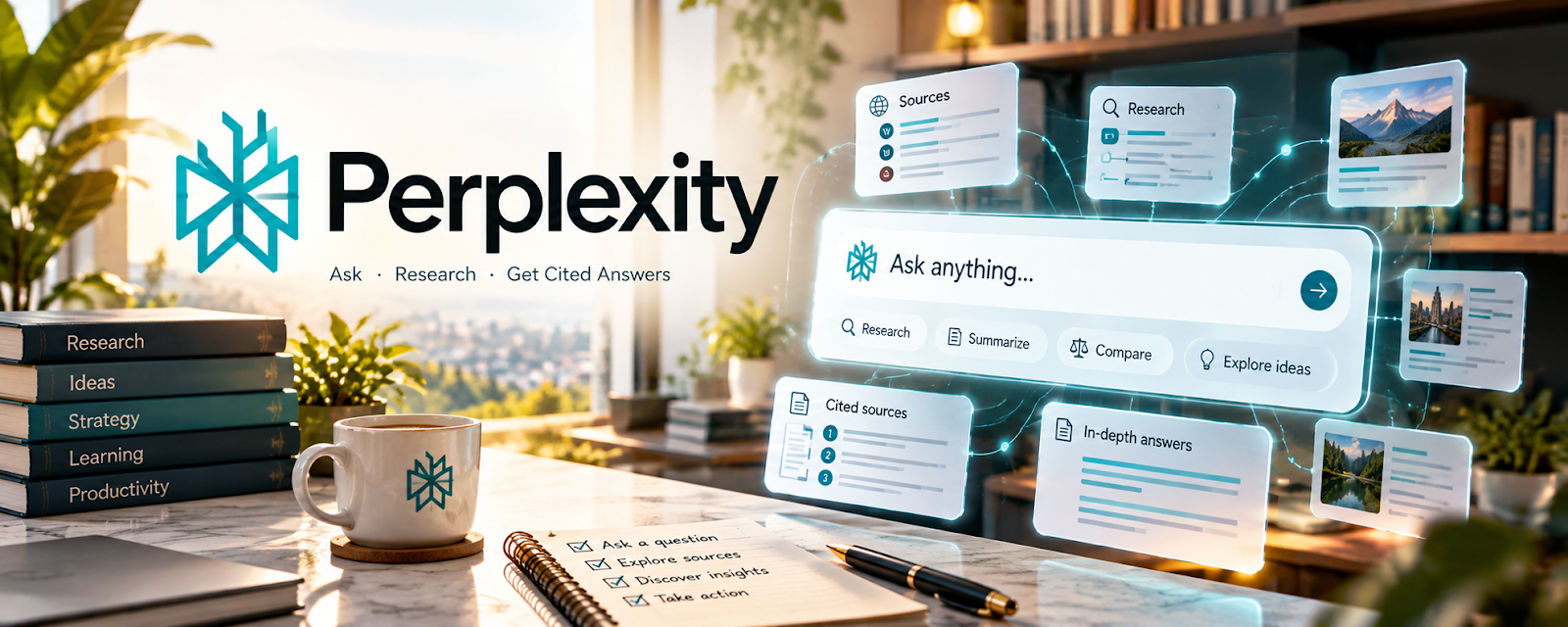
Official Website
Perplexity is an AI-powered research assistant that answers questions with cited sources.
🔗 Visit Official Website — Perplexity
Domain: www.perplexity.ai
What This Website Is
Perplexity is an AI-powered research assistant that answers questions with cited sources. For the ▶️ YouTube Automation side hustle, it helps you research potential content topics, explore niche questions, investigate audience interests, gather background information for video scripts, and study what competing channels cover — all in one place. Perplexity is a research tool, not a source of guaranteed-accurate information; AI-generated answers and citations can contain errors, so always open original sources and verify important claims before using them in a video.
How to Apply It to ▶️ YouTube Automation
Use Perplexity as a research assistant that helps you gather and organize information before writing scripts. Write or paste a question, review the answer with its cited sources, then open the original sources to verify key facts.
Step-by-Step Implementation:
- Choose a potential YouTube niche.
- Identify questions the intended audience may ask.
- Research those questions with Perplexity.
- Open the cited original sources and verify important facts.
- Organize useful findings into a research outline.
- Develop an original video angle and script.
- Validate topic demand with relevant YouTube research tools and audience data.
- Review the final script for factual accuracy before production.
Note: Perplexity does not provide definitive YouTube keyword search volume, competition scores, or channel analytics. It is a general research assistant, not a specialized YouTube analytics tool — pair it with YouTube-specific tools for demand validation. AI-generated answers and citations can contain errors; always verify important claims against original sources before publishing. Do not copy competitors' scripts or copyrighted content — use research to inform original, useful videos with appropriate source attribution where needed.
When to Use This
- You need to explore a new niche before committing to a channel direction.
- You want to find common questions your target audience asks.
- You need background information for an educational or commentary video.
- You want to compare claims from multiple sources before scripting.
- You need source materials to cite or reference in your content.
Best Tasks to Use It For
- Discovering potential content topics
- Researching niche questions and audience interests
- Gathering background information for video scripts
- Studying topics covered by competing channels
- Finding source materials for educational or commentary videos
- Comparing claims from multiple sources
- Organizing research before writing scripts
Getting Started Steps
- Visit perplexity.ai and create an account.
- Type a question about your target niche or audience.
- Review the answer and the cited sources listed below it.
- Open the original sources and verify any facts you plan to use.
- Save useful findings in a research document or outline.
- Use the organized research to develop an original video angle.
- Cross-check topic demand with YouTube-specific tools before production.
Good Beginner Search Terms
- Perplexity AI research tutorial
- AI research for YouTube content
- how to research YouTube niche topics
- using AI to find video ideas
- Perplexity citations and source verification
- research workflow for YouTube scripts
Monetization Angle
Perplexity does not directly generate YouTube income. Its potential value lies in helping creators research topics faster, improve content planning, and reduce time spent gathering information. Actual monetization depends on multiple factors, including audience demand, content originality and quality, channel eligibility, YouTube's current monetization requirements, viewer engagement, and compliance with platform and copyright policies. Faster AI research does not automatically lead to a profitable YouTube channel — focus on original, useful content and proper source attribution.
Pros
- Fast research across a wide range of topics
- Answers include cited sources for verification
- Free tier available for getting started
- Helps organize background information before scripting
- Useful for exploring new niches quickly
Cons
- AI-generated answers and citations can contain errors
- Not a substitute for specialized YouTube analytics tools
- Not a dedicated source of verified YouTube keyword search volumes or competition scores
- Free tier has usage limits
- Requires manual source verification before publishing
- Research alone does not guarantee audience demand or revenue
Who Should Use This
Use this if you research YouTube topics, gather background information for scripts, explore new niches, or need cited sources to verify claims before producing videos.
Who Should Skip This
Skip this if you already have a validated content pipeline with specialized YouTube analytics tools, or if you need guaranteed-accurate data rather than research assistance that requires verification.
Practical Applications
- Research a video topic and turn useful findings into an outline with a source list.
- Compare several explanations to identify questions your script should address.
- Open the original sources and verify claims before adding them to narration.
Important Considerations
- AI answers and citations can be inaccurate, incomplete, or based on weak sources.
- Do not present its output as verified YouTube search-volume data. Respect copyright and keep confidential client information out of prompts unless authorized.
Related Resources
Jasper — AI-assisted writing and content drafting.
Google Docs — Drafting and organizing scripts or research notes.
VidIQ Tool — YouTube-oriented topic and channel research.
Google Trends — Exploring relative search-interest trends.
Related Side Hustles
 YouTube Automation: Make Money Without Showing Your Face — Researching video topics and planning scripts.
 Freelance Writing: Get Paid to Write Online — Research and fact-checking skills applicable to writing assignments.
 Selling Digital Products — Researching audience needs and potential product topics.