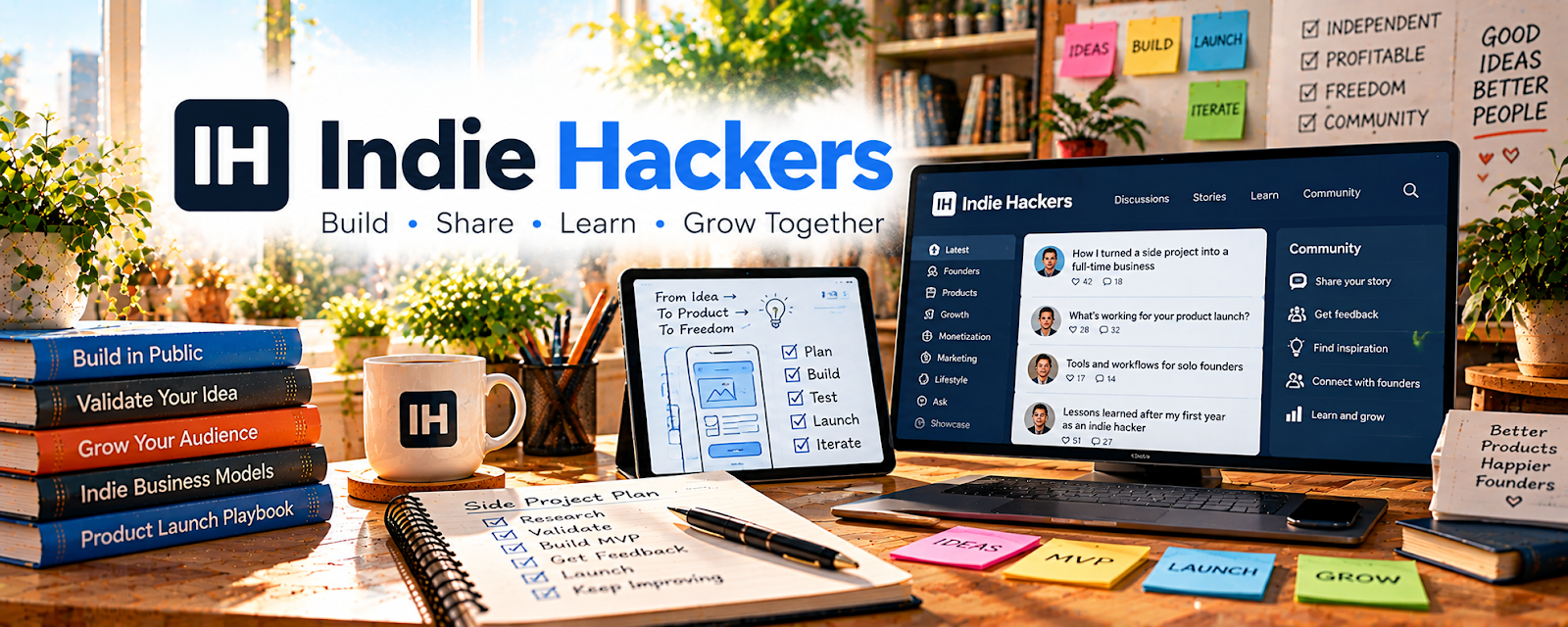
Official Website
Indie Hackers is a community for founders and creators sharing progress, lessons, and tactics for building products.
🔗 Visit Official Website — Indie Hackers
Domain: www.indiehackers.com
What This Website Is
Indie Hackers is a community for founders and creators sharing progress, lessons, and tactics for building products. For 💻 Selling Digital Products, it’s useful for productization ideas, pricing experiments, launch strategies, and realistic “what worked” case studies.
How to Apply It to 💻 Selling Digital Products
Use Indie Hackers as a “product building playbook”: identify patterns → run small experiments → ship consistently.
Step-by-Step Implementation:
- Phase 1: Clarify the product — who it helps, what outcome it delivers, and why it’s different.
- Phase 2: Validate demand — pre-sell, waitlist, or build a small free version to test interest.
- Phase 3: Launch and iterate — ship updates, gather feedback, and refine pricing/positioning.
Common Use Cases for this Side Hustle:
- Scenario A: You want product ideas and validation approaches.
- Scenario B: You want examples of pricing and launch strategies.
- Scenario C: You want accountability and “ship” momentum.
When to Use This
- You want examples of real product experiments.
- You’re building a small digital product and need validation ideas.
- You want pricing and positioning patterns.
- You can translate advice into your niche and execute.
Best Tasks to Use It For
- Finding product and niche ideas
- Learning validation and launch patterns
- Studying pricing and packaging experiments
- Building consistency via “ship” mindset
- Getting feedback on landing pages and positioning
Getting Started Steps
- Search for “digital product”, “template”, and “pricing”.
- Save 10 high-signal threads and summarize the patterns.
- Write a one-sentence product promise and define the target buyer.
- Create a simple landing page and a waitlist.
- Pre-sell or run a small beta to validate demand.
- Ship weekly improvements and collect feedback.
Good Beginner Search Terms
- indie hackers digital product validation
- pre sell digital product strategy
- pricing digital templates
- landing page copy examples product
- waitlist strategy for creators
- productized templates niche ideas
Monetization Angle
Indirect + direct: Indie Hackers helps you shorten the trial-and-error cycle. Better validation and pricing decisions can increase revenue and reduce wasted builds.
Pros
- Lots of real case studies and experiments
- Strong “ship and iterate” mindset
- Useful for productization and pricing ideas
Cons
- Mixed quality; filter for your stage
- Can become “research mode” instead of shipping
- Advice is broad; you must adapt to your niche
Who Should Use This
Creators building digital products who want validation, pricing, and launch patterns—and will execute weekly.
Who Should Skip This
Skip this if reading forums derails you. Use it for targeted learning, then go ship.
Practical Applications
- Research a product-positioning question across dated founder discussions.
- Ask for feedback on an original nonconfidential offer description.
- Test a modest idea with real customer questions and cost records.
Important Considerations
- Founder revenue and launch reports can be selective, incomplete, or promotional.
- Respect community rules, protect business information, and do not treat upvotes or others’ success as proof of demand or likely income.
Related Resources
Ko-fi Shop — Gives creators a lightweight storefront for selling templates, downloads, and small digital products.
Google Docs — Drafts guides, checklists, scripts, and text-based products before packaging.
Figma — Designs templates, mockups, and visual assets that can become sellable products.
Carrd — Builds focused landing pages for product validation, waitlists, and checkout links.
Related Side Hustles
 Selling Digital Products — Indie Hackers helps validate product ideas, study pricing, plan launches, and learn from creator case studies.
 Online Course Creation: Turn Your Knowledge Into Income — Course creators use similar validation, launch, pricing, and audience-building experiments.
 Newsletter Monetization: Get Paid to Write About What You Love — Newsletter operators can use community lessons to test offers, sponsorships, and paid products.